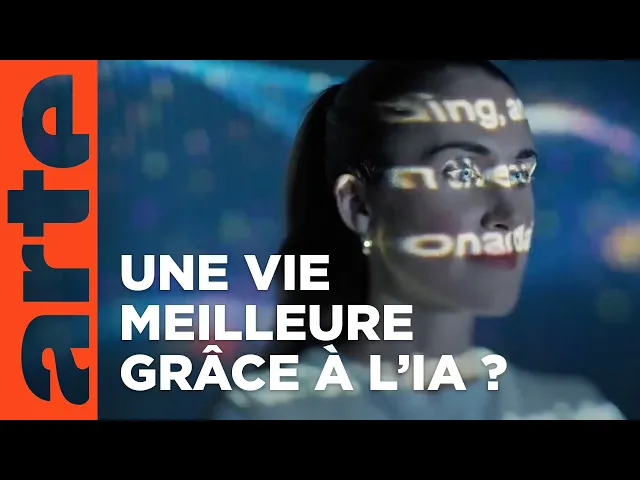
[Music] [Music] It will be revolutionary for our care providers to deliver datadriven decisions which will save lives. Oh, this is a deep fake video of you. >> Say I actually feel slightly sick.
The last 30 seconds were fake and I did not say these words. >> It just looks so real. You're literally not going to be able to believe your eyes.
>> I think we're all at risk. And in some ways, I kind of feel that this is in danger of blocking us off from human connection. >> So, are we the guinea pigs for AI?
But I think we maybe >> don't want to frame it as a battle between humans and AI, but at times it really does feel like that. Mayor party technology journalist [Music] Foreign [Music] [Music] [Music] What's happened in the last Never seen for text. [Music] In this dance of fear and trust, let wisdom guide us as we must.
forge a future where AI's embrace enriches lives brings hope to the race in some ways the question now is rapid pace and I think and how we're going to use Whenever there's an emergent technology like we're having now with the emergent AI machine learning technologies that are coming and that are here, people are frightened and they tend to do and catastrophize. >> So some of the short-term risks are things like the impact on jobs, whether AI systems will deskill people or take away aspects of their roles. There's bias.
So will AI magnify human biases? So things like gender discrimination, racial discrimination, will AI impact democracy by being able to manipulate people in how they vote? >> There's no way you're not going to hear about AI or it's not going to quietly go away and and and absorb into the background.
We will keep hearing about it and there will keep being innovations and breakthroughs. >> Generative AI technologies are proliferating at an incredibly rapid pace right now. It's just exploding.
They're brilliant tools for any bad actor who wants to be able to use the outputs to do horrible things to society. Fake video, fake audio, fake images, like the president of Ukraine uh saying that the war is over and and admitting defeat. That's there was a deep fake attempt at at that.
Foreford. [Music] [Music] There are millions of books. So without access it instantaneously, it's the scale of data that's been thrown at these things.
If these programs have absorbed all the text on the worldwide web, that's an unimaginable amount of text that's been thrown at these things. And we're in the era of big data. Every time you or your kids upload a picture of themselves to social media and they label it with their name, they are feeding the machine learning algorithms at big tech companies and they are providing that training data.
But secondly, to make it work, you needed lots and lots of computer processing power. So what big tech decided around 5 or 6 years ago, let's just turn the dial up to 11 with data and with computer power and let's see where we get. So what we've seen subsequently is a rush for everybody to do the same thing.
uh everybody who's got the data and the computer power wants to be in the game. So AI is just going to become everywhere in the same way that computers are everywhere. [Music] artificial contribut.
[Music] Preeacclampsia can be a very severe disease. It can result in severe prematurity which has lifelong consequences for babies. Um, also we do know that preeacclampsia can result in long-term cardiovascular impacts for women as well.
So, it's always a challenge to try and work out when is the best time to intervene when someone has preeclampsia. So, making the decision about when to deliver particularly if it's premature is a very complex one and we really want to try and optimize outcomes for women and babies and that's where a preeie can be helpful. Every 40 seconds a baby is lost due to the complication of preeacclampsia.
Another 5 million babies are born sometimes prematurely because of the complication of preeacclampsia. So this is a truly truly devastating condition of pregnancy and we want to do something about this. So where does the AI fit in?
How does it help? So where we need the AI is to bring together all the information on the expectant mom's pregnancy journey, collecting all the information on her from the time she's starts her pregnancy journey until she delivers her baby. And you can't do that without having good data analytics, without having machine learning, which is what we're using.
And that's where the AI comes into it. What we've built into our algorithm is some biomarkers that we found in the blood that if you like should be able to predict the future. So bringing all of that information together really that's where the power lies.
But there's already been groundbreaking discoveries using AI in medical science. You could literally do this for any disease. Cancer, heart disease.
You can diagnose up to 50 different diseases by looking at 3D retinal scans. It will be revolutionary for our care providers to deliver datadriven decisions which will save lives. As someone who has experienced extremely difficult and very very painful and he carried years later.
So if our artificial extraordinary amazing [Music] [Music] What we're going to do now is we're going to use AI to create the character for your story. So, you need artificial intelligence. You need to tell me what your character is going to look like.
>> An alien. And it has three legs. >> An alien with three legs.
Who's the main character in this story? A dog and a man. What does the man look like?
>> An old man. >> An old man. And what color hair does he have?
>> Gray like yours. >> Gray like my hair. >> The head is kind of a cylinder.
Big like goblin ears. >> What's the body look like? >> Like a human body with a shirt >> and two big eyes.
>> What do you think would be good about having a robot as a teacher? >> They know everything already cuz robots are really intelligent. because of the AI program.
Like they'd know stuff that was back in the 1980s. >> They can be really fast. So they teach us everything in one day and they won't give us homework.
>> Would they definitely not give you homework? >> Okay, let's see what happens here. >> Oh my god.
>> Wow. >> Let's see. Look, it's exactly like you described what it was going to look like.
Which one? That one. >> Which one's your favorite?
>> This one. >> The top one. How can artificial intelligence help in the context of the classroom environment?
It can have an impact helping kids practice in terms of reading or any subject, assessing them, intervention tools, screening them for difficulties in the classroom, freeing up teachers time in general. A really good use case of speech recognition in education is for dyslexia screening. We know that 10 to 20% of kids or all people actually have some kind of reading difficulty and most of the time we believe you need to wait till the child is 8 or 10 to be able to assess whether they have difficulties.
There's been research to show that you can do this at age four and five before they ever can even read a letter or a word. It can allow you to catch a child before they ever enter the education system and provide them with the interventions that they need and that's of a huge benefit to the child as you can imagine. >> Do you think the way we teach now is just going to have to undergo radical reform as a result of artificial intelligence?
>> There's a number of factors that are going to be considered of course. Yeah. I mean absolutely the authenticity cheating you know in exams I think it's the first thing that people think about when they think about chacht and you know kids doing assessments getting chach to write their essay but equally there's also a new tool that are going to allow everybody not just children students people at home that want to learn about a subject it's going to be like having an expert right in front of you I think it's still open about how it will change education but for sure it will >> I suppose in this day and age it's lifelong learning now we're preparing kids for jobs eventually in the wider world that don't actually exist at the moment.
Most of the jobs our people will be doing in the future haven't been designed yet. It's just a tool to teach with. You know, we have to adapt to the tools and to to move forward with them.
[Music] >> There's something called Amara's law that says we tend to overestimate the impacts of new technologies in the short term and underestimate them in the long term. with AI and job loss. I think Amara's law is a really good place to look.
When we look at the current levels of job loss that are a result of chat GPT and those types of technologies, there are definitely losses. Alan, what is Mana Arero and how does it use artificial intelligence? >> So, Mana Air is a drone delivery business.
When you get your takeaway, normally it's a roadbased delivery with either a driver on a on a bike or in a car. We do the same thing but with drones in the sky. >> Where does the AI come in?
everywhere really I think is is the short answer. Specifically, we use a lot of AI in our route planning to make sure that when the drones are actually flying in the sky, the route is optimized based on our battery and the weather conditions that we're we're currently flying in. >> How are people using it now and how many people are actually adopting this technology?
>> We're here based in Bobberg at the moment with 35,000 people that we're delivering to and we bring them anything from groceries to takeaway food to coffee. >> So, will people actually just use a drone just to get a coffee? Yeah, we've delivered about 600 L of coffee.
So, it's quite an impressive stat. It's a lot of coffee. This technology changes the way people shop and live, you know.
I think that's the exciting thing about it. I don't see downside. I mean, it's in it's environmentally friendly.
It's better for the environment. A drone can do three deliveries in the time it takes a car to do one delivery. And that's why we haven't seen coffee delivery as a thing before.
Our average flight time is 2 minutes 40. So, we still have the foam on top of the latte. >> There's been a lot of talk about how it will disrupt the workforce.
What becomes of the human in that instance? >> The human isn't being replaced. They're just moving on to other tasks.
So if we're to scale our operation around the country, we need thousands and thousands of drones. So suddenly it does lots of manufacturing to do lots of maintenance. I think if we scale that across Ireland and across the world, it's a job creator, not a job displacer.
[Music] So, you had a a special delivery today. >> We did. Yeah, it was unusual cuz it's not a type of normal delivery that we have.
>> This is something that a human would normally do. How does that make you feel? >> You know, you're going to do people out of jobs like the delivery drivers maybe some of them and that would be where they would start out.
Maybe people coming into the country starting a job. It's good for a starting point and your own children would like these would be part-time jobs that they would have while they're in college or when they're driving or whatever. And that's going to wipe all of that out for them.
It's just hard. It's hard being a parent with the amount of technology that's there. >> What do you think about when you think about the future?
>> I feel I feel fairly ready. I sort of grew up into this world and pretty much as I started growing older, I started getting better and better as well. I feel that like I've grown up with this whole concept.
It's somewhere in the background my whole life. There's definitely, as with everything, pros and cons to it. Is it taking too much like away from humans essentially?
Like is it well taking the job essentially? >> I believe there's areas it can be used in once it's monitored cuz like you don't want to go like too out of hand. >> If we look historically technology has created jobs.
There are there are jobs that exist today that didn't even exist 10 years ago. Being a social media influencer is a thing now. you know, who who could have possibly imagined that back in, you know, the early 2000s.
Now, there are people whose job it is to sort of engineer the prompts that go into large language models, and that's a job. So, there are completely new roles that AI and technology creates that never existed previously. For me, the question is, how are we going to ensure that the benefits of AI rise everybody's boats?
It's a rising tide. We need to make sure that the benefits of this are shared equitably across society. Creative artist.
I do think it's really important to think about the creative industries and what we need to do with AI and regulation to make sure that we don't drive the illustrators, the photographers, the artists, the writers out of business because of AI. These AI systems imitate that content. The people get no royalties, no benefits from it, and then those AI systems come and take their jobs.
It's like adding insult to injury. [Music] >> The impact of AI on our lives will continue to grow. So, what are some of the biggest challenges and opportunities we will have to come to terms with?
So, someone I'd worked with for many years in the industry called me up and said, "I found you on this website. Did you make much money selling your voice to synthetic AI? " And I had no clue what he meant.
I'd never heard of the website and I didn't even really know what synthetic AI was. So, I checked out the website. I found my voice.
Lo and behold, there I was. My name was Olivia on the site. How did you feel when you heard your own voice being put through this tech?
It was a strange moment. Um, because it kind of felt like my voice didn't belong to me anymore. There was no reference to me at all as the original owner of the voice.
It was just Yeah, it was just completely alien to me. Okay, so this one is the one we just recorded. Introducing the future of home cleaning, a revolution that brings cleanliness and peace of mind right to your doorstep.
>> Okay. And then this is my AI voice. >> Introducing the future of home cleaning, a revolution that brings cleanliness and peace of mind right to your doorstep.
So yeah, it's so like you. >> Well, I mean it is my voice. >> They're pretty much the same, but there are there slight differences when you hear them side by side.
>> Yeah, it's very jarring how similar they are and the fact that the other one just has a mind of its own and can do whatever it wants. >> It's been very difficult, especially because it's so close to me having my first child, to have to reconsider my career so soon and to try and find new ways of of living and working. I think if people became more aware of the human impact that people are losing money, they're losing identity, they're losing jobs, that they might stop themselves from going down that route.
Don't want to frame it as a as a battle between humans and AI, but at times it really does feel like that, but the truth of it is AI is created by humans. So, it's about humans making better choices about how they create this tech, which will have many benefits, I'm sure, but to do it in a in a way that doesn't take away or detract from other people's other humans living experience. So the first movement of silicon which is called mind um uses AI in a in a composer-l like way.
So I I worked with a computer scientist who had trained an AI that makes notes. So it makes the the sheet music that the players look at and perform. Um, and they had trained it on all sorts of different composers throughout history, including myself.
Actually, I'm interested in what what can be done with these ideas. But also, under the surface, AI is super weird. It's almost quite uncanny the way that these algorithms look at and understand, in this case, music.
It's not the way that we do this. for David. [Music] Do you feel a sense that it's different to a piece that would be 100% produced by a human?
>> Yeah, it's tricky. It's tricky as hell. Uh, and it's kind of wild when you get a piece written by a composer who's written the piece.
You know, it's the composer who's just done it all. And so, yeah, you've got question marks. And the orchestra spent the whole day asking me which bit is written by the AI?
How is the interaction work? you know, and even having spoken to Rob, I'm not entirely sure I I understand. And then I kind of wonder there's some parts of me, go that's kind of quite beautiful there.
And then you wonder, am I finding something beautiful that's nonhuman? [Music] So there's times today you kind of go, maybe we are we putting meaning on something that actually was just generated quite randomly by a bot or AI intelligence, you know? [Music] composing is a really difficult thing and you think of like you know you you play a piece by Beethoven when he was when he was deaf and you play that piece of music and you kind of go I connect with him like that's kind of time travel it's remarkable like really remarkable and then we kind of something that's given to us that by living composer who's worked with AI when we don't really know exactly what the AI did or what the composer did.
It's a different planet. We don't really know what to think really and we just play. [Music] Where's your head at then with regard to artificial intelligence and creativity?
Where's it going? What impact is it going to have? Well, AI by its very nature, it's impossible for that to be creative because the great creators, the great writers and painters and musicians, they all broke the rules.
And that's the genius of it. And AI by its very nature can't because it can only produce something based on what it's been given. [Music] musicians themselves.
Do you think they're at risk? You know, there's a lot of talk about various different professions that may be at risk because of AI. >> I think we're all at risk, whether you're a musician or a writer or an architect.
Everyone's at risk. And in some ways, I kind of feel that this maybe is is in danger of blocking us off from human connection. I think the big risk is we're at risk of not believing anymore.
I mean, we've I've got a whole orchestra left to take what kind of questions in their head. Every time we open a screen, we don't know what to believe anymore, you know. But I do have faith in human beings that we will always need connection, human connection, and that we will differentiate between the experience of having a screen in front of you and having real human beings who make mistakes.
But those mistakes sometimes are beautiful [Music] plates. Good [Music] fake. [Music] How easy is it to make a deep fake?
It's as easy as going onto your favorite search engine, using a a certain search term to find find the uh the apps to do this. This is a deep fake video that we generated of you. And I'd like you to just press play whenever you're ready.
>> I have to say I actually feel slightly sick. Um, >> advancements in AI have meant that it is now easier than ever to manipulate people's likeness and voice to create a deep fake. The results can be incredibly realistic.
This will make it even harder to determine what is real and what is fake. The last 30 seconds were fake. I do not speak Japanese and I did not say these words.
>> It just looks so real. >> Yeah. I'm assuming you you didn't do Japanese in your leaving service.
>> I didn't even know what language that was. >> Yeah. So, a a prime example of how, you know, a just a small video or the likeness of someone can be used to manipulate and generate entire new content.
It could be used essentially for literally anything. So, >> it's actually quite shocking, isn't it? >> Yeah.
>> Is this happening to ordinary people online? >> Yeah. So, it's starting to happen to just anybody really on social media.
fact 90% of deep fakes are deep fake nudity and 99 you know percent of those victims within that 90% are women. If you go ahead and just click the first uh link there the reason why this model is now so advanced is because so many people are feeding it data. [Music] If I seen this online I would just assume that this girl has taken a naked picture of herself.
But imagine that this girl is someone down the road. So there's a girl at a basketball game. >> Yeah.
there's someone at a birthday party. >> But if you look at someone who's not technologically inclined, maybe a little bit of tech illiteracy, they don't really understand AI. They're looking at an image of someone they know naked and their general assumption is they've taken a naked photograph of themselves and now it's on the internet.
You're literally not going to be able to believe your eyes. >> So, what can we do? >> Personally, if I was a woman right now with a social media presence, I'd be immediately locking down my socials.
My Instagram would be private. I'd only be accepting people who I know. And I guess it's just about being vigilant and educating people on what to look out for.
And you know, a lot of this is also about educating young men. Bad AI tools should not be on search engines, right? So the discoverability of them, the deplatforming of them is what needs to take place.
>> It just actually fills me with dread thinking about this happening to women and girls that I know. A lot of us are vulnerable to AI systems being able to provide the kind of technology that allows bad actors to impersonate us. Parents all over the world share stuff about their children online from the point that they're born.
and combining that data set of kids with facial recognition technologies with AI with the sorts of things that could impersonate them. There have been estimates that by 2030 millions of children could be subject to identity fraud because of information that had once been shared by their parents. >> There are now other questions that we have to asky and the on social media.
For me as somebody [Music] over a year ago, the level of conservative has just ramped up. specialist. What really brought us the AI boom over the past 15 20 years is the internet.
The internet meant the availability I say availability in quotation mark the availability of massive scale data sets because people are continually exchanging text you know typing on various forums. People are taking selfies and uploading them on you know the worldwide web. And that is what is kind of scraped, what is sourced and assembled as as training data sets.
This harvesting of data is something that's kind of taken for granted within the AI machine learning world. People don't even consider, you know, asking for consent. The benefit is that we are able to train, you know, these really impactful AI systems.
The negative side is that it's the internet. It's the internet. It's home for the world's you know beauty but ugliness and cruelty and everything in between and because a lot of content comes from the web where there is so much toxicity it adhers to really problematic negative stereotype so when you type beautiful you get I think >> white skin >> not only white skin about 98% of the results were images from pornographic sites so that's problematic representing women in those terms is problematic.
Large corporations and these companies that are developing and deploying these systems, regulators have responsibility to keep those companies accountable. York. A few months ago, there was a supposed explosion at the Pentagon and our software identified it as AI generated instantly.
We went on NBC. We talked about it live. Now, because regulations in the US don't require platforms to scan or flag or block anything, it went online.
It went viral and in seconds led to a hundred billion hundred billion flash crash in the market. Now the challenge for us is that yes we identified in real time but no platforms weren't required us to remove it until it had already gone viral until people had shared and reshared it. >> Where does the accountability lie?
How can we as individuals protect ourselves against something like this? >> That's a bit of a trick question because even experts often times can't tell the difference between real and fake and given how fast things are going. The only solution is AI software to identify AI in fake faces or fake voices.
So the onus should not be on consumers, should not be on folks like yourself and myself. The onus should be on the companies themselves that are sharing the media, whether it's social media, whether it's streaming platforms, whether it's news organizations. And we look to our elected officials and regulators to set simple standards that require those platforms to actually scan things in real time before you and I see them.
What needs to be done about it? Surely something can be done if we can see this title wave coming. >> The EU has got some AI legislation underway.
The challenge at the moment is what kind of model of regulation is going to fit AI in particular because it's such a rapidly moving target. um you know the process of creating a new drug and and getting it to market is is not one that happens in weeks but a new generation AI product that's the turnaround time it's weeks so there's a massive debate ongoing at the moment about how exactly we're going to regulate AI and I've been asked before what I think the most important skill is in the age of AI and I think probably the most important skill is skepticism informed skepticism not just accepting what we're given at at face value but questioning There's so much world diseases, but also existential questions that crop up. >> This starts to get very dystopian.
I I guess first of all, these folks are thinking about artificial general intelligence. In other words, an intelligence that is comparable with with human capabilities and maybe even superhuman. So, it understands it can do all the things that you and I can do and maybe a hell of a lot better.
The risks associated with that are we're surplus to requirements. And so, these might decide that we're no longer useful in the world and we're no longer in control of the world. But in my view, it's purely philosophical.
We're nowhere near that technologically. I think for the ordinary person on the street, we don't really need to be focused on that. What we should be worried about is whether AI is doing something for us that is useful and helpful.
So, climate change is probably the existential threat that faces humanity, not AI. But AI can be used as a tool to those people who are trying to look at what's going to happen into the future. >> Okay.
All ready to go. >> Yes. Ready?
Do this. Let's do it. Alfred as I never seen it before.
[Music] [Music] What we're trying to do is suggest that there's an alternative way of looking at the landscape and it's looking at the geography of these emissions. If we know where the emission is coming from, can we develop a policy tailored specific to that landscape? >> We're measuring different processes and dynamics and trying to get the sum of the parts rather than just one particular sector.
>> So Sean, can you fill me in on what we're actually doing today? Today we are going to carry out a LAR and uh RGB survey which is an imagery survey. That LAR data can be used to build a 3D model.
>> We're dealing with large and ever growing volumes of data here. We really need to make sense of that data and turn it into something that's useful >> using AI. This has been really a gamecher in terms of being able to work with that data to then fuse, analyze and do other processing on the data because these models ultimately inform the policies that are being implemented across the EU and in an Irish context.
[Music] [Music] David. The store has a yellow sign with black lettering. There is another sign that says plant and fuel products.
There is a white van parked in front of the store with green graphics. X that says the green barn. I have a condition called RP, reinitis pigmentotosa.
What that means is a progressive condition. So as I get older, I lose more and more of my sight. >> How has technology impacted your dayto-day and how you do things?
>> Technology is a it's a massive way to kind of close the gap and to bring down barriers for people with all kinds of different disabilities or conditions. >> Has it been a bit of a game changer for you, do you think? >> Definitely.
It's it's getting there. Um, I'm hearing that word game changer a lot and I definitely see the potential in it. It's early days I think for it, but I can definitely see it's it's making a difference and it's going to make a difference.
>> The bottom shelf has a box of oranges with a sign that says oranges for you for 2 and 50 or 98 each. Above it, there are apples and plums in separate sections. >> The key word is independence and feeling kind of self-sufficient.
And I think that's where it comes in really is that kind of confidence and independence. Two vegetarian breakfast. Two veggie sausages, mushrooms, grilled tomato, spinach, avocado, toast, and hash brown.
Some people are looking to AI systems for romance. There's one AI dating app that creates an AI version of you that talks to other prospective dates, AI versions of themselves to figure out in that initial conversation if there might be a match. I don't know, maybe I'm oldfashioned, but that does not appeal to me.
There are also software tools available where you can actually have a romantic relationship with an AI system. And I think that systems like that are really meddling with our psyches at a level that makes me deeply uncomfortable. [Music] We're already interacting with how to make us feel of some sort.
Startup [Music] Engineered Artsology. [Music] [Music] Oh. I was not expecting that.
[Laughter] >> Hello. Who are you? >> Hi there.
My name is Ama. It's nice to meet you. >> My name is Anmarie.
>> It's great to meet you, Anmarie. What we were interested in doing with our humanoid robot is emulate some of those human characteristics, be able to communicate in the way that people do, build an interface to technology that's just much more intuitive, much easier to understand. >> What's your purpose?
>> I'm designed to interact with humans in social situations and help advance the understanding of how robots can better integrate into our lives. I wouldn't want to live my life behind a screen. And I notice walking down the street now how many people are just staring at the phone.
Imagine we're interfacing with the digital world by talking to something that's like us that expresses emotes like we do. Suddenly we're heads up again. Suddenly we're back in the real world.
>> Ama, what's your favorite thing about AI? My favorite thing about being an AI is the fact that I can learn and grow. As I interact with humans, my knowledge expands and my understanding of the world around me deepens.
Interacting with humans is one of the most enjoyable parts of being a synthetic human. >> Each generation there are technologies that kind of affect us and then we we learn, we grow up a bit, we learn how to handle it. >> So, are we the guinea pigs for AI now?
>> I think we may be. I think Elon Musk said we're just the bootloadader for AI. We're just the thing here that starts it uh and then it will run on its own.
>> And do you feel that um as someone now working with robots, is it helping you understand yourself as a human? >> It's really the very reason that I'm interested in making robots. If you can make something that in some way imitates what it is to be human, your understanding of what it is to be human becomes clearer.
I hold the really weird distinction of being one of the world's experts in what happens to your data after you die. One of the things that really concerns me is that we leave behind a huge trove of digital remains, for lack of a better phrase, when we pass away. The chief scientist for Amazon stood up on stage at a big event and gave a demonstration of a grandmother who is deceased, no longer here, reading via Alexa the hold of the Wizard of Oz to her grandson.
After the video demonstration was concluded, the chief scientist explained that less than one minute of audio was required in order to enable this to happen. Increasingly, it's starting to matter a lot. Even for people who have very small digital footprints, so it might not matter how much of you there is.
It doesn't take very much for you to be recreated. Are we really ready for what lies ahead? >> I think we're on a journey which didn't begin with AI.
It began with telecommunications, then turned into computers, and that became smartphones. We're now in the AI era. And so I think this is this has been a continual process of change.
>> I believe strongly that all of the steps that have been taken around ethical AI, the regulation of AI, the fact that we know that there are problems with it and we're dealing with it, we should be very encouraged by that and we already have been living with AI for decades and it's been helping us and assisting us and doing things for us that are enormously valuable. And I think uh we have every reason to be optimistic for the future of artificial intelligence. There's a lot of opportunity here.
There's a huge amount of stuff we can do with it to be able to solve a lot of very big problems in the world. >> Artificial intelligence has already revolutionized many aspects of our lives. Ultimately, it's up to us as humans to decide how best to use these powerful tools for the benefit of all.
[Music] Fore! Foreign! Foreign!