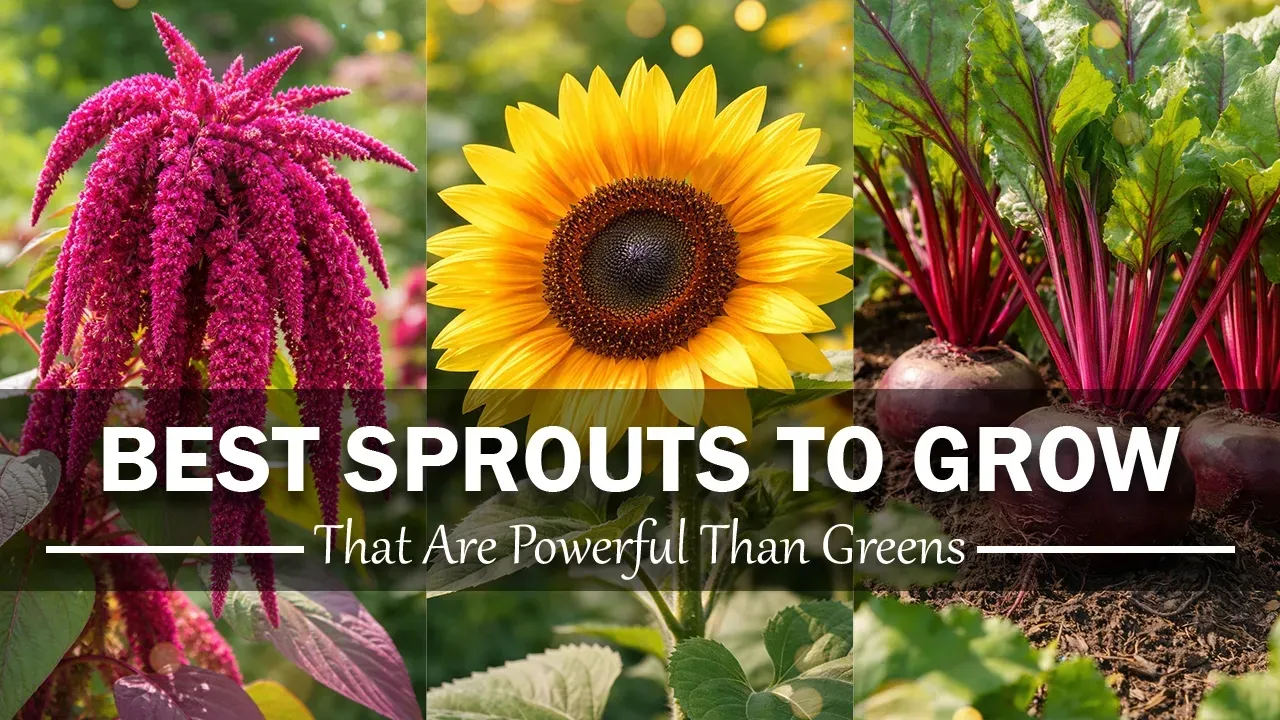
What if I told you that some of the most nutrient-dense superfoods you could possibly eat don't require a garden, don't need soil, and can be ready to harvest in less than a week? I'm talking about sprouts, tiny powerhouses that you can grow right on your kitchen counter for almost nothing. And today, I'm going to show you 20 of them that will completely change the way you think about fresh food forever.
Make sure you hit that subscribe button right now because here on the Homestead Gardener, we post new videos every week that help you grow more, spend less, and take control of your own food supply. So, let's get into it. Here are 20 sprouts you can grow at home, ranked from impressive to absolutely incredible.
Plant one, alfalfa. The classic that started it all. Let's start with the sprout that most people have seen, but almost nobody truly appreciates.
Alfalfa sprouts are the gateway into home sprouting, and for good reason. These delicate, mild-flavored sprouts are ready to eat in just 4 to 6 days, and they're packed with vitamins A, C, and K, plus a solid dose of folate and iron. Here's what most people miss about alfalfa.
It's not just a salad topper. Traditional herbalists have used alfalfa for centuries as a general tonic for vitality and digestion. Modern research shows these tiny sprouts contain saponins and flavonoids that support healthy cholesterol levels and provide antioxidant protection.
Growing them couldn't be simpler. You soak the seeds overnight, drain them, rinse twice a day, and within less than a week, you've got a jar full of fresh, crispy sprouts that cost you almost nothing. Here's what most people don't know.
The name alfalfa comes from Arabic, and it literally means father of all foods. Ancient cultures valued this plant so highly that they gave it that name thousands of years ago. And when you look at the nutritional profile, you understand why.
Alfalfa sprouts got overlooked because they became so common that people stopped thinking about them. They turned into a decoration, a garnish nobody paid attention to. But the plant that earned the title father of all foods deserves a second look.
Think of alfalfa as the training wheels of the sprouting world. Easy, reliable, and far more powerful than its humble appearance would suggest. Plant two, broccoli.
The cancer research darling. Here's where things start to get serious. Broccoli sprouts have been the subject of hundreds of scientific studies, and the results are nothing short of extraordinary.
These three-to-five-day sprouts contain up to 50 times more sulforaphane than mature broccoli. 50 times. Sulforaphane is a compound that researchers have been studying extensively for its role in supporting the body's natural detoxification processes and cellular health.
Johns Hopkins University put broccoli sprouts on the map with groundbreaking research, and the scientific community hasn't stopped paying attention since. Here's what makes broccoli sprouts special from a practical standpoint. They taste mildly peppery, almost like a mild radish.
They grow fast, and pound for pound, they deliver more concentrated nutrition than almost any vegetable you can buy in a grocery store. Growing them at home means you're getting them at peak freshness, which matters because sulforaphane content is highest in the first few days after sprouting. Broccoli sprouts got overlooked for decades simply because people assumed the mature vegetable was the only way to get the benefits.
But the sprout is where the real concentration lives. It's like discovering that the baby version of something you already loved is actually 50 times more powerful. Plant three, mung bean.
The Asian kitchen staple. If you've ever eaten at a Chinese restaurant, you've already met mung bean sprouts. But growing them yourself is a completely different experience.
Fresh mung bean sprouts are crisp, juicy, and ready in 3 to 5 days. They're an excellent source of plant protein, vitamin C, and folate. Mung beans have been a cornerstone of Asian cuisine and traditional medicine for over 4,000 years.
Ayurvedic practitioners consider them one of the easiest legumes to digest, and they've been used to support everything from digestive comfort to general nourishment. Here's the business case for growing them at home. Store-bought mung bean sprouts are often limp, watery, and days past their prime by the time you eat them.
Homegrown ones are incomparably better. Crunchy, fresh, and alive with nutrition. The growing process is dead simple.
Soak, rinse, drain, and keep them in the dark if you want thick, white, restaurant-style sprouts. Think of mung beans as the sprout that taught an entire continent how to eat well for pennies. And once you taste a fresh, homegrown mung bean sprout next to a sad, soggy, store-bought one, you'll never go back.
The difference is night and day. That crunch, that freshness, that juicy snap when you bite into one, that's what real food tastes like. And it took you 3 days and about 5 cents worth of beans to make it happen.
Plant four, radish. The spicy little powerhouse. Radish sprouts are for people who want flavor and nutrition in equal measure.
These vibrant, peppery sprouts are ready in 3 to 5 days, and they bring a kick that transforms any dish. They're loaded with vitamins A, B, C, E, and K, plus minerals like calcium, iron, and zinc. Here's what makes radish sprouts stand out.
That spicy bite isn't just flavor. It comes from glucosinolates, the same family of compounds that make broccoli sprouts so interesting to researchers. Radish sprouts deliver these compounds in a form that's immediately bioavailable.
Traditional use across multiple cultures included radish sprouts and microgreens as digestive aids and appetite stimulants. The peppery compounds stimulate digestive secretions, which is why they pair so well as a garnish on heavier meals. Growing radish sprouts is fast and forgiving.
They're one of the most reliable sprouts for beginners, and they add color and punch to everything from sandwiches to stir-fries. It's the sprout that proves healthy food doesn't have to be bland. Sometimes the most nutritious option is also the most flavorful.
Plant five, lentil. The protein-packed performer. Lentil sprouts are the unsung heroes of the sprouting world.
Take an already nutritious legume and sprout it, and you get something even better. Sprouting lentils increases their vitamin C content dramatically, improves mineral absorption, and breaks down the compounds that can cause digestive discomfort. The result is a sprout that's high in plant protein, rich in iron and folate, and gentle on the stomach.
Lentil sprout in just 2 to 3 days, making them one of the fastest options on this entire list. Here's what most people don't realize. Sprouted lentils are more digestible and more nutrient available than cooked lentils in several key areas.
The sprouting process essentially pre-digests the seed, unlocking nutrition that would otherwise pass right through you. Traditional cultures across the Middle East and South Asia have been sprouting lentils for thousands of years, long before anyone understood the science behind it. They just knew it worked.
Growing them requires nothing more than a jar, some water, and 2 days of patience. Lentil sprouts are mild, slightly nutty, and work beautifully in salads, wraps, and soups. You can even add them to smoothies for a protein boost without changing the flavor.
For anyone trying to eat more plant protein without spending a fortune on supplements, lentil sprouts are an absolute no-brainer. Think of them as the sprout that takes something already good and makes it genuinely great. Plant six, sunflower.
The crunchy crowd-pleaser. Sunflower sprouts are different from most sprouts on this list because you grow them in a thin layer of soil or growing medium, and you eat them as microgreens. But the wait is worth it.
In 7 to 12 days, you get tall, thick, satisfying greens with a nutty, almost buttery flavor that people absolutely love. Sunflower microgreens are rich in complete protein, healthy fats, vitamins A, B complex, D, and E, and minerals including zinc, iron, and calcium. They're one of the most nutritionally complete greens you can grow.
Here's what makes sunflower sprouts special. They're substantial. While most sprouts are delicate and light, sunflower greens have real body and crunch.
They can be the star of a salad, not just a garnish. Chefs at high-end restaurants pay premium prices for fresh sunflower microgreens, and you can grow them on a windowsill for a fraction of the cost. Sunflower sprouts got overlooked because people think of sunflowers as the big cheerful plant you grow for seeds, but the baby version is where the real everyday nutrition lives.
It's the sprout that turns a simple salad into something people ask you about. And once you start growing them, you'll wonder why you ever spent money on store-bought salad greens that wilt in 2 days and taste like cardboard. Sunflower microgreens are alive, vibrant, and packed with nutrition that no bag of mixed greens can match.
Plant seven, fenugreek. The ancient metabolism booster. Fenugreek sprouts have a fascinating history that stretches back thousands of years.
Ancient Egyptians used fenugreek, and it appears in traditional medicine systems from Ayurveda to Chinese herbalism, and modern science is starting to explain why. Fenugreek sprouts are ready in 3 to 5 days and have a distinctive, slightly sweet, maple-like flavor. They contain fiber, protein, iron, and unique compounds called steroidal saponins that researchers are actively studying for their role in supporting healthy blood sugar metabolism.
Here's what's remarkable about fenugreek. Traditional practitioners across multiple cultures independently arrived at the same uses for this plant. It was valued for digestion, general vitality, and metabolic support everywhere it was grown.
That kind of cross-cultural agreement usually means something real is going on. Growing fenugreek sprouts is straightforward. Soak, rinse, drain, and harvest.
The sprouts work beautifully in curries, salads, and sandwiches. Think of fenugreek as the sprout that ancient healers on three different continents all agreed was essential, and modern research is catching up to why. Plant eight, clover.
The gentle healer. Red clover sprouts are mild, sweet, and incredibly easy to grow. They're ready in 4 to 6 days and have a pleasant, gentle flavor that works in almost any dish.
But don't let the mildness fool you. Red clover has been one of the most widely used herbs in traditional Western herbalism for centuries. The sprouts contain isoflavones that have been the subject of significant scientific interest.
Red clover is also rich in vitamin C, B complex, and minerals like calcium, chromium, and magnesium. Here's what makes clover sprouts a smart choice. They're one of the easiest sprouts to grow.
They taste good to almost everyone, including kids, and they deliver a surprisingly broad nutritional profile. Traditional herbalists used red clover tea as a gentle internal cleanser, and the sprouts carry many of the same beneficial compounds. Clover sprouts got forgotten because they're not flashy.
They don't have a dramatic backstory or a headline-grabbing compound, but sometimes the best medicine is the quiet, consistent, gentle kind. It's the sprout equivalent of that reliable friend who always shows up when you need them. Plant nine, pea.
The sweet surprise. Pea shoots are one of the most delicious things you can grow at home, period. These sweet, tender sprouts taste like spring in a bite, and they're ready in 7 to 10 days when grown as microgreens.
Pea shoots are loaded with vitamin C, vitamin A, folate, and fiber. They contain more vitamin C per serving than blueberries, which surprises almost everyone who hears it. Here's the secret that makes pea shoots extraordinary.
They're so tasty that even people who claim to dislike healthy food will eat them. The natural sweetness is irresistible. Chefs use them as garnishes on everything from pasta to seafood, and they command premium prices at farmers markets.
Growing pea shoots at home is simple. Use whole dried peas from the grocery store. Soak them, spread them on a tray with a thin layer of soil, and within a week or so, you've got a harvest of sweet, crispy greens.
Pea shoots are the sprout that converts skeptics. If you know someone who thinks sprouts are boring health food, hand them a pea shoot. Conversation over.
Plant 10, wheat. The original superfood juice. Wheatgrass has been a health food icon since the 1970s, and for good reason.
This vibrant green juice is packed with chlorophyll, vitamins, minerals, and enzymes. You grow it in a tray of soil and harvest the grass at about 7 to 10 days, then juice it or blend it. Wheatgrass contains vitamins A, C, and E, iron, magnesium, calcium, and amino acids.
It's one of the most concentrated green foods you can consume. Here's what makes wheatgrass worth your time. A single 1-oz shot of wheatgrass juice delivers a dense payload of nutrition in a form your body can absorb quickly.
Traditional health practitioners have recommended it for decades as a daily tonic, and many people report increased energy and well-being after incorporating it into their routine. Growing wheatgrass at home means you're getting it at absolute peak freshness, which is when the enzyme content is highest. Store-bought wheatgrass juice simply cannot compare to juice pressed from grass you harvested 60 seconds ago.
It's the sprout that launched an entire juice bar industry, and you can grow it for pennies on your kitchen counter. Now, if you're starting to realize that these tiny plants are far more powerful than most people give them credit for, do me a favor. Hit that like button right now.
It helps this video reach other growers and homesteaders who are looking for simple, affordable ways to improve their food supply. And if you haven't subscribed yet, click that subscribe button and ring the bell. Here on the Homestead Gardener, we're building a community that believes growing your own food is the most powerful thing you can do for your health.
Now, let's keep going because the top 10 is where it gets truly incredible. Plant 11, chickpea. The hummus upgrade.
Take the world's most popular legume and sprout it, and you get something nutritionally superior in almost every way. Chickpea sprouts are ready in 2 to 3 days, and they're loaded with protein, fiber, and B vitamins. Sprouting chickpeas reduces their cooking time dramatically and increases the bioavailability of key minerals like iron and zinc.
Here's the thing about chickpea sprouts that nobody talks about. They're incredibly versatile. You can eat them raw in salads, toss them into stir-fries, blend them into a raw sprouted hummus, or add them to soups.
The flavor is mild and nutty, and the texture is satisfyingly crunchy. Traditional Middle Eastern and Indian cuisines have been sprouting chickpeas long before it became a health trend. It was just practical wisdom.
Sprouted legumes are easier to prepare, easier to digest, and more nourishing. Chickpea sprouts are the upgrade you didn't know hummus needed. And for anyone on a budget, think about this.
A bag of dried chickpeas costs a dollar or two. Sprouted, it gives you multiple meals worth of high-protein, nutrient-dense food. No cooking required.
No electricity used. Just water, time, and a jar. That's food sovereignty in its simplest form.
Plant 12, mustard. The fiery flavor bomb. If you like heat, mustard sprouts will become your new obsession.
These tiny sprouts pack an intense, spicy punch that rivals the condiment itself. Ready in 3 to 5 days, mustard sprouts are rich in vitamins A, C, and K, and they contain the same glucosinolates that make the brassica family so interesting nutritionally. Here's what makes mustard sprouts remarkable.
A small handful completely transforms a sandwich, a salad, or a bowl of soup. You get massive flavor impact from minimal effort and minimal space. Traditional mustard seeds have been used in medicine and cuisine across Europe, Asia, and the Middle East for thousands of years.
The sprouts concentrate that potency into a tiny, easy-to-grow package. Mustard sprouts are the proof that you don't need a lot of something for it to make a huge difference. A pinch of fire goes a long way.
And here's the practical bonus. Mustard seeds are dirt cheap. You can buy a bag for a couple of dollars and grow sprouts for months.
That's a lot of flavor and nutrition for almost nothing. Plant 13, buckwheat. The gluten-free green.
Despite its name, buckwheat is not wheat and contains zero gluten. Buckwheat sprouts, grown as microgreens, are ready in about 7 to 10 days and have a mild, pleasant flavor with beautiful, heart-shaped leaves. They're rich in rutin, a bioflavonoid that supports circulatory health and has been studied for its role in strengthening blood vessels.
Buckwheat microgreens also contain quality protein with all essential amino acids, making them one of the few plant sources that qualify as a complete protein. Here's why buckwheat microgreens deserve your attention. They're gorgeous, nutritious, and they grow and anyone with celiac disease or gluten sensitivity can enjoy them freely.
Traditional Eastern European and Asian cuisines have used buckwheat extensively, but the microgreen version is still relatively unknown. Buckwheat microgreens are the elegant gluten-free option that proves specialty doesn't have to mean difficult. Plant 14.
Adzuki bean. The sweet bean sprout. Adzuki bean sprouts are popular across Asia, but almost unknown in the West, and that's a shame.
These sprouts are ready in 3 to 5 days, have a slightly sweet, nutty flavor, and are packed with protein, fiber, folate, and potassium. In traditional Chinese medicine and Japanese cuisine, adzuki beans are considered especially gentle on the digestive system and supportive of kidney health. The sprouts amplify these benefits while making the beans lighter and more digestible.
Here's what makes adzuki sprouts a smart addition to your rotation. They offer a flavor profile that's different from any other sprout on this list. That subtle sweetness makes them work in both savory dishes and even smoothies.
Adzuki sprouts are the secret ingredient that proves the sprouting world extends far beyond what most Westerners have been exposed to. An entire continent of culinary wisdom is waiting for you in that little jar on your counter. And here's a tip.
If you make adzuki bean sprouts and toss them into a bowl with rice, sesame oil, and a splash of soy sauce, you've got a meal that's healthy, satisfying, and costs almost nothing. That's the kind of practical everyday food that sprouting makes possible. Simple, affordable, and genuinely nourishing.
Plant 15. Beet. The crimson superfood.
Beet sprouts are visually stunning. Deep red stems with green leaves that look like they belong in a fine dining restaurant. They're ready in about 8 to 12 days as microgreens, and they taste earthy, sweet, and distinctly like beets.
Beet greens contain betalains, the pigments responsible for that vivid red color, which are powerful antioxidants. They're also rich in vitamins A and C, iron, and potassium. Here's the visual advantage of beet sprouts.
They make every plate look like a professional chef assembled it. That deep crimson against a green salad or a white plate is absolutely striking. Beyond aesthetics, the nutritional density is impressive for something you can grow in a small tray by a window.
Traditional herbalism valued beet roots and greens alike as blood-building foods, and the sprouts concentrate those same beneficial compounds into a tiny, beautiful package. Beet sprouts are the proof that the healthiest option can also be the most beautiful one. And in a world where we eat with our eyes first, that matters more than you think.
When your food looks incredible, you want to eat it. When you want to eat it, you eat more of the good stuff. Beet sprouts make healthy eating effortless just by being gorgeous.
Plant 16. Green pea. Microgreens.
The farmers market favorite. Green pea microgreens are the number one best-selling microgreen at farmers markets across the country. And once you taste them, you'll understand why.
Those tender, curling tendrils with their sweet, fresh pea flavor are irresistible. At 7 to 14 days to harvest, they take a bit longer than jar sprouts, but the payoff is enormous. They're rich in beta-carotene, vitamin C, fiber, and protein.
Here's why pea microgreens dominate the market. They appeal to absolutely everyone. Kids love the sweetness.
Adults love the crunch. Chefs love the presentation. They're the gateway microgreen that hooks people on growing their own food.
And here's the beautiful thing. A bag of dried whole peas from the grocery store costs practically nothing and yields tray after tray of premium greens. Pea microgreens are the sprout that could save you real money on groceries while delivering nutrition that store-bought lettuce can't even dream of competing with.
Plant 17. Amaranth. The ancient grain reborn.
Amaranth was sacred to the Aztecs. They cultivated it for thousands of years as a primary food source, and it was so central to their culture that Spanish conquerors actually banned it. Let that sink in.
A plant so powerful that an empire tried to erase it from history. Amaranth microgreens are vibrant, often magenta or red, and ready in 8 to 12 days. They contain protein, lysine, which is an amino acid often lacking in plant-based diets, vitamins A and C, and minerals including calcium and iron.
Here's what makes amaranth microgreens fascinating. They connect you to one of the oldest agricultural traditions in the Americas. Growing them at home is an act of reclaiming knowledge that was nearly lost.
And the nutrition is outstanding, particularly the lysine content, which makes amaranth a valuable complement to other grains and greens. Amaranth microgreens are the sprout with a story. A reminder that the most powerful foods aren't always the ones with the biggest marketing budgets.
Sometimes they're the ones that empires tried to destroy and couldn't. Plant 18. Garlic.
Chive sprouts. The immune-support hero. Garlic chive sprouts bring the benefits of the allium family into your sprouting rotation.
These sprouts have a mild garlic flavor and are ready in about 8 to 12 days. Allium species have been used in traditional medicine across virtually every culture for immune support, cardiovascular health, and antimicrobial properties. Modern research has extensively studied the sulfur compounds in allium plants, and the results consistently support what traditional practitioners knew all along.
Here's what makes garlic chive sprouts practical. They give you a fresh, garlic-like flavor without the intensity of raw garlic cloves. They work as a garnish, a salad ingredient, or a finishing touch on soups and stir-fries.
Growing allium sprouts at home means you always have immune-supportive food on hand. No supplement bottles. No trips to the pharmacy.
Just living food growing on your counter. Garlic chive sprouts are the quiet, steady workhorse of the sprouting world. They don't make headlines.
They don't trend on social media. But they show up every single time with reliable flavor and dependable nutrition. In a world obsessed with the next big superfood, garlic chive sprouts remind you that sometimes the most valuable things are the ones that just consistently deliver without asking for attention.
Plant 19. Kale. The superfood supercharged.
Kale sprouts take the already impressive nutritional profile of kale and concentrate it into a tiny, tender, fast-growing package. Ready in 4 to 6 days, kale sprouts are milder and more tender than mature kale leaves with none of the toughness that turns some people off. They contain vitamins K, C, and A, calcium, and the same glucosinolates that make the entire brassica family so valuable.
Here's the key insight. People who say they don't like kale usually don't like the texture or the bitterness of mature leaves. Kale sprouts solve both problems.
They're soft, mild, and easy to incorporate into anything. All the nutritional prestige of kale, none of the objections. Kale microgreens and sprouts are the way to get people who gave up on kale to give it another chance.
It's the superfood redemption arc that most people don't know exists. And here's the kicker. Growing kale sprouts at home costs almost nothing and takes less than a week.
You get all the bragging rights of eating kale with none of the suffering. If kale had a marketing team, they'd be pushing the sprouts because the sprouts are what kale always should have been. Plant 20.
Broccoli raab. The ultimate sprouting champion. And here we are, number 20, the top of the list.
Dud. Dud. Broccoli raab sprouts, also known as rapini sprouts, combine everything that makes sprouting incredible into one package.
Ready in 3 to 5 days, these sprouts deliver a complex, slightly bitter, deeply savory flavor that Italian and Chinese cooks have valued for generations. They're packed with vitamins A, C, and K, folate, iron, and those powerful glucosinolates that the brassica family is famous for. Here's why broccoli raab sprouts earn the top spot.
They represent the full potential of what sprouting can be. Maximum nutrition, maximum flavor, minimum time, minimum space. They're the sprout for people who've moved past the basics and want something with depth and character.
Traditional Italian cuisine has elevated broccoli raab to an art form, and the sprouts carry that same culinary DNA. When you grow broccoli rob sprouts on your kitchen counter, you're not just growing food. You're growing a culinary tradition that stretches across continents and centuries concentrated into something you can harvest in less than a week.
That's the real magic of sprouting. Thousands of years of agricultural wisdom distilled into a jar on your counter. No fancy equipment, no expensive setups, no waiting months for a harvest.
Just seeds, water, and a few days of patience, and you can start today, right now, with whatever seeds you have in your kitchen. Here's my challenge to you. Pick one sprout from this list.
Just one. Try it this week. And once you see how easy it is, once you taste that first harvest of something you grew yourself in less than a week, you'll understand why I'm so passionate about this.
Growing your own food changes everything. It changes how you eat, how you think about health, and how you see your own kitchen. If this video changed the way you think about what you can grow at home, share it with someone who needs to hear it.
And make sure you're subscribed to the Homestead Gardener so you never miss a video. We've got a lot more coming. I'll see you in the next one.