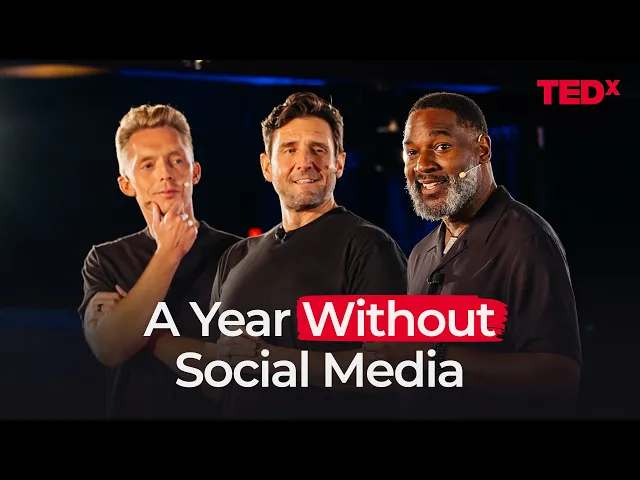
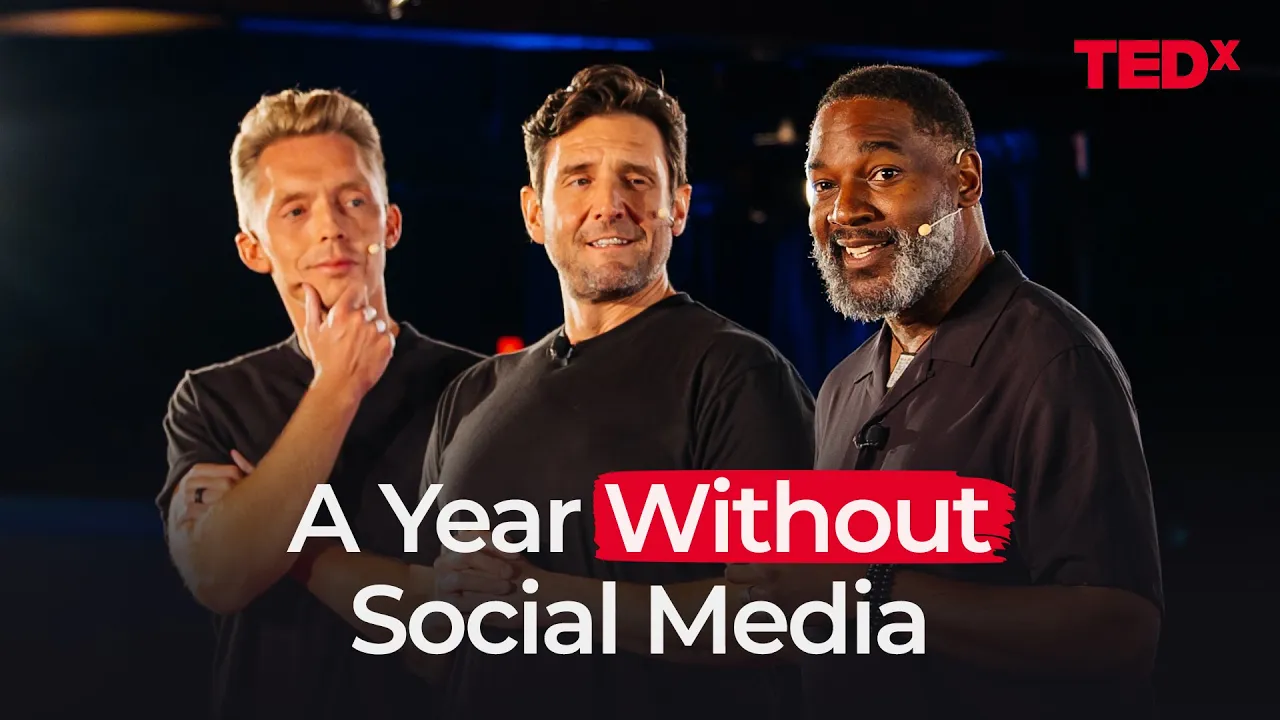
Would [music] your life be better with less social media clutter? Let's find out. My name is Ryan Nicodemus and these are my friends Joshua Fields Milbour and TK Coleman.
Together we run a simple living collective known as the Minimalists. Over the last 15 years, through our podcasts, films, books, and live events, we have helped millions of people understand what it means to live a meaningful life with less. Less stuff, fewer distractions, less clutter, less physical clutter, sure, but also less digital clutter.
You know, that clutter that emanates from our phones, televisions, laptops, tablets, smartwatches, and all of our other glowing screens. And all of this is really ironic because we have reached more and more people during our pursuit of less. In fact, just 18 months ago, we wrapped up our most successful year ever.
That's right. In 2023, through our social media posts alone, we reached half a billion people. We garnered more than 200 million views and we surpassed 4 million followers.
Sounds impressive, right? I mean, maybe. But what do we do when we reach these milestones?
Do we celebrate and express our gratitude? No. Instead, we asked, "How do we get more?
[laughter] What would it take to get to, I don't know, 10 million followers? Can we reach a billion people next year? How do we get more views, more likes, more more?
" It's starting to sound like maximalism, isn't it? [laughter] It's maximalism. It's it's consumerism, too.
You see, consumerism is the ideology that acquiring more will make you happy. Of course, it never works. And so, we keep trying to get more, more, more, more, more, more.
That's the problem with consumerism. It is never enough. And that's where we were at the start of last year.
Even though we had plenty, we wanted more. Turns out we were on the brink of digital consumerism. But then this guy stopped by our podcast studio in Hollywood.
This is Cal Newport. He's a computer scientist at Georgetown. He's the author of digital minimalism and he has never used social media.
When he stopped by our show, we told him about our little dilemma of more. And Ryan, he helped us better understand some of the real problems with social media. >> That's right.
Did you all know that the average person spends nearly two hours a day on social media? Did you know that people who use social media for more than two hours a day are nearly three times more likely to be diagnosed with depression? Did you know that social media use is linked to a 40% higher risk of sleep problems?
Did you know that 46% of adolescents say that social media use makes them feel worse about their body image? And 60% of users say that it negatively affects their self-esteem. >> Man, that's heavy.
>> I totally agree. But maybe we can lighten the mood with a little humor. Check out this clip from comedian Hannah Jones, who clarifies the problem by discussing her frustrating relationship with social media.
>> Hey, sorry I didn't respond sooner. I spend 5 to seven hours a day consuming advertiser funded short form video content that performs algorithmically on the basis of how well it can provoke an emotional response from its viewers. Meaning that I have what would be considered throughout most of history to be a full-time job where my nervous system just gets milked like a cow, rendering me completely unable energetically to nurture the relationships that bring me joy in my life and essentially giving myself type 2 ADHD.
[laughter] >> I mean, it's funny when we look at it like this, but it raises an important question. What are you seeking out? Is it trauma and pain and suffering and anxiety and anger?
If so, you've come to the right place because social media is great at making us feel those unpleasant emotions. But it's also true that social media, it's not going anywhere anytime soon. So, what do we do about it, TK?
Well, towards the end of our conversation with Cal Newport, he encouraged us to embark on a 30-day digital declutter where we completely eliminate social media from our lives for a month just to see what might happen. But of course, we are the minimalists. So, 30 days kind of felt like amateur hour.
We decided to make it a real challenge. What if the minimalists at the peak of our reach and success walked away from social media for a whole year? Would it bring us more peace?
Would it ruin our business? Could we be successful without it? We had to find out for ourselves.
>> Yeah. So, we left social media for a whole year. But that's just the beginning of the story.
Here's the rest. TK, do me a favor. Take a look at these photos.
What do these people have in common? >> They're all respected and admired for their talent. >> Talent?
Yeah, that's right. What else? They're all famous.
>> Fame. Okay. What else?
>> Aha. They don't have social media. >> Bingo.
They're all successful even though they don't have social media. >> What about this photo? >> Oh, that's uh that's Sydney Sweeney.
>> Oh, come on, man. You know she's got social media. >> I know, but for some reason, she just kept showing up in my algorithm.
Ah, that makes sense because some platforms use eyetracking data. They use eyetracking data to keep tabs on you. They watch how you interact.
Your front-facing camera, it's looking back at you. It pays attention to what you look at, how long you look at something, how quickly you notice certain things, and even if you come back to look again. All of this helps them figure out exactly what grabs your attention and what keeps you engaged.
So in a real sense, social media knows us better than we know ourselves. So if you keep seeing the same things [clears throat] or people or body parts [laughter] in your feed, it might be because your behavior is asking for more even if you aren't. It knows what you're tempted to click on even if you don't click on it.
It knows what you're attracted to even when you make the decision to avoid it. >> It's creepy. >> Yeah.
that his whole feed is filled with Sydney Sweeney [laughter] pictures. I agree. >> Yeah, maybe a little.
Maybe a little bit. No, I'm talking about that eyetracking data stuff. It makes me feel so exposed.
>> Man, that's how I felt without all my social media apps on my phone. I It's like I felt naked. But then I noticed all these interesting hidden habits, these terrible habits that were being reset in my own life.
After a month without social media, I stopped twitching from my phone while waiting in lines at the grocery store, at restaurants. It's like [sighs] I felt the anxiety just drain from my body. After 3 months, something amazing happened.
That glowing screen stopped following me into the bathroom. And after six months, I realized I had primed my friends and family to call or text, which deepened our relationship beyond the ephemera of comments and emoji reactions. But my favorite unexpected observation was this.
Every time I told someone I'd left social media, they all said the same thing. Oh, that sounds amazing. I wish I could leave social media, too.
[laughter] >> That's the point, right? I mean, if the minimalists could minimize social media at our peak, then perhaps anyone could let go of social media if they felt like it was making them miserable. >> Exactly.
But as you know, Ryan, whenever we're letting go of anything, that letting go process always starts with a few important questions. >> Absolutely. When it came to our excess stuff, the question that helped us let go of our material possessions was, "How might my life be more with less?
" And then last year when we started letting go of social media, more questions emerged like this question. How costly is social media? It may not cost us any money, but it costs us our time, energy, and attention.
We give up our peace for a small piece of dopamine. And that realization led me to this question. Will I become irrelevant or lose a piece of my identity?
Sometimes it really does feel like we're only as relevant or as memorable as our last post. I certainly felt that way, which then made me wonder. Will I be misunderstood?
Will people think I'm selfish? Some folks might feel like we're just abandoning them. Not only that, but they might feel like we're being irresponsible, which led to this next question.
Will I become a bad citizen because I'm less informed? It's hard to feel like a responsible member of society if I'm not keeping up with all the current events. But maybe access to non-stop news was making me miserable, which led me to one last question.
How much of my unhappiness is a direct result of social media? >> That last question is such an important one because it highlights the three main problems with social media. Obligation, overconumption, and discontent.
Let's start with obligation. Many people feel plagued by a need to keep up with every headline and every hottake. For example, when the actor Will Smith walked onto the stage at the Academy Awards and slapped the comedian Chris Rock in his face, thousands of pieces of content flooded in online just like that.
Everything from gossipy backstories to moral lessons, jokes, philosophical takes on the lives of the people involved. Now, how could you possibly feel informed or relevant if you think you need to have a take on all the takes? And that's just celebrity drama.
What happens when the discussion shifts to something serious like politics, economics, or war? This leads us to overconumption. For many of us, we like to tell noble sounding stories about why we struggle to log off.
You know, it's all about staying informed, right? staying in touch with our friends, being in tune with current events, but the truth behind why we're glued to these screens is a lot messier. At the level of our stated preference, it's all about relationships.
What if my friends need me? What if there's an emergency? But at the level of revealed preference, we cling to these phones because we want to watch hours worth of bar fights and proposal fails and videos of influencers in the wild almost falling off a cliff just to take that perfect selfie.
Scrolling has become the new smoking. It's stimulating. It's soothing.
It's a little addictive. We get irritable if we can't do it for a long time. And none of us really like it very much when other people do it right in our faces.
I'm trying to have a conversation with you and you're going to do this right there in my face. This leads us to discontent. It's one thing to look up highlights to a baseball game or to look for information about how to change attire.
Even when you search for something that's superficial, that requires some measure of intentionality. But the minds behind our digital spaces, they are getting better and better at learning how to keep us hooked. They're gradually replacing searching with scrolling.
You find one thing that you like, they immediately serve you up with 20 things that are even better. That used to require a click, but now the next thing just automatically keeps playing. It's like having a digital waiter who brings you something even tastier before you've had the chance to finish your first bite.
In the words of Neil Postman, we are amusing ourselves to death. We're more stimulated than ever before, but are we really satisfied? We're highly, highly engaged, but are we deeply connected?
Towards the end of the year, we really didn't know if we'd return to social media. We didn't want to reject it outright. As Anthony Dlo says, you are forever defined by the things you choose to renounce.
And the last thing we wanted our reputation to be was a bunch of guys who dogmatically renounced social media. We wanted to do this with an open mind. But as GK Chesterton warned, the purpose of an open mind is that of an open mouth, to chew on something solid.
So we set out to take a break from social media with an open mind and the goal to more deeply discern what's really worth chewing on. But as is often the case, difficulties were encountered when we made this change. First, there was the financial cost.
Our revenue decreased by 21%. >> Wait a minute. 21%.
That's crazy. I mean, I can handle 19% or maybe 20%. But 21, that's where I draw the line.
>> Well, man, I got more number problems for you, Ryan. in terms of the number of people we reach via new social media posts. We watched our numbers plummet from half a billion all the way to zero.
And then on the social side, there were some really cool opportunities that came up to collaborate with other other digital creators and we had to miss out on those two. But many of these problems weren't as problematic as we thought. There were some upsides.
When we left social media at the beginning of last year, we had some unexpected victories. Here's what we gained. For starters, people surprisingly started to show up to our live events in droves.
What we sacrificed in width, we began to increase in depth. And that freed up a lot of resources. And we began to use that time and that energy that was once spent on social media to do other creative things like work on a new documentary, engage in creative writing.
And this led to an increased sense of calm. By turning down the value on all by turning down the volume on all that external stimulation, we turned up in awareness. And this led to idea incubation.
You know, there are these interesting ways of thinking and seeing that begin to emerge when you can't immediately share every impulse and every observation with the broader world online. What happens when you begin to ponder those things in your heart? Our time away was like a cleansing of the lens that helped us renew our vision for the role that social media could play in our lives.
Yes, social media has its problems and it's so easy to talk about those things, but when we use it mindfully, it has immeasurable potential. I like to think of social media as kind of like a giant table. Now, if you take a table and you just randomly plop it in the middle of a room without thinking about your environment, you're going to experience that as an obstacle that gets in the way.
But when you put it in its proper setting and you use it intentionally, that same table becomes a space for community. We can think of social media as a digital table with three legs. The first is content consumption.
Now, for a lot of people, this can be a great source of information anxiety, but it doesn't have to be that way. Information isn't bad. Just like food, it's a source of nourishment that we all need to survive.
But just like with eating, it's possible to develop habits that leave us feeling fatigued and addicted. Well, we all know that the solution to eating problems isn't to renounce food. In a similar way, the solution to social media consumption is to learn how to engage things in a way that leave us feeling replenished and refreshed.
The second leg is creativity. In the same way that a minimalist doesn't renounce physical possessions, but instead seeks to celebrate them and use them healthfully, a digital minimalist doesn't renounce technology, but seeks to redeem it. By introducing just a healthy dose of intentionality into our social media use, we can redefine for ourselves what it means to be informed, what it means to be involved.
We can ask ourselves questions like, "What are the results I most want to create in my life? What are the skills I want to develop? The things that I want to learn, the ways that I want to show up, and then we can begin to orient our social media activities around that.
The last leg is connection. A hammer and a baseball bat are valuable tools, but they immediately become weaponized when we misuse them. So it is with technology.
No matter how valuable these tools are, they cease to be helpful until we use them with a sense of purpose and generosity. We often say love people use things because the opposite never works. What happens when we begin to use social media as a tool for love?
Once we simplify these three elements, social media ceases to be clutter like that giant table in the middle of a room and it becomes a well-placed table that facilitates real opportunities for genuine human connection. After we clarified our intentions around social media, we made the decision at the beginning of the year to make a return. kind of like when Michael Jordan came back.
Here are a few guidelines that helped us keep things simple. My favorite is the casino rule. Treat social media like a casino.
You can go in if you want, but decide how much you're going to spend before you walk through those doors. Set your time limits and stick to them. No matter what the heat of the moment says and no matter how many distractions try to keep you going.
The second one, replace scrolling with searching. You can do whatever you want online. The key is to keep it intentional.
So if you decide to go on YouTube to watch a documentary on Bigfoot, more power to you. On the other hand, if you sit down to pay your bills or do your work and you start tumbling down a Bigfoot rabbit hole, a strategy like this might be helpful. The third is make your phone boring by turning your phone to grayscale.
That's a simple little trick that produces massive results. When you drain the color from your phone, it makes it less of a slot machine for the eyes. Number four, declutter the apps.
What are the best apps to use? The ones that you'll actually use, not the ones that other people demonize. If you haven't used it in 6 months, get rid of it.
It's just digital clutter. And the last rule is the entryway rule. This is the art of creating healthy tension by taking your phone and sitting it by the entryway.
That way, if you want to use it, you've got to work for it. And you strip away the power that your distractions have to follow you around from room to room. Now, these strategies are going to work in different ways for different people, but the underlying spirit behind them is pretty simple and universally applicable.
It's all about setting boundaries without falling into renunciation. It's all about embracing restraints while still remaining open to possibility. and no more obligation.
This philosophy is about showing up with a sense of play rather than a sense of duty. And ironically, now that we no longer have to be on social media, our content is seen by more people and shared more frequently than our so-called best year ever. And the most important part is we give ourselves complete permission to walk away if any of this stuff gets in the way of our happiness and our health.
>> [applause and music] >> Oh, wait, wait, wait. One more thing. Sydney, if you're watching this, my DMs are open.
>> I apologize for my friend.