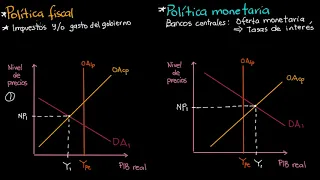
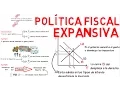
In this video we will study the definition of expansionary fiscal policy and its effects, in the IS - LM model. Fiscal policy is the decisions a government makes regarding public spending and taxes. Its main objective is to boost economic growth and, in general, keep the economy stable.
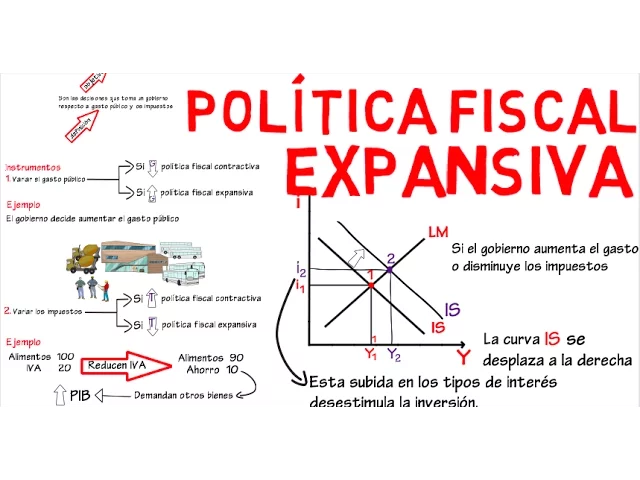
One of the instruments that a government has is to vary public spending. If it is increased, we talk about an expansionary fiscal policy and if it is reduced, we talk about a contractionary fiscal policy. Let's look at this example.
Let's suppose that the government decides to increase public spending through the construction of a new bus terminal, which requires new workers and inputs such as cement, steel and those needed in any type of construction. Then, these companies producing cement and steel must increase their production to satisfy the new demand and that is why the GDP increases. The other instrument is to vary taxes.
If it decreases them, it is an expansionary fiscal policy and if it increases them, it is a contractionary fiscal policy. For example, suppose a family buying $100 worth of food paid $20 in taxes. If the excise tax is lowered, the food now costs, for example, $90.
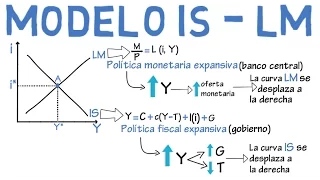
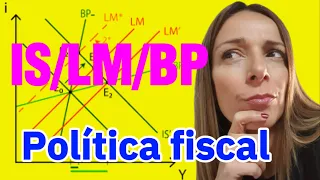
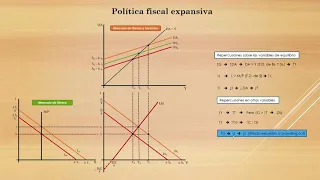
This remaining $10 could be spent by demanding other goods, which increases consumption in the economy and therefore the GDP. Graphically in the IS - LM model, which we described in chapter 11, an expansionary fiscal policy would have these effects; if the government decides to increase public spending or decrease taxes, the IS curve shifts to the right, going from equilibrium point 1 to point 2. The interest rate also increases, as the income of the workers and companies that took part in the construction of the new transport terminal increased.
They want to consume more and this generates an increase in the demand for money, which raises interest rates. This rise in interest rates in turn discourages companies from investing, as it is now more expensive to take out a loan. This effect is known in economics as the crowding out effect.
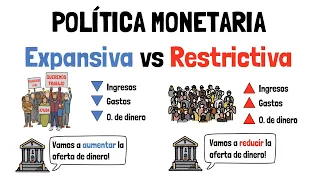
In the next chapter (13), we describe the effects of the expansionary monetary policy.