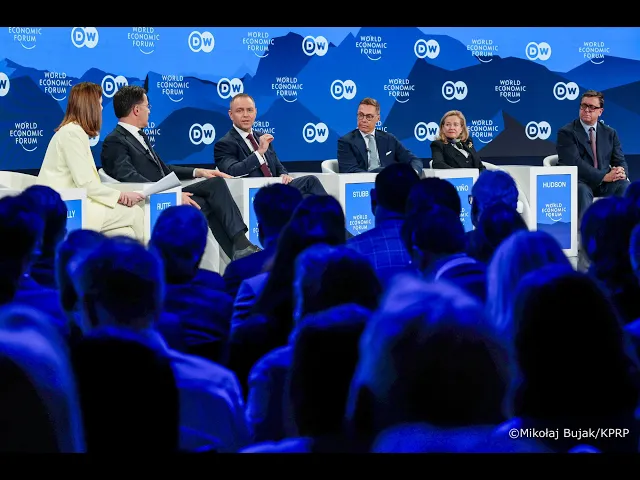
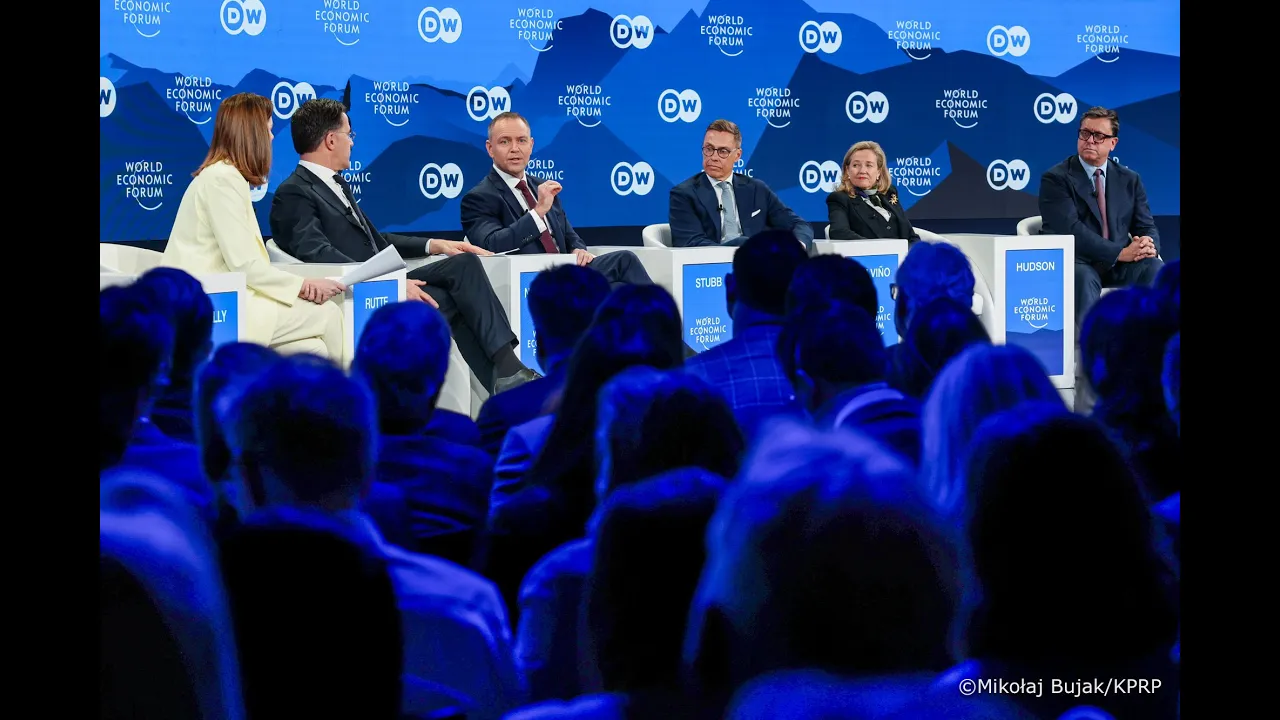
Can Europe defend itself? >> Hello and a very warm welcome to this special edition of Deutscheella's Conflict Zone from the World Economic Forum in Davos, Switzerland. I'm Sarah Kelly.
We're here with the NATO Secretary General Mark Rut, the president of Poland, Carol Nvotszki. >> Good morning. >> The president of Finland, Alexander Stup, the president of the European Investment Bank, Nadia Calvinho, and the CEO of Sanopi, Paul Hudson.
Welcome to all of you and thank you so much for joining us. Now, this question, can Europe defend itself, has really been thrust into the forefront as Donald Trump threatens allies over Greenland. As we wait for Trump to deliver a statement in just a few hours, there has been so much discussion um in the past few days, not only about the potential for a trade war with Europe, but also even the collapse of the NATO alliance itself.
And with that, Mr Secretary General, I'd like to begin with you because um with the US still a guarantor of European security, are European NATO allies hostage to Trump's demands? >> Well, listen, NATO since 1949 is the transatlantic alliance. And I think we have to be very careful in considering the fact that the US and Canada are not only in NATO to prevent the historic mistake the US made in their own view after the first world war which was retreating from the world stage and then the long arm of history reaching out to the US again in the second world war not wanting to repeat their mistake.
They are a NATO because NATO is crucial not only for the defense of Europe but only also for the defense of the United States. For the United States to stay safe, stay safe, you need a safe Arctic, a safe Atlantic and a safe Europe. Uh and and and all the military and all the politicians in the US know this and we really have to be mindful of this.
So when the question is uh is Europe safe? Yes, Europe is safe because of what Europe Europe is doing itself within NATO, but also because we have that strong transatlantic relationship, >> but we know the history. We know the stakes.
Let's talk about the current dynamics. And I'd like to ask you, you know, for for perhaps a bit of reflection here. Did you ever think that you would ever see one NATO member threaten the territorial integrity of another?
I mean, you have now the prime minister of Greenland telling his public an attack cannot be ruled out. >> Listen, my role is Secretary General when there is tension within the alliance. It has been there in the past between Greece and Turkey.
There have been other moments when there was tension. Then my predecessors always took the view that they should not comment on that in public. That's impossible.
Why is that impossible? Because as soon as I do, I cannot any longer help to somehow with others of course not me only myself but of course with with other leaders to basically uh diffuse the tension to deescalate etc. That's why you will not hear me comment.
you can be assured that I'm working on this issue behind the scenes, but I cannot do that in public. Um, so um um sorry, no comments from Greenland. >> Well, sometimes behind the scenes uh comments do become public in in various ways as we've seen in the past few days.
[Music] >> That's true. >> You've talked about security in the Arctic. No matter how you come out of this Greenland row, I mean, it really seems as if the dynamics have fundamentally changed within NATO.
You have Marco saying yesterday, we are shifting to a world without rules. Hasn't all of this fundamentally damaged the foundations of NATO, the this shared trust, the shared values. >> Of course, I see that there are these tensions at the moment.
There's no doubt. Again, I'm not going to comment on that, but I can assure you the only way to deal with that is in the end thoughtful diplomacy. >> So statements from me will not add anything here.
And when it comes to the Arctic, I think President Trump is right. Other leaders in NATO are right. We need to defend the Arctic.
Uh we know that these sea lanes are opening up. We know that China and Russia are increasingly active in the Arctic. There are eight countries bordering on the Arctic.
Uh seven are a member of NATO. That's Finland and Sweden and Norway and Denmark, Iceland, Canada, and the US. And there's only one country bordering on the Arctic outside NATO and that's Russia.
And I would argue there is a ninth country which is China which is increasingly active in the Arctic region. So President Trump and other leaders are right. We have to do more there.
We have to protect the Arctic against Russian and Chinese influence. And that's exactly what NATO ambassadors decided to do in September. We are working on that making sure that collectively will we defend the Arctic region.
>> I'd like to turn to Poland now. um you have traditionally been furiously pro-American in terms of you know efforts to keep them on board as a guarantor of security um uh in Europe. You've turned the term to the Greenland dispute and again this was a comment that I understand you made last week a matter between the Danish prime minister and President Trump just briefly.
Do you still stand by that after everything that you've seen in the past days and weeks? Of course, United States of America are the most important Polish bilateral ally. But we also appreciate a lot NATO.
We are the part of NATO and we feel responsible for NATO. This is the biggest alliance in the history of 20th century. I think like Mark Rut NATO is stable.
NATO is solidifying. But we of course recognize some problems about the Greenland. And I'm looking at the problem of Greenland from the strategic side.
We have Chinese, we have Russian, we feel in Poland Russian threat for three centuries even and we understand it at all in eastern flank of NATO. And if we consider ladies and gentlemen that global GDP is consisted of uh 15% of uh right European Union involvement and 15% of United States of America involvement but according in terms of security United States of America paying 65% for NATO and Europeans 35%. We have to consider what Donald Trump would like to say about the security because he's responsible for security of the world as the leader and he would like to support.
>> Do you really think you can stay out of this? >> Do you really think Do you really think you can stay out of this row? Do you really think that I mean isn't this the moment right now for solidarity in Europe?
Um isn't this key to a united and a strong response? There is necessity of solidarity in Europe, but there is also the necessity of building the good transatlantic relations. And I think that uh transatlantic relations are very important.
We know in Europe, we know, Alex, all my European friends knows how many mistakes had Europe done after and before 2022. and Donald Trump tried to convince our European partners that we have to solidify and his um voice is very important because of the financial because of the strategic ge geopolitical point of view. I of course hope that it will be solved thanks to all partners on the way the diplomatic way and I'm rather >> how far are you willing to go to have good transatlantic relations?
Does that mean giving the Americans Greenland, selling the Americans Greenland? Uh how far should European allies go if the Americans do move on Greenland? >> You know, we have 10,000 American soldiers uh in Poland.
Uh we buy American military equipment which is the best uh uh on the world. South Korean is also very good but American is >> and Finnish tanks. You >> and Finnish tanks a little little bit of a commercial break here.
Yeah. >> We have the biggest army in East Central Europe. Poland increased the percent of GDP for military service almost to five uh percent.
So we feel responsible for Poland I believe in Polish soldiers in our alliance but United States of America for all eastern flank of NATO are very important ally and those relations are also based on our history. This is the relation of values. We have common independence uh heroes in Poland and in United States of America.
So I think that we should solve uh this problem on diplomatic way. Of course I appreciate uh Denmark voice is natural. It's our partner Denmark.
But I'm looking at the Greenland as strategic point uh in the geopolitical issue between free world democracies world independence and uh with Russia. >> President Stub, I'd like to turn to you now because you along with the secretary general have been known as the Trump whisperer. Um you know now you're on the list being targeted for sanctions.
Um, you recently joined the NATO alliance. Is it just in time for its dissolution? >> No, not at all.
I think actually we're in the process of creating a stronger NATO than we have seen since the end of the Cold War. This is pretty much NATO 3. 0.
Remember that after the end of the cold war, a lot of NATO countries actually dropped their guard in terms of defense expenditure uh and capabilities. Whereas a country like Finland, which stayed outside, didn't do that. Uh we still have conscription and uh speaking of the Arctic uh we have the biggest military force of Arctic capabilities in the alliance.
We have 1 million individuals, men and women who've had their military training in Arctic conditions. Uh so uh I think we're strengthening actually the alliance as we speak and remember that we've doubled the border of the alliance with NATO with Finland joining and then with Sweden joining. So I think we're creating a new NATO where Europe takes more responsibility.
>> So then take us to the diplomatic efforts um and how you are trying to do that because you know you we saw over the weekend you along with your Norwegian counterpart sent this message to Trump calling for a deescalation of tension. He he responded quite quickly saying he's no longer purely thinking of peace. Who or what can diffuse the tensions of Greenland if not you?
Thank you, Alex. >> Anytime you want to take this one, Mark? No, I mean, listen, um, we are now in a phase in the transatlantic relationship, and you'll know that I'm pro- European, pro-American, and therefore by default protransatlantic.
We are in a relationship which is much more direct than it's ever actually been. I mean, the communication channels that we have directly with this pres with the president and with the administration are actually good uh and solid. Uh and then you know at some at times there are curve balls flying in different types of directions.
We try to catch them and we try to solve them. Uh you know you have two schools of thought here on on Greenland. One is to deescalate and the other one is to escalate to deescalate.
And I think at the end of the day we'll we'll find an offramp on this. Um I'll make two final remarks. If someone would have told me uh in Washington DC for the 75th anniversary of the alliance that we're going to increase our defense expenditure next year to 5% I would have said you have no clue about international relations or seek help with a doctor.
uh we did and I think what we need as an off-ramp now is some kind of a process whereby we start working on a real problem which is Arctic security and fortunately as Mark said we have seven countries Arctic countries one of them with a huge military uh that can help to deal with this so let's start working towards a process which leads us to a NATO summit in Ankara where we actually strengthen Arctic security within the alliance so this is what we're working on >> okay Nadia I'd like to ask you about the money this is a um point also to uh can Europe defend itself which is the topic that we're discussing today. The EU is freeing up hundreds of billions of euros to ramp up defense spending. You're part of that.
You have quickly ramped up um your capacity to mobilize capital for defense investment. This is something that's new for your bank. We also have to mention um how much do you see your future being defense and defense related projects?
Well, it's been a sea change in the last two years and we were just discussing with Alex that in the past was also working at the European Investment Bank how things have changed you know in in in the last couple of years in that we have extended the scope of projects we are financing and we have reached this magical number of 5% of our financing inside the union this year last year sorry in 2025 so that out outperformed our targets we were hoping to to reach that level this year in 26, but we already did in 25. We have a very robust pipeline of uh flagship projects, number of them in Poland, by the way. So that's European Solidarity actually supporting the defense of Poland on the eastern flank >> and and so my answer would undoubtedly be yes, Europe can defend itself.
>> Yeah, >> Paul, I'd like to turn to you um also with that because there's a role for the private sector as well here. Um NATO is treating medical preparedness as part of collective defense. You have many of your capabilities anchored in Europe.
Um does what you are hearing about European defense in the past days make you feel secure as a business person? Um and how do you see the private sector's role? you know the subjects that are being discussed are obviously extremely important and uh I trust in the process uh that people will get to the right conclusion.
I think health is unrecognized as the severity of what could happen if health sovereignty innovation sovereignty protecting populations is dep prioritized. I think NATO have made that point about making sure that people can get medicines they need in difficult times. I think in co my own personal experience was that I was getting calls from heads of state ministers of um uh health saying we need medicines give them to us don't give them to anybody else it quickly delineated and fragmented and and it worried us greatly given the importance of trying to work together to find some unity to make sure that we do things uh for Europe now so more than 50% of our manufacturing and R&D spend is in Europe And so we believe that we're one of the few companies that has that resiliency to be able to provide.
But there is a real moment for Europe. Perhaps it's not on the scale of this conversation and Greenland, but it is a real moment. Europe has long time been one of the great discoverers of medicines, >> the great providers.
Um pressure from Donald Trump on the price that is paid for medicines in Europe has be brought it into focus. And for the first time, China and the US publish more clinical papers, uh, win more Nobel prizes, uh, discover more medicines than Europe. And Europe's slipping behind and, and it's a moment there's still in control.
While I listen to this conversation, sometimes I worry that uh, there's a lot to be managed, escalate to deescalate. uh Europe in particular has health innovation and health sovereignty in the palm of its hand >> and if it chooses to step forward it can protect, it can innovate, it can compete. This is a moment not to be squandered.
>> Um I just like to add something and and kind of reset us a little bit. We're talking about can Europe defend itself and something that's really interesting is that we have not said the word Russia or Ukraine um I think so far in this conversation and um it just goes to show you um actually how the conversation has changed but I'd like to really take it back to um now defense defense capabilities the spending um that also we were talking about Polish president uh you know we know that you're already projecting to get to 5% of GDP this year um you're doing all of this spending hundred hundreds of billions of euros being ramped up, but to still be dependent on the Americans, and I'm talking about key things. So, air transport, strategic command and control systems, high-end intelligence.
Do you get the sense, especially after the events of the past days, that Europeans are really in a state of urgency to quickly ramp up the ability to handle a protracted conflict without the US? What is the plan B if diplomacy fails? I understand your question but uh I would like to assure you that our Polish independent and sovereignity is very strong.
Uh the first I believe in Polish soldiers of course in our history and our readiness to fight with everyone who would like to invade Poland. So we felt a strong country on the eastern flank of NATO but we also believe in diplomacy. Uh it's natural in NATO our cooperation with NATO with European Union.
Diplomacy is of course the part of the security guarantees. But what we can do as the Republic of Poland that our friends also doing this. I see the president of Latvia, Baltic states, we um of course made the decisions to increase the budgets for uh military service and it was uh the great achievement of Europe and what have happened uh in hag Donald Trump pushed Europeans to increase at the military service cost and GDP.
Also European Union need Donald Trump to be pushed by him to increase this budget. It it's it's not good way and many countries inside Europe still haven't um done this. So you you know we have big problem about the feeling uh for our security and responsibility for secure European Union.
>> Um I'm going to get to you in just a second, Mr Secretary General, of course. Um but uh President Sto, I'd like to ask you first. Um >> do you see this sense of urgency for a plan B um among your European partners?
Is there the need for that? And who should lead the charge? Because I mean it's a bit unfair.
We're sitting here on the panel with Finland and Poland. You know, you are um really doing a lot when it comes to defense, especially uh Finland. You have this this comprehensive approach to um to defense in your country.
Are your partners are they experiencing the urgency who needs to come up with the plan B and lead the charge? >> Well, I mean two answers. First is a direct answer to the question of this panel.
Can Europe defend itself? My answer is unequivocally yes. >> Without the Americans >> uh without the Americans I mean >> how well look >> but you're relying on them for these key elements.
How would you how would you do it at scale and at duration and at intent >> with an assumption that the United States would cut off completely any kind of work? Well, if we look at the defense composure of Europe by and large in a country like Finland. So, how do we do it?
We have conscription. 1 million have done it. We can uh mobilize 280,000 soldiers within weeks.
We have 62 F-18s. Your next question is going to be, do they fly without Americans? No, they don't.
But do we trust that they will continue to fly because it's in the interest of America to do so? Yes, we just bought 64 F-35s. We have the biggest artillery in Europe together with Poland.
Uh we have longrange missiles, land, sea, and uh air. We don't have these because we're worried about Stockholm, right? So, you know, the bottom line is that if you ask me the question that can the Finnish military defend itself against a Russian attack, the whole defense posture of the way in which you do it, yes, we can.
But then the second question which you were alluding to, I think we also have to understand that you fight wars on the battlefield, but you win them at home. And that means that all of us need to focus more on comprehensive security, the civilian side of things. That's why we have civilian shelters for 4.
4 million uh fins. That's why we have a security of supply where we don't get into any kind of trouble with food shortages, energy shortages or electricity grids because we've got this and this is the I think capability that a lot of European states need to do. Absolutely.
Final point. Uh it's all good and well to talk about percentages, but just remember you don't fight wars with percentages. You fight wars with capabilities and those you just need to have in stock.
>> Do European NATO allies need to think more about having capabilities that overlap with the United States. >> Well, this is >> to hedge their bets. >> The NATO is constructed like this that the US, Canada and the European NATO allies were completely integrated.
It doesn't mean that there is the US coming to the rescue of Europe or Europe coming to the rescue of the United States. We are working completely integrated and um for the protection of both the US and Europe. It's crucial that NATO is there.
There was one big irritant on the on the American side with NATO and the big irritant since Eisenhower was that they were spending the US was spending so much more than Europe was spending. Even today the the US is spending 3. 5% of GDP on core defense.
we are spending in in in Europe average 2% of defense. And here's my question to the audience. I mean many of you I know criticize Donald Trump but do you really think that without Donald Trump eight big economies in Europe including Spain and Italy and Belgium Canada by the way also outside Europe would have come to 2% in 2025 when they were only on 1.
5% at the beginning of the year. No way. Without Donald Trump, this would never have happened.
They're all on 2% now. Do you really think that in the summit in the H, as already Alex was saying, sorry, the president of Finland are saying that um um we would come to a overall defense spending of 5% including 3. 5 in from core defense if President Trump would not have been reelected as president of the United States.
No way. It would never have happened. So again, I'm not popular with you now because I'm defending Donald Trump.
But I really believe we can be happy that he is there because he has forced us in Europe to step up to face the consequences that we have to take care more of our own defense. And this is the the thing the Americans still have over 80,000 soldiers in Europe. They are still including in Poland in Germany and said they are still heavily invested in European defense and yes they have to pivot more towards Asia.
So it is only logical for them to expect us in Europe to step up overtime and there is this plan already in since Jen Stolenberg my predecessor designed it the NATO defense planning process to overtime make sure that Europe can take over more of these capabilities of these core enablers from the US to do more of the protection of the European continent. we still having a strong conventional US presence in Europe also going forward and of course right the nuclear umbrella as our ultimate guaranter but again I'm absolutely convinced without Donald Trump we would not have taken those decisions and they are crucial particularly for the European and the Canadian side of NATO to really grow up in the postcold war world you are not happy with this answer I suppose of Mark Rut that we need Donald Trump in European Union but we believe in our military service in Poland. I would like to add that Poland won with the Soviets and Bolsheviks.
Finland won with the Soviet in Bolsheviks in 20th century. Japanese and Afghans won with the Soviet Union. So we are ready in our countries to secure our independence.
But we need geopolitical and some relations in Europe and it to be stronger. We have time for just a quick closing round now and I'd like to turn to Nadia um to kick us off uh with that because we had the statement from the European Commission President Ursul Fundine uh yesterday describing a seismic change um that makes it necessary to build a new form of European independence and I'm wondering if you um can give us from the investment perspective what you think is necessary to realize that vision. Mhm.
I want to since it's a closing remark and I I was listening to to my colleagues and I I I want to say I think the European Union is is a superpower and I think we have to believe in ourselves and our capability and I'm very happy to see three leaders that are really very self assured you know because that's what we think I think we need to speak clearly. uh we are a superpower when it comes to research to health tech to new technologies to research centers to universities. We are in quantum computing.
We are in key technologies. We are not a defense superpower because the European Union is a project for peace. So it makes sense that we need some time to ramp it up from the European Investment Bank perspective.
We're all in to support Europe to be stronger in the world, but also to contribute to a peaceful world, a multilateral framework that actually can continue to provide us with win-win partnerships based on respect, shared prosperity, stability, uh because I think that that's at the end of the day what our children and grandchildren expect from us that are at the helm of important institutions at this historic moment for us. >> Paul, what do you think? um what what do you think is needed for this new form of European independence from from your business perspective?
I think um I think it's a moment for us again what the secretary general just said about uh defense spending contribution to NATO. Uh the president of the United States has done the same in healthcare spend in most of the European markets in the UK demanding uh in the UK to go from. 3% GDP to 6% over a period of time to pay um for innovation in the countries.
You know, that's a really remarkable intervention or challenge from the president of the United States. I've been in healthcare 35 years. I'm having different conversations with heads of state and ministers of health, ministers of finance on what it takes to to be the champion for the innovation.
One of the things you got to do is give patients in your country access to the best medicines in the world. You can't want the manufacturing, want the research euro, but then not give it to patients. And I think that's a real issue.
A lot of people are still struggling to understand that 54% of medicines approved by the European Medicine's Agency aren't available to patients in Europe. Approved in Europe for Europe, not available because money is not being made available because there are other priorities and we don't ever um belittle the tradeoffs. Drggy was very clear.
Everybody read the report. Everybody understood it. Um my conversations with the commission have focused on fair play between member states and not enough on competing with China and the US.
I think US is ready for the challenge because in the end patients win with access to innovation. I think China is coming. China is going to launch 40% of the world's new medicines by 2030.
40%. And we're not having that conversation. Europe has all of the skills and capabilities if prioritized to get it done and to compete not just to play fair but to compete in the rest of the world.
>> I want to uh turn to Poland now. Um and Mr President, I'd like to ask you, we mentioned a little bit earlier. I mean uh you know the threat that is posed by Russia, its ongoing invasion of of Ukraine.
You know this of of course better than anyone uh being on the uh eastern flank there. Um, do you think, you know, in in all of this talk, in all of this conversation over Greenland, is Ukraine the casualty here? Do we run that risk?
>> Can you repeat? I don't understand. Is Ukraine >> the conversation has been dominated in the past week and days >> about Greenland?
About Greenland. Okay. And >> now, >> where is the attention now on Ukraine?
What could this potentially mean for? What could it mean for the resources that they that they need so desperately in order to maintain this fight on the European continent? I think that Ukraine um issue subject after the attack of Russian Federation is most important not only for Poland and eastern flank of NATO but for all free uh world and I think that the problem around the Greenland uh doesn't mean that we don't think about the Ukraine we support uh Ukraine uh in Poland in in NATO in European Union United States of America supported uh Ukraine and we have to consider this problem as the main problem in Europe nowadays and I'm very happy that we are going maybe slowly but we are going to longlasting peace in Ukraine this must happen I think but I'm not afraid Madame Khali that the situation around the Greenland means that we forget about Ukraine We we understand the problem about the Ukraine and still feel the Russian threat.
We are still in Eastern central Europe under the Russian threat and I think that we are in the middle of the hybrid war. This is the peculiar Soviet composition which we have known for 100 years. You know this is the composition of uh military force uh information disinformation propaganda and uh we are nowadays in the middle of hybrid war in the European Union.
>> President Stub, I'd like to um ask you as well. Uh the US administration has made it very clear we we are in an era now of hard power. Um and they will wield it uh where they feel um it is advantageous or or or necessary.
Um you've said earlier that um Europe can defend itself without the Americans. If it comes down >> not not exact my ex that's not a quote >> more or less. More or less >> let's uh >> we'll go back to the transcript to the last one.
>> More or less more or less >> I love journalists. stoop stoop stoop against >> but but if it comes down to it if it comes down to it given the dynamics that we that that we have seen here >> does Europe also need to have the potential to defend itself >> against America >> no I mean come on let's not push the hypotheticals here uh let's get back let's let's get back to to to the reality of the situation and let's put it back into perspective uh and especially the war in Ukraine which cuddled there quite well mentioned. Look what has Russia achieved uh in the past four years.
Uh it's acquired 20% of the territory of Ukraine through military warfare roughly 2%. Uh in the process of doing that it has provided about 1 million casualties and dead. Uh it has decreased its sphere of in influence.
You can see the central Asian countries, you can see the southern caucuses detaching themselves from the Russian Empire. You look at the Russian economy right now, if we go with the inflation rates of the two first weeks, we're looking at 30% inflation this year, 16% interest rates, zero growth, no more reserves, incapacity to pay the soldiers when the war ends. So I'm more worried about Russia's unwillingness to end this war because they cannot afford to do so than about Russia's capability to win this war because end this not end this war because they're moving ahead.
So let's let's keep things into perspective. NATO hasn't entered the scene yet and they have not been able to advance uh in the past four years as much as they expected. This war has been an utter strategic failure of President Putin.
He increased the size of NATO. He made Ukraine European. He increased the defense budgets of European states.
And here we are asking ourselves shaking. Are we able to defend ourselves? My answer is yes, we are.
>> Secretary General. >> Absolutely. Secretary General, I'd like to ask uh for for your remarks also on that point.
Um we've been talking about can Europe defend itself. The question is how um and how that evolves also o over the next years. Do you ever see a day where European defense doesn't have NATO as the cornerstone?
>> No, I don't. Um and let's not forget the EU is great. It is 23 countries in NATO of the 32 are also in the EU, but it is only 25% of NATO overall GDP.
75% of NATO GDP is outside the European Union. Let's not forget that's a fact. Um the US is by far the most powerful nation on earth and the president of the United States is therefore the leader of the free world and you cannot envisions NATO without the leader of the free world being an integral part of that organization and nobody wants it.
Not on the US side, not on the European side. He said last night in his presser that he was doubtful whether the Europeans would come to the rescue if article 5 will be triggered. I tell him yes they will.
and they did on the 9th on the 11th of September 911 in in 2001 when for the first and only time article 5 was triggered. I have no doubt the US will come to the rescue here. We will come to the rescue of the US and we need each other for our collective protection.
You made a very good point. The risk here is that we focus of course on Greenland because we have to make sure that that issue gets solved in an amicable way. But the main issue is not Greenland now.
The main issue is Ukraine. And I agree with everything Alex Tup is saying, but I'm also a little bit worried that we might drop the ball focusing so much on these other issues. >> Yeah.
>> And as we speak, uh, Russian missiles and Russian drones are attacking the energy infrastructure in Ukraine. We know that it is now minus 20° in Kief. We know that Ukraine can only take care of 60% of its own electricity.
And yes, it is true. The Russians have lost in December 1,000 people dead. Not seriously wounded, dead a day.
That's over 30,000 in the months of December. In the 1980s in Afghanistan, the Soviets lost 20,000 in 10 years. Now they lose 30,000 in a month in one month.
But they still continue the attack, they still uh increase the attack. That means that if we Europeans here in NATO are thinking that because of the 90 billion the commission has been able to bring together with the nations or because the peace process is moving in the right direction. We can forget about the defense of Ukraine.
Don't they need our support now, tomorrow and the day after. And yes, great if there is a peace deal. Everybody's working on that.
The Americans of course are leading that process. Great that the 90 billion is there but that will only be there in March, April, May, whenever. So that still takes time.
So I need the European allies to keep focus on this issue. And what I'm really worrying about is that because of the peace process and because of the 90 billion we lose sight and that in the meantime Ukrainians do not have enough interceptors, have enough American gear particularly they need because it is not any longer available in Europe for them to defend themselves. So this focus on Ukraine should be our number one priority and then we can discuss on all the issues including Greenland, but it should be Ukraine first because it is crucial for our European and US security.
>> I'd like to open up the conversation now uh to the audience. There's a very high level audience. We have to say I'm seeing um president of Latia sitting in the front row.
I believe I also spotted the defense minister of uh the Netherlands here as as well. >> Hey >> um right there. >> Wave.
Hello. Um uh we'll be passing around a mic and um I would like to ask that you please uh stand up and that questions are kept brief because I see many hands going up. >> Thank you very much.
I have a very short question to Sjan Rut. Uh there are negotiations about Ukraine and I fully agree with you that Ukraine is the main challenge and the Russia basically is the main threat. The question is once we agree that there are some chances for the longlasting peace are we as Europe prepared for would be next with Russia with this aggressive approach with the society which is still through the disinformation educated let me say with aggressive approach towards the west what will happen with those thousands or hundreds of thousands of troops capabilities etc if they won't be engaged in Ukraine they won't just wait for uh better prosperous future as we are we ready as NATO to take this problem.
Thank you very much. >> And a brief response please. >> We are we are ready today.
There's no doubt but we have to be ready in 27 and 29 and 31. And this is why what we decided in the H to ramp up defense spending to this 5% was crucial. But you also have to ramp up the defense industrial production.
And we're not doing it. Not in the US, not in Europe. We are not nearly producing enough.
The fact that Poland, which is the closest ally to the US you can find, is buying in South Korea is because they cannot buy enough in the US or in the European Finland. >> Finland. Yeah.
But also Finland. Yes, Alex, I love you, but you are not producing enough. Your defense industrial base has to ramp up and you know it.
So please spend time on that. And uh this is true for the whole of NATO territory. So it is not only money, it's also the defense industrial base including preparing our other industries including our car industries etc.
for a moment when there might be a situation where we need them. Russia is on a war economy footing. They spend 40% of the state budget on defense 200 billion a year with a um spending power with the 200 billion because of the structure of their economy which is much higher than we can do in Europe.
Uh so we really have to be watchful here. Yes, we can defend ourselves today, but we have to deliver on the Dihe commitments. Not because of Donald Trump.
Yes, it equalizes with the US that keeps them in, but particularly because we have to defend ourselves. >> Okay, I think in the next round perhaps we take two questions and then we'll have them answered. Um, see many yes >> sorry my name is Andre Malaguti.
What do you think about the board of peace with Lucenko and Putin for Gaza? Please, >> one more over here. >> NATO is 32 countries in the northern Atlantic and I'm not commenting on things outside North Atlantic area.
Sorry, I I have too much on my plate already. Thank you, >> Margaret. Could you please comment on Mark Khan's speech yesterday here in in Davos that was very honest.
What's your reaction to it? I I I respect him a lot and I'll see him later today and I I think he had a he had a speech which was strong on Canadian values and what Canada can contribute to to the world. Um at the same time I would say this is very good and Canada's back when you look at NATO they were spending 1.
3 1. 4% they got to the 2% they have now a plan to reach the 5%. They're massively helping out with Ukraine now since so I could say since he became prime minister NATO is really back in NATO back in defending the transatlantic alliance and I think that's great news.
I think can I ask question sorry can I ask Sure. >> I think it was an excellent speech. It was a deep analysis of the change in the world order uh and the new balance that we're looking at.
It was very realistic. It talked about values-based realism as a driver for Canadian foreign policy. All in all, I think one of the best speeches that we've heard here in Davos this week so far.
>> Okay, we'll go first here. >> Yeah, thank you very much. Um, would you think that if the transfer of the sovereignty of the Greenland can be achieved uh would you think this might lead to the demise of the idea of so-called western collective and uh secondly that if these things be transferred would you think that the NATO 3.
0 zero just like the president still said we might be veer into something more like look like the wasab act rather than original so of course we have a polish president you can also correct me thank you very much >> one question there >> I'm Tamil from Saudi Arabia with a Greek mother and an Italian wife >> ah >> it's very clear >> you must be a happy man >> Europe can defend itself that's very clear today but my question is do we feel safer >> I'm planning to have retire in Europe do I feel safer today with all this stock up of military. >> Yes. >> As you asked the question, when the war is over, what do you do with all these military?
>> If you want to pre prevent war, prepare for war. >> The only way we can prevent the Russians or anyone who wants to do us harm to do us harm is to make sure that they know that the reaction we will have is devastating. Today, yes, it is.
But if we would have continued with this 1. 8 8 1. 9% defense spending and a defense industrial base which is not producing enough we would not be ready at 29 and 31 and our adversaries know this so uh I know that people are worried that oh we are spending more on defense yes we do this to prevent war from breaking out you have to be strong we have to be strong against those who wishes ill what we are doing we're still preparing to prevent ourselves for a war and I according in terms of today's question main question, can Europe defend itself?
I hope that we will never answer this uh question in terms of kinetic war and this is our responsibility leaders of Europe to think about the future and to be ready for even kinetic war and I think we try to do this >> but one point if I if I may add one point which is important is that Europe's defense is not only about tanks it is also about health it is also about win-win partnerships around the world building strong parters partnerships and finding alliances that go beyond maybe what we had in the world order of the last 70 years. That is also a way to defend Europe. I want to also put a word for uh all the actions that are being taken which go I think in the right direction for a stronger Europe and it's not only about the 5%.
It is very important but it's not only that. >> Yeah. And can I answer the question from the gentleman there?
I I think we have two op we have to understand that the world order is changing much like it did after 1918 1945 and 1989 and it's now emerging and I think we have two options which obviously are not binary one is a multipolar world and that multipolar world is about transactions it's about deals and it's about spheres of interest so that's when we go back to the 19th century a multilateral world is one where you have strong international institutions rules and norms I support the latter and I think that a majority of the states in the world do that as well. But the multilateral order that was created after World War II was created in the image of the west. Therefore, we need to now change the power structure and give agency to bigger players in the global south.
Otherwise, we go back into a dog its dog world and we try to avoid that. >> I'd like to thank you so much to everyone. There's there's a lot of hands still going up.
I mean the conversation I think is is going to be continuing for quite some time. Um a relatively eventful day I think also ahead of us here uh at the World Economic Forum in Davos. I know that there are bilaterals also planned as well.
Um a lot of diplomacy flurry going on. You have been here with us for can Europe defend itself. Thank you so much to your time and uh thank you so much especially for the panelist.
Thank you. Thank you. Thank you.