When people talk about a concept map, they tend to mistake it for a schematic or mind maps. It is as if someone tells us that a skimmed yogurt and a Greek one are exactly the same. And yes, both are yogurts, but their characteristics and the way they are made have their notable differences.
Therefore, we are going to see what things one and the other may or may not have in common. [SCHEME] An outline is a graphic synthesis of the different most important ideas of a topic or general idea. It is characterized by: 1) being made from left to right, leaving the fundamental idea to the left of everything.
2) Its content is hierarchical. 3) Braces are used to establish connections between ideas and concepts. 4) They can contain sentences.
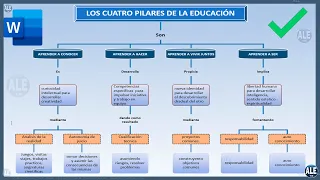
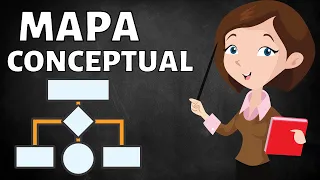
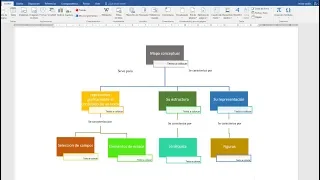
Schematics are one of the first graphic representations that we were taught in school and if I'm honest, I hated them very much. So if the same thing happened to you, leave me a like to see how many people thought of the schemes the same as I did. [CONCEPTUAL MAP] The concept map is also a graphic synthesis, but in this case it revolves around a concept.
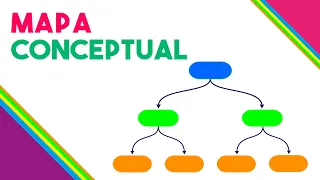
Its characteristics are: 1) It is carried out from top to bottom, leaving the concept at the top. 2) Its content is also hierarchical. 3) The concepts are connected with propositions and keywords that allow to follow their logical order.
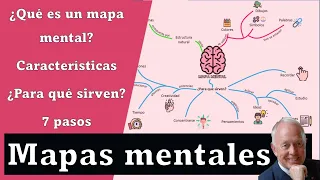
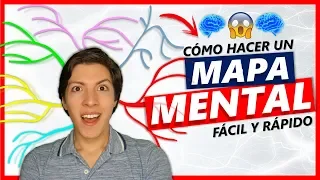
4) Boxes, rectangles or circles are used for the concepts and arrows or lines to establish their relationships. 5) They do not contain sentences but one or more words that make up the concept. [MENTAL MAP] The mind map is also a graphic synthesis in which a concept, question, idea or topic is addressed.
Its characteristics are as follows: 1) It is done from the inside out. 2) The main idea must always be in the center. 3) Its content is also hierarchical.
4) They are totally creative so you can use any shape, a square, a circle, a rhombus or a cloud . . .
whatever you can think of to highlight, of course, the concepts that are part of the concept map. 5) Connections are established with straight, curved, dotted, thin, thick lines . .
. whatever you want. In addition, images and symbols predominate and many, many colors are used .
6) One thing to keep in mind is that they don't usually contain sentences. Now comes the big question. What to choose: a concept map or a mind map ?
Well, if you want to understand or reflect on a topic, the best option is the CONCEPTUAL MAP. On the other hand, if what you need is to memorize content, the best option is a MENTAL MAP. Now we are going to see the five steps to develop a concept map, so the first thing you should be clear about is that there is no recipe with which to address all The topics, especially if they are very broad, but the truth is that when we face a topic , standardized tasks are usually carried out.
Let's look at 5 steps you can use to make a concept map. The first step would be to DEFINE. It is important to define a central concept or question that the concept map will answer.
And you might be wondering how the hell do I do that? For example, if you are studying a specific topic, it is normal to do a first reading to get a general idea of the topic and get those main concepts. The second step would be LIST.
Once the text is read, a second reading is made in which the concepts related to the main one are searched and they are listed in a hierarchical way. The third step is CONNECT. With the list obtained in the previous step, the different connections between the concepts are established.
In this phase you may have some key concepts or ideas hanging, but calm or calm, you can make a third reading of the text to see where they should be embedded or in case you have missed something important with which to establish those connections. The fourth step would be TUNING. In this step, the list with its relationships is transferred to the conceptual map, the propositions or keywords are added to it so that they keep a logical sequence so that anyone can understand it when reading it.
And finally, the conceptual map is read in order to refine the relationships between the different concepts. The fifth and final step would be REVIEW and REPLACE. In this last step it is important to review all the branches of the concept map and see if it is necessary to reposition the concepts or ideas that may require it.
Well, that was it for today's video. In future videos we will see how to make these concept maps with different tools. So let me know what you think of this video in the comments and we'll see you next week.