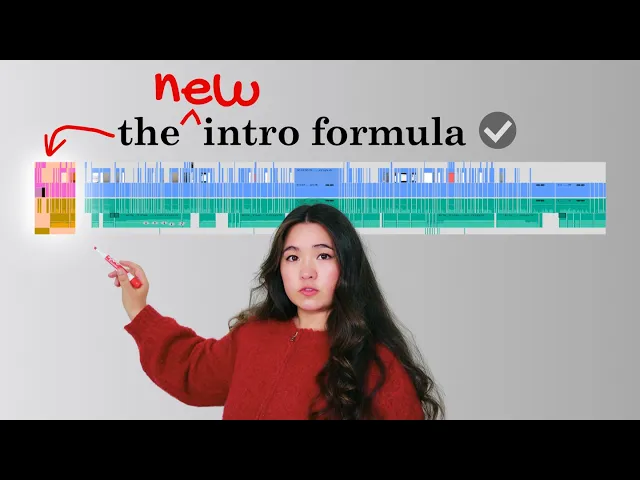
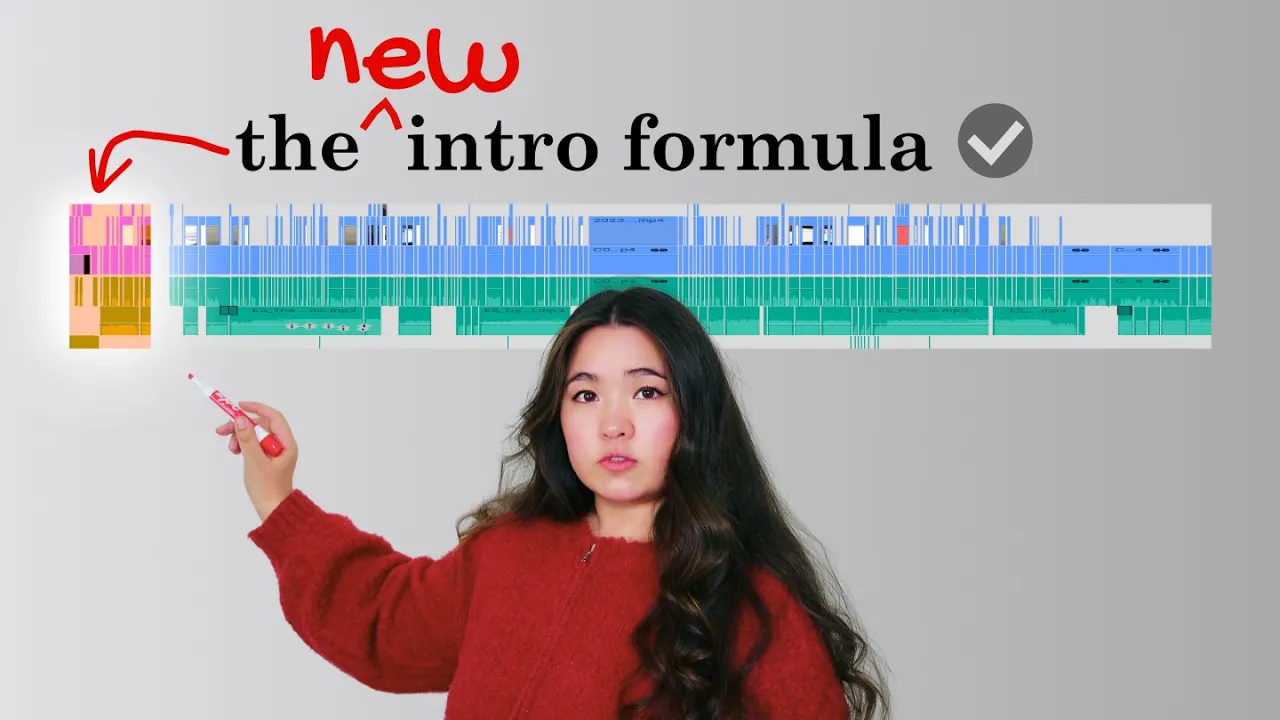
This is a video timeline, and this tiny section might be the reason your channel hasn't blown up yet. It's called the intro, and it's where most creators typically lose up to 50% of their viewers. So, how can you get people to stay?
2 years ago, I answered that question with a viral four-step system that helped thousands of creators actually get results. But YouTube's had some pretty big changes since then. And while many of the core principles still hold true today, I've learned some new tricks.
So, this is the updated four-step formula for making a killer YouTube intro to blow up your channel. And it all starts with step one, defining your plot promise. You see, your title and thumbnail don't just make people click.
They also set expectations or make promises for the kind of video your viewer is about to get. And in our intros, there's one promise we need to focus on keeping above all else. the plot promise or the promise of what the video is going to be about.
In this video from Michelle Karee, the plot promise is a video about her attempting to race Formula 1 cars. In this video from MKBHD, the plot promise is a video about his opinions on the iPhone 16. Pretty straightforward, right?
But here's the problem. We can't meet the plot promise in our intro if we haven't clearly defined what plot promise we want to make in the first place. Now, it's not groundbreaking information to say that your video's title and thumbnail or TNT are incredibly important.
If people don't click on your video, they won't watch your video. And all the time you spend scripting, filming, spiraling about your video quality and editing goes straight down the drain. So, naturally, when it comes to packaging our beloved video into a title and thumbnail, we want to present it in a way that is as clickable as possible.
Take science YouTuber Mark Robber. Mark wanted to make a video answering some interesting engineering related questions. Now, he could have titled his video something like, "I answered seven engineering questions, pairing it with a thumbnail like this.
" That TNT would have been accurate, but it's not exactly clickable, at least not for anyone who isn't already an engineering enthusiast. Compare that to the TNT he actually used. Testing what happens if you jump on a moving train with this thumbnail.
Suddenly, we're met with a highstakes stunt that anyone would want to click on, regardless of how much they care about engineering. Now, this is supposed to be a video about YouTube intros. So, why the heck are we spending so much time talking about titles and thumbnails?
Well, depending on what you do with your TNT, the plot promise you set up will be different, which means that your intro is going to change, too. And in a world where our TNT and our intro are closely linked, the last thing you want to do is make your intro first and then get locked into a TNT premise that people won't click on. Instead, start with the most clickable version of your title and thumbnail.
Use that to define your plot promise and then build out your intro to match that promise. Which brings us to step two in the formula to make a killer YouTube intro, your first 5 seconds. Because the very beginning of your video has one job and one job only, to meet the plot promise set by the title and thumbnail.
Let me show you what I mean. Going back to Mark's video, his title and thumbnail lead us to expect a video about him attempting to jump on a moving train and seeing what happens. Now, imagine after seeing this TNT, becoming interested, and deciding to click on it, you are met with this.
>> Today, we're going to investigate five physics and engineering puzzles using simple demonstrations as we go. you'd be confused, right? That's not what you clicked for.
This confusion causes people to click away because they assume that they're being click baited. So, to minimize drop off from the very get-go, your first 5 seconds need to assure viewers that they are going to get what they clicked for. And while there are a few different ways you can do this, one of the simplest and most effective ways is by saying the subject of your title and showing the subject of your thumbnail within the first 5 seconds.
Let's see how Mark Robber applies this formula in the very beginning of his video about jumping on a moving train. >> This is me on top of a speeding train and this is me in a hot air balloon to answer some of the most debated science questions on the internet. >> That was quick.
But what did we just experience? Well, verbally he says he's on top of a speeding train, which fulfills the plot promise audibly. And on screen he shows himself on top of a speeding train, which fulfills the plot promise visually.
As a result, from the moment we click in, we immediately feel confident that we're going to get what we were promised. And between saying and showing, the latter is more important now than ever before. Because ever since the adoption of the autoplay feature, more and more viewers are hovering over videos before clicking, using the silent preview to decide whether or not the video is worth watching.
And if you rely solely on the verbal script to fulfill your plot promise, well, see for yourself. Here's an old video from productivity YouTuber Ali Abdal. Let's hover over the video and see what autoplays.
Without the title, we'd have no idea what this video is about. For all we know, he could be about to break into an interpretive dance. And even with the title, there's no visual clue that he's talking about websites.
No indication that he's going to cover the value that we're interested in. Let's compare that to a newer video of his. Even without sound, we still get a sense of what the video is about.
There are books on screen. There are different categories being introduced. We're getting all that in only 5 seconds without a single word being said.
So, while your first 5 seconds don't have to match your title and thumbnail word for word and pixel for pixel, just make sure they're close enough to assure your viewers that your TNT wasn't clickbait and that they will receive what they clicked for. And speaking of clicking things, now would be a great time to well, you know, the rest. After you have your first 5 seconds planned out, you're ready to move on to the rest of your intro.
And this is where things start to get a little tricky because no matter what niche you're in, the rest of your intro should contain the same three core ingredients. Any necessary context and setup, at least one curiosity app, and your unique service proposition. We'll get to that in a bit.
These three ingredients can show up in any order, but they all need to be there, and they all need to be there fast. You see, there is this metric I like to use called time to value. Essentially, after a viewer clicks on a video, how long does it take until they receive some of the value they clicked for?
In the Ali Abdoll example we looked at before, how long does it take until he mentions the first book? In this video that you're watching right now, how long does it take until you receive the first tangible piece of intro information? The longer the time to value, the more impatient the viewer becomes.
The more likely they are to just click off. And the number one culprit behind a bloated time to value, too much context. Now, don't get me wrong, context is important.
It sets up the what of your video and often the why behind it, bring your viewer up to speed so they can better appreciate the rest of your video. But if you frontload all of your context all at once, all at the very beginning of your video, you risk losing your viewers before they ever get hooked. So to avoid this, the best creators in the world are masters of establishing just enough context to get their viewers to care, filling in additional information as needed later on in their video.
Let's return to Mark Robber's video to see how he does this. >> This is me on top of a speeding train, and this is me in a hot air balloon to answer some of the most debated science questions on the internet. >> In just one sentence, Marcus established the purpose behind why he's taking on these stunts to begin with, to answer highly debated science questions.
That's all the context we need to get on board. So consider what information you truly need the viewer to know from the very beginning. What's the minimum amount of context you can provide to get the viewer to care?
Be ruthless with your edits. Because when it comes to length, the most effective intros are only 45 seconds long or less. And we haven't even gotten to the most important intro ingredient of them all.
Curiosity gaps. A curiosity gap is the gap between what we currently know and what we want to know. It's one of the most powerful drivers of human behavior.
Because as humans, our brains are biologically wired to crave closure. But so when we're presented with an unanswered question or an unfinished story, it creates this mental itch. And the only way to scratch that itch is to stick around to get the answer.
As a result, creating strong curiosity gaps in your intro is one of the single most effective ways to increase a video's retention. introducing questions that can only be resolved by watching the rest of the video. Let's watch the rest of Mark River's intros to see how he opens not one, not two, but three different curiosity gaps in the span of just 36 seconds.
See if you can spot them. >> For example, my hot air balloon pilot here says he can land me anywhere I want. And yet, there's nothing here that resembles a steering wheel, which begs the question, how do you actually steer these things?
>> So, we steer. And now I'm on top of the train to learn once and for all why do you land in the same spot if you jump inside the train but not if you jump on top of the train. But I'm not stopping there because today we're going to investigate five more physics and engineering puzzles using simple demonstrations as we go because our goal by the end of this video is not for you just to know the right answers, but more importantly for you to understand why they're the right answers.
>> Did you catch all three curiosity gaps? Let's identify them and more importantly break down how Mark opened each one. The first curiosity gap is how do you steer a hot air balloon?
The gap starts with a contradiction. Mark claims that the pilot can land anywhere he wants, but then points out the seemingly conflicting information that there is no steering wheel. That unexpected disconnect triggers our brains to go, "Wait, what?
How does it work? " Then Mark follows that up by asking the question out loud himself. By verbalizing the question, he plants it clearly in the minds of his viewers, prompting us to have the same question, too.
And as a cherry on top, the pilot starts to answer, but then is cut off. Now, we know that the answer is coming, but we just don't have it yet. And by this point, even if we couldn't care less about hot air balloon steering a minute ago, now we need to know.
Through contradiction, verbalization, and interruption, Mark makes the curiosity gap stick in our minds like a splinter. Mark also uses verbalization to open his second curiosity gap. >> Why do you land in the same spot if you jump inside the train, but not if you jump on top of the train?
>> But you don't need to propose a big mystery in order to evoke curiosity. And in fact, Mark's last curiosity gap is the simplest of them all. By merely promising us that there are five more physics and engineering puzzles ahead, even showing us visual hints as to what they might be, he inherently prompts us to wonder what are the other puzzles and what will their answers be.
This question along with the other two Mark introduced gives us almost no choice than to keep watching to get the answers. So, as you plan out your own intro, ask yourself, what questions can you introduce? What contradictions, interruptions, or teases can you incorporate?
And what promises can you make now that you can pay off later? And if you're having trouble coming up with strong curiosity gaps, I have some bad news for you. Your core video idea might just not be interesting enough in the first place.
Because good curiosity gaps don't appear from just anywhere. They're born from conflict, tension, and transformation. And if your video concept doesn't set the stage for those elements to exist, you have nothing to hook your viewer with to begin with.
there's nothing to wonder about, nothing to tease. And that's when using a story planner tool like Sputter Studio can be really helpful. Now, I've been a Sputter Studio partner for almost a full year now, which is kind of crazy to think about.
And while I've highlighted many of their features before, I've never shown you this. It's called Story Beats, and it works as a brainstorming partner to help you level up a vague idea and turn it into a concept rich with curiosity potential. Here's how it works.
Drp in your video idea. Go into story beats and select the type of video you're working on. General works great for most formats.
From there, you can start workshopping your idea, fleshing out the overarching goal of your video, the character growth you want to show, and the overall theme or message you want to impart. You can edit everything with your own direction. And once you add an element to your idea workshop, Spider Studio will keep all future suggestions aligned with the story you're building.
Each story beat you brainstorm can become a potential curiosity gap. And those curiosity gaps will make it easier to not only write a more compelling intro, but also make a video more worth watching in the first place. To workshop more curiosity apps of your own, use the link in the description to try out Spider Studio for 14 days free.
Spider Studio is also currently running a limited time offer at the lowest price they've ever offered. So definitely take advantage of that if you still can. Thank you so so much to Sweater Studio for sponsoring this video.
So, at this point, we've done a lot. We've delivered on the plot promise set by the tunnel and thumbnail. We've established the minimum necessary context, and we've opened strong curiosity gaps.
Now, that alone could be the basis of a decent intro. But if you want to cross that line from decent to truly killer, there's one more intro element you need to add, your USP. This stands for unique service proposition, which is just a fancy term for the thing that makes your video special.
The reason why someone would watch your video instead of all the others like it. Because now more than ever, in a world of near infinite content, videos have become commoditized. Pick a video on any given topic and is usually easily interchangeable with dozens of other videos on that topic, many of which are conveniently offered up in the suggested panel.
As a result, when watching through your intro, your viewer isn't just deciding whether to watch. They're deciding which version of this topic is the one most worth watching. In your USP is how you convince them that the answer is yours.
So, how do you do that? Well, while there are a few different ways to establish a USP in your intro, the most common and most powerful ways to do so are expertise, effort, personality, and proof. You can signal expertise by calling attention to your domain experience, showing you have deeper knowledge or authority than the average person talking about your topic.
You can do this explicitly, like in this video from Wired, where history teacher answering dictator questions introduces herself like this. I'm Professor Ruth Bengat. I study authoritarianism.
Let's answer some questions from the internet. In one sentence, she's established credibility. And this credibility increases the perceived value of this video because now we know that we're getting information from someone who actually knows what they're talking about.
But signaling expertise can also be done implicitly. Dr Mike doesn't need to detail his medical credentials because the scrubs he's wearing do it for him. And Legal Eagle doesn't need to explain his resume because a suit, office, and delivery style signal it to you immediately.
But maybe you're not a domain expert. That's okay. My own personal favorite way to establish a USP is by showing effort because we naturally value things more when we know they took a lot of time, money, or energy to make.
This is due to a cognitive bias known as input bias. And you can trigger it by showing the work that went into your video. Big creators do this all the time.
Take this video from Mr Who's boss. In his intro, he says, >> "I'm about to spend $10,000 in the next 4 minutes buying the craziest transparent tech on the internet. " Immediately, the video feels more valuable.
It feels like a bigger video, a video that's worth more of our time because of the financial investment that went into it. But don't worry, you don't need to drop 10 grand on a video in order to trigger input bias. All you need to do is show how much effort went into your video.
Maybe it's by mentioning how many books you read for research or by showing time-lapses of your prep work or even just by editing in a way that clearly takes skill to pull off. As long as you're doing something that a few others would or could do, you can leverage input bias. And speaking of things that a few others can replicate, the third way to establish USP is by highlighting the very thing that's most unique to you, your personality.
And I know that just be yourself isn't necessarily the most helpful advice in the world. So, let's go a little deeper. Your personality is your flavor.
It's the tone and energy and lens that your video filters through. And when that specific flavor is upfront and clear, it turns your video from just another video to your video. A creator who's absolutely nailed this is Orion Tran.
Check out the beginning of this video of his titled I tried airport sleep pods. >> I developed an unhealthy obsession with sleep pods last year when I went to Japan. Maybe it's because I'm a small man.
Or maybe it's because they're awesome. >> In the span of just 10 seconds, you know exactly the type of video that you're in for. The tone is goofy and self-aware.
The vibe is chaotic in the most lovable way. And the energy is uniquely Ryan. There are many, many videos out there about trying out sleep pods.
But only Ryan's can make you feel this specific way, which makes it irreplaceable. Now, personality doesn't have to mean funny or quirky. Maybe your specific flavor is calm and cozy, or skeptical and analytical, or warm and inspirational.
Whatever it is, when it's upfront and intentional becomes a clear signal of what sets your video apart and it establishes your video as not just a source of information or content, but as a unique experience that viewers can't get elsewhere. And finally, when all else fails, the last way to establish USP is through proof. Because in a world where it's more common than ever to make bold claims without the actual payoff to back up those claims, you can signal your video's worth by simply proving that you actually did the thing that you said you would.
Take a look at this video from Mike Shake. His title makes a bold claim, but we're all used to people stretching the truth for the sake of clickability. But as soon as we click into the video, we get this.
>> This is a slingshot. And this is also a slingshot, but he can punch through concrete blocks. Boom.
We got proof, baby. Mike isn't just talking or theorizing about the concept. He actually succeeded in building the slingshot.
And by seeing that proof up front, we're now confident that we're not going to be disappointed and that we're going to get that real payoff. Now, some people worry that showing the result early will spoil the story, but in reality, what you're doing is proving to your viewers that there's a story worth sticking around for in the first place. Mark Robber likes to call this principle Jenga storytelling.
You see, everyone knows how a game of Jenga ends. The tower falls. It's not a big mystery.
But the fun part, the reason why we play is how it falls. Which blocks get pulled first? When does the tower start to wobble?
and what finally causes the whole thing to collapse. The same concept applies to your video. By showing the result early on, by proving that you actually did the thing you promised, you build trust and create anticipation.
When it comes to selecting a USP of your own, you're not limited to just one. And if we return one last time to the Mark Robber intro, we can actually see that Mark establishes his USP and not one, not two, but three different ways. There's proof when we see him literally standing on top of a moving train.
There's effort in the fact that he's traveled to multiple locations and in his stunning and hard to capture visuals. And there's even personality with the inclusion of a little scream that embodies the childlike joy and wonder that Mark carries through each of his videos. This USP stacking helps to explain why Mark Robber videos are so dang hard to replicate.
When you click into a video of his, it's clear that you're not just getting a video about physics or engineering. You're getting a deeply trustworthy, insanely higheffort Mark Robber video about physics and engineering. A video that you truly can't get anywhere else.
The result is an intro that is nearly impossible to click away from. So, as you plan out your own intro, consider what makes your video special. Why would someone watch your video over any other they might see in the suggested panel?
Because the clearer your USP, the easier it is for your viewer to keep watching. At this point, you've laid out all of the essential building blocks for a killer YouTube intro. You've fulfilled the plot promise made by the title and thumbnail, and you've provided context, created curiosity gaps, and established your USP.
The ingredients for a killer YouTube intro are all there. But just like any recipe, even the best ingredients can be ruined if they aren't put together in the right way. Which brings us to the fourth and final step in making a killer YouTube intro to blow up your channel.
Front-loading the viewing experience. Because as much as we've been talking about your intro meeting the promises set by your title and thumbnail, your intro also makes promises of its own. You see, your intro serves as a proxy by which viewers can determine whether or not it's worth investing their time watching the rest of your video.
In other words, they judge the entire rest of your video based on what they see in the intro. This means that if your video includes stunning visuals, custom animations, or anything else you associate with a quality video later on in the video, but those elements don't show up in your intro, your viewer may never know they exist, and they may therefore assume that the quality of your video is worse than it actually is. So, instead, frontload your quality.
Lead with all you've got. If you use multiple types of footage throughout your video, reflect that same visual variety early on. If you have a cool custom animation later on, make a shorter version to place in your intro.
It may even be helpful to annotate your script line by line with what the viewer will see. Some YouTubers organize this as a T- sheet. I like to simply make comments directly into my script.
But no matter how you organize it, ask yourself, what are your viewers hearing with their ears? And what are they seeing with their eyes? These annotations will help inform your shot list, ensuring you're capturing the right footage and making the right edits to create a viewing experience that's just as intentional as the words you're saying out loud.
Because on YouTube, watch time isn't expected, it's earned. And if you assume that viewers will get it as long as they keep watching, chances are they won't. Now, I know that this all might seem like a lot of work for only a 20 to 45 second long segment in a video, and you're right.
It absolutely is, but it's also worth it because if someone clicks off of your intro, they'll never get to see the video you spent so long on making, the video that deserves to be watched. So, if there's anything to remember about making a killer YouTube intro, it's define your plot promise first. Use the first 5 seconds to meet that plot promise.
Use the rest of your intro to provide context, create curiosity gaps, and establish your USP. and frontload the viewing experience to reflect the quality of the video ahead. If it's helpful, you can even download this guide to reference every time you sit down to plan out an intro.
I'll put a link to grab it for free, as well as a link to try out Sputter Studio for 14 days free in the video description below. And look, if you're feeling a little overwhelmed right now, if it all feels like a lot, you're not alone. This whole YouTube thing that we're doing, it's not easy.
I've been making videos for over four years now, and I still struggle with my intros. I don't think I know a single person who doesn't. But I think that's maybe part of the beauty of making YouTube videos.
There's no such thing as the perfect intro or the perfect video. Everyone's out here just trying their best, learning new things along the way, and applying what they can. So, if it feels hard, it doesn't mean that you're doing it wrong.
It just means that you care. And hey, welcome to the club. We need you.
So hold on to that passion and let it carry you forward because your videos deserve to be seen by the world. The world just has to make it past your intros first. But if you feel like you're doing everything right, but still not seeing any difference in views, you may be dealing with problems beyond your YouTube intros.
So to learn how to fix these seven common but sneaky mistakes holding most channels back, click here. Otherwise, thank you so much for watching. Like and subscribe if you can.
If you need a sign, keep creating and I'll see you in the next video.