welcome students to the final part uh the fourth part of lesson one this is on Military instruments and non-military instruments so we will review different types of techniques and instruments that governments especially Canada use the instruments of foreign policy are generally divided into military and non-military instruments I'm going to divide them that way and also talk about the benefits of using the instruments and then the potential costs of using the instruments rather than lecture to you at this point I'd like you to somehow participate and your instructions will happen as I speak where I'd like
you to think about some instruments and also their benefits and costs so work your way through this although in the exam it's a multiple choice exam you won't be able to write your ideas you won't be able to fill in blanks but you are I hope planning to be either a Foreign Service officers or maybe work in the field of Canadian government and so take the opportunity to think this through because it will help to make you a better Diplomat I hope so let's go ahead so put here a picture and this is all the
worldly Goods of a person this is a National Geographic picture and this is everything that they own but you own a computer you actually have access to all the world's knowledge indeed when we talk about this in class if we were in class or in our group here which we are you in my class have more knowledge just among yourselves than all of the noblemen in Europe everyone in the medieval time period by far you know way more and so surely together or just alone like this guy in the picture you can figure out some
military and non-military ideas your ideas so important well a country like Canada we have diplomatic proposals we have ideas we use instruments not just from our past but from the future we think of ideas and we bring them to the bargaining table like I said Canada is a member of more International organizations than any other country in the world it's time for us to begin with military instruments which Canada tends not to use here the most destructive obviously is total war total Armageddon the end of the world and as we talked about midnight this is
the most destructive but there can also be limited Wars so let's talk about those what I want you to do is go to Wikipedia or to go to any site and just look up examples of Wars lists of Wars take a look at the United States the number of the United States has been involved in dozens and dozens of Wars Canada less so and I want you to make your own list of limited Wars okay list is going to be different from anybody else's but here what we're looking at is so that let's say you
are in the foreign policy service of I don't know some Jamaica or China or if you're working in Japan I have no idea where you all are some of you are in you are writing to me in a different time zone somebody just passed the midterm exam and arrived here from China congratulations he did very well I'm so pleased for him but what I'm trying to say is I don't know where you all are but you need to think about the benefits and the disadvantages of using limited War there are some advantages to limited War
I'm sure Vladimir Putin thought that there were advantages to going to war think of some advantages think of the costs of War I know a lot about the cost of War because I look at cypri and I look at organizational assessments and I'm very familiar with the costs I tend to think less about the benefits which is an um a problem think about them and then I want you to go on to think about alliances so here group it I'm trying to teach you a way of thinking as well where you are going to think
in certain ways about instruments so here we are at the point of the alliances are an instrument like NATO like NORAD and then you can have permanent alliances like NATO and NORAD or you can have temporary alliances like the Coalition of willing during the Gulf War the Afghanistan Coalition during Afghanistan and right now a temporary alliance against Ukraine that's mainly the EU Canada and a lot of Western countries essentially 135 countries temporary Alliance so can you think of the cases of temporary alliances for example if you're interested in the Middle East are there any saudi-led
alliances are there any alliances in history under uh Hussein pictured there what about Queen Elizabeth and the Commonwealth moving fairly quickly you're getting the idea that you are making your own toolbox and you need to think you can go back in history you can go to the 1600s you can go to the invasion of North America you can talk about the World War One World War II it depends on you but about the benefits and the costs of military alliances try to think about the benefits and the costs from the perspective of the leaders the
leadership that you will be advising no you said yourself I won't be advising anyone on Military pressure pressure is used in all sorts of ways in all sorts of relationships and it's the use of military power to intimidate in order to convince your adversary that it's not a good idea to take that particular action so deterrence is one form of military pressure it's not complicated this involves convincing an adversary your enemy or maybe your friend that the cost of attack are guaranteed to be more than the cost of non-attack non-attacking or not attacking it's just
telling someone that if you try to attack me I I the costs are going to be really high for you okay so that's all you're doing deterrence so what are the cases of military pressure here you need to go back in time let's say you want to go back to Louis XIV like I have here what are some of the causes what are the what are the cases of military pressure bombing of Hiroshima and nigasaki these pictures but you you you can prompt your mind by just going to Google image and going through and looking
at military pressure and and the costs and you can get distracted thinking about Queen Elizabeth times and so on the costs of nuclear weapons are books have been written on this the costs for the world of of users okay I want to talk about non-military instruments because Canada is so good at this we are incredibly good as I lectured earlier um in terms of the golden age of Canadian diplomacy in terms of using diplomatic pressure either to approve or to disapprove so I put a picture of George Bush here using diplomatic pressure in the American
diplomats are very good at this as well sometimes we say the hand in the the the the the fist in the in the glove or the velvet glove and things like that but some of the commonly used methods are a formal letter of protest I talked to you about that before writing a letter conciliatory as Pearson did or not withdrawing an ambassador closing an embassy closing our embassies in South Africa because of apartheid closing our Embassy in in China in Russia cutting diplomatic relations completely extremely effective non-military instruments a foreign policy that you need to
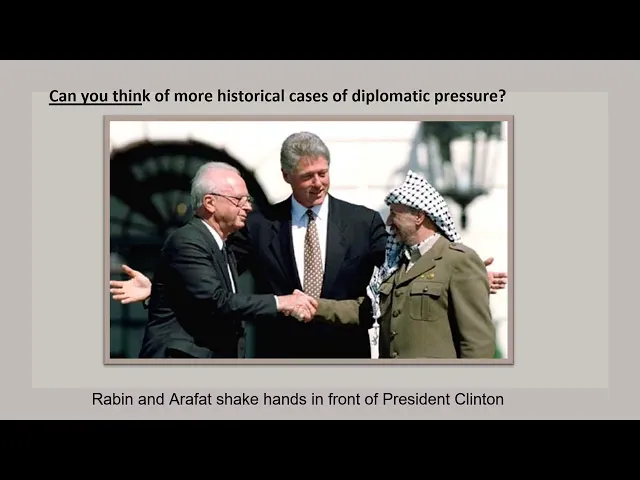
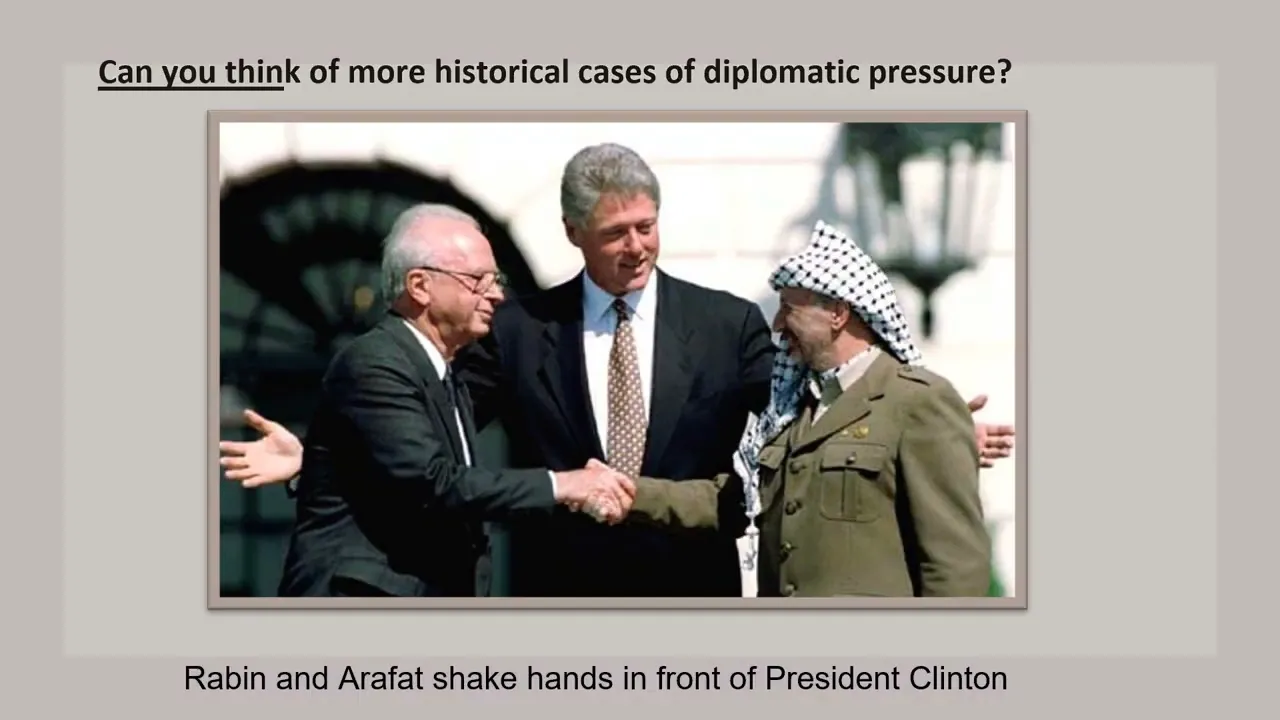
think about and know about say to your boss let's say it's Napoleon Bonaparte here I hope you would never have them as your boss but you need to give him examples of using diplomatic pressures so he says oh yeah that's a good idea I remember the Iraq War Tony Blair George Bush they did that good idea so I put here a picture of itsak Rabin and Yasser Arafat shaking hands here they are actually in front of President Clinton who brought them together at Camp David they both got on the Nobel Peace Prize for this so
think of historical cases hang on think of unsuccessful cases of using diplomatic pressure in here the one that always comes to mind is of course the United States decision to invade Iraq because they thought that there were weapons of mass destruction hidden there and that Saddam Hussein would use them did they think that or not we don't know but there's Covina the Secretary General of the United Nations and George Bush deciding what to do unsuccessful case in hindsight here we're thinking about the benefits and the advantages of using diplomatic pressure which can be many first
it's obviously less costly here we have a Pierre Elliott Trudeau meeting with Mao Zedong the leader of China and he went to China and he went to Russia Pierre ellioto senior the father of Justin Trudeau he went to China and he met with the leader of China because they wanted to open up to China they wanted a measure of Dayton I also talked to you about a Lloyd axworthy during the landmines treaty here and I talked to you about how that was an example of using diplomatic pressure inviting countries the costs of diplomatic pressure are
also can be high for example if you pressure rather than go to war against Saddam Hussein then maybe he would make bombs maybe he would make biological bombs think about it in terms of the past and keep going so that diplomatic negotiation is another instrument and this can be in two phases pre-negotiation when you are talking about what you're going to talk about at the table so I put this picture here he's phoning he's talking about hey do you want to negotiate it's not a negotiation yet it's trying to figure out the options pre-negotiation and
then when you finally get to the table here you are at the table you try to identify the problem and you search for negotiations and you engage in a rational decision-making process so can you think of cases of diplomatic negotiation they might not be necessarily sitting at a table but they are negotiating with each other they are trading they are negotiating land they're negotiating rights think of some cases of diplomatic negotiation and put them in your mind is different from yours and I might be thinking about cases that I know about of negotiation but yours
you might have different examples in your mind and you might think of different benefits it might be personal or it might be domestic benefits who knows and you need to think about the cost so when you're advising someone you're saying okay these are the benefits but here are the costs so you're you're presenting everything in terms of costs and benefits or in terms of merits and demerits it's a it's a successful way of thinking people like it is to our rationality legal instruments including international law are non-military instruments and international law is a body of
rules that governs the conduct of States obviously so the scope can be very extensive and in human rights international law is also applicable to individuals as well as States this is all obvious so okay so international law is obvious because it just seems obvious to us that slobin and lossovich pictured here should be taken to court and he was the head of Serbia at the U.N the instigator really of the of the coast of World War and the ethnic cleansing that was carried on so here he is an international Accord where he actually died before
he could be sentenced largely arguably sit down the stage should have also been brought to International Accord this is Saddam Hussein but he was dragged through the streets and killed he tried to escape maybe it would have been better to take them to International Court rather than kill him okay so can you think some of the benefits of international law obviously it's cheaper to bring people together at this sort of a banquet and get them to agree on on an international law that's a lot easier than going to war however it's not always successful there
will always be Saddam Hussein's and Adolf Hitler's and Salah but on the lasovich is in our mind and adversaries so what do we do there the disadvantages of international law Are Legion and many people are very wary of international law particularly in the wake of Russia's attack on Ukraine and there's a lot of worry that our International rules-based order is being threatened you framed all this I want to introduce to you another instrument which is called csbm csbm's confidence and security building measures but we always say csbms and this is the idea of increasing openness
and transparency that's why I put a picture of Gorbachev because he brought in the ideas of perestroika and glasnost glasnos means openness perestrochia means restructuring but anyway he is is symptomatic of that idea or symbolic of that idea of increasing openness about and transparency of among states about their affairs so having more military exercises that we know about I like the idea of csbm's I want you to think of some cases where csbms were used here's a picture of Lord Robertson who was NATO Secretary General meeting with Vladimir Putin at NATO headquarters trying to negotiate
this was quite a long time ago you can tell Putin's much younger and it was a case where they were trying to build up confidence did it work some of the benefits of csbms are that they are cheap in the short term for example the landmine treaty is in itself a confidence building measure confidence and security building measure because it increases our confidence that the armies and militaries will not use anti-personnel mines which are very hard to clear from a war zone here you can see they're trying to get rid of such a dangerous job
get rid inch by inch of land mines such a problem so with benefits and then costs the disadvantages of using csvms are that they're ignored you can reach out to North Korea or to Saudi Arabia or to Iraq and spend a lot of money and energy and you don't know if you can trust them now I put this picture here of Kim jong-un's father of Kim Jong-il he um could we have trusted him could we have reached out to him or not it's notable that he was a real a Hollywood film fan he had 20
000 Hollywood films in his collection I don't think he was rational we couldn't have reached out to him in hindsight could we have and we didn't know that it was this son that was going to inherit we thought it was another son what about reaching out to Iraq could we have reached out so these are some of the disadvantages it's it's hard to measure in hindsight whether these confidence and security building measures csbms are or were successful