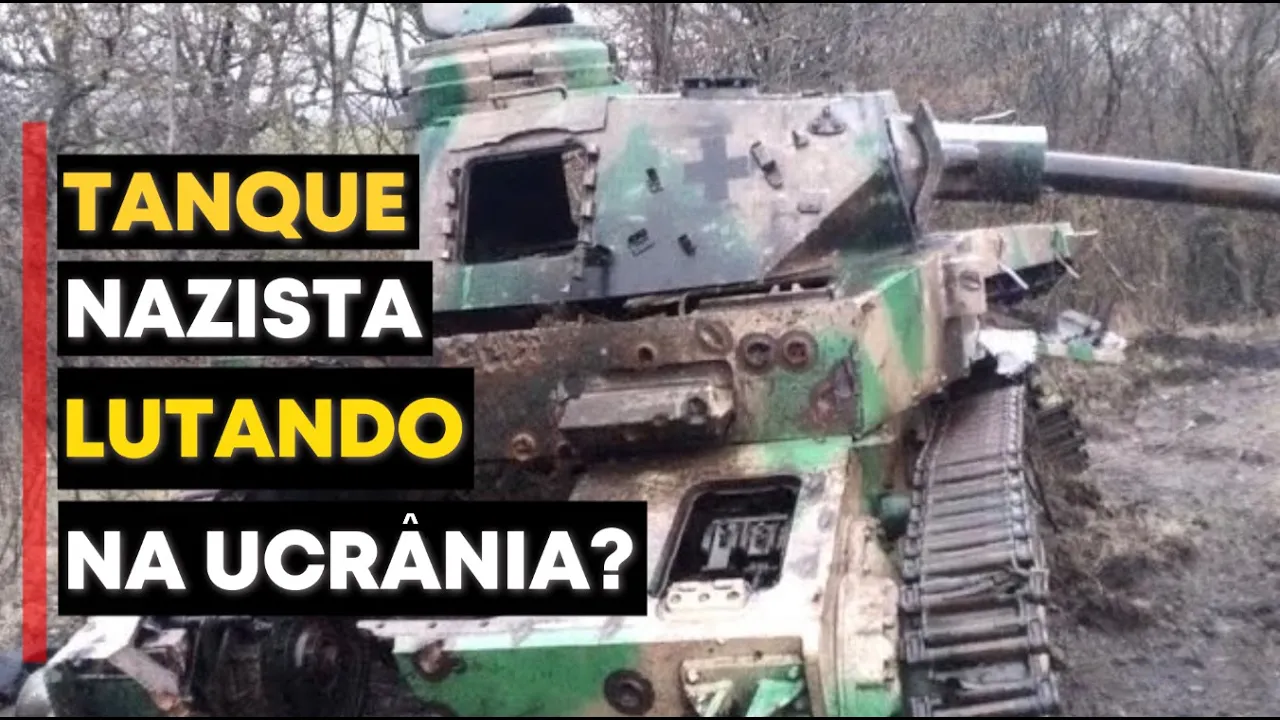
Something very interesting and unusual appears to have been discovered on a road in Ukraine. It is a German panzer that appears to have traveled back in time, straight from 1943 to the current battlefield in 2023, and ended up destroyed - perhaps, again, by the Russians. But the appearance of this strange tank, as recorded by the Russian troops who captured it, caused doubts across the internet.
Is it a real tank? Was it a real WWII tank? And how did it end up destroyed in Ukraine?
The Panzer 4 was the main armored vehicle of the German Army and the Waffen-SS Panzer Divisions had them in large quantities. After World War II, many survived in various states of conservation, being taken to museums and collections around the world. They existed in several different models, with the model in the photo appearing to represent a Panzer H or J.
In lively discussions on the internet, a kind of consensus seems to have been reached that this tank is not a replica, but rather an original with some modern additions. Obviously, the non-original parts are as follows: the cannon is a piece of iron pipe; the barrel opening is missing; and no breach is visible within the tower; the tracks turn out to be from a Soviet single or double track BMP from the 1960s. But as many people have pointed out, a large portion of this tank appears to be from an original Panzer 4.
For example, the driver's cab and its lid look legit, as do the brake shoes. The frontal armor plate is marked with very old-looking projectile shots from types of weapons not used today. Interestingly, the steel plate has fractures similar to fragile late-war German armor - and is not at all the same solid steel plate.
In fact, this tank shows signs of an ancient internal detonation, which blew out some of the hatches that are missing from the wreckage found. An interesting theory circulating on the internet is that this is an original Panzer 4 and that most of it was deliberately destroyed by its crew at some point a long time ago. It was then probably recovered and partially restored in Ukraine - perhaps as a private project, or for a museum or collection.
This tank would then have been dragged to the front line to be used as decoy to draw Russian fire away from some valuable items. In fact, it was hit by Russian fire and then captured by ground troops. The bait theory is not at all impossible, as the Ukrainians had already done this with some T-34-85 tanks taken from World War II-era memorials and used them as roadblocks or for ambushes against the Russians.
Similar to this, it was an obvious replica of the German Panther tank filmed in another position and which was also destroyed. An additional theory is that this real Panzer 4 was one of many destroyed after World War II that were rebuilt by Czechoslovakia shortly after the war and later sold to Syria, which actually used them in combat in the 1960s against Israel, where they were destroyed by the Israelis in the Golan Heights. Recently many panzers were recovered from the Hills area for restoration and somehow this tank ended up in Ukraine a few years before the current war until called up to fight again.
Another theory is that this tank was a wrecked shell captured by the Red Army in World War II and later used for target practice, hence the damage to its frontal armor - later recovered at some point in recent decades for partial restoration, hence the old-looking rust, the hatches and the lost weaponry. Regardless of how it appeared in a field in Ukraine, the vehicle - if it is a real Panzer 4 - is, in fact, very valuable, potentially worth anywhere from 2 to 3 million to collectors who are interested in restoring it accordingly with its pre-1945 specifications. Did you like this story?
Subscribe to the channel and share the video. See you later!