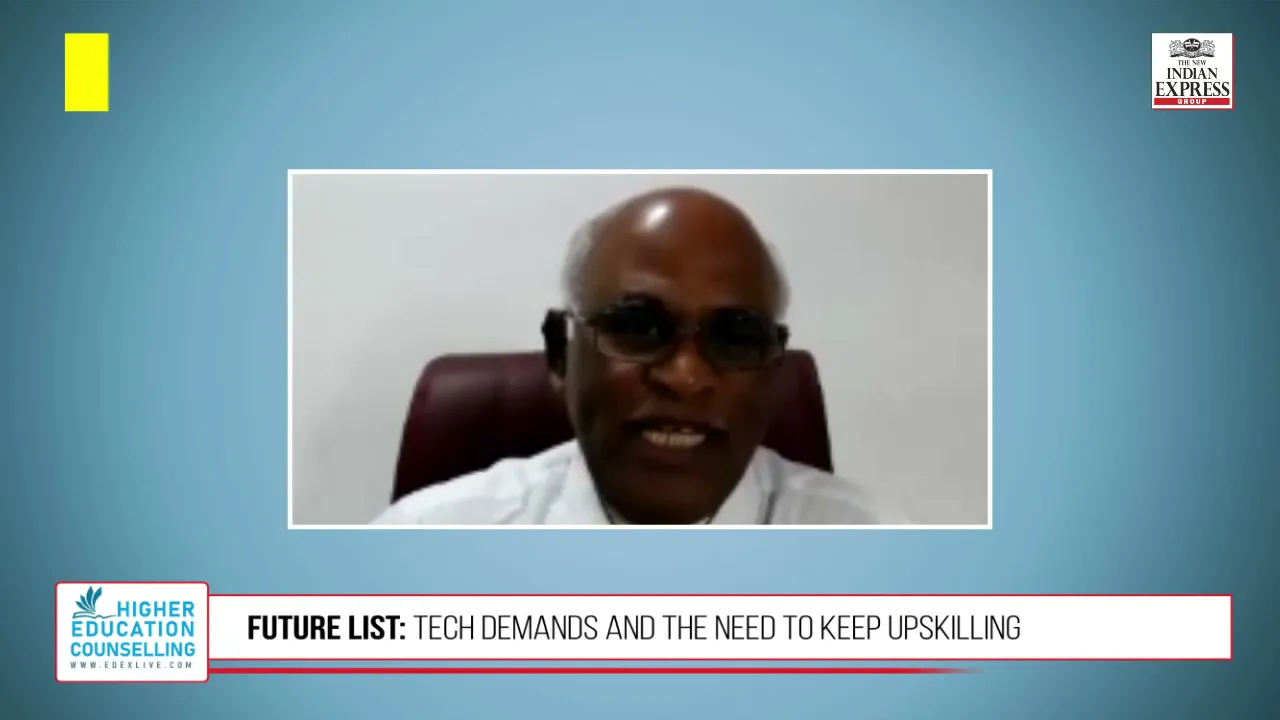
[Music] good evening ladies and gentlemen students of all ages experts from the field it's lovely to have you with us this saturday evening the saturday morning for our friends from america and we're here for this last in the series of webinars that we've been having with the new indian express sri ramachandra engineering and technology part of srihar talking about All of the various skills and counselling that you need to have as you go into college careers and then move on to having great global jobs and we're extremely excited to take this conversation forward today because
the last of the series is often reserved for the best and today we're going to be talking about emerging technologies there are a whole lot of these words being thrown around people talk about new tech people talk about ai in a way That hasn't been invented yet people talk about skills that haven't really been formed yet and people want you to be job and skill ready as you hit industry well we're going to talk to our panel of experts to understand just how that works let me welcome our very very very erudite panel today we
have dr steve hoover who is executive director from the center for global security at rochester institute of technology Welcome we also have with us mr pb kotor who heads uh global talent transformation at vipro mr madhu gandhi sami who is head of ai at qualcomm who's joining us from hyderabad and finally my co-host and my dear colleague professor v raju who's provost of engineering and technology at sri ramachandra Welcome everybody thank you for being here and as we kick off the session i look forward to some very very interesting viewpoints let me now request professor
raju to set the context for this conversation and talk about skills that he believes we really need and students today need to really hit industry with the bank professor raju if you will good evening mr daniel and all of our Colleagues from india and also dr hoover from usa i would like to thank you for joining us so late on a saturday evening or so early in the morning on saturday in the usa we appreciate and we also would like to thank all the attendees for joining us i would like to share with you just
uh aspects of enhancing the skills in industry In the ideal scenario an engineer going through four years of education would get a series of skills and not only that along the way they would learn to learn so engineers job is to continuously learn lifelong learning is a requirement whether it is done by itself or the employer helps the person learn at ramachandra this is what we do In engineering we help the students learn and go through a series of internships every year and then prepare for lifelong career path if you look at some of the
current technologies uh emerging technologies uh the companies have said if this is sf last year or so and we have listed about 10 of these each one you would see the demand of the employer and the proficiency of the employees Starting with cyber security cloud computing analytics web development and user interface design in all these areas there is a higher demand and the proficiency is lagging and cyber security leads in that area no wonder we have a cyber security specialist over here who's going to talk about all those things as we go looking more at
the cyber security just looking at two years for instance the Available recruits and the need for extensive training was reported by about 45 percent of the companies in 2017 it went to 53 percent of the companies in 2019 so there has been an increasing need for extensive training in industry in areas like cyber security further looking at cyber security from crystal gr cryptography to network infrastructure security and in Between all areas relating to global security again uh dr hoover will talk more about those things i assume so the need is anywhere from 60 percent with
about 20 plus percentage and the need is extreme and all the way to something like 80 percent in the companies that is the kind of need that exists according to some of the prominent surveys another area this is data analysis Over here again 43 percent of the companies have said there is a acute need for continuous training or upskilling to fill the potential gaps but it goes from product design and service to all other aspects of it but on the top is the data analytics another input from ibm which has said about 150 000 employees
were needed from their perspective as of 2018 And if you look at broader uh the importance of the skills and the extent to which the companies were satisfied i have just put two arrows to indicate problem solving happens to be an area applicable for pretty much all data analytics is another one where there is a 90 percent importance to that but only about 70 percent are also filled with the kinds of skills and if you look at other areas some soft skills And others are very technical aspects in nature and if you come to india
the india's talent in the artificial intelligence we are told bottom heavy in other words we are able to graduate students with the bachelor's or masters and go into jobs but on the higher levels for research in Other areas we are behind other countries in this case usa with about 10 000 or so but india and china happen to be in this list of 10 at the bottom of the list so we have long ways to go to develop the skills at the higher end in areas like artificial intelligence another area that is significant for almost
all countries including india is manufacturing globally Manufacturing has focused for the last 20 years also in china and usa has a major concern in that area as of now there is the gap that gap is expected to widen in terms of the balance of payment and other things to about 500 billion dollars in the next 10 years unless we have the right type of skills in india and the usa and elsewhere if You look at the upskilling needs of various countries in the next five years india happens to have the top spot with about 87
percent of the companies saying that there is a great need for upskilling and we're not really for behind our you know if you compare a country like france or brazil so there is a need in those countries as well this is a global aspect of it and India happens to be with a lot of young people potential to provide the skills for the global market but we have a lot of upskilling and reskilling requirements and what are the companies doing if you look at india the usa asia is a whole europe america uh south america
and on this extreme it's north america and so the companies are doing three Things either they hire new talent or they train and develop the existing talent or they go on to contract now in in countries like india that contracting is much smaller but then there are our friends uh mr madhu and mr kotour will be able to say about those things but training and development happens to be a major aspect that the companies have been doing about 67 percent of them whereas in north america that part is about 51 percent and the contract part
Is about 57 percent this was in 2019 however if you go to places like europe and south america the contracting part comes down and so to give you a perspective there if you ask the companies what do they do reskilling is someone who is going to be doing similar jobs so there is no higher skill requirements they upskilling is moving on to the next level of job so most of the companies about 60 percent Of the companies have said they do both but when it comes to reskilling only a small percent and about 10 percent
of the companies don't have a formal program for skilling purposes and again we ask the employees what do they think about they all want the majority of them want technical skills about 22 percent of them have set and then there are other skills people also look for promotional purposes are Personal interests and about 75 percent of all the employees of companies where the surveys done by mackenzie and others have said they are interested in getting higher skills and there are various reasons given for promotional purposes promotion within the company are entirely going into a new
field or starting a business or other reasons so for Promotion purposes within the company is the majority of the people saying why they would like to have upskilling and if you look at the impact of upskilling you know employee satisfaction happens to be a major factor it has improved considerably but significant improvement on one end and overall improvement total of about 73 percent have set however The net worth of the companies growing up also has been a factor and there are other things that we have listed as customer experience brand perception and all the other
things are affected by upskilling and how the companies are dealing with those thank you i think that probably provides some context for the discussions i'm sure over here the experts from industry And usa will be able to share their views and i would like to thank mr daniel for providing the opportunity thank you sir thank you professor raju it's always a pleasure to have you set the context because i think very few things talk to this generation like statistics too and i think i think in india we're a bit of a sucker for good statistics
because uh it it really jumps out to you it Calls to you and the minute you said that the demand for all of these great emerging technology jobs was so much higher than the supply people are like great the minute we graduate we've got jobs to go to and that's a good place to be and on that note may i now invite professor steve hoover to talk to us a little bit about why there's this whole new run for cyber security they say data is the new oil But i've been reading a lot about how
cyber security is probably diamonds and platinum rolled into one and how the job market is booming because of the amount of digital transactions that we're doing so professor hoover if you'd like to talk to us a little bit about why we see such a huge huge boom in cyber security and allied technology fields great thank you daniel um yeah so the couple things i want to touch on i'll talk about the the The demand um and um what's driving some of those technology changes and and how that really affects you over your career and what
that what that means i think um as you not only develop the skills to enter a field but to stay current because the pace of change is high so just uh to build on the level of statistics um a couple of interesting numbers um from the u.s um it's cyber jobs are in high demand and there Is a significant under supply of talent so one interesting thing to note is that cyber security jobs when posted by employers take 21 percent longer to fill versus other i.t jobs because there is really a shortage of candidates there
are 500 000 job openings posted by u.s employers um and the demand outstrips the supply such that it's Expected there's about a million jobs that will go unfilled over the next uh five years um we've seen that in our program here at the rochester institute of technology we are one of the few universities to offer a bachelor's of bs in computing security and our program has doubled in size over the over the last five years we have about 150 entering freshmen in this coming year just focused in computing Security and our graduates um we have
that we see about a 98 placement rate in jobs at an average starting salary us of 75 000 dollars a year so the demand is there um without a doubt and the projections are all it will continue for quite a long period of time and you know why is it i mean it's the it it's very simple really technology changes rapidly and through those changes introduced both new threats And new opportunities and so this also i think ties to one of the key messages for today is the need for constant learning and upscaling and so
i'm going to give you a few dates of the first appearance of a technology right so if you think about a a career is maybe 40 or 50 years long and so i picked 25 years i went back and said 25 years what are some technologies that That showed up over that period i'm going to give you the date they first showed up the first showed up means you know researchers are working in a lab it doesn't mean it's widely deployed there's a famous quote by a science fiction author uh william gobson gibson rather he
says the future is here it's just unevenly distributed meaning right that it starts in small pockets i'm going to give you the dates they first kind of appeared But normally these things take five to ten years to really you know promulgate to where they create this this high demand and so um 25 years ago 1996 fishing the the idea of fishing first started with some researchers and and people but again it took five or ten years till that was a big a big thing and that's an entirely different kind of threat an entirely different kind
of skills it's not a it's not a small change um it's It's one people need to learn some deep technology about um connected cars 2001. first uh onstar connected cars starting to remote diagnostics now we have cars that drive themselves have more computer you know it's estimated that 35 of the cost of a car is in the um electronics and computation and we all know the intelligence even in in low-cost cars today uh um the automated braking systems etc uh Backup cameras etc and these are all now serious cyber security threats and the reality is
for many years car manufacturers didn't really deal with that in terms of their system design and so that's a massive change so again 2001 it first occurred but really about seven to ten years ago you start to see this becoming a serious problem and again a very different type of cybersecurity threat and opportunity Um cloud we take that word so much for granted today people forget winded aws uh amazon web services which is the largest provider of cloud services in the world and the one who really started the commercialization of it only started in 2006
15 years ago and really by about um about five years later you know gaining a lot of popularity cloud security is very different than on-premises security the issue and again Both cyber security all these new technologies they are both new threats and new opportunities uh cloud actually can make security easier because we can easily deploy new security technologies on the cloud to help companies um protect themselves um the iphone 2007 um so 14 years right which really is what popularized uh smart mobile Computing and again took about five years to really uh take off and
just five years ago in 2017 the idea of what's called a deep fake and a deep fake is basically using deep learning from artificial intelligence to make a fake video or audio that makes people look like they're saying things that they aren't right and so this application of ai as a threat now to provide Disinformation but that's also the time when we start to see ai being deployed in cyber security tools to do a adaptive detection of of um um uh uh attackers because attackers change what they do this is an offensive defensive uh uh
battle and so the point is that's the last 25 years really you know those technologies taking hold in the last 15 years And that's the pace of change that that we see and why um always continuous lifelong learning is so important some of that self-taught as um uh dr raju mentioned um but there are other modalities as well certifications and upskilling um are very important and i encourage people to you know stay up and look at what is the latest um the other is I think a really important thing is going back to like the
demand gap the demand supply gap in cyber skills provides the opportunity for career switching so some of this is upskilling how do you keep your skills current and stay you know i you know how do i understand cloud technology how do i understand artificial intelligence and its applications to cyber security but with That tremendous demand um for talent and the gap it's also an interesting opportunity for career switching and so one of the things we're doing at um rit for example is we launched last year a cyber security boot camp and the idea of a
boot camp is it's a 15-week full-time hands-on very intensive this is a remote program we actually put together to be completely remote but highly interactive And at the end of that 15 weeks you do not have the equivalent of a bachelor's in cyber security but there are many entry-level jobs monitoring systems watching alerts helping again deploy fishing tools and training employees on how to use fishing tools and and and detect phishing and prevent it but that training enables you to enter that career now and you're not done at the end of that 15 week but
that allows you to get those Entry level jobs and then to continue upskilling through other lifelong learning kinds of opportunities we also have through edx the rit micro masters program again for for someone who's a higher education achievement but wants to switch into cyber and can get the micro masters online which um enables you again for for um more advanced entry-level jobs and so you're seeing educational offerings Really adapt to meet that upskilling need but also reskilling and so i just encourage people to think about both of those thank you professor that was an extremely
uh interesting short take down history and i think that's a good place to start always uh could i now invite mr mother kansas to talk to us a little bit he of course is an expert on ai and all these ai really so i'd like him to to talk to us about What he thinks are the skills needed for the future but also to give us a little bit of context about how easy or difficult it is for the average computer engineer to reskill up skills these are words we hear a lot these days but
is it really as simple as you know going on any of these one billionaire tech platforms are just taking a short term course finishing it um i'm sure there's more to it and i'm Sure mr mother is going to tell us all about it actually i think has given a very fantastic uh details on this demand and skill gap and how the technology changes i think which is it's a pretty valid point um the technology changes fast and at least he talked about from 25 years to now but when uh back 23 years before like
it takes a while for technology to drastically accept it Across the industry but the time you take for this inception or innovation to the adoption is kind of narrowing a lot nowadays like if for example if the steep fake sns is kind of introduced within uh six months or one year there is a lot of startups kind of for muslims and then started using those technology and it kind of gets a widespread acceptance and market decision happens so what it Brings is it again goes back to this fundamental point of skill gap because the technology
changes very fast the technology adopted by the industry yesterday's the people are the business very first and that means everybody needs to kind of risk their obstacle it's not like for example if you talk about a um the a expectation is not like you learn it and then you kind of use That expertise for a longer time it needs a constant upskilling and the reskilling to be staying current on the system so it's gone all the days like people learn global and be a mainframe developer and then he kind of retires with that technology but
it's not at all possible in the industry now so we need to kind of really make up our mind to up skill and reskill to stay current and stay alive this job so that's that's That's that's something we need to be really uh available and coming back to this point about um what does it takes for upskilling or re-skilling so so the what is one advantage i see now is like at least in back in my days when i was at college as a student uh learning about this new technology was very difficult you whatever
let's say if you want to learn a programming language you have one java reference book or that other book then you got to kind of do it It was a very hard way so now there is so many free platforms are available so i kind of envy the later the current students of this current generation there is plenty of learning materials available and they can learn things for us and the college is also kind of coming up with this new gap closing program like the industry needs and what the college is providing so that that
kind of like kind of really appreciated but the question is how many Students are really aware of it and trying to utilize this opportunity which is provided by the university sls available in the open so that i think the students need to kind of really spend time on it and other stuff is is it is it just like learning the certification is going to help um no i don't think it wouldn't help much because um that most of the courses is kind of busy In such a way that every course you take it and they'll
kind of they ask some multi-choice question about it and then try to see some kind of uh estimate on how much this student understands it but what would really help is what are they doing with the technology what kind of the hobby project they are doing it so that is what really matters so this you kind of take it further okay if you feel Somebody is learning a course then i would expect them to go to kaggle and participate with competition use those data set and make utilize the skills they learn and constantly tune it
only then this upskilling is going to give a real value because it's people say that the top paying job is very difficult to get but for the employers finding the person with the right skill for the same job it Is a lot more difficult than those person because there is a lot of uh jobs still in open heavy i mean it's very difficult to fill uh many job tricks are open for three months four months six months say even for senior question we couldn't easily find those candidates a lot so uh i think don't don't
get saturated with what you get keep on upskilling and the courses available yeah both universities and the Open platforms we must need to use it yeah and be aware that the technology is very very fast i hope i kind of covered few points which you are looking for it's it's interesting because as you pointed out i'm sure mgit company is grappling for this show having a few vacancies that they're really not able to find the right fit for and they're hoping and hoping and hoping That they will find that right person uh and i think
it must be held not just on the tech guys but also thank you so much uh let me quickly bring in mr of course is a little bit on that side of it it's talent acquisition so he knows a little bit about how difficult it is to find great people to build some vacancies uh Why he gives us his initial remarks i would also like like him to probably tell us a little bit about how seriously people within companies actually take an upskilling exercise this is something that most companies insist on today but how seriously
do people take it and that's something that i think will help students also understand uh what they need to be doing and probably what they don't need to be Doing also so mr kotu we'd love to hear from you good evening good evening dr raju madhu and good morning dr rohr it's a pleasure connecting with you i truly appreciate this question because those who are on the call want to know quickly what is happening in the industries how they can pick up i think fundamentally there are multiple technologies used Upskilling reskilling cross killing multi-skilling and
so on and so forth right so many times people they complete their degree have their knowledge you know they do some intervention with uh you know help of you know placement officers they go with the training program but in the corporate when they enter when the campus to corporate happens you know they they come with that no i have a good grow you know computer Science background electronics background and all that but the ground reality is that the moment they hit the corporate you know offices there is a completely 180 degree shift in the expectations
at the same time they are good in learning they are good in passing the examination but in front of the customer these skills will not be sufficient right so therefore they start Struggling and industries heavily invest in their campus to corporate transition training programs right this is a phenomenal investment coming from all the companies whether is you know itinerable industries manufacture industries pharma industries even to the extent possible tourism and entertainment industries they invest heavily if you look at budget i think the budget on edtech based it on Those companies investing in the initial induction
training program possibly he is four to five percent of a big gdp either u.s or india that's the level of investment happens i i'll put these four you know upskilling risk killing and all that upskilling is the order of the day whether you are outside the corporate or inside the corporate whether you are a professional or you are a personal entrepreneur upskilling is absolutely The key thing for person to move the transition from x position to y position in whatever the sphere he or she is rescaling is inevitable priority in today's world because technologies are
rapidly changing the cycle at which it changes our human adoption to that change is nowhere Near term so one is exponentially growing our adoption is even not coming 10 20 percent near to that the technology that was changing for three years five years once now started changing in the last 3 years 18 months and in the last 1 year for every 3 months technology change the generations who have joined this call they know their mobile phone every time every app they have it shows there Is an update the technology is changing so much you need
not have an intervention you need not shut down your mobile but it continuously provides you updates the people who have been on the job at least 40 percent of the people expected to upskill by 2022 that's the current trend because of the pandemic what the Quanta is to talk about before and after the new knob has completely defined the rules and regulations of curry scaling whoever is in the corporate world expected to change the reskilling upskilling format every financial cycle each individual in iit industry expected to at least gain one new skill and get exposure
to two skill so Therefore is a vertical expertise and a horizontal exposure is new norm in this post kovid era so it is not that i have learned so many i have done something you know i have a certification i did my research it is not going to help say every single day in this digital era i expect to increase this thing and at the same time there is an impetus on Cross scaling so when i joined wipro i joined as an internet security expert and i was so happy developing algorithm putting into everything within
18 months they changed my role from a techie to a management i felt that i am not doing good job therefore that's why they pushed me into management and within no time possibly organization will look at me sending out so when i moved into the management they leveraged my technology competence they Also put me into management i was able to do my mba from i am bangalore and leadership change manager and at the same time you have to move up you must become a people manager so technology management and when i moved from management to
people complete is emotional intelligence nothing to do with a task killings become so critical you want to you want to do that so typically People have these four skills skills for employability employability skills then the skills that put you into the customer project skills then there are skills for promotion or progression and the skill is for leading a peaceful prosperous life so therefore it is not you know one skill will make you a very very successful individual so once you Move from campus to corporate there is a customer ready skills once you are ready to
have that skills achieved then you have a skill for your own elevation once you are elevated then you have to become a global citizen and you have to show that you are not only prospering doing great in your personal life as well as in a professional sphere yesterday thank you very very much and with a little bit of a note of hope As well because everybody knows that after the pandemic we've had and all of this bad news we're hearing about the independence i think we need to leave students [Music] if you have questions that
you would like our panelists to answer you know whether you and your chat boxes go for it and we'll be sure to pick them up uh once you're done with this new Discussion let me now very quickly ask dr hoover doctor who are you of course spoke about uh you spoke about how far back cyber security is reached and you know where we're going and how it's very difficult to determine path that this digital transformation is taking but i wanted to ask you from an american perspective and given the work that you do at rit
how ready are the graduates that you put Out there into industry when they hit industry how ready are they to take on the challenges that typical cyber security companies today pose to them do they need any sort of help before they actually sort of hit the ground running yeah good question daniel thank you so um you know they uh the answer is yes and no and so uh let me let me you know give you a bit of a of a texture into that so One of the things i i think it was um a
madhu who really emphasized the importance of the application of your classroom learning and i think that is so important that um to really integrate what you learn in the classroom into doing and so at rit we require Co-ops or internship positions if you're not familiar with a co-op program of all of our graduates so that is a graduation requirement for everybody in a technical field at rit so students will maybe do first two years of classes and then do a co-op block working for a company it has to be a paid position where and it
has to be technical work we actually review the assignments and you Know give the students credit um for that and that that ability to apply your knowledge in a real world environment as you're learning it and and the students have to do at least 30 weeks total or equivalent of an academic year right of in addition to the four years of courses right eight semesters of courses they must do two semesters of co-op and so so that's the no part right By the time our students graduate they are um hands-on and i would really strongly
encourage um anybody in a technical field what you know i did that as uh you know in my bachelor's i went to university where it wasn't required but it was optional and i did two well actually three co-op blocks i wanted some extra experience and it really makes when you go back and then before i went got my phd i worked for a While and i also did some summer work while i was getting my phd it really means you learn more in the classroom because you also understand the the context and so so you
know any student i strongly encourage and i think matu also pointed out and you can do that in interesting ways that aren't even a job he talked about kaggle for people who don't know that it's a site That offers um basically ai coding challenges and big data analytic coding challenges and you can prove your expertise by working on a problem it really helps with employers but it really helps you learn better so that's the no part the yes part is you know these are complicated systems and you're a junior you know you're a junior when
you enter when you've completed your your bachelor's you've had some hands-on experience and so you can step Right in to be productive in that junior job but you need some supervision and help um to continue to learn and and to grow in that in that in that role so i think if students come out of their undergraduate degree or their any program with that hands-on experience i think yes they can step right in no they can't do it on their you know on their on their own i think it's also interesting to sort of understand
where things lie Here in india uh so maybe i'll ask professor raju also weigh in because there's somebody at srihar and sret they have a lot of courses which sort of promise to give students exactly what you're talking about and make them industry ready in that sense professor raju how not just talking about your students but generally as far as indian students are Concerned how industry ready would you consider them to be and where would you think the gaps really lie uh thank you i think the doctor who were mentioned about the unique aspects of
rit the students after two years they go work in industry for almost a full year so it's a five-year engineering program i happened to be part of rit for about 13 years after my studies over there and ran a program with this co-op that he talked about it's a five-year program we took that as a model and built the program at sri ramachandran engineering and technology we start with the first year nine months of courses where they get certain skills immediately they go to work in industry And then in the second year they get additional
skills they go on to work for three more months like that in their fourth year they get to work for six months by the time they graduate they would have finished about 15 months of work experience this is unique not many colleges universities in india have this system although many of them have provided up to this point six months of internship in the Fourth year however it's not widespread because those who go for internship may already have a job offer from a company and then they provide this option we are moving in the direction the
all india council for technical education has come up with this recommendation to universities and colleges to create these internship opportunities however the universities and colleges which are Providing the skills and the application aspect of it are able to place them in jobs very well they are ready but probably a larger portion of the institutions do not have that luxury and companies like wipro take the graduates and they provide training anywhere from three months to longer time frame before they get into their assignments pretty Much all the companies that i know of wipro has done it
for a long time infosys tcs all of them have been providing the initial training but for that matter in the usa also companies like general electric for a long time has provided not just one year for almost three years an induction program where uh especially if it comes to technical and management aspects of it and that is very intense and they go Through that program mr i wanted to ask you you know we spoke about this very briefly in our previous interaction we talked about the effect of the pandemic and how uh sort of working
online and you know remotely has is something that you embraced as a workforce the world has had to embrace it but when we talk about this training period that every graduate sort of comes in and there is a sort of an orientation And a training and uh dare i say a sort of a bridge period before they're actually uh sort of deployable in fields like ai uh how is that experience been now remotely in the last year or so i'm sure you've seen lots of young people come in and you're on boarding them and so
on and so forth what are some of the advantages you see and what are some of the challenges you see that's a pretty good uh pretty good Question i think it's we are into this pandemic for more than a year and i think we kind of trained our trained our first batch through completely online um onboarded them uh did all those training and then we are going to get the second batch uh this year as well uh through online uh there is i think it has both the pros and cons and uh some of the
positive things is like a kiss in the country like india the people get a lot Of time now because if somebody need to be employed in bangalore i think coder can very well appreciate that how much of the time saving they will have in bangalore for commuting to office every day it it i think from that time it takes people to get ready and then travel and reach and then have a coffee and then come to the desk it's simply uh one to one half hour one week and then one half hour on the return
so that's Around takes around three hours of time so that three hours of time is saved so the people kind of mentally available and they are kind of energized and they can so now you have this extra time available so this time is your kind of very important time available for you so how you are utilizing this to kind of upskilling yourself or letting things faster so that is what becomes really helpful on these students because i see That when we give some assignment for the students compared to how they will uh do during this
on job training and this now they got more time and they are able to interact with all those uh tools the communication tools available and they're they're spending more time on learning fast that is one one positive thing i see and the main negative thing is the innovation is going to be a bigger Uh problem going forward for this industry because measured innovation happens through the networking and this informal and formal meetings but that in-person connect is kind of missing due to this pandemic so many companies mostly on this innovation site coming with on the
products that are accomplished they are bit worried saying that if this convert so they are going to get a hit on number of uh i mean the number of patents is not Going to reduce but uh the uh number of innovation which kind of changed the industry that really uh the strong pattern and high value patent are new innovation that is going to get hit is what the common fear across the industry that's on the negative side of things and from from the technology growth and the other things i don't see there is apart from
this In person connect i think it's people kind of worried a lot every company can worry about how they are going to manage it just because it happened so fast within uh two weeks the company needed to chase they need to send everybody out and need to manage everybody it's a very big concern or a problem for everybody but but i think almost every industry kind of sailed it and they're very comfortable now all the Rules are evolved so even post this pandemic when the company open measure not forget i think a good portion of
the company is going to give permanent work from home so they will have optional offices because they have the stability and the companies who really wanted people to come for this innovation and connect those purpose they are going to give mostly their flexible work options mostly uh two weeks Two days a week those kind of options so i think it it kind of changed how the industry the software industry and or even the processor industry going to function so that is going to have a good um i think in this hybrid model i using it's
going to be good because it has the positive of working from home you save a lot of time for which can use it for your personal lessons of skilling at the same time you are going to office for a Couple of days where you kind of remove those negative whatever the connect in person connect and that's what i personally miss is i miss a lot of whiteboard sessions i i take i take few architects to my office and then draw things on whiteboard and come up with a new design very fast now it takes a
lot of time explaining over the video because it takes time even if you use all those fancy tools white boarding tools available but so that Will get resolved during this hybrid model so i'm kind of uh eagerly waiting for this hybrid model to kick off where he can go to office on specific days and remain in this country to work from home so i think that's one big positive happening i think it's undeniable that somewhere along the line as much as everybody is sort of they talk about how working remotely has done wonders for their
life in general i think Everybody's sort of waiting to get back and collaborate because like you said over networking i think collaboration is what has been missing and social growth has almost entirely not happened during this year and that's something that we're also looking forward to but i i must explain this to uh professor hoover because when you mentioned traffic in bangalore professor hoover bangalore In india i'm sure you've heard of the city the traffic is so legendary they say that if you want to take a flight somewhere the flight will probably be an hour
and the trip to the airport will take you six hours i've i've i've personally experienced it many times well you have this one oh yeah oh yeah and that's why i preferred coming to chennai daniel Actually in there this isn't having an airport in the city i remember when they redid the chennai airport it was it was a big improvement yeah yeah but they kept it in the same place which is a blessing so uh mr porter this is an extension to the question that i asked a little earlier and this i asked you because
you uh you've designed so many of these Programs and you designed it keeping people of all ages in mind typically if you look at how maybe a few years ago even going back up to a decade or so if you looked at an upskilling program or as they called it a training program for employees people would probably like it because they didn't have to work that day it was probably in a star hotel somewhere which meant good food Uh see it meant you know you could go home early or maybe not i don't know but
these were some of the you know common perceptions that people had when it came to training now that paradigm has entirely changed because uh we all know that to be relevant if you don't have the skills then you're probably out and you're probably out in a very bad way right keeping that in mind do you think that the whole upskilling Exercise do you think it works better within the company or do you think it works better on somebody's own time whether investing money and time doing it with a good university or an edtech platform or
do you think a little bit of both is what works it's absolutely a very very interesting question daniel so i think you rightly mentioned a couple of years back and 10 years back when somebody is put into a training Program it was a paid holiday type of attitude people had you know going to the five star hotel more than a networking more than looking at what is there in the allah right and speaking about again and again till the universe certificate is given okay now what is happening is the learning i don't use the word
skilling risk killing of skilling and all it is the ability to grasp grab in in a shortest possible time the Ability called learnability so this is a new jewel in our crown learning is the ownership of every individual so in that era learning training was a responsibility of the organization now whether you offer you don't offer because of the competition an employee is expected to learn himself rehearsal and be in tune with the latest trends What they felt what they learned what they certified was relevant to that time but what was learned yesterday may not
be relevant today right the transition between yesterday and today is phenomenal that's why dr kuara was mentioning future is now while the future in times it is tomorrow or later but it is now in the now part of the future how you Need to equip yourself with multiple skills technology skills behavioral skills leadership skills negotiation skills problem solving skill application thinking you know design thinking so many skills are there they know that it is a competition in the competitive edge if i'm not in the league somewhere i will disappear from the mainstream of the growth
so people take the ownership So when i say that you learn a couple of years back you know anyway i have a skill i will survive but today it is not like that every individual will need at least five different skills technology skills behavioral skills domain skills process skills and people skills whether you are a junior or a senior leadership You expected to grow in all the five dimension of the skill competency framework i think second point you also told that where the learning there is a humongous amount of learning material available today so in
our era when you used to you know find something beyond what is there in the reference book or textbook going to libraries like going to himalayas today everything is in the form right you just it's only effort has to put in Type in something you don't want to have energy to type in there are so many modus applications ai application just speed them up and tons of the content into your fold so that is a problem for the learner today they have so much of learning so much content but they don't know which one to
pick for their learning so therefore it is important for the corporates it is important for the Universities so dr raju mentioned clearly you know first year you learn this topic you do this internship you gain this competency so as the corporate you know in order to be a level one competent or a developer or a manager an architect a project manager we have defined the learning path there is a learning journey in that learning path in the entire learning path we have everything available for each learner and we also Tell that you learn this much
you practice this much you get certified so that much of the clarity is provided to every learner it is not the fresh share it is not the two three to five years it is for the leadership at the helm of office as well therefore getting the right content for the right job for the right customer at the right time for the right cost is the key to be successful in the rapidly changing digital Workplace thank you mr porter i think that is very successfully put professor hoover i have a bit of a i have a
bit of a off-peel question for you um you know this year uh though professor raju talked about how uh jobs are plenty in these sectors and that the demand was the supply is still not you know properly being met uh there is an undeniable fact that so many jobs have been lost and people have been added pink slips across the board Because of the pandemic and what it has cost for us now it also is a fact that a good many number of graduates in india haven't been able to find jobs right after they've graduated
especially those even in emerging fields now this may be due to a variety of reasons but allow me to ask if you're a young graduate in a field that you have chosen and you thought is emerging and you haven't got yourself a Job is it a good idea to consider getting into a sort of lower paid co-op or just do a free internship to sort of see how the industry is working maybe even give yourself a shot at getting a job do you think that's a good idea so i i i definitely think as i
tried to explain earlier that getting experience applying your knowledge makes a huge huge difference um and um And it does on a couple of fronts i mean one is you you you actually learn more by doing um and so that helps you the other is frankly um when you go to interview for a job if you can talk about what you've done beyond i took this class which you know all of your classmates did but you could talk about something you've actually built on your Own um or etc is very very powerful so i think
that um if that's the way you get that experience then yes i think there's also other interesting ways um that are available today that weren't available 20 years ago so kind of the idea of a lower paid position or a free you know internship even so like a free internship if it's really good Work where you can apply your learning that's good if it's if it's you know you're in a technical field but if it's free work where you're you know doing kind of administrative work but not actually doing your technical applying your technical skills
i wouldn't do it because there are equivalent three things you can do uh again module mentioned these are a competition you know there Are sites there's places called topcoder you can go and compete and demonstrate your skills on real problems which you can then talk about you can also do open source software development there are so many open source packages out there where you can go and find a problem that needs somebody to develop technology for and implement that and then your name is associated with that and you can point to that to employers So
i would i would say yes go get experience the free internship or the paid position if it's not actually doing the technical work then i would go and pursue these other things that i'm talking about where you can demonstrate your knowledge uh in a hands-on way i think it's also relevant because instead of sitting at home and sort of You've sort of exhausted all of your options and you're not really getting the callbacks i would say guys if you're in that position please don't be disheartened even if all of your friends have got jobs and
job offers in hand you never know what's around the corner and what might work for you like mr porter actually said he started in software and then he made it management and you know that's a whole other chapter and you Never know who can end up where so remember instead of just sitting at home and if you don't really have something in hand solicit an internship get yourself a co-op because that believe me i think everybody here will agree is the fastest way to get your talent noticed and and you can literally make it happen
with you know i wouldn't say very little effort but i Think that's the fastest way to get your talent focused so remember even after you've graduated it might sound insulting the way i'm putting it but if you've got nowhere to go consider an internship i think that's a huge takeaway for all of you guys mr mother could i could i very quickly just uh ask you one very nuanced question here how easy or difficult is it for graduates to actually you know you Finish graduating you don't really have a job how difficult or easy is
it to get an internship at that stage in india is it actually acceptable is it done i think that that changes from the company who is sponsoring the intensive so for example uh most of this product based company getting this internship is kind of a big kind of difficult It's not about the money they spent with the students it's more about the time the experience employees spending with the students so that is what more valuable here both for the company who is giving this intensive power as well as the students who is uh taking the
intensive because they should value more about their interaction with those because they are learning that's not more valuable here so um [Music] So so i think if if if there is an opportunity is possible where intensities i will mostly think some majority of the services-oriented companies could offer more intensive opportunities i think if available please go on grab it and don't even double think about that immediately go and grab it because that is the easiest way to get down to it and uh from Company's point of view the intensive like like say if there is
a two guys if i had to choose a guy who already interned with me compared to a new uh person uh if the new person's tv is kind of really fancy and then he did really excelled compared to the guy who interviewed who kind of did my this game for inaudible two to three months and if i believe this guy will take the bill at least ensure my uh requirement i would definitely go with The guy who i did the intensive bit rather than this new guy if i had to choose between these two so
there is always positive organizations that is one point and the second point is kind of little bit related um so nowadays when we kind of look at these cvs for the age of majority of the students uh comes with the cv at the end of the city they'll at Least have say they did uh a certification yeah a certification b they will list those certifications but when we kind of really talk to them in the interview kind of asking some some deep technical question which is related to the course they did majority of them kind
of finding it very difficult to answer so nowadays at least what i'm personally looking at is i'm i'm i just look at a certificate at least What i gained from is okay this is very good this person showed interest and he did this course i like it then again i'm going for it to look at the projects not just i would look for any section called project whether he did via this kaggle or a top corner or any of those is any kaggle score he mentioned over there or rank him and said or he mentioned
any toy project there so that is what i am giving more weightage so The certification along with the project you did is what going to give more value to this your cv just being the certificate because now everybody is making those uh majority of them making those certificates now uh uh so i think that also need to be uh the the student need to develop saying that okay intensive offer pretty good grab on it i think many uh colleges are providing those opportunities as a part of the sports That is gold mine grab on to
it and people who is unable to get those internships the best way is to do the certifications and related projects either via that website or even your own hobby project make sure it is you applied this knowledge somewhere which you will be able to explain to the interviewer so then you should be kind of easy to get the ai jobs or any of those cutting edge jobs I think that's that's extremely important practical experience over an embellished cv and that's that's sort of the last thing that i'm going to ask mr porter as we sort
of find this work close uh mr corto you of course you're a veteran when it comes to this sort of management and hr policy and you've seen both the tech side of it and the management side of it uh and i'm sure you've seen thousands and thousands and thousands of students come with cvs That look like gold you know they'll read excellently they'll have a lot of you know six pages sandwiches i once got a cv that was 14 pages long and that's an entire other conversation about what to put into your resume and what
not to put into your resume but i'm sure you've seen people put down skills after skills and courses and certifications and short-term courses and so on and so forth but As a recruiter beyond actual technical knowledge what is it that you would recommend that these students bring to the table both in the resume and the literal table i mean what is it that you think is vital sure very very interesting inspiring question for all the audience as well so uh daniel i'll just give you you know if you conduct any company i am giving it
a More generic data at this point in time i am sure my corporate colleague madu also agree now if i think it's maybe true with uh dr raju so if they conduct a you know admission test for the university if three lakh people join i am also taking the same phenomena for us now for iit services company if three lakh people participate in your campus recruitment so only 30th You can selection test from three hundred thousand to thirty thousand in thirty thousand people who are shortlisted after the whatever the basic uh test now you will
end up with only three thousand people will come to technical interview right in a technical interview only 300 people qualify right they go to the hr And and in 300 people so 10 of that filter out in hr and you will left with 200 200 plus people so when you give the offer when number of people joining the iit industry 50 of the people will filter out the phenomenal amount of effort that goes by the industries the university is huge Therefore to put it very very simple right what is very important for every fresher or
a lateral person to put a skill you can mention i am capable of doing this so that's why i call it four important letters a b c d if the resume covers that a b c d then job is done in my opinion a is Abilities if you are able to say i am a good coder in the rank of 1 to 10 i stand at 8. you check anything about that so you already given your persona to the interviewer you you are the best so abilities second is a belief belief about learning belief about
the corporate belief about the job that person is going to pursue the third is The initiatives projects whatever you have done in the university should demonstrate the c part of the story commitment right so industry expect your commitment to do something without monitoring and d the last abcd is a devotion to anything whether it's a learning doing collaborating exploring deep learning and doing it Again and again so if any fresher or later you mentioned i am good at this right so sound technical knowledge is more than enough to be 80 percent ahead of that then
your ability to communicate present yourself make the right pitch answer to the point and create a Positive influence on the recruiter do not really do bombastic you may not have a very uh flowery language the customers are very very simple they expect you what is here pass on to them so right head to heart i call it you may have flooded with lot of things in your head but they want to see it in the heart whether you are capable of if head to heart is done that's why i call three h philosophies If the
person fills his resume with 3h h is head the second h is heart the third h is hand so strategic thinking emotional intelligence and action on every assignment if you are able to demonstrate that coders 3h formula you will be successful in any sphere of the world so that's what i wanted to tell you need not write A very bombastic very flowery and many times 86 percent of the resumes are more or less a template if i ask modules application ai application to scan and give me a report it just throws me 86 percent of
the resume is more or less same i see a simple example uh there is phenomenally there is one predominantly one column operating system known they put somebody who has put operating system on 20 years but they also borrow It so they will start windows 75 windows 2 5 yeah everything they are not there today right and even they have not touched you know 18 unislabs and linux they will only studied an ms word but they put linux unique so and so simply so i ask why you just tell that i am good at this operating
system so being precise on what they know And if they are asked to tell that if they are able to produce is phenomenal samir i appreciate the curriculum dr raj was created in srit and he deeply plugged in internship version i happen to be one of these you know opportunity to demonstrate the students project amazing work they have done and it is the first year second semester Internship work if that kind of the university industry collaboration happens the student need not really worry about whether you write the half-ish resume or 14 you can tell you
test me anything and everything i'm game for it i was i was wondering if we'd be lucky enough to hear uh one of mr koto's uh little uh you know abcd hhh things today and We're lucky enough to get two of them so and i i cannot think of i cannot think of a final note to end this conversation on uh all i think i would take away is um everybody knows today where technology is headed but it always pays to stay updated and i know that staying updated is often easier said than done but
as uh professor hoover very beautifully told us in the beginning Uh if you're not keeping track of where we've been and where we're going well you're probably going to get lost along the way and that's just as simple as it gets so remember stay updated uh upskill whenever possible but most importantly be very very very truthful about what your abilities are and what your abilities aren't and i think that will take you very very very far in life i hope this was useful for you guys as you chat out your future and for those of
You who are looking for jobs and are disheartened as well i really hope this does a lot in trying to understand your life and your careers path remember everybody has a place somewhere and i'm sure you're going to find it thank you mr koto thank you mr mother thank you professor hoover thank you professor raju it's been a wonderful session it's been great listening to all of you i know it's been a pleasure for all of our listeners as well Let me uh take this opportunity to thank professor raju for letting us support this series
of webinars it's been a great experience for all of our listeners and we hope that it reaches a great number of students and helps them make some very very good nuanced important career decisions so thank you very much once again everybody thank you for being here we hope you had a good session if you have any other Questions feel free to reach out to us and we will make sure the speakers do answer in their own time thank you stay safe remember mask up social distance and stay wax get vaccinated as soon as you can
thank you stay safe and take care