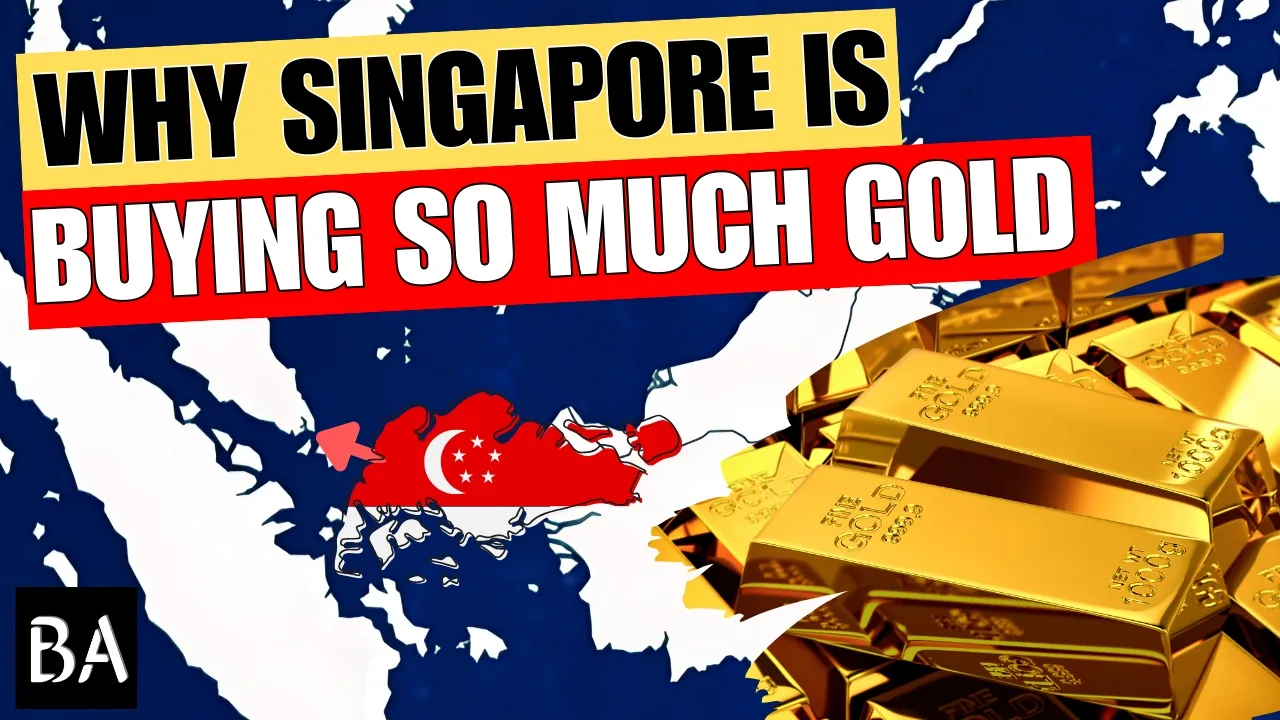
Singapore has emerged to become one of the largest holders of gold reserves in all of Southeast Asia. Here’s a graph on the gold reserves of the biggest economies in the region. Here you can see that Singapore has over 220 metric tons of gold which puts it as the second-largest in the region, just behind Thailand which has 235 tons.
It is above all other major Southeast Asian economies like Indonesia and Malaysia, and is above many, many economies out there. But this isn’t really the trend that we want to talk about in today's video. Singapore would undoubtedly emerge as one of the largest holders of gold.
That is simple to understand because of their economic status. Their economy far surpasses that of any other economy in Southeast Asia. They are rich, well managed and are sought after by the international community.
That simply means that they have the resources to buy up gold, which unlike developing countries like the Philippines or Indonesia has limited reserves due to economic constraints. The real story that you want to understand here is actually about Singapore's gold buying spree. If we graph out the accumulation of Singapore’s gold reserves over the past few years, we get to see that the island nation has acquired so much gold in 2021 and in 2023.
Here, just before the accumulation of gold, Singapore had only about 127. 4 tonnes of gold in the 2nd quarter of 2021, which at market value at that time was worth about $7. 4 billion.
But in just a short span of time, Singapore aggressively increased its gold reserves. In the 1st quarter of 2024, Singapore’s gold reserves amounted to over 236. 6 tonnes, which at market value was worth $15.
5 billion. This means that in less than three years, Singapore nearly doubled its gold reserves, making it one of the fastest accumulators of gold in the world. So, that is what we want to understand in today's video – why is Singapore rapidly buying gold reserves.
Does it signal some kind of shift in global finance? Or is Singapore preparing for something bigger? Well, before we go on and try to understand that, we must first talk about the role of gold in today’s foreign reserves.
Gold has been regarded as money and a store of value for thousands of years. Throughout history, it has served as a hedge against inflation, a means of protecting wealth during economic downturns, and a trusted asset in times of geopolitical turmoil. When modern economies face uncertainty—from financial crises to currency devaluations—gold often outperforms many other asset classes.
And over the past few years, especially since the 2020 Covid-19 pandemic, the entire economic environment that the world was in had shifted dramatically. There was a surge in inflation, supply chain disruptions, and massive government stimulus spending, all of which weakened confidence in traditional fiat currencies. That is why when we graph out the gold purchases by country, we get to see a rapid increase in many economies.
Here, you can see that several economies, particularly China and Russia, have rapidly accumulated gold in the past ten years, from 2013 to 2023. This, however, is over the past ten years, and Singapore had only been accumulating gold since 2020. But there’s a good reason why these economies have been buying up gold, which may also be a reason for Singapore’s gold-buying spree.
That reason is de-dollarization and financial independence. For years, the global financial system has been heavily dependent on the US dollar, which has been the dominant reserve currency. However, several countries—including China, Russia, and now Singapore—are increasing their gold reserves as part of broader efforts to diversify their holdings.
While some nations are actively pursuing de-dollarization, which involves shifting foreign reserves away from the US dollar and into other assets like gold, the euro, or the yuan, Singapore’s approach is more nuanced. Rather than signaling a move away from the US dollar, its gold purchases appear to be a strategic hedge against global financial instability. But you’ll most likely think that it’s easy to see why Russia and China did it.
They did it because they would potentially have a conflict with the United States, and being heavily dependent on the US dollar would leave them vulnerable to sanctions, financial restrictions, or economic manipulation. But Singapore? A country that has long maintained strong ties with the West, why would they be making such a move?
The answer lies in financial resilience rather than political confrontation. Unlike Russia and China, Singapore isn’t under any immediate threat from US-led sanctions or trade restrictions. Instead, its gold accumulation appears to be a calculated decision aimed at strengthening its economic stability in an unpredictable world.
Put simply, Singapore is managing risk, not rejecting the dollar. By increasing its gold reserves, the country is ensuring that it holds a stable, non-currency-dependent asset that retains value regardless of geopolitical shifts, financial crises, or inflationary pressures. This move aligns with Singapore’s long-standing strategy of economic prudence, diversification, and safeguarding its financial system from external shocks.
And that’s not the only reason for that. There’s loads of reasons, and even more specific reasons as to why Singapore is buying up gold. But there have been no publicly disclosed specific reasons for the increase in gold, so we’ll leave it to this kind of global trend in the accumulation of gold reserves.
Now, if we were to graph out the gold purchases of Singapore again, we actually get to see that even though the island nation had been acquiring so many gold reserves in the past few years, the country, in the past few quarters, have actually been selling them. Here you can see that in the 1st quarter of 2024, Singapore had over 236. 6 tonnes of gold, which made it the largest holder of gold in all of Southeast Asia, surpassing Thailand.
But in the latest quarter available for the fourth quarter of 2024, we get to see that Singapore’s gold reserves had come down to just 219. 6 tonnes of gold. That may not seem substantial, but it requires some explanation.
After all, if the entire world is seeing a surge in gold demand – why is Singapore starting to sell them? Well, the answer can lie in the price of gold. If we were to graph out the price of gold, we would get to see that the price of gold has surged in the past few years as well, which is quite in line with the demand for gold by central banks.
Here you can see that the price of gold skyrocketed. Prior to the Covid-19 pandemic in 2019, the price of gold per ounce was around $1,700. But in just a few years, the price of gold had reached over $2,880 per ounce as of the time of writing.
Some analysts even suggest that the price of gold would continue to rise as global demand for it would stay the same. At these prices, it makes sense for one to sell their gold right? If Singapore were to buy these gold at lower cost in previous years, and sell them today or in the past few months, wouldn’t it mean that they would book a profit?
Well, that’s correct. But that is only one of the reasons why we think Singapore has been selling their gold. Maybe it’s because of the price of gold which if sold at the right time would help Singapore profit from them.
It’s what Singapore has always been doing. You see, an article by Bloomberg even reported in August of 2024 that Singapore had actually seen a record drop in gold reserves in June, which was the largest monthly decline since 2000. And they said that Singapore’s decline, despite the global central bank buying gold, is an anomaly to the general trend.
But it’s Singapore that we are talking about. Singapore has always been different from the rest. They are probably seeing something that other countries are not.
For instance, it could be that they are seeing profit, which we just mentioned earlier. Or it could also be because Singapore is just rebalancing its foreign reserves. Singapore’s foreign exchange reserves are actively managed by the Monetary Authority of Singapore, and the MAS may have shifted funds to other assets such as US treasuries, bonds, or other high-performing investments.
So, Singapore’s buying spree of gold is due to several reasons ranging from shifting economic environment to maintaining financial independence. But anyway, do let us know what you think. Thanks for watching!
![[Online Special] What makes up Singapore’s reserves? - Pt 1/5 | Singapore Reserves Revealed](https://img.youtube.com/vi/h0wI1dHL9sw/maxresdefault.jpg)