thank you very much everyone for having me today um you may have joined some other presentations from me before with macmillan where we really went into the detail of a framework for global citizenship education and how to incorporate it into the classroom um i hope we will get a little bit of time to do it um a teaser of that towards the end of the talk but actually what i wanted to do today was ask this question what exactly is a global citizen what is the the purpose of global citizenship education um because it is
such a broad area and there is diverse perspective so i hope you'll join me on um what is a bit of a journey um we will be first looking at sharing some perspectives on what we think a global citizen is um i can then show you some common perspectives you can find in education looking at my research i'll propose my own perspective and a framework for implementing gce as it's often referred to in shorthand in elt and then we'll also look at why elt is such a good subject for gce and how we can actually
practically integrate it in the classroom so my first question for all of you and please um put your comments in the chat is what or who do you picture when you think of the term global citizen take a mental photo of that individual or series of individuals and describe them in the chat theresa maybe could you just um because i can't access that at the same time i wonder if you could read out what just a couple okay yeah flexible tolerant of diversity let's see if there are any more 21st century skills says marina a
citizen aware of global warming monica says no nationalities marjorie says inclusion globe a guru says mikhail an open-minded person someone who can adapt to different parts having wide perspectives patient cooperative tolerant people young people diversity unity uh someone who's aware of various cultures diversity and has various experiences thank you that's fantastic and actually i have been able to work out how to get the chat up at the same time so i can see for example maria and uh miranda that's brilliant um so interesting already you can see what what a diverse um perspective we have
on what it means to be a global citizen um let's look at some other examples maybe you think of someone like this when you think of a global citizen leonardo dicaprio a famous celebrity campaigning for climate change uh speaking to the un um you know affecting change trying to bring people together maybe you think about this maybe you think about um two successful international um business people um going across different cultures comfortably traveling all over the world um etcetera or do you think about this do you think about maybe malala or greta and someone mentioned
the dalai lama earlier maybe someone that has given their life to a particular cause and um and championed it and reached prominence as a result of that but what about this what about a teacher and their students i think actually um hopefully by the end of this talk uh we will all agree that really the t the teacher is one of the most pivotal global citizens you can possibly imagine um just by joining this particular um conversation today and you've joined dave earlier you can see already that you're communicating across cultures you are looking ahead
to the next generation you are preparing the next generation for the challenges they will face in the future and your actions are every day in the class in the classroom and outside of it um so all of those um global citizens are perfectly valid but i think in particular the teacher is you know one of the most um inspirational uh examples of a global citizen you can imagine uh so let's let's think then instead of can we find a definition for a global system can we find an agreed definition well there isn't one um there
are there is like diverse interpretation of this term and as a result of the education that is needed to uh develop global citizenship i'm just going to show you three so here is oxfams a global citizen is someone who is aware of and understands the wider world and their place in it they take an active role in their community and work with others to make our planet more peaceful sustainable and fairer then you have unesco you know one of the most high profile champions of gce um because of course they they really popularized it when
they introduced it into the un's sustainable development goals so here's unesco's definition being a global citizen is a way of understanding acting and relating oneself to others and the environment in space and in time based on universal values due respect for diversity and pluralism in this context each individual's life has implications in day-to-day decisions that connect the global with the local and vice versa i don't know about you but i find that a much harder definition to get my teeth into there's a lot there and in fact when we look at um different interpretations of
gce unesco can often be positioned at the center because there is quite a lot of room for interpretation in that very broad definition or then we have the oecd their definition is of a global citizen is to live harmoniously in multicultural societies to thrive in a changing labor market to use media platforms effectively and responsibly and to support un's sustainable development goals so already you can see there's no consensus and there's some difference between those three definitions just looking at those three so i would like to suggest that we need to ask whenever we come
across global citizenship or global citizenship education we need to ask who is promoting it why are they promoting it you know what is their agenda do they have an agenda and to what end what kind of global citizen does that individual organization ministry of education what kind of global citizen do they seek to develop and also what do we think as individuals um a classic example of being incredibly critical which as teachers we train our students in all the time and we also do ourselves here are some perspectives so this this is what i've looked
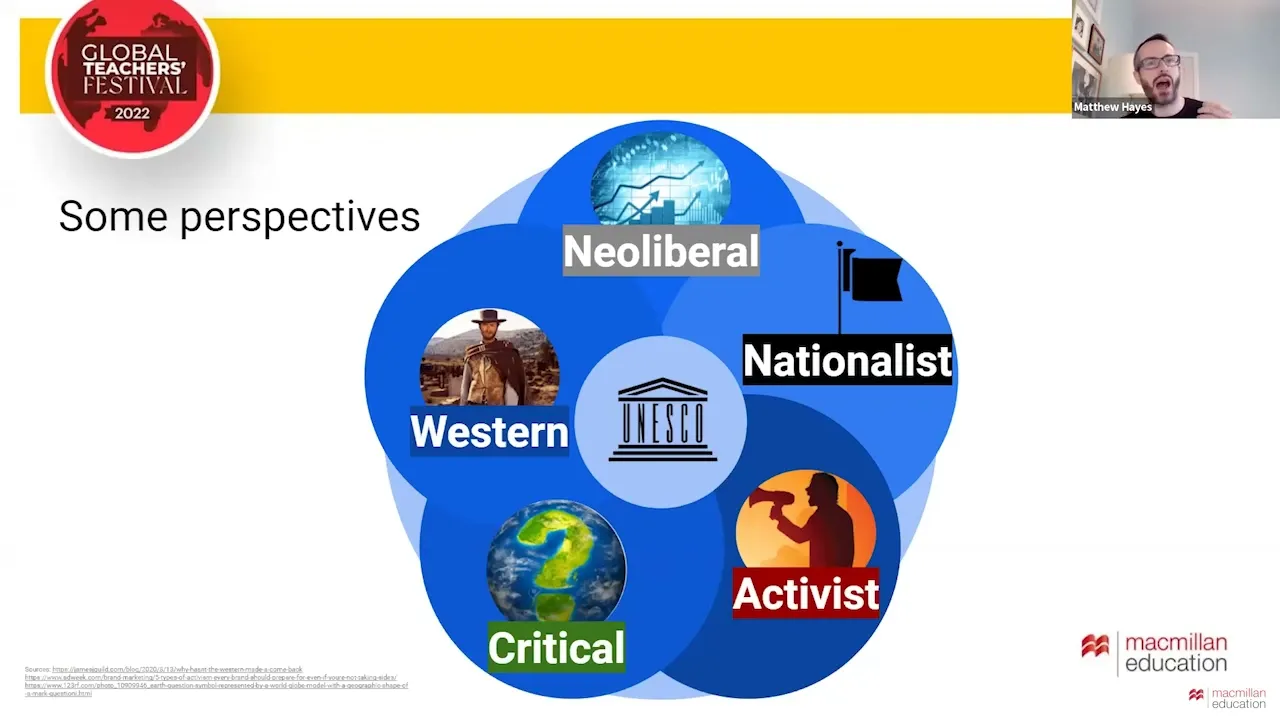
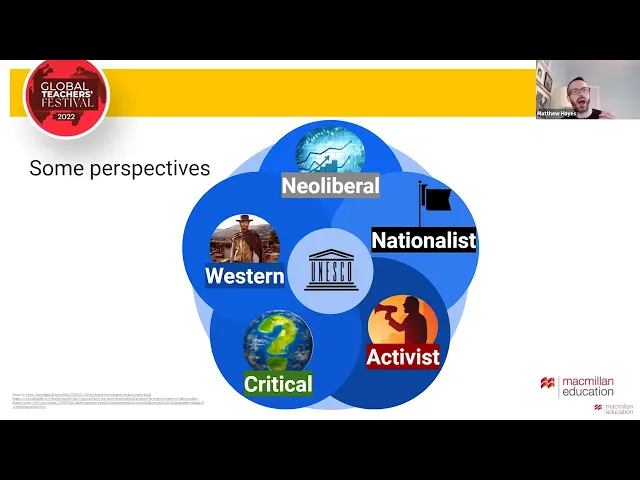
at a lot in my research when you look at gce and how it's implemented there are broadly um these five different um possible interpretations so the one at the top neoliberal that's basically a view of global citizenship education where the global citizen that you're you're desiring to achieve is effectively um a active participant in the global economy so we're talking things like entrepreneurial spirit really good communication skills the ability to work across different cultures but a neoliberal perspective focuses um predominantly on that or or almost exclusively on that sometimes to the detriment of other aspects
of gce then we have a nationalist perspective this is where you might find global citizenship used in national education curricula but really it's just used as a buzzword and basically the education is really more national citizenship education there's not that same connection to the global community and and the sense of rights and responsibilities we all have not just as members of our own nation state citizens of our own nation state but also citizens of this wider world then there's activist so this is global citizenship education with a very specific agenda so it's where there's a
clear direction for the actions that students need to take and a clear perspective on what's wrong with the world and what um this framework seeks these students to address and then forgive me for the photo i couldn't think of a better photo for western by which i mean um uk us western europe um and and so on um so you have to have deal with clint eastwood here but the western perspective is one where um a certain western view of the world permeates the interpretation of global citizenship education and in a way it can seem
to be a little bit colonial imposing western ideals and values onto other contexts which really isn't in keeping with the aspirations of global citizenship education and then finally there's the critical interpretation and this is one i'd like us to spend a little bit more time on this is the one which i think is particularly powerful and i hope you also find actually inspiring because it really helps you think about how to question the world around you um and you can broadly see it as questioning some of these other perspectives and um the underlying power structures
of the world so let's look at let's look at critical a bit more um can i ask you to imagine a field of corn harvest the corn and place it in front of your mind's eye uh tell me in the chat what do you see when you look at that harvested corn describe the corn what what color is it what does it look like uh rabi is saying yellow martha's saying yellow orange natasha i think clara yellow mustard anna's saying mustard beige shiny yellow green and yellow yellow nandita's saying multicolored um ammo is saying yellow
andre saying mustard um brilliant thank you so much everyone keep it going keep it coming blue someone said blue fantastic mexican colors brilliant uh and we've got green as well from marisol and purple even from evan brilliant um so this is an exercise that uh vanessa andreotti a very um famous researcher in this field who i who i do recommend you you have a look at if you're interested in this particular area of global citizenship this is exercise that she recommends and here is the uh the striking illustration of a very real um corn harvest
and you can see lots of different colors here multicolored uh even within themselves so what a what a different range and what um what professor andreotti is trying to get us to think about here is the danger of a single story so the danger that we can get caught up in these um these single perspectives of the world around us um and there there are many dangers posed by that um there's a ted talk here as well that i recommend you watching called the danger of a single story which talks about one author's experience of
how growing up she used to read all these childish stories charts or childhood stories about children playing in rainy england and having strawberry jam sandwiches and all this none of it resonating with her own lived experience in nigeria um so you can see how if we don't really question the world around us there's danger that we all think that the corn cob is yellow and therefore we should all want to be yellow in an educational context it could mean that we have one perspective on what a global citizen could be and rather than celebrating the
development of all of this this different this diversity amongst global citizens we're trying to create uh this conveyor belt of these yellow corn cobs of global citizens so this single perspective um so i i hope you found that interesting that that's really what the critical perspective is all about questioning the world around us um so given that i encourage you to question my own perspective but this is the perspective that um i and a number of others would advocate around how to think of gce and this is something that i've also worked with macmillan education
on um what you see here is the bloom's taxonomy applied to global citizenship education so it should have knowledge it should have attitudes and actions and it should have a layer of skills wrapped around that but importantly as regards these actions this paolo fairey quote kind of guides the perspective behind this that education doesn't change the world it changes people and it's really people that change the world and with that um with that very thought-provoking quote in mind the purpose therefore of this framework is to provide students with knowledge about the world around them and
the skills they need to engage with that world and to take actions in that world to address issues they care about but ultimately those actions are to for them to decide that it's not for us as teachers or as educators to impose our view of what actions should be against these these big global crises it's for students and individual global citizens to decide that themselves but let's look at a bit more detail around this so if we look at the knowledge domain you can also refer to this as global orientation and i would define this
as developing in our students a positive confident view of the world and the citizens role in it and that breaks down into a number of different learning outcomes we want them to encounter their responsibility for positive global outcomes so each citizen has a part to play in addressing these big global issues whether it's climate change poverty inequality gender stereotyping racial um justice whatever it may be each citizen has a responsibility for a positive and by extension of negative global outcome we also want to expose students to multiple global cultures so they can feel confident engaging
across cultures accepting differences and celebrating different perspectives we want them to encounter ideas of global interdependence to recognize in the 21st century we are all part of this big world and everything we do impacts each other it really isn't possible anymore to be siloed in our individual communities or nations we also want them to learn about the global institutions such as the um um so that having that knowledge they can then um take actions that may be appropriate within those frameworks according to how they would like to act and then finally we want them to
encounter this concept of having a multi-faceted identity so they can have their national identity but also their identity as part of the global community and also even their identity as a star wars fan or their religious identity or other other cultural identities so going back to those different perspectives we saw earlier and what i'm advocating here as um you know what i hope is the appropriate perspective on gce um in the context of knowledge it's a diverse view of the world with multiple perspectives it's not western-centric it exposes students to cultural and national complexities so
we don't want to see content for example that may provide a shallow or stereotype perspective on a particular culture or country it should be a really critical perspective of the world and its injustices so we want to try and avoid that savior approach or that kind of heroic charitable approach and instead question the injustice of the world at larger levels so rather than unquestioningly donating to a cause in a developing country or going abroad to to do some volunteering work we encourage students to think about their own part in the the injustice of the world
at a global level why should it be that if you are born here in london you have much better opportunities than you might do if you're born in another part of the world and that's that's really starting to question the world around them and then also it's an outlook for every citizen so there is no exception this this should be um a universal concept does not require um students to be traveling all over the world it does not require them to be only tackling issues at a global level if anything it's about connecting those global
issues that we all face to their local um expression so if it's climate change it's it's looking at how climate change is impacting you at a local level then in terms of skills we can think of these really as global skills and that's important that word global is really important in this context because sometimes you might see skills in the context of global citizenship education divorced from the global issues that they're really designed to address so 21st century skills and life skills for example have a lot of overlap here but the key difference is that
rather than developing these skills in isolation we want to develop them in contexts in which global issues are raised so all of these um the four c's and these other skills that you would have come across before it's not about just addressing them in isolation it's looking at projects or tasks where students can communicate but in the context of global issues so we'll look at some other examples later but it could be presenting a solution to a local issue to a key stakeholder or decision maker locally it could be in terms of creativity it could
be coming up with that solution in the first place um so i think just to highlight on this this particular area i just want to highlight again that this is very much not just about developing skills for a student to compete in the global economy but also to take action against those global issues and then finally attitudes in action this is the domain that in gce we can refer to as global action this is really the defining element of gce so think about that citizenship aspect that's the really key point here global citizens of education
is different from global education or development education or some of these other related concepts maybe like global competencies for example which came up in this morning's talk because of this identifier citizenship and as we all know as citizens wherever we are being a citizen gives you rights and responsibilities and that's the key thing here around action so with global citizenship it is about acknowledging those rights some of which are enshrined in the u.n human rights some of which you'll have at a local level and then acting on them and without going into all of these
i think if you look at the the bottom example this idea of students being actively encouraged to exercise their responsibility as global citizens one way of doing this in the classroom is to provide examples of how other global citizens have addressed an issue for example about let's say loneliness of um of pensioners and the elderly in their area and then ask them how they might tackle an issue of their choosing so you can still encourage action whilst keeping it um personal and specific to those students um conscious of time let's skip that one if you
don't mind um so why english language teaching why should we care about this in elt i think it helps in this respect to think of it as both an opportunity and an imperative so dave talked a little bit about the opportunity earlier english of course forgive me um english is the world's common language so if we are going to be engaging communicating with citizens all over the world it most likely is going to be in english and in fact um through elt you will be exposed to citizens from lots of different nationalities and cultures um
given 75 of non-natives of english language speakers are non-native and so global citizenship gives you a framework in which to do that also in the context of the classroom and in textbooks we need content in which to develop language skills so there is this this fertile ground in which to raise some of these global issues and finally students want it again going back today's talk i think you mentioned um one of the students saying how much they enjoyed engaging with students from other cultures and the english language felt like a great context in which to
do that indicating that appetite we have amongst our students there was also a recent instagram report that pointed out that its most active users are social justice advocates so there is this thirst to engage with some of these global issues unfortunately that turns us to the imperative because one of the reasons why there's such a first is because when um the youth of today look to the future they can feel afraid anxious and powerless um there was a recent uh report by the nature journal on this which found that over 60 percent of that younger
generation are worried about the the future and have these feelings of anxiety and powerlessness so with gce you give them a framework in which to have agency in which to feel like the individual actions they do do matter and they can make an impact in the world of course also um bearing in mind some of the history around elt textbook production in particular and resources it does tend to sit in the hands of a small number of largely western based publishers so you can also argue that for elt publishers such as macmillan um or oup
cambridge pearce and others the imperative here is to make sure that when we are putting content into textbooks that are going to be used all over the world we are not perpetuating western perspectives we're not imposing those views on the world but we are actually uh going back to vanessa androti thinking really critically about the world and that that is where gc is a very helpful framework and then finally how do we do all this uh in a word it's clil and i'm sure many of you would have used clil throughout your career already content
and language integrated learning so um we have this precedent for how we can bring different subjects into the development of the english language um in fact going back to my own time at mental education this is a fun picture of dave um at the ministry of education in bahrain 10 years ago promoting one of the earlier gateway series and in that early series dave talked about something called click which was kind of like a clil plus cross-curricular topics were integrated into textbooks as well as literature but also international cultural knowledge so no surprise that in
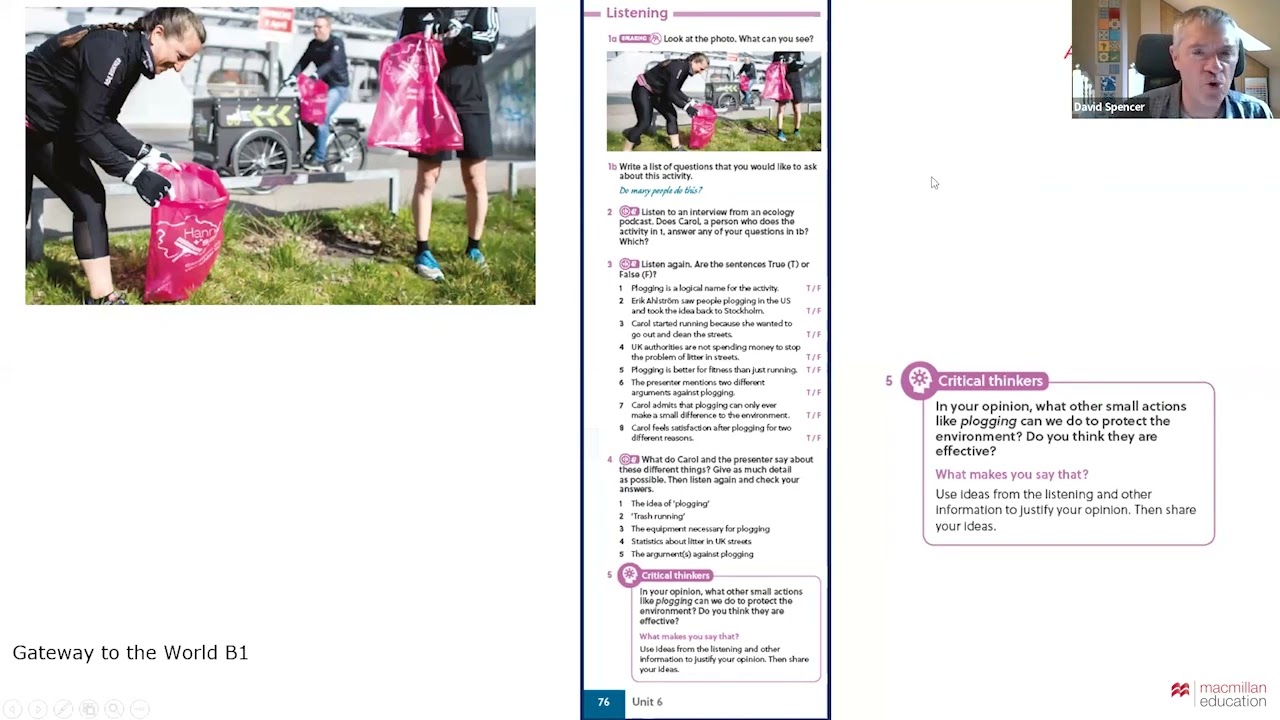
dave's new work global center education is very much present because he's been working on that in that vein for many years which leads me to some practical examples so here is a practical example of how you can bring gce into the classroom uh in this case by the textbook so here is a project task where students are asked to research life in their country and to present it to teenagers from another country using the virtual classroom exchange by the way you could also if you don't use that textbook you could also partner with the british
council's connected classrooms which allows classrooms to connect all over the world that's a great way of engaging students across cultures whilst also doing so through topics that could be around global issues as well so maybe they work on a collaborative project together um for other examples um i have an article on one stop english that i hope would be helpful that's got some very practical um lesson ideas and also i've done a couple of webinars with jonathan hadley a very experienced elt teacher where we again look at really practical examples of embedding gc in the
classroom and i would also recommend nezma suleiman and nathan wallace talk on gc in egypt where nesmer in her role as a primary school teacher of english talked about how she could bring you could bring environmental issues into the classroom and it is really fantastic to see that not only um is it very doable to integrate gce into an elt context her students really relished it and increased the engagement in the class so a final thought then before we um hopefully pick up uh some questions i came across this quote recently um in a in
a shop here in the uk and it's by a zero-waste cookbook author called anne-marie bono we don't need a handful of people doing zero waste perfectly we need millions doing it imperfectly and i think that's just a great concept which you can transfer to gc as well that i know this must seem quite a big daunting task but um we don't need a handful of people doing it perfectly we need millions doing it imperfectly and um i think just starting your journey you'll hopefully build a passion and enthusiasm for it and i'm sure your students
will respond to it too so thank you very much i will stop there and please do reach out to me directly as well i've got my my links uh there and i'll also share the slides afterwards um you touched on something very important which which there was a question in the in dave's uh session matt with that quotation about doing projects imperfectly um a question we didn't have time to answer in the last session was um what if the students don't actually achieve an end result is that still um a successful project a successful collaboration
what do you think yes i think it is in a word absolutely so um we talked about this in in the earlier time zone for this as well where we talked about is it possible to assess global citizenship and uh we had some back and forth with other teachers and realized it's very difficult but you can assess their exposure to these ideas and being able to put their you know be able to articulate what the challenges that they would like to address and come up with some ideas to to tackle them but i don't think
that um they necessarily have to be successful and in fact i think it was nesmo in her talk that um talked about how she feels like her classroom should be where students can make mistakes and can fail because they're being prepared for a wider world and so better to have that in the safe environment of the classroom um yes and i think the journey that students are taking towards thinking about and and and talking about and reading about looking around them is also a great gain for the students don't you think absolutely absolutely i think
one of the things that um uh we worked on a lot when i was working with macmillan on their own framework for global citizenship is this idea that when you look at some of the outcomes around the action domain yes projects around addressing a global issue are great but also we can consider a critical consciousness as part of the action domain so uh if if students are questioning the world around them and going quite deep in questioning common assumptions and why things are as they are that's almost as important as addressing those global issues because
that is a life skill that they can carry with them for the rest of their life yes i would agree with that i think that very wise very wise man thank you so much now there are one or two other little kind of there's a little bit of hesitancy um tom uh says that questioning certain behaviors in some countries is seen as indirect opposition to those in power um and definite uh also uh uh echoes this uh that sometimes authorities don't like students being involved in certain aspects so you know i that's a worry that
maybe a lot of teachers have is there anything that you can advise in that field i'm so glad that you asked that because we shouldn't hide away from that it is yes it is difficult um and we shouldn't pretend that the the full the fullest ideals of gc are going to be possible in all contexts um what i would say is that in my research looking at gc in public school textbooks in the uae which some might say has you know that same you know very different perspective to how you might question authority than you
would in the uk or in the west um there they do have um context in which um societal and governmental priorities are questioned so thinking of one very specific example um the students are encouraged to look at the uae's investment into the space race in marvel and they've the ua have done this um very impressive um miles project and the questioning for the students is is this the right use of government resources should it actually be spent on the health service etc and there are some templates and some back and forth and this these are
textbooks that were co-created with the ministry of education so i think um i i couldn't speak myself to your particular context you would know better than i but clearly in that particular context they found a way to engage with the questioning aspect uh to a degree uh of course they weren't questioning um the rulers themselves but they were subtly questioning uh that those priorities and so um it is doable but i don't um i don't highway hide away from the fact that you're going to have to adapt it to a particular context absolutely yeah so
teachers um you know choosing i presume what topics are safe um in their country um the wisdom of the teacher there is a global citizen absolutely absolutely i suppose also um this is where uh textbooks and other resources could help because maybe if you're if you're as we often have an elt if you're a teacher that's come from another context into that one you might feel uncomfortable making those decisions early on and we've seen examples where um teachers thought they were on the right side of it but but weren't um and so that is potentially
where textbooks can help and that's why it's great that milan is doing what it's doing because those textbooks will have gone through an approval process so you can feel you can feel comfortable in that that content but wherever you can bring in your own ideas as well of course that's even more powerful as a teacher thank you so much [Music]
![Global Citizenship Education: What, why and how? [Advancing Learning Webinar]](https://img.youtube.com/vi/tvFCgWsR9_M/maxresdefault.jpg)

![Putting Global Citizenship Education into practice [Advancing Learning Webinar]](https://img.youtube.com/vi/TZZ3VhOYv5o/maxresdefault.jpg)