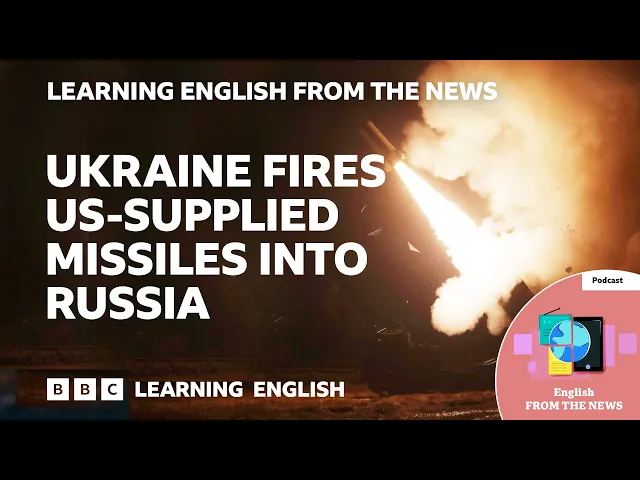
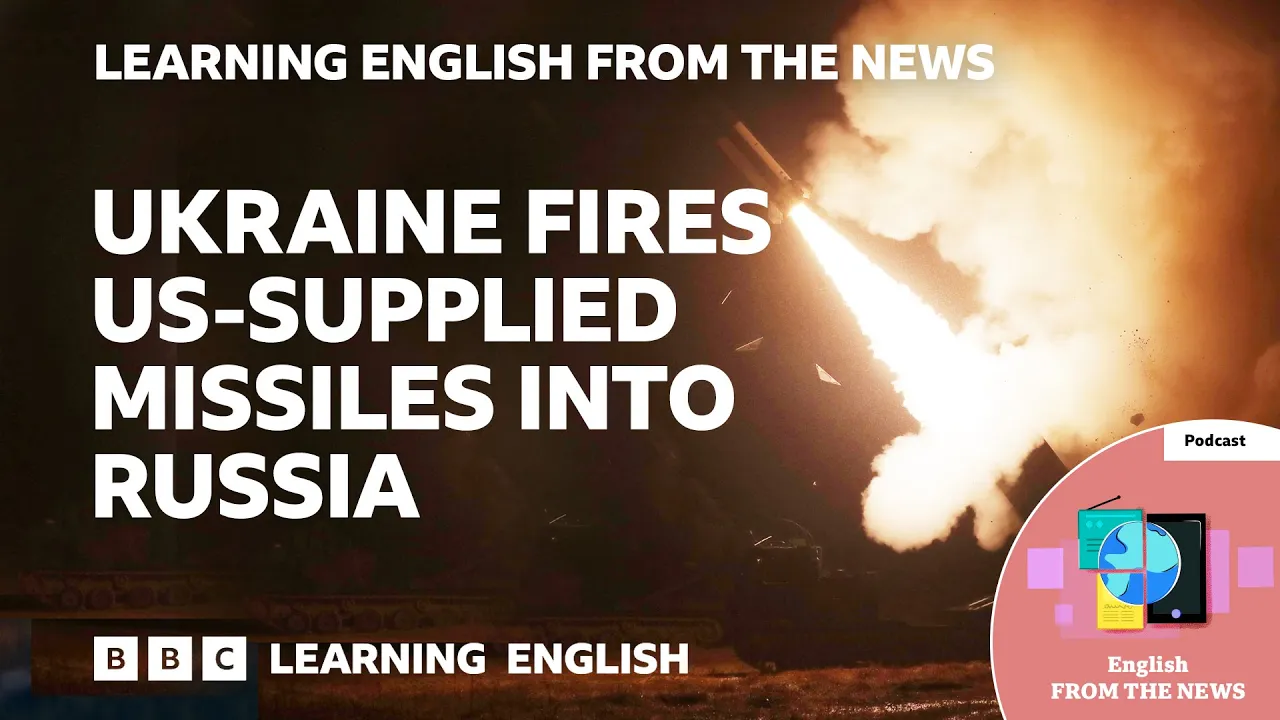
From BBC Learning English, this is Learning English from the News, our podcast about the news headlines. In this programme, Ukraine fires US-supplied missiles into Russia. Hello, I'm Phil.
And I'm Pippa. In this programme, we look at one big news story and the vocabulary in the headlines that will help you understand it. You can find all the vocabulary and headlines from this episode, as well as a worksheet, on our website, bbclearningenglish.
com. So, Pippa, let's hear more about this story. US President Joe Biden has given permission for Ukraine to use landmines supplied by the US in the war with Russia.
It comes after Ukraine was able to use US-supplied long range missiles to attack inside Russia for the first time. It's a big change in the war, as previously the US had not allowed landmines to be used or missiles to be fired into Russia. The change comes as the war between Russia and Ukraine hit 1,000 days.
Let's have our first headline. This one's from Sky News. Where do Russia and Ukraine stand militarily after 1,000 days of conflict?
That headline again. Where do Russia and Ukraine stand militarily after 1,000 days of conflict? And that's from Sky News.
This headline is using the 1,000 days milestone to reflect on the war. And we're interested in this question: Where do Russia and Ukraine stand? What does it mean, 'stand', here?
Well, you probably know the most common use of 'stand'. So, if I stand, it means I'm on my feet - vertical. And things like buildings can also stand when we're talking about their position.
And that metaphorical use is important here. That's right. We can use 'stand' metaphorically to talk about the state or situation of something.
So, in the headline, where do Russia and Ukraine stand? It's asking, what is the situation for each country in the war? Yes, and we have lots of common uses of 'stand' in this way.
We can ask 'where do things stand? ' or 'how do things stand? ' to ask about a particular situation.
Yes. For example, if you and I had had an argument, I could ask, where do things stand between us? And I'm asking, what's the situation?
How do you feel? Yes. And we have another very common expression 'to know where you stand'.
And this means to be certain about what someone feels or thinks about you. Yes. I mean, we haven't actually had an argument Pippa, have we?
Um, I know where I stand with you, and we get on well. We've had 'where do things stand? ' - what is the situation?
For example, I've been off sick for the last few days. Where do things stand with the big work presentation? This is Learning English from the News, our podcast about the news headlines.
Today, we're talking about President Biden's decision to let Ukraine use long-range missiles and landmines against Russia. Ukraine has welcomed Joe Biden's support, although it says the missiles alone won't win the war. Meanwhile, Russian officials are unhappy about the change and have accused the US of escalating the war, making it worse.
A spokesperson for the Russian government, sometimes called 'the Kremlin', said that Ukraine using the long range missiles from the US could lead to a nuclear response. And our next headline is about this. Kremlin accuses Biden of ratcheting up nuclear tensions.
And that's from The Times in the UK. That headline again, Kremlin accuses Biden of ratcheting up nuclear tensions. And that's from The Times, a newspaper in the UK.
This headline is about Russia's response to Biden's decision about the missiles. And we're interested in the phrase 'ratcheting up'. Can you tell us more, Phil?
OK. Well, a ratchet is a tool with a handle that you turn in one direction only, maybe to tighten a bolt. So, if you ratchet something up, it means that you increase it over time in controlled stages.
So, metaphorically, you turn the handle each time in the same direction. So in the headline, the Kremlin is accusing Biden of ratcheting up nuclear tensions, of increasing tensions bit by bit over time. Now, remember this headline is reporting the opinion of the Kremlin.
We often talk about nuclear tensions ratcheting up, but we can also use the phrase to talk about prices, interest, pressure or efforts. Yes. For example, politicians might complain about banks ratcheting up interest rates.
As we said, a ratchet tool can only turn in one direction. So, when someone accuses someone of ratcheting something up, they usually believe there is a plan to increase something, that they're doing it on purpose, step by step, and that the change is difficult to reverse. We've had 'ratchet something up' - increase over time in controlled stages.
For example, the protest group are ratcheting up their pressure on the government to change the law. This is Learning English from the News from BBC Learning English. We're talking about President Biden's decision to let Ukraine use long-range missiles and landmines on Russia.
Now, as you probably know, President Joe Biden is almost at the end of his presidency and Donald Trump will take over as president in January. Trump has said he wants to end the war between Russia and Ukraine straight away once he's president, although he hasn't explained exactly how. There are concerns that Donald Trump might slow or halt support for Ukraine, causing Joe Biden to boost his aid to Ukraine before he leaves the White House.
And we have a headline about this. This one's from The Spectator in the UK. What will Putin do about Biden's parting gift to Ukraine?
That headline again, What will Putin do about Biden's parting gift to Ukraine? And that's from The Spectator in the UK. This headline is asking about how Putin will react to Biden's decision.
And we're interested in this expression, 'parting gift'. Yes. So, a parting gift - this is a present given to someone who is leaving or by someone who is leaving.
Yeah. For example, when someone retires at work, colleagues might collect money to buy them a parting gift to say goodbye. OK, but Phil, the headline is describing the decision about the missiles as Joe Biden's parting gift to Ukraine.
It feels strange to talk about missiles as a gift because it's quite a serious thing. Yes, well, this expression, 'parting gift', I think we often use it to talk about things that you wouldn't normally give as a gift. It's often not as straightforward as it looks.
Yes. And we actually use 'parting gift' ironically, sometimes to talk about something that's not a gift at all, that's kind of meant as a bad thing. For example, an employee that's been fired instead of someone who's retiring might leave a parting gift for their boss, and maybe they leave lots of unfinished work for them to do.
We've had 'parting gift' - something given to someone who's leaving, or by someone who's leaving. For example, When I left university, my professor gave me a parting gift of a recommendation for my dream job. That's it for this episode of Learning English from the News.
We'll be back next week with another news story. If you've enjoyed this programme, you can find lots more to help you with your English on our website: bbclearningenglish. com.
And don't forget to follow us on social media. Search for 'BBC Learning English'. Bye for now.
Goodbye.