Um Workshop our slam to 3 Workshop just a review of the agenda for today so we're going to start off with a debrief of we we're in qms 3 now and we're in the pre-examination phase of qms 3 so we're going to be looking at some activities from qms 3 so we have specimen management first then we're going to which is going to be a debriefing Q&A we're going to have packaging specimens for shipment to Referral it which is also a debrief and a Q&A then we have tracking referral specimens so for this activity we
are going it we did a lot of that work in our self-study sessions however we are going to conduct a part of that activity during this live session then we're going to move to LD so the first three will be covered by me then we're going to move to LD for using standard operating procedures and LD is also going to help us to close with the Homework and any announcements so let's move Swift swiftly into our first activity so as I said we're in qms 3 so qms 3.1 the pre-examination phase and the first activity
there was looking at specimen management how we manage our specimens in the lab and is to ensure make sure that we ensure that specimen Integrity is of the the utmost importance there's a very um famous phrase I don't know if you guys Know but there's a very famous phrase that we use um when we're talking about our specimens right and the the a quotation not a phrase is it a phrase or a quotation I don't know um but can anybody tell me what it is uh in the chat box if you remember from any qms
Workshop Etc if we used it before or you remember it from our self um studies and the recorded lectures put it in the chat box right and if you remember it's because we we Described the sample as our key kind of input into the process Musa Musa very fast $2 for you garbage in garbage out James also says the same Kim garbage in garbage out exactly so what we put into the process is what we're going to get out of the process and when it comes to the lab the sample is our key quote unquote
ingredient it is what we use to be able to get our results it is what we're Testing everything we do is around that sample that we get in the lab and so ensuring its Integrity is of the atos importance so the purpose of this activity can let's fill in some blanks the sentence says the quality of the dash to the laboratory directly determines the quality of the what what are those two missing words let me get some responses those are fast yes yes Emmanuel thank you that was very fast From you Nadia also inputs and
outputs Vlad also got inputs and outputs as well Robert thank you so yes the quality of our inputs is going to directly determines the quality of our outputs like we said garbage in garbage out so assuring that specimens are acceptable is an important function of laboratory management and is highlighted in the role plays that we watched so we did some parts of this activity um During our recorded lecture so we had one recorded lecture to to to um listen to very brief it was about 5 minutes then we had two role plays and your only
job was to watch these role plays and to come this morning so that we can have a conversation to compare and contrast these two role plays of somebody accepting a sample in the lab right so the purpose of this activity was to assure that the quality of the impul the laboratory in order to assure the Quality of the output and what you needed was just job 81 your criteria for specimen acceptability you were to observe compare and contrast two different methods to reject unacceptable specimens in the lab and participate in classroom discussion regarding those role
plays so I hope that you are all able to watch those role plays and you have come already with your thoughts on those role plays what did you see that what did you See in terms of comparing and contrasting those role plays what would you what did you like what would you change does did what you see reflect what happened in your lab sometimes remember that this is a learning environment so everything we're doing is also to learn so let's have a a conversation a brief conversation around what we observed in those role plays and
let's think about how we can improve processes in our Labs if necessary or Maybe you're watching those role plays and things I have something I think what we do in our lab is very good and I have something I want to share with the rest of my colleagues Coles who may be facing some of these challenges remember that specimen rejection is not an easy is one of those I would say processes in the lab that can often put us in conflict with our users especially with our clinicians when you say when somebody brings a sample
you say no we can't Accept the sample for ab CD reasons especially when they cannot understand those reasons so let's have a conversation let's let's who would like to start us off with this conversation in terms of what did you note about these role plays and what um comparing and contrasting and the whole issue just around sample rejection in the lab and the importance of having criteria and implementing those criteria um Nadia said I found it Difficult to understand what they were saying but in the second video the person receiving the samples was very rude
to his colleague thank you um and na just for everybody's information we are going to be changing those videos so I'm sorry that we couldn't do it for you but if afterwards you want to use any of those resources there'll be new videos already available even now if you go to the website you will note that for assessing safety incidents those videos Have changed so again if you want to go and download those and use them when you're training other people in your lab please go and check out those videos so we will be changing
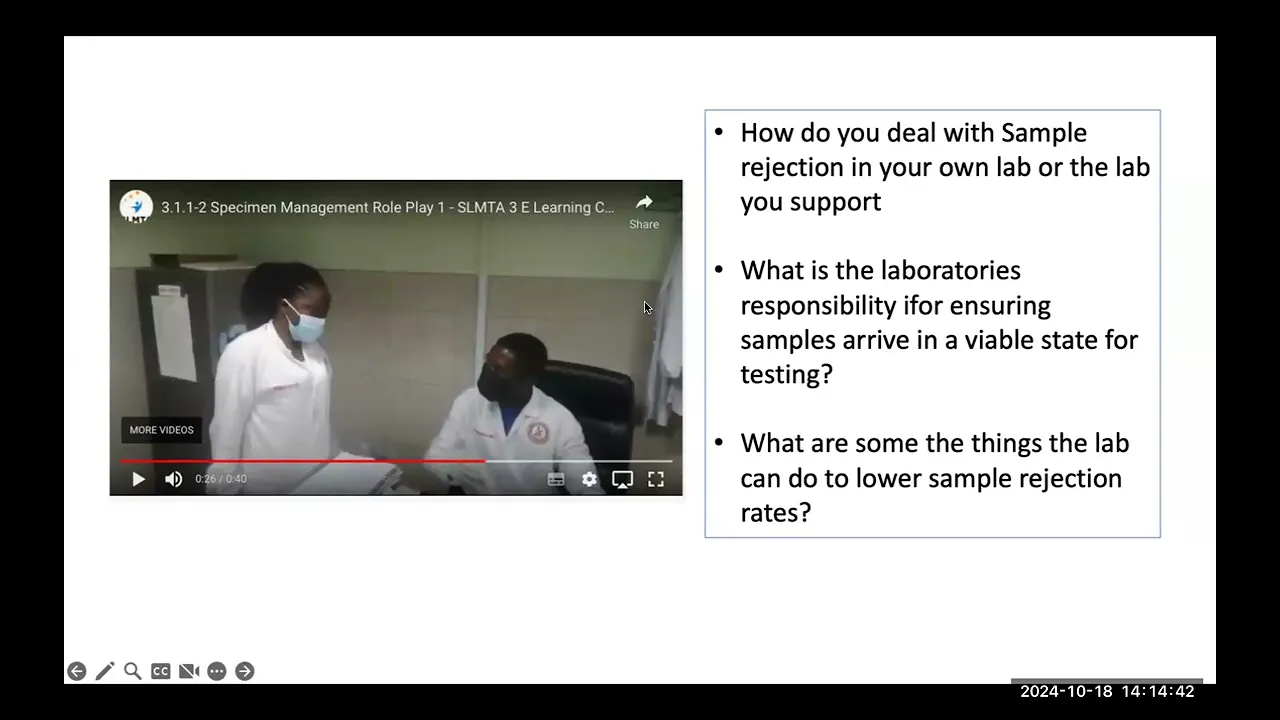
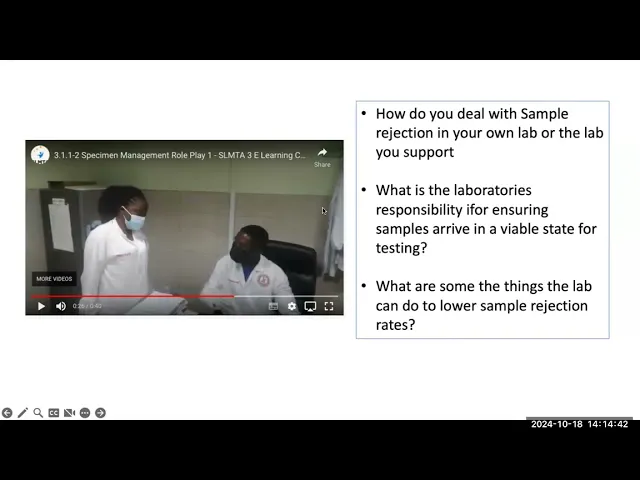
all those videos and my apologies that we couldn't get it done in time for you but the new ones will be there for you to um to access and we will let you know when they are but thank you very much for that comment so two people agreed to say that the the the interaction between in the second Role play the the person receiving the sample was very rude right but so what is it around you know I have three questions if you look at the screen says how do how do you deal with sample
rejection in your own lab or the lab you support what is the laboratory's responsibility for ensuring samples arrive in a viable state for testing and what are some of the things that the lab can do to lower sample rejection rates in the lab So um these are some of the discussions papam says there are no clear procedures for sample rejections no register an attitude issue was Major okay so these are some of your observations EA says the first video was polite and communicated well I didn't see any sample rejection l or form being filled and
Immanuel says a sample mislabeled incorrect patient information or without the requirement may also be rejected so we're getting different things but I Would like to have a conversation based on those questions just just we've got like five minutes left for this to ask you what did you what what did you see anything or even Rel related to the questions is sample rejection something that is difficult in your lab for you to implement and how have you gone about making sure that you can do what you need to do without being on the wrong side of
your users so will anybody like to share their experience that they have In their lab around sample rejection please raise your hand lots of comments coming in the chat box but I want somebody to raise their hand and talk to us fish please go ahead Gooding from cambodi and I hope you get better soon and yeah for my in Cambodia we work uh related to HIV v testing and there are only La only two lab in cambod in one count and we receive all sample from any Province and The problem is sample rejection due to
the period of their delivery they took two they took around 8 hour for transer transfer the samples and they need to keep their sample at their lab for about two to three day before sending to centrals so the most retion retion sample is sample quality see they don't put in the refrigerators they don't Sony the samples they just keep directly the whole blood into the refr and the region The re rate is uh very high due to S pa uh put in wrong temper temperat and we uh not in the our tracking form uh every
month and then uh the problem is that we provide more many training to them but the stuff at the country at the Province they always change the stuff that's why it difficult to train them again and again and sometime the Regis uh problem is happen the same is repeatly that is would be difficult to our lab to control see we receive a lot Of sample from The Province thank you very much fish so you bring up a good point about when you are the receiving lab right when say for example you said we receive samples
from The Province so say you are the tery lab you are the reference lab and these samples are coming you described a process happening in some of these provinces where the samples are not being sto St properly they aren't being processed properly and so when they come To you they're not viable for testing and then there was the the added issue that even when you do training retention of the people that you were training is low so you you see that problem occurring and reoccurring and that is something that we we as the lab and
we have to realize that it is our responsibility as long as you are the receiving lab it is your responsibility to ensure that you receive those samples in a viable way for testing so um I Wonder how fish um currently you are going to navigate that process I know it's very difficult but let me read some comments kantu says that they provided like a clinicians laboratory handbook where instructions on Sample collection um are provided and I think this is generally good practice um obviously doesn't resolve the issue of Staff retention and people leaving once they
know when you've trained them blad also says to minimize conflict with clinical Personnel it will be helpful to provide them with the lab's acceptance and rejection criteria beforehand and if possible give an orientation on laboratory processes absolutely James also follows up on that um so thank you for that contribution fish I'm sure that we we can all here ATT test to having some challenge around that Demetri hello Demetri can you hear us sorry my headphone was not down you're hearing me now yes we can yes we Are so in my laboratory I work at a
reference lab and we receive samples from the nearest hospital which is about um 1 kilometer away from us most of our challenge um comes from sample received from the wall boards where the doctors are taking those samples you have interns in training and every time you have a rotation you notice that the rejection rate increases for all type of samples also on the weekends where the transportation of the sample becomes a Challenge we find that for CB4 and viral load samples those rejection rates are high so what we have had done was to do orientation
each time we have a new batch of interns that are incoming we would do the lab would do orientation for those interns and we have long recognize that our clinicians don't read the user manual which is available electronically for them through our um Lis system so we're contemplating doing an app to Allow them to easily click on things and they can find the information without having to reach through a whole lot of leaflets before they can find the information that they want and we have also um adjusted our transport times and extended our um opening
hours for those persons who have challenges with transport thank you that thank you for that sharing that I I think we're all learning about what we can do Pap also put a comment in the chat box which um I Can see that you all like which she says we conduct regular regular quarterly sample sensitization to cover new stuff now and that's a great practice to say that we you know coming back to what came up with dimitry and fish fish mentioned the fact that we have a problem with detention on Demetri side we're talking about
who is doing the ction right and in some of our labs to to be able to utilize the stuff that we do have we normally sometimes put the Interns and people who are not technical staff in say photomy or front desk in pre-examination and so we have to also and that is not out of say that we're intentionally doing it to make sure that untrained people are there but it's just to make use of what stuff you're given sometimes you're not given enough trained Personnel to be able to do all those jobs and so having
some of those um um strategies as was described by Demetri with the orientation or papam to Say well regardless every quarter we do a review I that's best practice and remember our concept of continuous development and continuous Improvement that just because somebody has been trained on something once doesn't mean that we leave it and that should be a continuous process so I I I appreciate those contributions last one from Robert please hello um good morning good afternoon evening can you hear me yes we can Robert all right so just brief Comments about uh what we
do in our lab and how we uh deal with issues of projections um we do similar work with um with the work of p in their lab and and that is the do viral Lo HIV and then early infant diagnosis so one thing all have does is to use a dry blood sport uh because we receive samples from across the country which travel long distances so best way is to use DPSS which can you know last and and and compared to receiving Plasmas so one thing we do to reduce rejection rat is that first of
all we've got a set limit Beyond which our rejections are not supposed to go uh so we do analyze um you know the reasons for different rejections is it that the quality of the DBS sport is poor or is it that this sample has been collected in expired DBS cards and and so we analyze some of these Trends depending on which facility they are coming from and so we communicate specific to that Facility where the specimen is coming from and say look would notice this train and I think you need um a training in this
area or maybe your personnel uh need refresher training and this is what we are actually doing um right now with one of the facilities likewise we came up with a recommendation recently you know to analyze to have a database of the of the DBS cards that are expiring so that uh when we see that they are due to expire we can alert the facil ities Whose cards are about to expire to avoid them you know from accidentally collecting specimens in expired cards that are going to be rejected so this is some of the things that
we do to you know minimize rejection rates and keep it within the range thank you very much for sharing that Robert Jennifer says there should be stringent protocol in rejection and acceptance of specimens more that more that more that more errors arise in the pre-analytical phase Yes very true Jennifer thank you for that contribution we we we tend to put most of our focus and if you in the recorded lecture I pointed this out that we put most of our focus in the examination phase and yet the pre-examination and the postexamination phase contribute to the
bigger part of our processes and so more Focus needs to be there and let me just acknowledge all the sh the um knowledge sharing and um people sharing what they do in their Scenarios what what strategies they have taken to look at sample rejections in their lab um Christina has also put a comment there and I'll strongly encourage you to again go there and read those comments I'm sorry I can't cover all of them but please um you were there and I'll also again um like to ask Kennedy if he can share the chat on
your Forum afterwards so that we can read and learn from each other because I think they're great contributions there thank You very everybody for your contributions and sharing your experiences so just to end on this activity is to say following up with what Christine um Jennifer and a lot of you have said have your acceptance and rejection criteria make sure it's documented make sure it's communicated and shared with all your users so that they know exactly what they need to do when they are collecting and sending a sample to You I saw a comment earlier
um which reference the fact that in I think it was F in your setting a lot of the HIV um testing is done by retired staff and that is because a lot of the um those HIV tests are kind of point of care tests Etc and and we so and that got me thinking that we need to think about the expanse of what we categorize as users because a lot of the time we focus on our clinicians and maybe on our nurses don't forget all of these other people Your testers your counselors Etc all of
them who use your service and may be providing you with samples that we have to communicate clearly with them and at the end of the day have a system that ensures that your criteria is implemented because at the when you get that erroneous result and you send it out who is going to be blamed please if you make a mistake and send out a wrong result who is going to be blamed so we we all know Who the what the answer is to that exactly so we have to take responsibility for that process thank you
key messages please Robert since you were the last one to speak please go ahead and take us through our key messages okay um key messages um to preserve the quality of laboratory inputs one must not accept specimens that are of poor quality dangerous improperly labeled or not accompanied by a complete Requisition cautious respectful helpful communication is required in all customer service interactions and Communications specimen rejection is an opportunity for Education combining verbal and written communication regarding spacement acceptability is important for education of providers the the ultimate goal is to preempt and prevent space rejection thank
you thank you to Robert let me read that last one again specimen rejection is an Opportunity for Education combining verbal and written communication regarding specimen acceptability is important for education of providers the ultimate goal is to preempt and prevent specimen rejection so if we go back to those role plays your job is to educate your job is to tell them what to do in a respectful and a customer focused manner so that you're actually teaching them on what to do next so that next time they come they are not disappointed so please Be the person
in roleplay one and not the person in role play to so at the end of that activity can you determine specimen acceptability can you communicate specimen acceptability policies clearly to laboratory users and can you plan and imp and Implement an improvement project with a goal of preempting and preventing specimen rejections and I see the yes is coming through they can f so I'm going to say yes we can and move on to our next Activity which was a fun activity packaging specimens for shipment to referral sites right purpose of the activity help me to fill
in the blanks referral testing requires proper packaging and shipping of patient specimens to preserve their what and what and to protect all persons involved in their transportation the what and the what oh I see it coming through Emanuel integrity and suitability Emanuel you're F you're on it today integrity and suitability integrity and suitability yes to impact the yes the integrity and suitability and to protect all persons involved in their transportation and in this activity participants learn the importance of safe and effective specimen packaging and practice appropriately packaging samples with available materials of varying levels of
sophistication So this is what we did we first in our recorded lecture we explained what specimen packaging and shipping entails and why it is important we reviewed what triple packaging is when we talk about triple packaging we in we reviewed what it was then we went on to introduce our activity and conduct it which is the the activity was that in your lab right we are going to learn how to package samples now we know and you know that is one of the important foundations of this Course is that I I can't remember I don't
know if it was us as the master trainers who were having a conversation the other day but somebody mentioned the fact that when they're in the US and things like that people always ask them that how come so many labs in like resource limited settings are getting accredited and what are you guys doing to meet the standards and this this um activity is one of the things that we like to Showcase and this is some one of The great things about this course that the way that it is structured and the principles and the the
um what we teach means that if you're an advanced lab or if you're a lowlevel lab or regardless of what setting you're in you can still meet the requirements and this was a great activity to Showcase that to say that when it comes to packaging and shipping samples uh uh a very key area of our of the things that we do in the lab we know That there is a conventional way of packaging and shipping these samples but we also know that a lot of labs may not have the resources to buy those conventional materials
that are needed to package and uh uh and ship samples so we wanted to show you that you can use other available materials to do the same thing right what was the caveat please there was we can use the um we can use these rudimentary packaging to package and send samples but what was The only caveat about that where can we send those samples using rudimentary packaging there is a restriction somebody in the chat box but we did that so we challenged you in the lab to say in in your to say go to your
lab and work with your team assemble conventional packaging and assemble use your imagination to collect other packaging and see whether you can achieve the same triple packaging principle using the conventional Packaging materials and the rudimentary packaging materials and thank you all for your submissions I I I had some challenges opening the folder um but I was able to open it um eventually and I was able to see what you did in your labs and thank you for all the different pictures and the different scenarios that were sent obviously it would be fantastic to show all
but we can't so let me focus on um two the first is from Nadia wo so you Can see in Nadia's picture conventional Packaging so this is the process and thank you I like the way you labeled each photo Nadia to show us exactly what was being done this is also for conventional packaging so you can see at the end the package which is in um picture number nine closed ready sealed ready to go and then we have the rudimentary packaging also from Nadia's lab you can see the process of packaging that Specimen and putting
it all together and here again we have a triple package um sample ready to go now for the next one I want to show you I have to stop sharing slightly and reshare so please give me a moment I'll let me do that now I need to reshare my screen and this comes from vad um my apologies let me see if I can find um acrobat so flad I'm not seeing that but um let me close this come again Okay Vladimir I'll come back to yours let me try and find it and come back to
you unfortunately it's not coming up on my screen to share but then the other one I wanted to share was from Vladimir's team and I really like that because you started off Vladimir you really showed us that this was a a group effort that you you really did absorb what we said and you did it as a team so I saw you you you had all the faces of your lab team together you you took a Picture and you went through the process taking all those pictures thank you very much so many different ones to
share but I hope that we were able to prove through this activity that you are able to achieve the same triple packaging using the rudimentary materials now I asked a question in the beginning what is the only caveat to that right and so um I'm trying to see where where the responses are coming from Demetri says this is Really what I appreciate about slam ensuring Labs still are able to meet the requirements with limited resources exactly um Emanuel says including League proof containers so so the caveat I was looking for and let me ask you
this question is if I package with rudimentary samples can I send those packages internationally say I was shipping from country a to Country B am I able to use the rudimentary Packaging let me see the answers coming there no No exactly exactly so please remember that whilst you are you it's perfectly acceptable for you to use rudimentary packaging within your borders um it is not acceptable you cannot actually by ayat rules move those samples Between Borders right so you have to in that case use rudimentary um conventional packaging but remember also that the majority of
the samples we will be transporting are within our borders right and so this is a very good way of Being able to utilize our resources more effectively so thank you very much everybody for your contributions I really enjoyed going through them I wasn't able I said I had some challenges opening the folder so I'm going to go through them some more and we will be awarding some dollars I really love seeing everything but for now NAD and and Vlad thank you very much for sharing um so key messages for this activity please um Emmanuel can
you help Us yes can you hear me yes we can okay H proper specimen paging and shipping is important to ensure quality results and the safety of laboratory and career personnel the three factors necessary for specimen packaging and shipping are the right packag the right temperature and the right time frame regardless of the sophistication of the packaging materials it is possible to propell P package and ship specimen to for referral Testing thank you and um let me just read the last one regardless of the sophistication of the packaging materials it is possible to properly package
and ship specimens for referral testing and I hope we're able to prove that now in the chat box Joan says it will be very enjoyable when offered physically and that is the slam to cost and I can assure you that it is very enjoyable when we offer it physically so hopefully you will all be applying next Time we offer a physical course we look forward to seeing you so at the end of that activity can you identify the components of triple packaging system and their purpose and can pack can you package specimens appropriately with the
provided packaging materials I see the yes is coming through and from the evidence that I've seen from the photos you sent in yes I can say that you can so please go out and spread the word right to Those labs that you're working with who are resource challenged who are struggling to know how they are going to achieve this we just looked at a activity that was all about sample rejection how you package and ship a sample is critical to the Integrity of that sample so this activity may seem very simple but it's a really
critical activity there was a comment in the chat box I would like to read about it was about um I will come back to it and Highlight it but it was about challenges that were faced during covid-19 when samples were constantly breaking and leaking and I would challenge that that was because of how they were packaged so that's one comment I'll highlight it and put it in the chat box later on but it's there in the chat as well so thank you very much everybody let's move on to our third activity which is tracking referral
specimens right so now we have looked at managing the sample packaging The sample we have sent the samples now we need to track those samples right we need to track the samples to make sure that we get the necessary results so the purpose of this activity is show that referral specimen status is essential for specimen management to ensure the timely return of test results so using a case study we learned how to use a log to track referral specimens follow up on an issue and document the occurrence so during our self study we Explained what
a referral tracking is why referral tracking is important we also conducted the first part of the activity the quality record and we also did the review and we did part of activity two which is taking appropriate action and part the other part of activity two is what we're going to do in this live session and then we're going to debrief and have a Q&A so in the first part of the question you were looked you were asked to review The activity log right the referral log and to answer the question so you had hand out
to one the referral log and then you were given a u a a list of questions you had to review the log and answer those questions so this is the log hopefully you all recognize that and this was the questions that you were given to answer so let's move straight on and review those answers right and we're going to be using musa's homework for this purpose so the first question Was what is the approximate turnaround time for the following test AFB ptin malarial smears and CD4 now let's review Musa says two days two days and
one day do we agree or disagree in the chat box if you agree say I agree if you disagree with any of those T turnaround times raise your hand or say no don't agree and then we can discuss okay so I see lots of agreement so we have two days for AFB smut malaria smars two days and CD4 one day Musa could you Unmute and tell us how you you were able to determine the 10 around time hello mus are you there yes M I'm here yes how are you able to determine the turnaround time
please uh thank you uh you can compare between the AF Mar SM these are the procedure that needs bit complicated steps to to get the results that's why you can see the CD4 have one day and those AFB and marar two days From the reer RS and uh uh I think it's because of the proced steps that needed that's why they seems to be having different uh tities thank you Musa thank you so go into the chat box kin Nadia papam Emmanuel Christina you get $1 each because everybody else above you agreed but you said
malaria is one day I agree also so Nadia can you please unmute and tell us how you were able to Determine that malaria is not actually two days but one day and let me just go back to our log yes and the first one it took a a lot of days and they have a response specimen number 18 so I ignore that that one then we have specimen 33 and it took one day to get a result and specien number 28 also one day to get a results then we have a specimen 69 and we
should expect the result for That day thank you yes thank you thank you very much Nadia so if you look at the specimen referral look look at similar samples the malaria samples what is the turnaround time for most of those samples you will note that it was 24 hours right so the you look at the day it was sent and the day the result was received and it was within 24 hours so maybe you were looking at a specific sample where we haven't received the Result yet or had exceeded that which may be one of
the um samples which we need to follow up on but if you look generally at the samples or the malaria samples that were sent look at the date that they were transported and the date that the result was returned and you will note that it was 24 hours right so again this a very simple little thing but it just goes to show that review is more than just looking at sample it takes a Certain level of critical analysis which is relatable to anything that we do in the lab that because of the nature of the
the work that we do we need to be very critical and careful in our review all right so let's go back to those questions um and it says provide two reasons why Dr Smith was notified under the notes column so the first one um Musa has is to say that we had a malaria a broken malaria slide and then we also had a positive AFB result do we agree With Musa on those answers please yes I see lots of yeses coming through positive yeah and I agree as well we had the broken slide so we
need to get a replacement sample and we also have a TV result which is positive which is kind of like an emergency right why is the do why is the documentation important and I think that we all had different responses in terms of the documentation but um Musa puts here accountability ensures that all actions regarding Specimen handling results and communication are properly recorded which is critical for traceability and accountability quality control helps maintain high standards of laboratory practice by tracking specimen's handling and communication with health care providers so you all had varying answers to this
but you were all hitting on the same theme you need to document number one so that you can trace if you send a sample Without documenting how are you going to be able to know when you sent it who you sent it to what was sent the details documentation remember in qms is our King documentation is our King so documenting first and then the areas of accountability traceability and quality um so Nadia says this document is important to ensure the traceability of specimens ex exactly um Sophia says the critical results should also be recorded I
agree with that um Emmanuel says because it serves as a reference to communicate about the critical and positive values in a defined time great so lots of reports but we all understand the importance let me read um one more I think two more ebena and Christina um ebena said the documentation helps to keep track of patient samples transported by monitoring the turnaround time and any other incident so you are looking at it from the perspective also Of the fact that turnaround time is one of our quality indicators right so that documentation is also helping you
to monitor your turnaround time for samples you're referring and Christina says there are several reasons traceability compliance with ISO communication incident documentation so it all is essential as part of our system last question says list the patients with outstanding tests that require followup Musa has Clinton Steve ptio Miguel Tom Jones and Carol right do we agree or disagree in the chat box please good so Nadia already says Clinton Steve and CH Miguels their results are delayed um for Jones and for Wright they expected on that day we reviewed right yes so what may me want
to do so you all agree with that um but coming back to Nadia's result we would because we expecting it that day for Tom Jones and for Carol Wright we will want to follow up to make sure that we get Those results so we agree thank you very much for that Musa um thank you for those responding and allow allowing us to discuss your homework so the these are the answers yes so agreeing with what Musa and the rest of you were saying okay so now we moved on to the next part of our activity
when we looked at and just to remind ourselves that um having a referral log is part of the requirements we have to meet those requirements according to so standards And this has been well discussed by all of us but when we went through our referral log we noted that we had some delays we had some issues with um some samples and so coming back to I believe it was um was it Nadia who made that comment or um let me get it was Christina Christina says do you remember in Christina's comment she says incident documentation
that's what you need to move on when something happens for Example the broken slide apart from just going to the clinician and say we need a new one you have to document it is a non-conformance so we moved on to that part of the activity to say let's document this incident as a non-conformity and let's make sure we take appropriate actions and we went through an example of how to document the incident so I won't go through it too much but now we want to look at talking about risk management we've Talked a lot about
how the new standard is very focused on risk and I'm happy to say that before the new standard even came up and we had this big focus on risk slamed to three because we're in C five so we started this before ISO even came out and we were already focusing on risk from our end and so the next part of the activity which we are going to complete in this session is to look at that element of risk and assessing the risk of some incidents is happening in Different kind of scenarios so for your homework
and this is why it's important that you have your tool the tool that was distributed by Kennedy out and you also have your answers available okay you were asked to use the tool and you were to look at four scenarios where the incident is Just Happening is a one-time incident and where another scenario where the incident is something That is recurring so on the screen you can see just one of those right so you had an incident you had to look at the graph there and it says career service performance this graph is showing career
service performance and it says to estimate the risk to two components must be considered the probability of occurrence of harm the frequency and likelihood and the severity of the harm so what you have to do is look at that curious service Performance and then look at what it is showing and say is this something that is happening frequently or if is this something which is happening maybe once and use that to determine the level of risk and to propose the appropriate actions to take in that scenario so what are we going to do you've answered
these questions what are we going to do as part of these activity we're going to go into breakout rooms we're going to go into breakout groups We're going to have four groups you had four scenarios you're going to go into four groups please your group assignment is going to be based on what group it's random the the groups are going to be random if you are in room one you are going to be group one if you are in room two you're going to be group two room three group three room four group four if
you are in room one group one you are going to look at the group one scenario that is why I said it's Important to have your tool now what I want you to do is to have a discussion please have a discussion in your group read through the scenario and I want you to share and discuss what did you say what did you when you looked at that scenario was it something that happened frequently or was it happened that happened once then I want you to have a discussion about the proposed appropriate actions and how
you will ensure the action once implemented is Effective share your ideas your strategies your actions to address that issue let's talk and have that interaction for 15 minutes minutes and choose a rorer please in your group so that when we come back to the plenary for the last 15 minutes or 10 minutes of this activity in your every group is going to present to say in our group this is what we discussed these were the different ideas and the reason why we want to do this is just to show that for One scenario there may
be different ideas just as we have seen in some of our other activities on how to address the issue so now that you have taken the time individually to think about it go in your groups and listen to your feather colleagues your fellow colleagues ideas and the strategies that they would have to um to address the issue and to prevent it from occurring again and to make sure that the action is effective As well again remember to choose a rapporter in your group who will come back into the plenary session and summarize your discussions from
your group so now you're going you're going to kind of debrief your homework together okay so remember if you're in room one you're in group one if you're in room two group two three group three and room four is group four okay so I will be in room one um Janet if you can please just Monitor room two three and then if you wouldn't mind monitoring room for four in group four okay thank you um 15 minutes you're going to have to have this discussion please in your groups Kennedy can you please put us in
the breakout rooms please or launch the breakout rooms thank you hello Kennedy are you there please can you hear me yeah the we are not randomly assigned Kennedy you need to recreate the room okay e e welcome back everyone I think we all back um so welcome back from the breakout groups we're going to go straight into the debrief so for each group I hope your rapporter is ready and you're going to debrief with us and just summarize the discussions from your group how what did you estimate for your Scenario from reviewing the data what
was the the likelihood of the risk occurring the consequence and what did you say in your group would be the appropriate actions um to take and to also ensure Effectiveness what did you say you would do to review the effectiveness of these corrective actions so group one so room one group one was me salom over to you and please each team each group has two minutes please two Minutes thank you bet so in group one we we say that the likelihood of losing specimen in transit with reference to this case is low however the consequences
are high because every patient sample is important so we need to have the results and also um they proposed appropriate actions that would have taken as the labes to perform a root cause analysis to investigate why the samples were lost and propose uh actions that will be taken and then Implement the actions that will have been identified from the root cause analysis and also conduct training to The Courier Services if the the reason for losing samples was because of cers not being aware and also to ensure that the proposed action is effective once implemented we
conduct a regular review of the sample loss incidents and then track the data and perform audits to analyze the trend for improvement back To you bet thank thank you very much salame so if you have any questions for group one just think about them put them in the chat box otherwise let's move to room two and group two this was your scenario it was number of lost mdrtb samples from the TB clinic so you were to discuss that in group two so raor for group two all right so for group two the likelihood of losing
a specimen in transit we saw that it was was low but The consequences we of losing the referred specimen were high because of the nature of the specimen one and the importance of this the sample to the patient so the proposed appropriate actions to be taken were as follows um one of the uh actions was was that uh uh let me just see this that the transportation logs must be reviewed daily to determine if there are problems for instance if response times are not Being met and they should be recorded in the referral register and
then we should verify the log and uh the drivers also need training and evaluate the effectiveness of the training periodically and uh the second part which is how we sure the the the actions are effective it was proposed that we should conduct regular Audits and inspections and provide ongoing training and education to lab staff and the last one Was that to ensure that our samples are packed in one container rather than in separate containers so that we minimize the risk of losing them one last thing is that based on the risk score we need to
also plan for have a mitigation plan and monitor Effectiveness because of the nature of the risk that's all thank you so in your group you really looked at the nature of the sample to categorize the risk in terms of the consequences right because in a lot of our settings TB is like a reportable disease it's a a disease of priority so that is why when we looked at our referral logs as well we saw that you know one of the diseases that we had to phone the doctor straight away for were the TB results as
well for thank so thank you than you for that those discussions were there any contrary views in your groups um put them in the chat box I'll come to them otherwise let's go to group three so if you if you're looking at your homework And you feel like there was something that you noted which is missing from what we're hearing in our discussions and the our summaries please go ahead and put it in the chat box I'll be happy to read that rapporter for group three uh so after analyzing the information that presented uh in
the uh group three uh we decided that um the likelihood of losing a specimen in transit is medium but uh on the other hand the Consequences from losing a referral specimen are high taking into account the level of losing the specimen and the um and in the import importance of these specimens for uh for Health Care system and public health and we propose the several um action to take for laboratory so the immediate actions the identifies the root cause of uh this um high level of uh losing of specimen and provides their rainforce some activity
for rainforce packaging and labeling Uh procedures to ensure the correct labeling to avoid misplacement and some and also after the immediate action to conduct some preventive action uh to implement some engagement and alternative career for highrisk period and Implement real time uh tracking for example a barcode system to track specimen movement and also of course the monitoring and um Improvement weekly review of referral logs and perform review uh reviews with carriers and um Um by addressing the medium likelihood and high impact the laborat can't minimize risk ensure continously and protect potential outcomes and in order
to ensure that the proposed action are Implement on the effective level we need to to set up uh set sorry set some performance metric and targets for example the track the number of FL speciment per month and set a target for reducing speciment loss uh and delivery turn turnout time and to ensure the Specimen reach the referral lap within the within the agreed time time frame time frame sorry and continuous monitoring using referral logs and regular performance rute with Carrier Services it's very important and of course develop and corrective and prevention action plan for any
uh carrying issues issues thank you very much Christina and group three um um Robert says thank you as well for group three so when I just Want to let's look at the graph of group three so group three classify the risk of the likelihood of losing the specimen as medium um and I would like in the chat but did anybody have a different categorization for that risk CU I'm just group three if I was looking at this graph and every single month you were losing samples um my categorization would have been high canu you agree
please unmute and tell me why you Agree um yes because when you look at the the rate or the percentage of the samples that they're losing at some points they're hitting more than 10% of the samples and to me that means 10% of your patients are going to go without results and that is quite high in the lab setting and also it's consistent from month to month to month to mon every single month samples are being lost right papam do you have anything to Add on to that yes true actually because you just mentioned what
I mentioned I was in the group and I think mine was high and high because if you look at R High the absolute number and then every month no month we had a month except the September where we have low numbers but again look at the numbers in September every month the numbers are very high so to me it was high and a lot of other people in the chat box also agree and we must remember That you know this that is why I thought you know having this conversation or these conversations are important because
we may come from different perspectives in terms of how we look at these risk and how we classify and categorize them right and that's just even evident in the discussions that were happening in your group to say this is how do we how do we say this is a medium risk or a high risk Sophia do you have anything to add on to That yes uh because I also come from group three and I was category uh the uh this case into for the likelihood as a high and the uh consequence uh as a medium
uh my reason to choose uh the likelihood as a high because of the rate of the losing sample is uh become higher like uh6 and uh compared with to the total sample is 804 and uh the rate of losing is uh from 1 month to one month is keep Losing so it mean the implementation of qms did not review their system uh it should be uh even like in the management review meeting it should be rest to discuss and solve this problem as soon as possible because it impact to the patient result and uh the
refute petion of the lab and for the consequence uh i c as a medum because of uh we didn't know the uh source of specimen uh so maybe uh for me just uh my own idea I consider it as the blood So it's container BL potion and I use it uh based on the uh risk group ERS uh specimen okay thank you very much for that contribution Robert so group four let's move to group four then we can continue the discussion if we have this in the chat box group four rorer please two minutes so
we classified the likelihood of losing the specimen as high that was a debate as well and we our consequence was high based on the type of sample that was Being lost so for the corrective action we looked at um that we would train or courus um to ensure that there is proper um sample transport and um sample handling techniques and we look at developing engineering controls to prevent sample loss such as um ensuring that the containers that we're using is um is going to secure our specimens then we also look at developing uh logs or
um specimen Referral logs and ensuring that our chain of custody forms are completed and signed off and in terms of ensuring the action how we track whether or not the action is um effective we looked at reviewing or logs to compute what our specimen rejection rate is going to be like after um implementing those actions thank you very much from group four so agreed the risk High the risk of losing it high the risk of the consequence high again because of the Type of samples that we're dealing with lots of comments coming in the chat
box and again my apologies if I can't read any every single one we will be sharing the chat but very relevant comments and I'm glad that you're also sharing your different thoughts about how you categorize the risk as well now there was a question in the chat box that says that how do how do I know how to categorize the risk and I'm happy to say that when when Janet um and LD come when we move on soon we're going to be looking at risk assessment and Janet is really going to be walking you through
that process of how to look at developing your risk management program in your lab how we look at and categorize different levels of risks right so for this discussion was interesting because for some aspects some say it's low some say it's high some is basing the risk on for example if you looked at scenario one with a Courier company the risk of losing the sample was low but we categorized the the consequence as high because we said one sample being lost could cost one patient's life whilst another group would say no because the sample is
for ABC so I would categorize it as low but because this is a TB sample I will categorize the consequences as that so we have to learn and have a standard way of being able to look at each of these risks and defining the category of those Risks and I'm happy to say that Janet will be taking you through that very very effectively thank you all for your discussions and your contributions um uh I hope that you were able to see those different um um aspects as well um somebody's saying you can't see the slides
um is it me can you see my slides please could you confirm please if you can see my slides um be just it's in a strange Mode straight let me let me see if I can go to is that better can see it yes yes fantastic okay key messages please key messages who would like to help out Benn can you help us with our key messages one is not there so canu please uh key messages weekly review of the specimen referal log ensures referred specimens are properly Tracked it is the Laboratories responsibility to ensure test
reports for specimens referred to another another laboratory are returned in a timely manner to the provider occurrence reports assist the laboratory to identify and to address problems that affect laboratory operations occurrence reports assist the laboratory to identify and to address problems that affect the laboratory Operations so we see that from the do log to the occurrence report to the risk management these are all Interlink processes to ensure that we have effective functioning systems so at the end of that activity can you review a specimen referral log and track ESP specimen's referral status and can you
follow up on referral reports that are outstanding and document the investigation again I see lots of yeses so I'm going to say thank you all I'm Going to hand over to LD now but I will be in the chat box and any questions that are pending related to the activities we just covered I will do my best to cover for you thank you very much everyone over to you LD uh thank you so much Beatrice um I think we can allow a two-minute break uh would that suggestion be in place or should we continue all
right we will have a Two-minute break no more no Les so please be back after 2 minutes please thank you for the meantime that you guys that are here um feel free to chat or talk El they want your story during this to minute [Laughter] break all right let me let me share first let me make sure that my slides would appear as designed yes we are seeing it Okay very good story I reserved my story um for the debrief so I'd like to um kin earlier you were alluding to the need for a risk
score uh kin can you tell us a story about a risk score if you can and if you may okay thank you may I here yeah go ahead Please okay the risk let me see the risk score I think the risk score is calculated so so as to determine whether the risk is high low or medium we need to have to determine the score of the risk that means the point that we have stated before the criticality the third one the criticality of the risk should be calculated based on the frequency detectability that's multip multiplying
we take a number or Discussing based on their sity frequency and criticality all these calculated scores can be assumed as a risk score which is used whether they are high low or medium because the criticality of the risk is determined that for to to be low it must be the the average of the the multiplication of the three activities must be less than 10 to be medium uh from 10 to 20 and above 20 we say high so this is 20 you say it's high yes this is a system that we have used in our
lab For calculating our risk wow I'm impressed K Janet this will be the Fun qms 4 discussion once we reach our risk-based thinking risk based scoring all right we have 30 minutes I'm sorry 30 seconds left uh Joan are you with us okay maybe Jan took the um needed break I am here oh okay I have a story but I'll do that one later during um after the debrief Nadia it's a bit tricky to establish the probability of occurrence that is true and severity objectively who I love that word Nadia uh the bottom line here
Nadia is there is always some level of subjectivity when it comes to even when you say risk assessment um there is always so what we do is to make it um less subjective but there will still be Um a a form a subjective form yes jet said people um assess risk all right I'm hoping that those of you who went for a short break are back and may I be allowed to proceed what's the consensus all right there are several yeses here all right so uh thank you Beatrice for taking us through uh the first
part of qms 3 uh qms 3 by the way Is path of workflow management and 3.1 um talks about the pre-examination and we are proceeding to 3.2 and actually directly proceeding into 2.2 of three because the 3.2.1 is just an overview all right so this will be uh the activity stand using standard operating procedures and this will be a Q&A take note it's a Q&A the principle here is pretty straightforward so let me go straight And forward are there any questions that you want answers or any comments please raise your hand or use the chat
box whichever is easy for you uh no taker okay that's good now U just I'm just curious how many of you and please be honest have um a test an assay or an examination in your lab does that does not have an sop a written one n it's very quick and very honest we still Do all right thank you yeah pit said we so pit are you use are you saying your all your tests have Sops right okay well I'm just curious if you have any test that does not have sop so it looks like
it's only Nadia and I'm pretty sure Nadia will do you will do something of it oh Lydia also says rdts in my lab still don't have um Sops well I'm assuming that you guys Will do something about those because um the message is pretty clear here a standard operating procedure is our uh weapon against variation all right so no questions well let's uh proceed to to the next slide and this is uh for me a um I'll give you a practical tip uh there is much advice in the literature on how to prepare um examination
procedures or sopies and for many Laboratories it remains a major part of preparing for Accreditation trust me those of you who have experienced accreditation the preparation of all these documents entails huge amount of work all right now although 7.3.6 of iso15189 U talks about documentation of examination procedures please remember that and I'm using this example this is a process diagram for routine H and E uh stained uh this is hemx hematoxilin and eosin and you might be asking LD why are You picking this one well last Tuesday office hour we were just discussing microtom so
examination Sops would be required here in the examination processes right so in our process approach you look at those steps in the process and then make sure that there is Sops written once for each of these or each process that requires an sop now having said that please do not forget to also make sure the pre-examination Processes so we always think in terms of pre-exam exam and post exam in terms of a process for a test and please do not forget to make sure that we also have the required Sops for the Post examination processes
again my my advice here is do not just focus here in the examination make sure that we cover the whole shebang from pre-examination all the way to the post examination all right so let's uh close this with the key messages And before I move forward let me check in the chat box um okay kinest so can we have sop for every process um my direct answerin is there are definitely steps in your process that would require an sop kin have I helped you oh all right well on the chat box please I need you to
participate you have seen the key messages for this Activity so there are missing um words here or word first key message is sop is defined and standardized best laboratory practices and if properly followed sop ensure a blank uh a laboratory blank produces accurate and reliable test results Nadia said and blood said Papa Mo said Musa said consistently okay uh Kennedy the first 10 uh participants with the right word Consistently will get a dollar base next key message Sops take complex task and break them into simple steps thereby assuring a blank of the entire processo na
always uh impress about your fastness not your furiousness all right the answer is completion again first uh 10 participants with the correct answer completion we get a dollar third Sops must be what blank clear concise and easy to Follow is it is it complete yes that's the answer and last but not the least you don't have to answer this one if an sop is not available like in some few cases participants can easily create one for their own Laboratories using the SOP template and available technical information such as the operator's manual or package insert all
right Well let me ask you can you and this is with regards to the question if we have achieved the objectives of this activity recognize the components of a correctly written sop can you write a clear complete concise sop that includes all the steps of a specific process and can you use knowledge gain in this activities to write an sop for his or her own laboratory if the need arises a lot of yeses and Joan said yes that's a good Yes well I believe um we have achieved the objectives of this activity all right if
you have any questions please raise your hand otherwise let's proceed to the next which is basically um a reminder for um the homework but before before we go okay uh uh Robert please go ahead Dr Robert R yeah uh thank you so for the Sops for pre-examination we have separate sop for pre-examination and for post examination we also have a separate Sop for that but for the examination process per se can we just reference on the package inserts thank you oh that's a good question can we reference the package insert you guys are expert I
am not uh Sophia said yes Kanto said I think so yes yes yes yes Joan said possible all right Joan you're not very sure okay um all right before I give the floor to Um Janet let me uh uh quote 7 I think it's 7.3.6 uh uh letter D um and this might not be a fully correct um but the the the requirement there is um information from product instruction for use that contain sufficient information can be incorporated into procedures by reference um sounds like that Janet any final advice to Dr Robert Rees all right
Al you know I've always Got um something all right so again if you have high functioning competent people um in your Laboratories then referencing straight to the package insert is fine but uh for those of us that get older and can't see very well the packaging s writing is sometimes very tiny so it may be wise to put um your package insit steps into your sop in a format that's obviously uh better to read or easier to read um so I found in our Context um in our Laboratories that were not high functioning it's better
to have all your information in one place and then use your package insid or your um as your reference at the end of the SOP rather than um leaving the staff to go to the to the package insert every time so if you as I said it does it's based on competence in my opinion so I'm sure there are a few of you that may have um some suggestions with that thanks all thank you so much uh Um Janet um beatric please um thank you LG just to add on in my lab a long time
ago when I was on the bench and per hour um I wouldn't call it an accreditation body because the whole UK the workout the lab I was working in was in the UK and the whole system the whole system is a is accredited by the UK standards and one of the requirements was that we had to have a we had to have the Sops but we had to show in our Sops that we have Referenced the package inserts and moreover we needed to have the package inserts in the lab to reference when required so if
an assess and they were looking at your sop they would want one of the references from that sop for that method to be your package insert and moreover they would also expect to see that those inserts in the lab as documents control documents in the lab so also please refer to your accrediation or your standards body in Terms of what they also expect from you just to add on to Janet's comments but yes you know you depending on what how your accreditation system works they may require you to have it and to reference it thank
you thank you so much Beatrice uh Dr Robert Ras I hope you were guided and there's a lot of good comments on the chat box all right um Janet mentioned about like as older people and I think um she includes me that includes me rather um On on the chat box please how many of you know this and if you know name it I have a quick story to share with you and this is related to an sop uh who Jennifer it's an RBC pipet okay all right this is actually an RBC uh th pipet
um who else did get that one um only Jennifer said an RBC pipet are we okay L you said not in my generation all right is this an age thing H it's an Age thing all right let me share with you a quick story about sop I was assigned to a conflict area and on my first day as a I was assigned as a laboratory director first day straight from the airport I was introduced to the loveb workers and right away I was told and this is through a translator by 15 gentlemen standing in front
of me LD we don't need you I said Wow and [Music] um they showed me uh this an RBC pipet and challenged me can you perform this test and I was like H I said well do you have an sop uh Joan that was rude yes but um this is Afghanistan to be honest with you so that was mild so I was good I said do you have an sop and they said um yes and unfortunately it was in farc so I cannot um I cannot read it uh at the end of the day um
the the good thing is I was lucky to have learned the skill in um using this the thop pipet and those of you who do know know this we use this one to delute your blood for cell counts specifically Red Cell so unfortunately um or fortunately uh the mouthpiece that they were using actually this one at that occasion was already filled with blood And I told them first of all I know how to use this one but give me a new mouthpiece because that mouthpiece looks like it has blood the bottom line I was I
was telling them that um your sop needs to be updated because they were not using the new bow properly um it took them it took me several months to be accepted in that laboratory but at the end of the day um I was supposed to be well me and my wife supposed to be there for three months But that turned into four years just because I know how to uh do the Tom pet anyway that's the SOP so let's close this with homework and announcements uh we're entering week 10 and um these 3.2.3 is QC
that important then 3.2.4 is there more to QC than just plotting data so in excusing that important you just need to answer the homework uh document after reading the Handout in 3.2.4 this is straightforward there's a quiz 3.3.1 validation of test results um you need to create a validation checklist and 3.3.2 is the test report ready to be released this one is fun because you guys will be identifying the errors omissions um other errors uh dels um in a test report let's look at the specifics in 3.1.2 as I have said you read the hand
out and this is after Viewing the recorded lectures and answer the questions in the worksheet pretty straight forward uh is QC is there more to QC than just plotting data definitely yes so please review the recorded lectures use this homework document and complete the quiz validation of test results well you need to V develop a result validation checklist use this document after viewing the recorded Lectures and last but not the least review the worksheet and identify all the errors and you'll be able to answer the question is the test report ready to be released all
right that's it um Can can PL launch rather the end po question please and then participants please respond appropriately um rafhael made a comment hopefully they have stopped using the mou pipe thing Yes um fortunately before we left Afghanistan they uh had a fully functional fully automated equipments yes or no of you understood next week's homework uh it's a unanimous yes I'm sharing the results thank you so much [Music] and let me thank you again and a reminder to remember to take the survey after today's webinar and also please Give to the course coordinator the
questions you have for the office hour by close of business in on Monday and please show up in time again we would like to thank you guys for your commitment to be uh part of this webinar I know it's a sacrifice and it's a fruitful afternoon for us thank you so much have a good weekend uh Beatrice go ahead please um Elie just as a note to everyone we appreciate all the comments the questions and the chats and please Remember that we we have a finite time for the live sessions so if you have any
pending questions any questions we could not address or address adequately during the live session the office hour is where we need you to bring those questions so you know if if something is not answered here you think no this is something I really want to know this is a comment I really want to make please bring it to the office hour we we're very happy to address it there as you Can see most office hours sometimes we even finish early so we have that one hour for us to just discuss these things answer those questions
take those comments and and talk within ourselves and learn from each other thank you all have a good weekend thank you betri kin your question is is the office our changes uh ktie were there Communications of a change sorry what change are you Referring to are you talking about next week no uh next week the same yeah it's the same kin just one hour change yeah no change it's only like there a few weeks that we have extended offic hour which is two hours right like this Tuesday nober five is the next extended but it's
still the same kin it may be shorter than one hour though but the time will still be the same well actually for for us the time will change Because we we we use like a daylight sa time we are moving back falling back you know starting November 3rd um but for you unless you you come to use the daylight savings time and you have this time variation there's no change we just basically it's a same we use uh Nairobi time in Nairobi Kenya doesn't have dayl savings time so you just use East African time as
and then convert that to your current local time okay all right Joan always says enjoy Responsibly Joan I'm not very sure um are you referring to um Father's Day yeah in Malawi every Friday is Father's day so the fathers um celebrate you know what I mean Cate there's a saying uh beer law in heaven there's no beer you guys can complete the sentence a song all right have a good weekend everyone thank you so Much e








![5 Things Successful People Do Before 8AM [FULL MESSAGE] | Terri Savelle Foy](https://img.youtube.com/vi/z0D6sgPnPh0/maxresdefault.jpg)