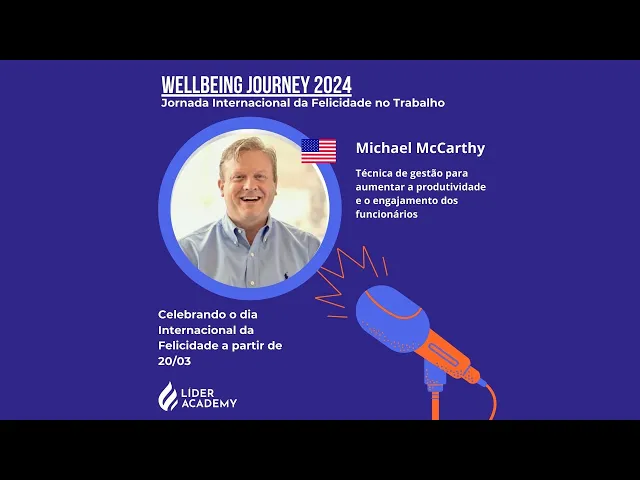
[Music] wellbe Journey Academy hello Michael so I just introduced you and um I mentioned that you were a professor of uh professional executive Devan in Harvard but you way more than that uh and I know that you bring happiness into the workplace so I would like you to tell us a little bit about that how do you how do you how does what is the importance of having happiness in a workplace how to engage uh a the employes to have a positive workplace Bonia and thank you for having me on the show The reason I was interested in positive workplace and is a class that I'm teaching at Harvard and executive Ed is in 2016 I retired I was 36 years years old and I had a successful money management firm and everything looked great in the United States retire early that's the dream and it really was the American Nightmare for me I became really depressed and what I hadn't realized is that I lost my meaning and purpose in life and going around on vacation for the rest of your life is not meaning and purpose I wasn't helping anyone I was just being selfish and hedonistic and it wasn't fulfilling so I went to Harvard to take the positive Psych ol ology class there taught by tal Ben Shahar and two things happened one is I realized that uh I had lost my meaning and purpose and that was the core problem uh also I had a bad diet so I actually changed my diet there was a a great book by DrJulia Ross called the mood cure and by changing my diet I ended up getting the brain chemistry that I needed and that inspired me to create the first food company in the world that helped people with anxiety and depression it was called booty bar bu Udi and it was Sanskrit for budah or wise because all the ingredients were wise and did something for the brain and I thought well that'll be my meaning and purpose helping people get happier by changing their diet I thought I could scale with it so I took the entrepreneurship and Innovation class at Harvard to stay organized because I was procrastinating a lot and making the company was amazing it was the first company that I had made that wasn't focused on money it was focusing on helping other people and it was the most fulfilling experience of all all the seven companies I've had that was the most fulfilling because I was connecting with people and I was helping make the world a better place it was also my least profitable company no regrets I was I was wealthy in satisfaction action and that's how I became a professor was I was afraid of procrastinating again and I went to the professor and said can I take the class again and he said no but you could be a a grader and a teaching assistant and I just kept getting bored with being the grader and teaching assistant and eventually I became the professor and then during covid um well actually it was before covid I had started to work at another another school and on the first day this was another College undergrad my first two classes were 100 students and 20 of those students they were all female came to me and said I have an anxiety and depression problem can you help and they were sharing that with me because I told them I became a professor because I got depressed being retired and and I have no problem being vulnerable so I kind of made them feel psychologically safe to share with me and I thought wow that's a lot 20% of students are anxious and depressed and then I went home and I thought we because we had a lot of people from Latin America in our class this school has about 150 different countries represented it's like teaching at the United Nations and I know that in Latin America uh there can be so much esmo with the men and I thought I wonder if the guys are just as depressed they just don't want to share it cuz it was all women I thought if 20% were women what if the real number of anxiety and depression in my class is really 40% and I went to the dean on the first day of work no I'm sorry the next morning second day of work I went into the Dean's office and I said statistically you're gonna have a suicide here got huge like what do we do about that and I said well just look at the data you know you have somewhere between 20 and 40% of your student population is anxious and depressed they're they don't have any family support because they just left their country for the first time they don't have their pets they don't have their friends uh they're not terribly welcome in the United States the United States has the United States is full of immigrants and they've never welcomed anyone I'm Irish and Italian when the Italians came they weren't nice to them when the Irish came they weren't nice to them it's like the new ones just don't get treated well and I said they're they're 18 they don't have the skills they don't have the resilience I they don't have the social support they're vulnerable so I taught a class on positive psychology to 150 students on campus and I created a I created something called I've made this up I created a thing called the 3: a. m. friend it was a positive intervention there's no evidence based behind it I just made it up and I said hold up your hand think of all the people that you're willing to talk to or have call you at 3:00 in the morning if they have a problem and and so the hands were going up some were like three three fingers some were like 10 and it said now show me how many of those people know that you are their 3:00 a.
m. friend you specifically said at 3:00 in the morning when you're really having trouble you know that it's okay to call and wake me up and all the hands go down and they said this is the problem with people who are feeling vulnerable they feel like they're a burden so if you really love your friend call each one that you would be willing to call have them call you at 3:00 in the morning and let them know that when things aren't okay a okay for you I am here for you and two months later I got an email from a student and he said I prevented a suicide called said he was going to take a bottle of pills and remembered that that he had gotten the 3:00 a. m friend call from him a few months earlier and he went over to his house 3:00 in the morning just chatted with him and he didn't take his bottle of pills and when I applied to University of Pennsylvania's master of Applied positive psychology program uh I got in and they only take about 30 people a year and the father of positive psychology is Martin Seligman and he it was really it was like learning from Freud and now uh Marty is giving his the last class of his career at Penn and I'm one of his teaching assistants so every Tuesday I helped teach positive psychology to undergrads with the father of positive psychology and now I really have meaning and purpose in my life and my thesis was I had to move positive psychology in a positive direction and I thought you know people spent half of their Waking Life at work and my generation had always been here's your paycheck do what I tell you to do and I could care less if you're happy or not and I saw a real opportunity with Gen Z that I have a lot of respect for them I know a lot of older Generations don't understand them but I feel that they have a higher ethical structure than my generation they will quit if they don't like you if they if they don't think that uh what you're doing is is ethical they they'll leave without another job and they really do want to be seen as whole people and I thought what if work was great I mean what if work was a great place and that was that was my thesis so I actually made uh a guide book on exercises that you can do and since it was during covid all the exercises had to be done either in person or online uh they would only take a few minutes and they wouldn't cost any money because corporations are always really big on saying no by saying we don't have budget so I thought I'm not going to get that objection everything's going to be free and I've done it interestingly enough I've done it for major corporations uh like Nissan and also uh a lot of government agencies so uh we've been called in uh to NASA when they did the Artemis launch that was exciting uh the FAA the EPA the Clean Air Act and it's really interesting to be able to share really easy Concepts to Major organizations that are managing thousands of people and making those lives better even though I'm probably not going to meet those people um it's it's really it's a fun job I think I have the best job in the world that's why I you share one of those uh suggestions from your guideline uh yeah there one of one of my favorite ones and this this was something that came from the EPA uh it was a challenge they said when we were in person we had really good um really good brainstorming sessions very creative and now we're all remote and and the creativity is dropped and I remember that the but DrBarbara Frederickson from University of North Carolina became famous for the broaden and build Theory which was trying to figure out why do we have positive emotions like what's the point you negative emotions like fear and anger can help with survival and they can help protect you and prevent you from danger and and then you can procreate and the species survives so we're kind of negatively biased and that's why we survive because we're always looking for danger but the world is a lot safer than what it used to be so Barbara was trying to figure out why do we have positive emotions and it turns out that by having positive emotions you actually have greater peripheral vision like physically in a positive emotion when you're in a good mood you will have greater peripheral vision and that increases creativity because you actually physically look up and you look around and you start to connect things because you literally see different things that you could connect in a brainstorming session and when you're in a bad mood you lose peripheral vision and you kind of look down at the floor and the EPA was trying to figure out why do we have such low creativity on zoom and I said you're staring at the camera you're staring at a point you've lost your peripheral vision you're not up and looking around like that's it like I it's it's physical it's not it's not anything else it's a physical problem and they go how do we fix it and I said well you have to have an anchor day where everyone comes into the office and that anchor day is a brainstorming day and a lot of people did not want to come into the office because they would come into an empty office and be on a zoom call with everyone else because they didn't have an anchor day they could choose whatever day they wanted you should not allow people to come any day they want if it means they're going to come into an empty office because then they get resentful and say well what was the point of that so you should only come into the office when there is a purpose and brainstorming is a purpose coming in to have really great lunch where we all bring in food for each other is a purpose because I'm noticing that with hybrid and remote work culture is being lost and there are people that are in the workforce gen Z that have never been in an office and we don't get that the older Generations don't realize they've never seene culture they don't know what it is and they're not valuing it and it's really an interesting challenge for me to see how do you actually navigate this one uh but I would but I would say like one of my favorite ones is if you're going to have a brainstorming session you would do it in person versus on Zoom because of peripheral vision that's amazing and it's and it's so simple it's very simple yeah yeah even now if you did if you had to do remote if you had to do remote and there's no way you're going to do it in person let's say it's a global company get rid of zoom and have people on an audio call so what I would do instead is so let's say that you and I would team up let's say we have a team of 10 uh we would do diads so you and I would put on our headphones and we would go take a walk wherever we want to walk so I I like the ocean so I would go walk along the ocean uh if You' like to walk in the park or walk in the woods or walk with your dog uh you would go do that and we would just talk together we would we would get our ideas and then we would then present our ideas into a larger group so let's say it would be a a phone call of four people that's probably the max because that gets a little little uh confusing and then you share these better ideas and then you could go back onto Zoom where people have these more developed ideas and for your introverts that are in your group uh people would actually list out ahead of time ahead of the meeting what the ideas were so that the introverts could spend time thinking about it you the extroverts like I'm really an Ambert I go back and forth uh you could throw out an idea to me and I can run with it other people need to think about it so being really thoughtful about how others want to interact with you is also important so the fun part of my job is that people give me these challenges and I just make up up policies and exercises to do based on the research that I learned at University of Pennsylvania and this is Uncharted Territory for all of us and I think it's fascinating I think that we could make the workplace an amazing place and a lot of people kind of see it as annoying this hybrid remote no one's really happy and I'm like could you just look at the opportunities that we have in front of us and do something with it so so I think it's kind of fun I think I think what's happening now is fun I like it uh you you just gave us a based science-based information on why we need to open our Horizon right it's physically it's our Optical field and uh what you described calling talking in in peers and then in in quars is one of the uh liberating strictures I don't know if you're familiar with that technique but that's also a technique on getting introverts to put them uh into the world and walking is one of the suggestions for negotiation because when we yes because and for two reasons one is because when we walk we walk side by side so we are walking together towards a a a place a purpose so it's not that we are one against the other we are together walking towards a direction and we keep so that makes us because negotiation is not uh as one against the other it's both of us within a circumstance and we have to figure out a way to transform that conflict into something that is not a conflict so that's we we are whether we like it or not we are bonded into that situation so and also walking is about the physical movement that we need as human beings I love that I love that because I I also teach negotiation and I and I tell my my I I do a poll in the beginning you to raise your hand if you think that the counterparty is your enemy and usually over half the room views them that way and I said you know um if you're TR trying to sell a house and there's only one person that's interested in your house it's not very helpful to view them as the enemy Michael let's go going back to the positive psychology uh I would like you I would like to have your uh takeaways on how that affect the workplace how can we make people more engaged because engagement in a way is the base for having a a nice culture if like you were talking about it we were talking about it like if we want to if we work if someone Works willing to leave there is an impact on the whole environment so uh what would you s suggest to engage employees and bring this positive happiness culture into the workplace I would be much much more thoughtful and slower about the hiring process so two things I would do in the hiring process the first one would be I would only hire for meaning and purpose so one interview question would be how does working at our organization fulfill your personal meaning and purpose in life and to see what they say and if it's not something thoughtful that's going to be informative it's going to be if they give an answer like well it's it's close to work or I can walk to work or you have a really great retirement plan that's not great and I actually learned this from the co-founder of madna DrBob Langer who is the Pioneer in creating mRNA technology and when he made the covid vaccine we interviewed him on our podcast and and I asked him uh how many people quit during covid he said none I said did you have to give any raises no did you give any vacation time no any bonuses no how'd you do it he said we only hire for meaning and purpose and when covid happened people saw it as an opportunity to do their life's work and I wow so hire for meaning and purpose the second thing is give the autonom of the department that's going to take in that person so let's say let's say Joseph uh is applying to a job at at Apple instead of the human resources department interviewing Joseph and then saying Joseph is better than the other applicants and and sending them to that department send Joseph to that department and let the department decide if they want to hire Joseph so you could send your final three candidates so let's say it's going to be Joseph Jane and Maria send those three people in for a week pay them pay them with the understanding that the team is going to pick when the team picks the right person they're going to be intrinsically motivated to make sure that they fit in and they they they're going to be fitting in on on culture and are you really a team player and sure it it is a bit fake because you're only there for the week and you're trying to be impressive but you have a lot of different people with a lot of neurodiversity on that team that are seeing different things about the each person they're going to pick up a lot more from that exercise the other is when you are looking for an applicant ask your team first do you know anyone that would want to be a part of this team and even without saying it uh they're going to be doing the cultural filter of okay well I have I've have Maria and and John are looking for a job oh Maria wouldn't like this job no no no no but John you John John would like it John would fit in so asking existing PL employees because if you don't fit the culture you're not going to you're not going to fit it the other one is that I would only hire for optimism so there is a assessment you could take called the lot R lot-r it's very short you can get it for free online and you really want to hire people who are optimistic because they're going to be better brain stormers they're going to get along well with other people now in a team let's say a team of five you do want to have at least one pessimist no more than one uh to keep the group grounded from an echo chamber but when you hire for optimism you tend to get people who are more productive uh they also earn more money live longer and if you hire for optimism and meaning and purpose and you give the the team that they're going to work with the autonomy to make the final hiring decision you prevent so many problems of trying to engage people you you get get the hiring right first um you don't have to do a lot of cleaning up afterwards so I would say be really thoughtful about your hiring good and what about the current uh Workforce right yeah so it's like oh well you're here you're here already what do we do uh so what I would do is that I would sit down with them and I would do an exercise called iy guy so iy guy is from Japan it stands for the reason for being and it's basically for intersecting circles that you will have iky guy or the perfect Life's a perfect job if you do what you love and you're good at it and the world needs it and you get paid for it and when you're missing one of those circles it becomes a you can you can actually di diagnose and predict uh what's going wrong with someone typically the biggie that you're going to get is you don't love what you do and and that's the worst one to not have because a lot of people would get a job for the money and they get they get imprisoned by money because now they have a nice house they have a nice car maybe the kids are in college and for them to go to another job that really fits their meaning and purpose very often means you're not going to make as much money and they they won't do that but you can be miserable and Rich at the same time and when people don't have the Love Circle that is really indicative of two things one is you may want to consider working somewhere else and that's okay because the employer is not happy with you the employee is not happy but before we get to that point I would do what we call Job crafting and I know we had chatted about that a little bit before we started the podcast today today and that's really just looking at your existing job through a different lens so it's not like you're going to change the job at all you're going to change how you look at that job and if you can do effective job crafting it will work and job crafting can be hard I was working at a college where the students were very wealthy like really wealthy bodyguards chauffers that kind of thing and they just didn't care were they were not engaged students most of them and they were just going to go back home and be rich again and run the family business and it really dragged me down by thinking I'm not making a difference I don't matter I'm wasting my time where's my meaning and purpose and when I did job crafting I realized that I was focusing on my disengaged students trying to engage them and I was ignoring my engaged students and when I flipped it and said you know what I can't be fully present for 50 students in a classroom meaning available for office hours and meeting I really could give a lot of attention to maybe five where I'm meeting you on weekends we're going out for coffee and and that kind of thing and I thought you know that's about as many engaged students as I have so I focused on the engaged students and the disengaged ones I thank them because because I didn't have the time for them and I wasn't going to make a difference with them so all I did was change my focus instead of focusing on what was wrong with my class I focused on the ones that were right and so now my policy with my students is I will match your level of Engagement in this class if you're super engaged I'll be super engaged if you could care less I'll match you there too and and so I'm still working there and I have a lot of peace of mind so I would say you you would do the job crafting with a person based on the icky guy that they have and if you're not good at your job that one's easy to fix um and that one's just basically training so you you can fix things uh and that's what I would do pretty much with uh with the icky guy training and if it looks like it's not a match and we're not going to change this then give them the opportunity to to go look for another job peacefully and not have to sneak around and then you start looking for someone and you start hiring the right way hire for meeting and purpose and optimism and uh thank you and but all of that uh refers to either an individual that is willing to look inside and get to know like have some self- awareness and move on to a better lifestyle like to get is interested in growing or is also relates to a manager that is interested in keeping a good environment a good culture for for the team but uh what about those managers that are not interested because I I see a lot still uh in companies um managers or the leadership that is like it's working that way I don't care uh it's their problem so maybe uh you could bring us a little bit of your experience with the generational conflicts on what to do with those managers that are still resisting sure the from from my I from the research that I've looked at uh I think the biggest problem is the manager layer because 70% of an employees performance is going to be impacted by the manager so if if it's a really great supportive manager that employee 70% is going to bump up because of that if the manager doesn't really care or is complaining that's going to rub off on the employee it's like humans are infectious you know I can cheer you up if I'm in a good mood I can drag you down if I'm in a bad mood we're basic basically just spreading to each other so 70% of your performance is going to be based on your manager now also 55% of managers in the United States are looking for another job only 22% of managers trust the organization that they work for and only 15% of managers are comfortable managing remote or hybrid which means most people don't have a good boss and it's the same diagnostic with the boss the boss is an employee as well because there's someone above that person it's the same thing you sit down with them with iyy and say okay where in these four circles I love what I do the world needs it I'm good at it and I get paid for it what do we need to fix and here's the interesting thing a lot of those managers did a good job before covid when covid came and everything went remote and hybrid they don't know how to do it and so the good news is that iy Circle that they're missing is the good at Circle and that's the easiest one to fix with training so the next thing that I'm moving into is is teaching people how do you manage people hybrid because what they're doing now is really annoying they uh they just they bug you they micromanage you hey are you sitting at your seat uh do I see you work there's software that can see that whether or not you're you're tapping the keystrokes uh there's software that will see whether you moving the mouse but since I teach employees they've all hacked around it they have gifts where they do a screen saver and it looks like I'm there looking at you and moving but I'm really not uh there's a little machine you can buy online that will that will move your mouse when you're not there so it looks like you're clicking on your Mouse um and I sit there and I said you know why don't why don't we take the advice that we got from the CEO of Rico USA who manages 14,000 people he said work where you want how you want the way you want I am not going to measure your input but I will measure your output and I would since this is a new world go to your employees and say listen I'm your boss I that's the way it is and my job is I work for you to make you do a great job job I want you to love your job I want you to love working here I want to support you any way I can through the lens of I work for you what can I do to make your job better so you you flip it and ask them I I cannot believe how many managers guess at what they think the employees need for engagement and they try something I said how about we flip it go ask them easier yeah yeah just ask him have a meeting you don't go there don't you can't be in the meeting because you might shut them down if you have if there's not enough psychological safety in the room but let those people decide what are what are five changes that we want to make in the organization that would make us like this place better and commit to an experiment of doing at least one of those for two weeks so you make the commitment ahead of time so you know that that you can be trusted and you do it so if they say well we're going to make the workday um start at 10:00 a.
m. instead of 9:00 a. m.
um okay we'll try it and and you put down the key metrics of I need the deadlines met I need the quality to stay high and I want no complaints from the customers if you if you hit those three I don't care when you work let's do the experiment and if the experiment Works make it policy if it doesn't you debrief Why didn't it work what what didn't we see that we see now okay what's the experiment what's number two that we're going to do and you just keep doing it you just keep doing experiments and you give people agency and autonomy they will love you if people can create their own workplace environment their own culture why wouldn't they love you we we we get out of the that that's what I call the Pirates uh Pirates uh parrot boss right the one that is like over there telling you what to do and then we move to the assignment boss that gets an output and uh what you're telling in addition to agency I think there's a lot of accountability because the person it it becomes less patriarchal and it becomes more adult in a way I I would say consider the possibility that your employees are much smarter and much more capable than you think that they might be bored they might be resentful and maybe that's why their performance isn't where you want it to be just be open to that but it might be you and it's it's easy to fix it's easy to fix so I see it all as an opportunity I think we're in a really interesting time in our lives where we can work from anywhere and I'm just shocked that so many people see it as um not a great thing they keep comparing themselves to other people oh well they're completely remote uh this got this one's got has a better deal than I do uh what I would like to share with the audience today is a lot of people are saying that they they like remote work uh and they want to keep it they don't want to go back to the office I understand that but a lot of people who work remote are lonely true and it makes sense they're alone they don't want to admit it because they think it's going to be weaponized against them so I would say managers should be spending some time making sure that the remote workers are getting what they need to to combat loneliness and also be open to the fact that maybe all the answers for your happiness and well-being don't come from work and also do some across the board policies of you know let's bring back the weekend and be mindful of what you do so if I'm your boss and I say hey take the weekend off you know you don't have to email me but if I email you on a Saturday or a Sunday and I said don't feel you you can email me back on Monday what I'm saying is not my behavior and what you take in is if I want to succeed and be a manager I need to work on the weekends because that's what I see my boss doing and with them telling me to take the weekend off that's for the worker so it it doesn't work to do that you have to shut down the email server and say to everyone no one emails anybody Friday at 5 p. m. to Monday at 9:00 a.
m.