All right, so, here's the thing. . .
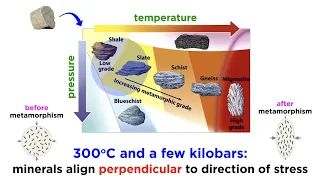
I want to know: What are metamorphic rocks and how does plate tectonics make them? Let's talk about it. First thing, metamorphic rocks are created when existing rocks are squeezed and heated, causing new minerals to form.
If you take a sedimentary rock like a mudstone- squeeze it and heat it enough- you'll get a new metamorphic rock called mica schist. Most of the squeezing and heating happens in the crust as a result of increased temperatures and pressures. Fluids also play an important role.
Metamorphism happens at a sweet spot where the pressure and temperatures are high enough for minerals to transform, but not so high that melting occurs. We're talking between 200 to 800 degrees Celsius, or so. Metamorphism encompasses a wide range of mineral transformations, all happening in the solid state in the Earth's crust over thousands to millions of years.
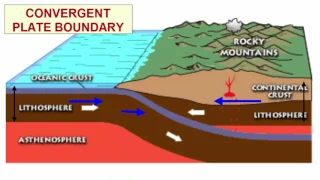
Second thing, plate tectonic theory explains how the solid Earth convects. Simply put, the old lithospheric plates sink into the mantle and are destroyed at subduction zones, and new plate material is created at oceanic spreading ridges. All that sinking and creating of plates sounds like the squeezing and heating that goes on during metamorphism.
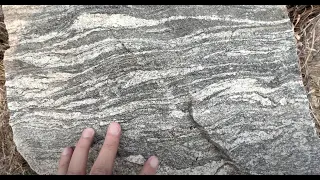
So you'd think that plate tectonics and metamorphism would be best of friends, but really they're more like polite strangers. And the reason for this goes back to the first conceptions of metamorphism that began in the 1700's. So, we're back in the 1700's James Hutton, who's often called the father of geology, brought up early ideas of metamorphic rocks when he proposed that gniess formed by heating underground.
Then, in 1883, Charles Lyell coined the term "metamorphic rocks". Fast forward to the 1900's when Pentii Eskola introduced the concept of metamorphic facies, which began the systematic study of metamorphic rocks that continues today. The study of metamorphic rocks has had a long history compared to the relatively new theory of plate tectonics, which was only accepted by the scientific community about 50 years ago.
This new kid on the block has totally transformed all of the geological sciences. That being said, it's not surprising that the old discipline of metamorphic petrology does not yet mesh well with the much newer theory of plate tectonics. But, we'll show later on how metamorphic petrology and plate tectonics are in fact closely related.
We know generally how metamorphic rocks are created, but there are a lot of different types and they have some confusing and colorful names like "greenschist" and "blueschist". I mean, it almost sounds like the beginning of a Dr Seuss book, or something. For igneous rocks, we can classify them on the basis of the three or four minerals they contain, but that sort of systematic classification doesn't exist for metamorphic rocks.
To review, metamorphism is a kind of rock cooking and plate tectonics is the kitchen. The Earth's hot interior and high pressures far below our feet are "cooking" rocks and causing them to metamorphose. The type of rock that we get after being "cooked" depends on how hot it got, how high the pressure was, and what marinating fluids were present in the "geo-kitchen".
Scientists characterize these geo-kitchens by the temperature and depth domain that they occupy in the Earth. There are three main types of plate tectonic kitchens where rocks are "cooked": there are hot ones where magma dominates, normal ones with thick sediments, and cold ones where metamorphism is controlled by pressure. Aside from squeezing and heating, metamorphism is also controlled by the composition of the original rock also called the "protolith".
The minerals from the protolith will transform to new minerals depending on the conditions at the time the metamorphic rock was formed. Conditions such as temperature, pressures, and fluids. Because there are so many kinds of protoliths and such a wide range in possible temperature, pressure, and fluids, there are an incredible number of possible minerals and mineral compositions that can form.
And this means that there are many kinds of metamorphic rocks with many different names. So, one way to simplify the complexity of metamorphic rocks and relate these to plate tectonics is to use metamorphic facies, the concept that Eskola proposed a century ago. Metamorphic facies are places in the pressure temperature, space just like the diagram shows.
One way to think about pressure temperature space in the Earth is to imagine some depth below your feet where there is a certain temperature referred to as "T" and measured in degrees centigrade (°C). In this diagram, T is shown on the horizontal axis. Pressure is a function of depth in the Earth, so we can show two scales, one on the left showing pressure in gigapascals, and written "GPa".
As a side note, atmospheric pressure is about 100,000 pascals, and "giga" means "one-billion", so 1 gigapascal is about 10,000 times atmospheric pressure. The scale on the right converts pressure into depth in kilometers. Note that normal continental crust is 40 kilometers thick, so the diagram covers pressure-temperature conditions in the crust and the upper mantle.
This metamorphic facies diagram has a lot of interesting stuff on it. There are seven colored areas labeled with the name of a different metamorphic facies. You can tell that greenschist facies rocks form at lower pressures, shallower in the crust, than do blueschists.
You can also easily see that amphibolites form at lower temperatures than do granulites. The names of metamorphic facies sometimes tell you what minerals can be found in a rock metamorphosed under the various conditions. For example, greenschist facies metamorphic rocks contain green minerals like chlorite and epidote, while amphibolite facies rocks generally include black hornblende.
Blueschists contain blue minerals like the sodium-rich amphibole, glaucophane. Eclogite and granulite facies are named after the actual metamorphic rocks that form under those pressure-temperature conditions. Sanidinite facies is named after the high-temperature polymorph of potassium feldspar that is often found in metamorphic rocks formed by contact metamorphism when a large, hot igneous body intrudes sediments and "bakes" them.
The thin white line is also interesting. . .
The curved line shows the temperature that granite begins to melt if water is present. Granite is used because it is representative of the composition of continental crust, Rocks that cross over to the right of this line are called "migmatites" and geologists argue whether these are igneous or metamorphic rocks, in fact migmatites are both. Another interesting set of thin white lines show the pressure temperature conditions where three polymorphs of Al2SiO5, or aluminosilicates, form.
These minerals form in rocks that are rich in, you guessed it, aluminum. There are three key aluminosilicates: : Andalusite, Sillimanite, and Kyanite. Sillimanite is the high temperature polymorph, kyanite is the high pressure polymorph, and andalusite forms at lower temperatures and pressures.
The last interesting thing on this diagram are the five pale dashed lines labeled 5, 10, 20, 30, and 100 degrees centigrade per kilometer (°C/km). These are five different geothermal gradients and tell you about the geo-kitchen. The average geothermal gradient in the continental crust is about 25°C/km, and gradients that are much higher or lower than this tell you that some interesting geology is happening.
For example, high geothermal gradients are found in regions with a lot of igneous activity, like a rift or on a spreading ridge or around volcanoes in an island arc. Low geothermal gradients tell you that cold materials are sinking, and here's the exciting part: knowing what metamorphic facies are present in a given region lets you figure out what was the geothermal gradient when the rocks formed. For example, if you are studying a region where you find greenschist and epidote-amphibolite facies rocks, you are right to think that this region was once 15 to 30 kilometers deep in the crust where the geothermal gradient was about 25°C/km.
It is geothermal gradients that allow us to link metamorphic rocks to plate tectonics. Look at the four colored arrows, which distinguish the four great kinds of metamorphism in order of decreasing thermal gradient: contact, regional, burial, and high pressure-low temperature metamorphism. Contact and regional metamorphism can be related to magma-rich environments such as mid-ocean ridges, island arcs, continental rifts, and hot spots.
While burial metamorphism is associated with sedimentary basins and passive continental margins. and high pressure-low temperature metamorphism is associated with subduction zones. These can be assigned to specific plate tectonic environments: Divergent plate margins and the hot magma-rich parts of convergent plate margins are associated with contact and regional metamorphism, whereas transform plate margins are associated with burial metamorphism, and the cold parts of convergent plate margins are associated with high pressure low temperature metamorphism.
We'll stop here. All this talk of geo-kitchens has made us hungry. We hope this video made you a little more interested in metamorphic rocks.
We also hope that when you study them, you will think about how plate tectonics made the geo-kitchen your metamorphic rocks came from, and the long hot journey it went on before you held it in your hand.