Hello this is a lecture topic video discussing intermolecular forces now we've already seen some intermolecular forces as we've been talking over this last chapter to of material um and again what does an intermolecular force actually mean this means this is something right some sort of force that's occurring between two molecules okay so that's what the inter is telling us all right so this is between Molecules all right and the biggest one that we've talked about thus far are ionic interactions so when we start to form ionic um compounds all right these positively charged cations interacting
with these negatively charged um anion okay um well these two things again they interact through these charge charge interactions that are essentially dictated by kum's law okay and these are actually really quite strong interactions which is why most ionic Compounds are solids at room temperature okay but the other intermolecular forces that we're going to talk about today okay we're not talking about straight up charge charge interactions now they are charge based in other words they are partial charges okay partial charges interacting with other partial charges so in other words they can still be kind of
derived from kum's law all right um but they're a little bit different than than what we see with ionic interactions And so the ones we're going to talk about are called ion dipole interaction actions dipole dipole interactions and there's a special type of dipole dipole interaction it's called a hydrogen bond all right and then finally we're going to finish this off our discussion off with London dispersion forces okay and what you're going to see again is that while we're not talking about point charges interacting with point charges much like we do when we're Talking about
ionic compounds interacting all right we're going to be seeing these partial charges interact now with that being said all right you can see how this is continuing to build on these models that we've been talking about so it's absolutely essential that you can draw leis dot structures because without leis dot structures you cannot assign geometry if you cannot assign geometry you cannot start to talk about the polarity of the molecule and without Being able to talk about the polarity of the molecule it's really hard to understand what's going on with these intermolecular forces so again
I uh challenge you to take a step back uh go back and review your notes maybe rewatch some lepic videos um to kind of help support the new information that we're going to be talking about so again if we're talking about atoms that are held together in molecules all right they are held Together by int molecular forces okay again this is atoms all right within a molecule okay those are held together by int molecular forces that's intra means within okay so within the molecule um and those forces are coming from those shared electrons interacting with
the nuclei of the bonded atoms okay so that's an INT molecular uh interaction now we can start to build these all right you can imagine taking uh many of these compounds or these ideas that We've been talking about and building big biomolecules okay like DNA and RNA and protein okay well again Lots um these molecules are very large these biomolecules are very large they have lots of these other functional groups okay we started to talk about functional groups these grouping of atoms that have particular types of chemistry that they're really intimately associated with all right
well what you can start to see is that you can get functional Groups interacting within a single molecule that would also be an intra molecular Force okay now that's not what we're going to be talking about this time we're going to be talking about again intermolecular forces things that are happening between different molecules okay and it is these sorts of forces these intermolecular forces that help hold molecules together in these condensed States what do I mean by condensed States I'm talking about our Liquids and our solids so our liquid and our solid phases okay uh
when we're talking about um these inter molecular forces whether it be uh through water or or or whatever the compound may be okay when we're talking about a solid or a liquid it is these intermolecular forces between these molecules or these elements all right that are actually holding these things together okay so let's take water for example all right so here's water down here and you can See that there are six of them each water molecule has all right two oxygen hydrogen bonds all right and we've talked quite a bit about water all right it's
got a bent molecular geometry all right and you can imagine drawing in our little Bond dipoles okay our bond vectors however you want to whatever you want to label these things as that's kind of helping us uh visualize the polarity in those bonds remember Oxygen's quite Electro negative hydrogen Is not so much uh Electro negative and so that plus within our arrow is kind of focused on our hydrogens all right because it's the least Electro negative of the pair within the bond right and so that oxygen is kind of drawing all right drawing that electron
density up into the oxygen and then of course don't forget we have our lone pairs okay and so we get these two Bond vectors these dipole these Bond dipoles and what they do is they give us this overall dipole Moment that's going somewhere in this direction again this is a function strictly of water's geometry okay and because of this particular geometry and the fact that water is a polar molecule multiple Waters can interact with each other okay and what we can do is we can start to draw in or symbolize these interactions with these blue
dashed lines that you see here okay those blue dash lines and so what you can see is that water will interact with each other All right in this hexagonal kind of shape all right this six-sided shape here right so um what we can start to do though all right is think about um adding energy okay and what do we want to do okay uh we want to add energy in here so we can increase the temperature and what's that going to do what that's what that's going to do is let's assume that we're dealing with
um solid water okay so we're dealing with ice All right and we have our Waters that are in a nice organized uh sort of fashion here okay all interacting and this nice hexagonal sort of lattice all right so what you'll have start to see is as we start to increase the temperature is these molecules will start to absorb that energy okay they'll start to absorb that energy and then what If eventually what we'll do is We'll add enough energy let me erase these guys all right what we'll do is We'll add enough energy is that
we'll start to break these interactions okay we'll break these interactions and essentially what we can do right you can imagine what we're doing is having a phase transition where we're going from solid water ice right into liquid water okay liquid water now our water molecules are still very much water molecules all right but now they have more freedom there's more energy in the system and they are not Bound to interact with each other in that rigid structure that we saw in ice but they are still interacting with each other all right that's why we still
have our condensed State again which is water okay in this case liquid water all right and then what you can do is you can imagine adding even more energy into that system and then look at those bonds what what can we start to do with those interactions okay those intermolecular interactions we can Start to break them okay and so then what do we have we have another phase transition we go from liquid water to being gaseous water okay where essentially all right these guys take up so much space all right they're almost essentially liberated and
they are so far away from one another that they don't interact anymore okay and so what you can imagine we we can do with any sort of condensed State like whether it be a liquid or a solid all right is we Can start to add energy into that system to break those intermolecular forces that are holding these things together in the liquid uh State or the solid state okay but when a substant converts between different phases of matter okay so just like what we're talking about this this solid to liquid transition or the liquid uh
to gaseous transition all right the molecular makeup this is really important the molecular makeup of that substance Remains the Same okay yes We broke those intermolecular interactions which is allowing us to change our state okay but we never broke okay we never broke those oxygen hydrogen bonds okay um is still is water okay so U that's an important concept all right we're doing these phase changes we're not changing the chemical makeup of that substance whatever it may be all right we're just overcoming those intermolecular reactions that are allowing us to change our physical States all
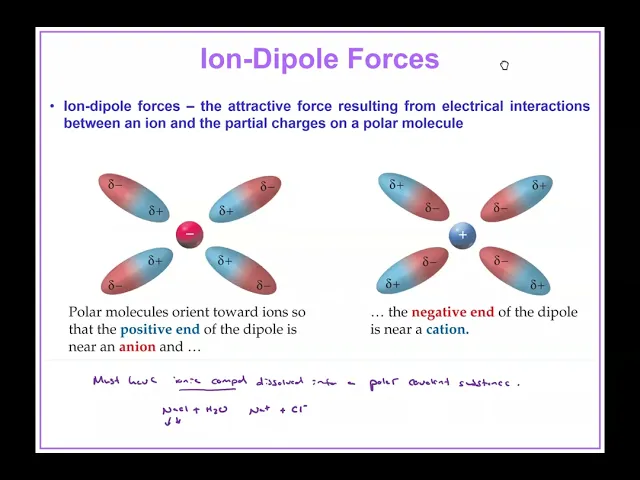
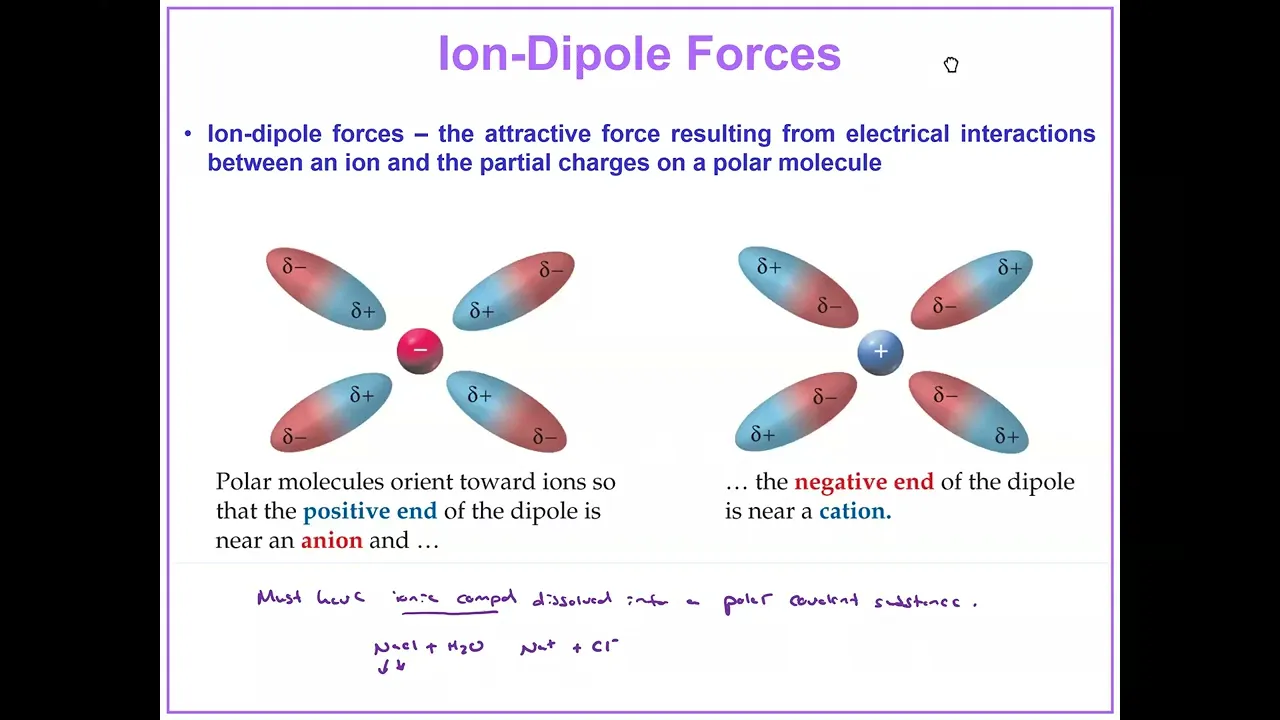
right and so those changes again um in our state is due to overcoming those forces that we see among those individual molecules again those are our intern molecular forces that we're going to be focusing on today okay and so our first one again our first of four all right is an ion dipole Force okay an ion dipole force and this is the attractive force that results from electrical interactions between an anion or excuse me an ion and the Partial charges on a polar molecule okay and so we have to have two different things here okay
you must have let's just write this out you must have an ionic compound dissolved in a polar calent substance so this is the type of force where you have to have a mixture of Substances where one of those substances has to be an ionic compound and the other substance has to be a polar calent substance all the other interaction that we talk about all right can happen within a pure substance by itself or a mixture of substances but this one um has to have a mixture of substances okay and so you can imagine all right
that we take um you know everyday table salt so NAC okay and we dissolve it into water all right so NAC plus water okay well what's going to happen with that NAC when we drop that into water well it's going to break up into its constituent ions we're going to get our sodiums and we're going to get our chlorides and what's going to happen well our sodiums have a positive charge so again we're going to get our sodium cations and we're going to get our chloride and ions okay so these guys are kind of free
floating around okay Not really free but they're they're not interacting with each other and let's see why they're not interacting with each other so again let's revisit the molecular geometry of water so let's draw this out okay so we have our bent molecular geometry okay again we have our two lone pair of electrons all right and we already said that that oxygen hydrogen bond is very um polar okay in other words the electro negativity difference Between that oxygen and that hydrogen hydrogen is such that the oxygen is with drawing a lot of electron density away
from that hydrogen all right and it's happening to both of these bonds so we get these two Bond dipole vectors that we can draw okay and we have our lone pairs that are out here okay and so what you can start to see is that what we're going to get all right is this polar molecule again which is water all right and and we can see that because that Again those vectors are just showing us all right that that electron density is moving away from those hydrogens all right and up towards the oxygen all right
and those lone pairs so that we get these partial positive charges okay partial positive charges and we get these partial negative charges kind of focused out here okay and so again this is polar we can see this just from these bonds these Bond vectors all right these dipole vectors all right you Could also ask yourself the same questions that we asked in previous lectr toopics all right one is the molecular geometry the same as the electron cloud geometry or is it Square planer all right well again our electron cloud geometry in this case is tetrahedral
but our molecular geometry is bent so this question that the answer to that question is no all right and all right so therefore it already tells us that this is a polar molecule it's not Symmetrical in terms of its shape all right it does have only carbon hydrogen or oxygen hydrogen bonds all right but in terms of the molecular shape or the geometry is not symmetrical so we have a charge distribution we have a polar molecule and this polar molecule has a dipole whole moment all right there is a separation of charge one side of
this molecule has one particular charge and the other side has a different charge okay and so um and so what do we have we Have this polar molecule all right one side with this partial positive charge and another side with this partial negative charge well what you can imagine all right is that these negative charge up in this diagram let's imagine that that's our chloride okay and then let's imagine that these orbs okay with a partial positive side in blue all right and our partial negative side um uh kind of indicated in this red all
right is our water all right and so what You can imagine is let's let's take this image of water and put it up here okay what you would see is that those waters are those hydrogens within the water molecule those partial positive charges are now interacting with that point charge that is the chloride annion okay and so what you can start to see is that what we would call um a solvation all right or a hydration of this chloride anion by those partial positive on the on the hydrogens of the water molecule Okay and so
what they do is they completely surround this annion okay and we're only showing in this particular image that uh within the plane of the page there are four of these water molecules that you could imagine orienting around chloride now let's think about what's happening with the positive charge all right let's imagine that this is our sodium okay well in this case all right again Imaging that these orbs that are Surrounding it are water now what you see is that the partial negative charge all right is all oriented and interacting with that positive charge on the
sodium cation okay so now instead of the hydrogen's interacting with the Sodium cation we actually have these elect drawing clouds from those lone Pairs and the oxygen actually oriented towards uh that positive charge of the sodium okay and so this is called an ion dipole interaction okay and again this Is because we have an ionic compound that is dissolved inside of a very polar Co valent substance all right and what you can see this is a better U kind of pictoral representation of these interactions right where again our oxygens all right which have our partial
negative charges all right are interacting with our sodium and our hydrogens okay with their partial positive charges Are all interacting with the chloride okay and this is one reason okay these strong interactions these strong ion dipole forces these strong ion dipole interactions okay are the whole reason that salt dissolves in the first place okay essentially what we do is we replace the interactions that occur between the sodium and the chloride with these new interactions with water okay and essentially what we're doing again is we're Hydrating this is called hydrating our ions okay and by hydrating
those ions essentially what we do is we're shielding uh those sodiums and those chloride from one another in other words they're interacting so intimately with the water that's surrounding them that they can no longer interact with themselves and that's what keeps them U essentially dissolved in water okay so again that is our ion dipole interactions okay we there's a there's a Bare minimum requirement that we have to have an ionic compound that is dissolved within a polar calent uh substance okay now our next interaction our dipole diapole forces okay so remember we've talked about um
hydrogen fluoride okay quite a few times actually and remember that this was a diatomic molecule that again is very polar okay you can tell that all right because there's this buildup of positive charge out here okay around our hydrogen all right again Represented by our Light blues um into our dark blues and our purples and there's this negative charge buil up up okay that's occurring out on our fluoride okay or the Florine all right again represented by our yellows our oranges and our Reds okay so we have um this charge distribution okay that's that again
um is leading to this unsymmetrical distribution of our electron density okay so again we get a build up of partial positive charg these Are partial charges not full charges okay um and what we can tell from this again is that we're going to have this molecule is polar and it has a pretty strong dipole moment okay dipole moment well what you can imagine all right is that if you have a pure substance let's say again that we're dealing with just HF okay hydrogen fluoride all right we can get dipole dipole forces okay between these These
hydrogen fluoride molec ules all right and that's the attractive Force resulting when polar molecules line up okay so they're lining up or they're reorienting themselves so that the positive and negative ends are close to each other so again let's imagine that this is our Florine and this is the hydrogen all right again we have our partial positive charge on this side our partial negative charge on this side all right well now these molecules are going To orient themselves so that the partial negative charge on the second molecule interacts with the partial positive charge on the
first molecule so on and so forth so these are again dipole dipole forces okay and these are happening okay this has to have in order for this to happen you have to be dealing with something that is a polar Co valent molecule okay polar coent molecule and It can be a pure substance or it can be between multiple like a mixture okay of polar coent molecules okay and so um it's pretty straightforward to think about two of these guys in isolation all right but remember typically when we're in a lab setting okay we're dealing with
all right mole values we're dealing with many many many molecules of a particular substance okay and so you got to kind of take into account what's really Happening in that sense all right and what's really happening in this condensed State okay again we're talking about our solids and our liquids okay where there are many of these molecules in close proximity what actually happens that the dioles Orient themselves in order to maximize this is a this is uh kind of a balancing act if you will we want to maximize their attractions okay while we're minimizing The
repuls ions okay and so you can see that within this little cartoon figure here all right our attractions are in red there are a lot of these attractions these negative charges interacting with these positive charges okay and here's one there um and this guy can interact with that guy over there but there's also these charge charge repulsions okay so we got to think take that into account as well right these charge charge Repulsions let just keep with the scheme here here in blue so we got to take that into account as well so what these
things ultimately do when we're talking about our condensed States okay our states of matter our solids and our liquids all right is they're going to orient themselves so that we're maximizing these these uh positive negative interactions all right and minimizing our positive positive interactions okay and our negative Negative interactions so those repuls of forces so maximize attractions minimize repulsions and again all right I these cartoons they're showing like full negative and full pos positive charges but that's not what we're dealing with here in any of these sorts of situations okay these are not ionic interactions
right these are partial charges interacting with each other okay whether we be talking about our dipole dipole forces okay um or if we're talking about All right the the dipole Force okay when we're interacting with an ionic um uh an ion okay when we're talking about our ion dipole forces okay so again these can be partially described by coolum's law or essentially they fall out of kum's law because essentially they are still charge charge interactions now this is a dipole dipole Force there's a special type of dipole dipole Force okay so polar coent molecules can
make dipole dipole forces But not all polar coent molecules can make something that we call hydrogen bonds all right and so before I go on to that I almost skipped over a slide I apologize okay these moments these dipole uh dipole forces all right okay if they get strong enough they can actually affect the physical properties of a substance okay and so what do I mean by that well generally speaking as we increase molecular weight okay of our compounds all right they Tend to increase in the in terms of their boiling Port how boiling point
how much energy does it take to go from this liquid to gas transition all right um and so but what you can see here is in this case all right we have uh five very common organic compounds so these are some common organic compounds s and if you look at their molecular weights they are approximately the same Molecular weights okay or molar masses all right actually let's use the symbol for marar Mass okay molecul or molar mass okay they're about the same but okay so and I just told you the trend is as you increase
in your molar mass or your molecular weight okay you tend to increase in your boiling point all right well these are approximately the same but what you can see is that we have a steady Increase okay in our boiling points and the question is well why is that okay so why don't we look um at some of these molecules okay and again we have propane so this is one of the hydrocarbons we've talked about okay otherwise known as alkanes and so we can draw our leis Dot Structure for this okay and we can start to
think about the geometry again every one of those Central carbon atoms has Its own particular geometry okay and in this case they're all tetrahedral all right so in our case of propane all right our molecular geometry is is equal to the electron cloud geometry okay okay because if you look at each of those carbon centers there are four uh electron domains around it okay and that tells us that we have uh a tetrahedral okay electron cloud geometry And all four of those electron domains are bonding okay that also tells us that our molecular geometry is
also tetrahedral so if we go back all right to our questions when we're trying to figure out polarity okay again we can do this with our bond vectors our dipole vectors all right but let's just ask our questions um our answer to our first question when we're trying to determine um our if a molecule is polar or not all right was is our molecular geometry the Same as an electron cloud geometry and or is it um a square planer okay well we can say yes here okay and the second question you ask all right uh
of two is are all those pral atoms essentially the same all right and these are all essentially the same we have hydrogens bound to everything okay yes there's carbon carbon Bond but that's not very um that's a pure non-polar Bond all right and we again we also consider that um these carbon hydrogen bonds are Essentially non-polar but so we're going to say yes this is not completely true okay um it's not completely non-polar all right but we're going to call this a non-polar molecule and we know it's not completely uh non-polar because again there's a
little bit of electr negativity difference between these guys okay and that little bit of electro negativity difference does give us a Very slight d pole moment and remember what the dipole moment is that's mu and essentially it's this this this um where we take the magnitude of our charge separation times the distance all right between those charges okay so we had a very small dipole moment so this is this is more or less non-polar molecule okay now how about aceton nitr all the way down here on the opposite end okay well ch3 CN that's a
nit let's draw L do structure okay and let's start to think About how this looks in terms of its polarity okay well again we have a little bit of electro negativity difference between these guys and then this carbon carbon bond is really non-polar at all but we have a pretty electronegative nitrogen atom connected to this carbon all right and so what do we see we see something like this all right and so we can also ask ourselves this question all right and or go Through these questions that we asked over here and we're going to
come to the same sort of conclusion that this in fact is a polar molecule a very polar molecule all right again we can see that by looking at our dipole moment value of 3.9 that's a pretty large value and so we have a pretty large dipole all right and so our molecule what we're thinking about is going to have a charge separation okay We're going to have this partial positive charge kind of focused down on those hydrogen ends all right and this partial negative charge that's focused up by that nitrogen and this lone pair on
the nitrogen okay so we have a very polar MO molecule okay and so how does that kind of relate the fact that uh propane is non-polar in aeton nitr is polar okay well I'm telling you this because this helps explain this boiling point Trend that we see okay well these Non-polar propane molecules all right they can't interact very efficiently through these dipole dipole interactions yes they can interact through with each other all right but it's not very significant especially when when you're comparing it to the the dipole dipole interactions that aceton nitrol can make with
itself because again you can imagine that we could draw another aceton Nitro molecule right Here where that partial positive charge is interacting with the partial negative charge that's focused up here on that nitrogen all right and now this partial negative charge down here is free to interact with another aceton nitrol via another dipole dipole interaction okay and so the fact that these guys interact so well with each other okay we get a large dipole and these large dipoles lead to Greater dipole dipole forces and because of those greater dipole dipole forces okay we also see
that it takes more energy to disrupt those to disrupt those interactions okay and that's again why we see that we have a much larger boiling point for aceton nitr than we do with propane Okay now going to that special dipole dipole interaction that I started to introduce before right is hydrogen bonding okay so all polar calent molecules can make these dipole dipole interactions but not all polar calent molecules can make hydrogen bonds there is a special um couple of uh of of things that have to be met a criteria that have to be met in
order for something to be able to make a hydrogen bond okay and water again is another Great example of a molecule that makes Not only dipole dipole interactions but also makes very strong hydrogen bonding interactions okay and so let's take a look all right at water in its solid state so this is a picture okay or an image of a snowflake okay and you can see that um and maybe you know this maybe don't all snowflakes have these six points all right coming off of the center all right and again that's because solid ice makes
these hexagon Sorts of structures that we saw before I can kind of highlight one right there they make these six-sided kind of uh uh Crystal lates if you will okay that kind of lead to this six-pointed structure for our snowflakes all right and so um these water molecules if we take a closer look all right so we have this crystal lattice this water lattice okay they're kind of held together through these interactions that are represented by these dashed bonds and so what we can Start to do is we can start to zoom in a little
bit closer and see how these water molecules are actually interacting with each other okay and so so remember again we have these partial positive charges out here on our hydrogens all right and we have these partial negative charges that are kind of building up on this oxygen that's again because we have electro negativity differences and we also have these lone pairs of electrons out here okay and so What is is a hydrogen bond because what I want to say is that this right here okay is a hydrogen bond okay that is a hydrogen bond well
there's some criteria for a hydrogen bond we have to have an electronegative atom okay that is bonded to a hydrogen and those tend to be nitrogen oxygen or Florine okay and why is that so important Okay because a hydrogen bond is an unusually strong dipole dipole attraction okay that occurs among molecules in which a hydrogen is bonded to a highly electr negative atom again are nitrogen oxygen Florine and what does that do because the electro negativity difference that gives us one side of this bond that has this partial positive charge and another side that has
a partial negative charge charge okay so that's the first criteria for a Hydrogen bond okay the second criteria all right is that we have to also have at least one lone pair on our electronegative atom okay so again only at least one nitrogen tends to have one lone pair oxygen oftentimes has two all right and again Florine all right depending on the scenario could have up to three in this case okay but it needs one okay you have to have at least one lone pair of electrons okay and then what happens all Right is the
partial positive charge on a nitrogen say interacts okay let's just say that we have an oxygen over here okay that has let's say we have an oxygen bound to something else let's have that's what the N let's just leave it like this okay and that's got a partial negative charge okay and you get this interaction okay between that hydrogen and that lone Pair on another Electro negative atom now this can also be within itself like within a pure substance all right or it can be within a mixture the way I've shown it here this would
be a mixture all right we got one molecule okay that has uh the hydrogen connected to this electr negative nitrogen all right and then another molecule that has an oxygen that has at least one lone pair in this case I drew two okay and what you get is this kind Of partial charge partial charge interaction between okay that partial charge on the hydrogen and a partial negative charge on another electron netive atom that has a lone pair okay that is essentially the definition of a hydrogen bond okay um but this is all predicated on uh
it fitting those two criteria okay you have to have a hydrogen that's bound to a really electr negative atom all right and you also have to have another electr negative Atom that has a lone pair of electrons okay and again this allows for us to have these partial uh positive charge on the hydrogen interacting with a partial negative charge on uh whatever that other electronegative atom is okay and what you can see is that this hydrogen bonding can have a dramatic effect on the physical properties of a molecule okay and so what I'm showing you
here all right is uh these coal binary compounds of group 4 a 5 a 6A and 7A that have uh again binary compounds with hydrogen okay so what you can see again is we increase the molecular weight all right so in every case as we proceed upward okay we're moving down as you see these guys all right we're going from the top of the periodic table and that column to the bottom so top top to bottom top to bottom and then top to bottom all right So again what are we doing we're increasing the molar
masses of our compounds and what you see is that we get this uh very gradual increase in our boiling point okay and so this is a pretty good Trend that we see for groups 4 a 5A 6A and 7A now what you may have noticed is that I've left off a couple places okay I've cut left off some essentially the founding members okay of each of these groups all right let's take a look and see what those look like All right now when we add those in what you can see is that our member okay
of group 5A all right so that's nitrogen that would be ammonia okay that's the binary hydride for group 5A or water okay if we're talking about 6A so oxygen with its hydrogens all right or Florine with its okay so hydrogen fluoride right what you see is that these molecules do not follow the general Trend that we see with all the others and the question is Well why is that and what I'm going to tell you is that it's because of their ability to really hydrogen bond quite exquisitly okay and so what you can see here
is that I've given you guys the boiling points again now we're in degrees Celsius okay versus before we were talking about uh Kelvin all right so these are in degrees celsius a little bit easier for us to kind of wrap our brain around and what you can see is that ammonia all Right compared to the other members of group 5A has a pretty high uh boiling point all right so does hydrogen fluoride and so does water okay and the reason is all right is because these bonds are so polarized okay and so we have very
polar nitrogen hydrogen bonds here okay again we can draw our little uh Bond vectors all right our bond dipoles and here again remember Florine most electronegative atom Okay and oxygen okay so we have very very polar calent bonds okay and so again this is a a direct result of the fact that there's such a massive electro negativity difference between these atoms and hydrogen okay and the other reason is it's the small size okay of nitrogen Florine and oxygen so remember the periodic trend on your Atomic radi as we go from left to right on the
periodic Table our Atomic radi okay decrease okay and as we go from top to bottom okay our Atomic radi also increase okay and so we also are dealing with so uh elements so nitrogen Florine and oxygen that are very electronegative all right but they're also very small okay they're also very small because it's nitrogen oxygen and Florine so very Small and why is that important well the small size of those elements allows for very close approach of those dipoles all right which again is helping us to strengthen those intermolecular forces so the fact that we
have these really polar Co bonds all right very Electro negative atoms interacting with hydrogen okay and those electr negative atoms are very very small allowing us to get really uh good uh interaction between them all right we get very very Strong hydrogen bonding and this strong hydrogen bonding leads us to these very anomalous sorts of um boiling points that don't quite fit in uh with the rest of the groups that we uh saw previously okay so they're enom usly High so very high okay they don't quite fit the trend all right and that's the reason
so therefore it takes a lot of energy to overcome those very strong interactions and essentially separate those guys uh so That we can get them into a gaseous State all right and that's again why we're getting these unusually high boiling points okay our last set of forces are London dispersion forces okay and these are the forces that involve in what we call an instantaneous dipole and we'll talk about what that is in just a second which subsequently induces a momentary diapole in a neighboring molecule okay this happens in all Molecules that's important to understand all
molecules have the ability to take part in these London dispersion forces but this is especially important all right when we're talking about nonpolar molecules and atoms of noble gas elements okay essentially these are the only types of interactions that these two types of molecules um can make again non-polar molecules and Noble gas elements these are the only types of interactions that they can essentially Take part in okay but again all molecules have an ability to to to take part in these London dispersion forces so let's think about what these things are what is an instantaneous
um dipole and what does a momentary dipole look like all right well let's say we have some atoms so atom a and atom B all right think about it as being hydrogen okay that's fine and what do we know about hydrogen okay it has a 1s orbital so let's think about our one electron Kind of zipping around and our 1s orbital uh again uh that's defined by some probability distribution okay okay and then we can even think about this as a molecule like diatomic hydrogen okay so a hydrogen B bonded to another hydrogen okay again
electron density is evenly distributed throughout this molecule okay again this is a nonpolar molecule okay uh pretty symmetrical uh electron density no Separation of charge or anything like that okay so then what we can have are these cases okay that's our starting point and then let's say we have an instantaneous dipole okay well remember that our electrons are not static all right they're kind of zipping around uh in some region that's again defined by defined by the shorting gear equation all right so all has to do with probabilities right but so sometimes all right they
do in fact look nice and Symmetrical all right so no un equal distribution of electron density but sometimes you might imagine that the density kind of shifts to one side versus the other side and what does that do that gives us a buildup of this partial negative charge and a partial positive charge okay this is what we call an instantaneous dipole it is a momentary nonsymmetrical electron distribution and what this can do okay is it can help create a temporary dipole Okay and so you can see this happening with atom a all right again let's
just assume this is hydrogen well let's look at diatomic hydrogen all right it can happen over here too even though diatomic hydrogen okay so H2 is non-polar sometimes those electrons that electron density is more focused okay on the hydrogen to the left versus the hydrogen to the right and so what does that do that gives us is essentially this temporary dipole all right where One side of that molecule has a partial negative charge and the other side has a partial positive charge okay so again two different cases of of instantaneous dipoles and what these instantaneous
dipoles do they give us a non-symmetrical electron distribution which caus us to have a temporary dipole in something that typically wouldn't have a dipole at all okay all right so now what does that do for the other atom all right so atom B the other hydrogen If you will okay so what that can do again we have this partial negative and a partial positive charge well that that temporary dipole that instantaneous dipole causes another okay a momentary dipole in a neighboring atom again in this case we'll just say this is hydrogen so that now instead
of being nice and symm Al distributed all right we get all right that electron density shifting more to uh the left side of that atom again giving us a buildup of Partial negative charge on one side and partial positive charge on the other so essentially we're getting now within something that was non-polar all right we're getting this kind of charge charge interaction okay um and so this instantaneous diap in atom a or hydrogen a all right induces a dipole in a neighboring atom okay and this also happens within a molecule too so again we have
this buildup of negative charge on our leftmost hydrogen when we're Talking about diatomic hydrogen here all right and a partial positive charge on the right hand side well this partial positive charge on the right hand side can induce okay a dipole in molecule B okay we'll call that h2b all right we now on its leftmost side okay on that leftmost hydrogen it's going to get a buildup of electron density giving it a partial negative charge and the one on the right is going to get a buildup of a partial positive charge and so again What
do we get we get these dipole dipole interactions okay this is again called a London dispers Force okay um again the only type of interaction that we can see with nonpolar molecules and atoms of noble gas elements but it can happen with all molecules okay and so that's our fourth type of of of intermolecular interactions that we'll see okay and again this is completely reversible all right it's instantaneous okay we get These instantaneous dipoles and we get a momentary diapole being induced in a neighboring molecule or a neighboring atom all right so again completely reversible
and so um how do we see that these things uh change as we get bigger okay and so as the atomic number increases all right again what's going to happen okay if we increase the atomic number we're increasing the number of protons right but we're also increasing the number of electrons Okay thereby all right that increases our chances of occurrence of getting these momentary dipole interactions okay and so in other words as you get bigger and bigger and bigger you become more polarizable that's the word okay you become more polarizable that means it gets becomes
easier all right for us to move that electron cloud of the atom all right in other words we can distort that electron cloud a lot easier because there are more electrons uh to work with Okay um and again what we get uh from that polarizability or that Distortion of our electron cloud is we get these dipolar charge distributions okay um and again this also applies to non-polar molecules all right so let's take a a hard example here okay so these are our halogens okay we're going from F2 to cl2 br2 to I2 okay so again
our atomic number is increasing atomic number of Florine is nine chlorine is 17 bromine is 35 an iodine is 53 okay so what you can see here is that as the atomic number increases our molecular weight is also increasing okay as you might imagine all right but we also see that our boiling points are also increasing okay and that's because when we're talking about I2 even though it is a non-polar molecule by itself all right it is very polarizable so we can essentially start to make lots of London Dispersion forces okay there's lots of electrons
big electron cloud it's easier to distort that electron cloud to give us these dipolar charge distributions and when we get these dipolar charge distributions we can induce okay we can induce a dipole in a neighboring molecule of I2 therefore they get a pretty strong interaction and that leads to an increase in their boiling point versus okay uh our diatomic Florine okay and we can also see this with our noble Gases all right so helium atomic number of two neon atomic number of 10 argon 18 Krypton 36 and Xenon 54 again as we get bigger in
our atomic number we're increasing our electron count as well we're also increasing these shells okay of our of our atoms all right so they're getting much much bigger and they're becoming more polarizable and what we see uh with that increase in the molecular weight and then the increase of our electron density we also see that Our boiling points also increase as well all right again that's because Xenon is much more polarizable okay again it's easier to induce these dipolar charge distributions and therefore it's easier for an atom of xenon to induce a dipole a momentary
dipole and another atom of xenon all right and then they can interact these dipole dipole interactions okay and so it's much better this process is better with Xenon than it is with with helium okay at the Top so here's a table okay just kind of uh a summary table of what we've talked about summary of these intermolecular forces um and just again just to point some things out uh when we're talking about ion dipoles all right we always need two substances don't forget about that okay we have to have an ionic substance with a polar
Coent substance okay whatever it may be okay um again what we're doing is we're taking uh the polar calent molecule and orienting its its dipole moment so that uh the the partial charge um interacts with the correct ionic charge up from the ionic compound okay so again we already saw this a good example is sodium interacting with water where again the sodium carrying the positive charge will interact with the partial negative charge on water that's kind of Focused on the oxygen and those two lone pair of electrons okay now the rest of these can take
part with pure substances okay or mixtures all right and again they're dipole dipole all right where essentially in this case one end of a dipole interacts with the opposite end of the diapole on a second molecule okay um here's an example out here okay and a special case of a dipole dipole interaction is a hydrogen bond where again we have a Hydrogen that's uh directly bonded to a very Electro negative atom either nitrogen oxygen or Florine this is typical okay and that electro negativity difference causes us to have a pretty extreme charge separation between that
Electro negative atom and the hydrogen where we get partial negative charge buildt up on the electro negative atom partial positive charge build up on the hydrogen and this hydrogen U can Interact with another electr negative atom that again has a lone pair of electrons okay um and then finally it takes us to our London dispersion forces okay where again this is where we have an an instantaneous dipole that's essentially inducing a dipole in a neighboring uh atom or molecule okay and now the other thing I want you to notice here is the differences in their
energies okay and so again ionic uh compounds or ionic Interactions we did not put in with this all right but they are really really really quite strong interactions okay um but some of the these other intermolecular forces can also be substantial okay and so what you can see is that our ion dipole interactions are are are quite substantial we're talking 35 to 400 KJ per mole of energy so in terms of the ones we've talked about today uh those are worth the most okay um and that's followed uh closely by These dipole dipole interactions and
what you'll see is that specifically our hydrogen bonds which again is a type of d dipole a special type of dipole dipole interaction are actually worth more than just standard dipole dipole interactions okay and again what you'll see with our London dispersion forces they are generally the most weak of the ones that we've talked about okay U but it varies quite significantly all right and so this depends on how small or large our Non-polar molecules are or or or the context like what type of molecules are we talking about and how are they interacting with
each other so this varies uh again quite significantly um depending again on on context and the type of molecules that we're dealing with but generally speaking in terms of energy our ion dioles are are number one and then hydrogen bonds are number two followed by just straight up dipole Dipoles they're close behind sometimes equivalent if not a little bit more um and Then followed by our London dispers forces and just because it depends I'm just going to put a little arrow here all right okay and now we're not going to go through this table all
right um but this is a table going over essentially all the slides we've talked about it's kind of a flowchart so if you like these things um I suggest you take a few Minutes and read over it okay it kind of supports what we've been talking about the one thing I will say is the book all right kind of groups up our dispersion forces our dipole dipole forces and hydrogen bonds they collectively call them Vander wals forces okay um I tend not to think about it this way um and so I'm not going to ever
refer to them as such all right but the rest of this table I think is perfectly valid all right so please take a few minutes um And review that all right so let's do some sample problems and so these are the types of problems that we could uh you could see us asking you guys um about uh these intermolecular interactions okay identify the most important types of intermolecular forces present in each of the following substances and so right off the bat the one thing you can say all right because all molecules to make this they're
going to make some of these London dispersion Forces okay um we would get London dispersion forces in each one of these examples okay but now let's take a closer look what other types of intermolecular forces can we have in these well we got to start to think about our molecules involved all right so ammonium chloride ammonium chloride this is an ionic compound so when we drop this in water it's going to separate into its Constituent cation which is our nh4 plus so our ammonium cation Plus our chloride annion all right and now we got to
think about what water is well again water this bent molecule it is not symmetrical okay not in terms of its geometry or um just in general okay so we get an unequal distribution of electron density okay as you might expect all right we got these polar oxygen hydrogen bonds okay and kind of going up Into these lone pairs right and so what you can already start to see is that we have a partial negative charge on one side of this molecule and a partial positive uh character that's focused again on those hydrogens all right and
again you can ask yourself the question so the electron domain um geometry the electron cloud geometry match the molecular geometry in this case we got four electron domains all right but two of them are bonding two are non-bonding So they do not line up and again that already tells you that this is a polar molecule okay so what do we have we have an ionic substance that is dissolved in a polar Cove valent molecule all right and so in this case what we can also have in addition to these London dispersion forces is we can
have ion dipole interaction which again are really quite significant in terms of their strength okay all right let's look at the next one Teflon all Right so this is essentially a carbon backbone this parenthesis here and this letter N means that there's many many many copies of this guy in parentheses that's connected to this carbon and that carbon all right so essentially it's a carbon backbone and then we'll just put our dot dot dot dot dot because we don't know how many are there all right that's bound to one more and it's completely bound up
By flines okay and so the question is is this a polar molecule or not okay okay and again if we're I just want to take one step back if we're drawing our Lewis Dot structures don't forget each of those flines needs its lone pairs to be indicated okay but uh for Simplicity sake let's let's keep moving forward and so you can look at the geometry of each of these guys and they're tetrahedral all right um this is essentially a Nonpolar molecule okay okay a non-polar molecule and again the big thing that non-polar molecules like to
make are London dispersion forces okay London dispersion forces all right how about chcl3 so we can draw our structure all right and we can start to draw our Bond dipoles okay again those chlorines are Going to be pulling a lot of that electron density away from the carbon the carbon is going to be pulling some of it away from the hydrogen and so what you'll see is we're going to get a buildup of negative charge okay on those chlorines and a buildup of partial positive charge focused around that hydrogen okay again you can ask yourself
the questions all right is the electron cloud uh geometry equal to the molecular geometry in this Case yes they're both tetrahedral okay but then the next question of the two is are all the peripheral atoms of the same element in this case no one of them is hydrogen so again this is a polar molecule and so we can already figure this out just by looking at these uh these Bond dipoles as well okay and so we got a polar molecule all right all molecules again can make London dispersion forces okay but this guy being a
polar coent molecule can also Take part in dipole dipole interactions okay so that's the type we would have here and now let's take a look at nh2 CL all right again we've drawn this structure out a couple times we got our lone pair on the nitrogen let's think about where the electron density is going okay nitrogen is more Electro negative than hydrogen so we got these and then the chlorine is more electr negative than the nitrogen all Right and so we get again this partial buildup of negative charge focused out on that lone pair on
the nitrogen the chlorine and over around these hydrogens a partial positive charge okay again you can ask yourselves the same questions as we have before and you'll come to the same conclusion that this is in fact a polar molecule all right so we know that it can make Okay London dispersion forces okay uh we know it's a polar coent molecule so we can make dipole dipole interactions but in this case what we also have is a very electr negative atom okay nitrogen all right that is bonded to a hydrogen okay and that electr negative atom
also has a lone pair of electrons on it okay and so again that electro negativity difference between the Nitrogen and the hydrogen means we're going to have this partial negative charge there partial positive charge on the hydrogen and so what you could imagine is another molecule being oriented all right so that the hydrogen can interact with that lone pair of electrons okay okay and so this guy should be able to hydrogen bond as well okay all right so that's Our sample problem okay so now is a participation question okay so again identify all the intermolecular
forces these imfs okay present in the solids of each of the following pure substances okay so I've given you four examples here all right these are the molecular Force inter molecular forces that we can uh that you have to choose from that we've been talking about this during this lecture topic video all right and so essentially I want you to assign uh these forces that each of these substances will make okay now here's another sample problem so now that we know how to identify these intermolecular forces let's start to think about how these things can
actually affect the physical properties okay of a substance and so for each of the following groups rank the substances in order of decreasing boiling point okay so decreasing boiling point so that's telling us to go from the Highest temperature boiling point all right to the lowest temperature boiling point and in fact what does this really mean it means let's organize these guys in terms of the strongest intermolecular forces to the weakest intermolecular forces all right and so the first thing we need to Do all right is we need to draw some structures of these guys
all right so carbon tetr chloride all right carbon Tetra fluoride and carbon Tetra bromide and then what we can do okay again if we're drawing valid leis dot structures each of those perip atoms need to be filled up with their octet of Lone pairs electrons okay so don't forget about that all right but what we Can start to do is think about what type of molecules are we dealing with are we dealing with polar molecules or are we dealing with non-polar molecules well again let's ask ourselves those questions all right does the molecular cloud geometry
there a molecular uh or the electron cloud or electron domain geometry match the molecular geometry okay or do we have something that's squar planer okay well in this case we have four electron domains around each Of those carbons all right um and each of those electron domains is bonding okay so in this case the electron cloud geometry equals the molecular geometry and in both cases they're tetrahedral okay so we have essentially a very symmetrically shaped molecule okay now the second question is all right so let's put a yes here okay and the second question is
are all those Perl atoms the same okay the same Element and in that case that answer is also yes so each molecule okay is non-polar each of these molecules is non-polar okay we're symmetrical in both our shape and we're symmetrical in terms of the bonds that we're making okay and so now the question is what sort of interactions can we make what sorts of intermolecular interactions can we make and remember non-polar molecules the best thing that They can do all right the thing that they can only hope to be able to do all right is
to make these London dispersion forces so they can all make London dispersion forces okay so how do we know which one all right is going to have the highest uh boiling point versus the others okay well remember all right as we add more and more electron density right so if we Inc as we increase our atomic number let's think about what the atomic number is of our peral atoms Chlorine is 17 okay Florine is nine and bromine is 35 so as we increase the atomic number we also are increasing the electron uh count as well
okay and so we're getting more and more electrons around these guys as we increase from Florine to chlorine to bromine and what does that mean it means it makes them more polarizable okay in other words it's easier to get this momentary or this instantaneous dipole all right Where electron density shifts to one side of a bromine versus the other all right so we get this instantaneous dipole being formed this charge separation and that makes it much more likely to induce a dipole in a neighboring molecule and when we get this happening pretty efficiently all right
we get better interactions happening all right so what that tells us is that our strongest as we're organizing these from The strongest to the weakest London dispersion force okay our strongest is going to be carbon Tetra bromide which is greater than carbon tetrachloride which is greater than carbon Tetra fluoride okay now how about the increasing melting point of H2 so diatomic hydrogen carbon monoxide and Hydrogen fluoride all right so we want to rank these in order of increasing melting point all right so in other words lowest melting point to the highest temperature of our melting
point okay or I guess the other way to think about it is the weakest okay weakest inter molecular forces to the Strongest inter molecular forces and so let's draw our molecules out and see what we're working with here so diatomic hydrogen okay again this is a non-polar molecule it's non-polar let's draw carbon monoxide okay and hydrogen fluoride okay let's take a look at these guys a little bit more closely so again this is a non-polar molecule diatomic hydrogen because again both of those hydrogens are equally Electro negative neither one wants electron density more than the
other okay so that one's pretty straightforward well let's think about uh carbon monoxide so we have a carbon oxygen triple bond all right remember oxygen is quite electronegative relative to the carbon so we're going to have um a a bond dipole that looks like this this is also representing the overall dipole moment of the molecule okay and so what you can Imagine is that we're going to get this charge separation here we get a partial positive charge on our carbon and a partial negative charge on our oxygen okay and again when we're talking about um
hydrogen fluoride again Florine is the most electr negative atom and so again we're going to get a a a bond dipole that looks like this which also represents the overall dipole moment of the Mo molecule where we're going to get This partial positive on our on our hydrogen and this partial negative build up okay on our uh floring okay so now let's go through and see what kind of interactions we can make okay so non-polar molecules again we can the only thing they can really hope to do is be able to make London dispersion forces
okay which again are the weakest of our forces all right um again with some exceptions all right um let's look at Carbon monoxide again everything can make these London dispersion forces so let's put that there and then we have uh as you can see it's a polar calent molecule all right there's no electr negative atom that's connected to a hydrogen so it can't make uh hydrogen bonds but it should be able to make dipole dipole interactions okay and then we have hydrogen fluoride again it can make London dispersion forces everything can Um it can do
dipole dipole interactions as well because again it's a polar calent molecule but now in this case all right we have an electronegative Florine that's connected directly to a hydrogen okay um and so we got a very polarized Bond there and that Florine also has bone pairs okay and so it should be able to make hydrogen bonds so if we're organizing these from our lowest temperature uh our lowest Melting point temperature to our highest melting point temperature which again is just reflecting the interactions that we can make from the weakest intermolecular forces to the strongest intermolecular
forces all right our order should be H2 is the lowest okay followed by carbon monoxide all right and again with the greatest being hydrogen fluoride again um these two guys can both make all right London dispersion forces and these dipole Dipole interactions but hydrogen fluoride also has this very unique ability to make hydrogen bonds and we've already seen that hydrogen bonds can um drastically um affect the physical properties of molecule all right especially when we're talking about uh melting points all right so now here's a participation question for you so following the same sort of
examples that we just did on the Previous slide all right rank the following substances in order okay of decreasing melting point so what you want to do is draw out these structures figure out the intermolecular forces that are at play all right and then organize according decreasing temperature melting point Okay so again our highest temperature melting point to our lowest temperature melting point all right which again is telling us that we want to organize them from the strongest inter molecular forces to the weakest inter molecular forces all right and with that if you guys have
questions don't hesitate to reach out uh I hope you're all well and I will be seeing you soon have a great Rest of your day