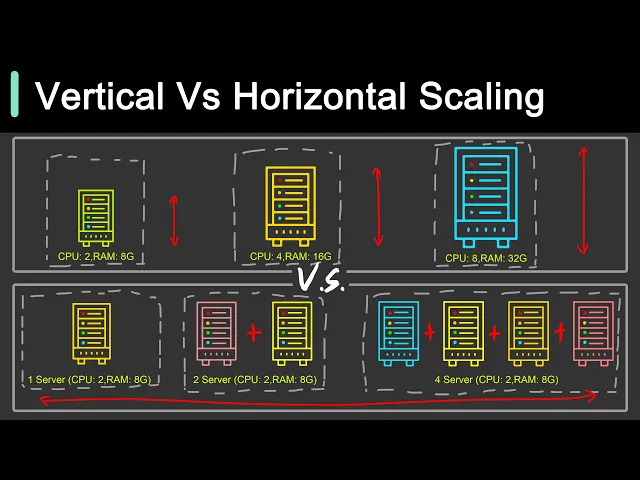
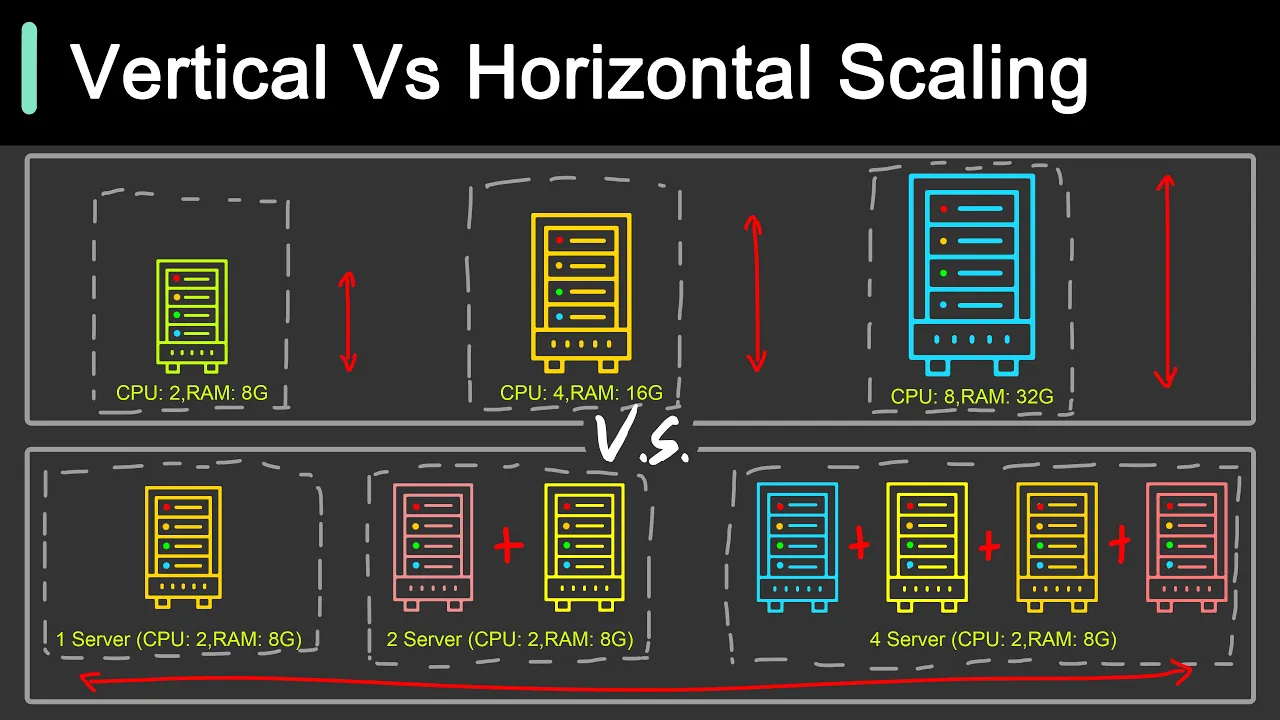
So your startup is taking off, and your servers are struggling to keep up with the surge. What do you do? Scaling up or scaling out?
This video will explore both vertical scaling and horizontal scaling. Understand their strengths and weaknesses so you can make the right choice for your growing infrastructure. Vertical scaling means adding more power to your existing server.
This could involve adding more CPUs, RAM, storage, or network bandwidth. For example, say your cloud database hits capacity limits on its starter 8-core server. You could upgrade to a 32-core instance with faster SSD storage, 96GB of RAM, and 10 gigabit networking.
Now the beefier box can take on the extra load. Some advantages: It’s simple to implement. Upgrading existing hardware is easier than setting up new servers.
It’s cost-effective in the short term. You only pay for the additional resources you need. Everything runs on one machine, making maintenance and upgrades easier.
Now, some disadvantages: Single point of failure. If the server fails, everything goes down. Limited scaling headroom.
There are physical limits to how powerful a single server can be. High cost at large scale. Upgrading to high-end hardware can be expensive.
Horizontal scaling means adding more servers to your infrastructure and distributing the workload across them. This is also known as "scaling out. " Instead of cramming everything into one big box, we could spread capacity across three 8-core nodes.
The popularity of cloud services with auto-scaling and serverless computing has significantly simplified this approach to scaling for some workloads. Some advantages: High availability. Distributed systems offer increased availability through redundant servers and failover mechanisms.
Predictable growth headroom. You can add more servers as needed, scaling your capacity as your needs grow. Improved performance.
Spreading the workload across multiple servers can improve overall performance. Lower cost over time. Distributing the workload across more efficient servers can be cheaper than upgrading to high-end hardware.
Now, here are some disadvantages. Complex to implement. Setting up and managing a distributed system is more complex than managing a single server.
This is especially true for stateful systems like databases. Higher upfront cost. There are several dimensions on the cost front.
First, sharding your database or application to distribute the workload can be complex and require significant development effort. Maintaining data consistency across multiple nodes requires data replication mechanisms, which can add additional overhead to your system and increase operational costs. Distributing traffic efficiently across multiple servers requires a robust load-balancing solution, which can add additional software or hardware costs to your infrastructure.
So, vertical or horizontal scaling? Which approach should you choose? Like many things in software engineering, it depends.
Here are some factors to consider: Budget. Vertical scaling is generally cheaper in the short term, but horizontal scaling can be more cost-effective in the long run. Workload.
If your workload is unpredictable or bursty, horizontal scaling can help you handle peak demand. Performance requirements. If your application is performance-sensitive, horizontal scaling can help you distribute the load and improve responsiveness.
Another key factor: If your application requires complex sharding or other horizontal scaling mechanisms, the additional development and operational costs need to be factored into your decision. No matter which approach you choose, remember that scaling is a journey, not a destination. Your infrastructure needs will evolve as your business grows, so be prepared to adapt and adjust your scaling strategy over time.
If you like our videos, you might like our System Design newsletter as well. it covers topics and trends in large-scale system design. Trusted by 500,000 readers.
Subscribe at blog. bytebytego.