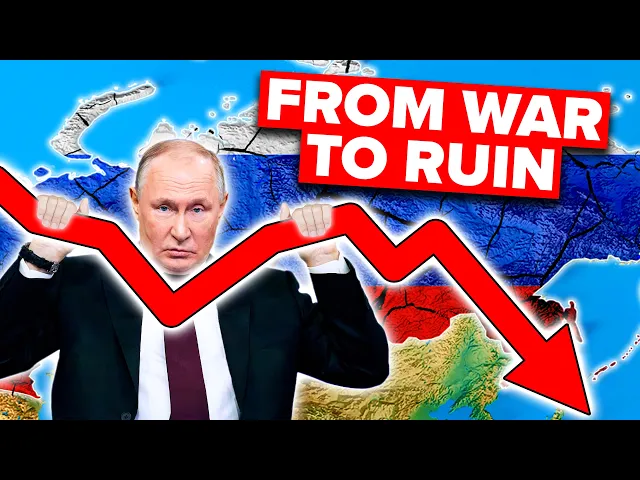
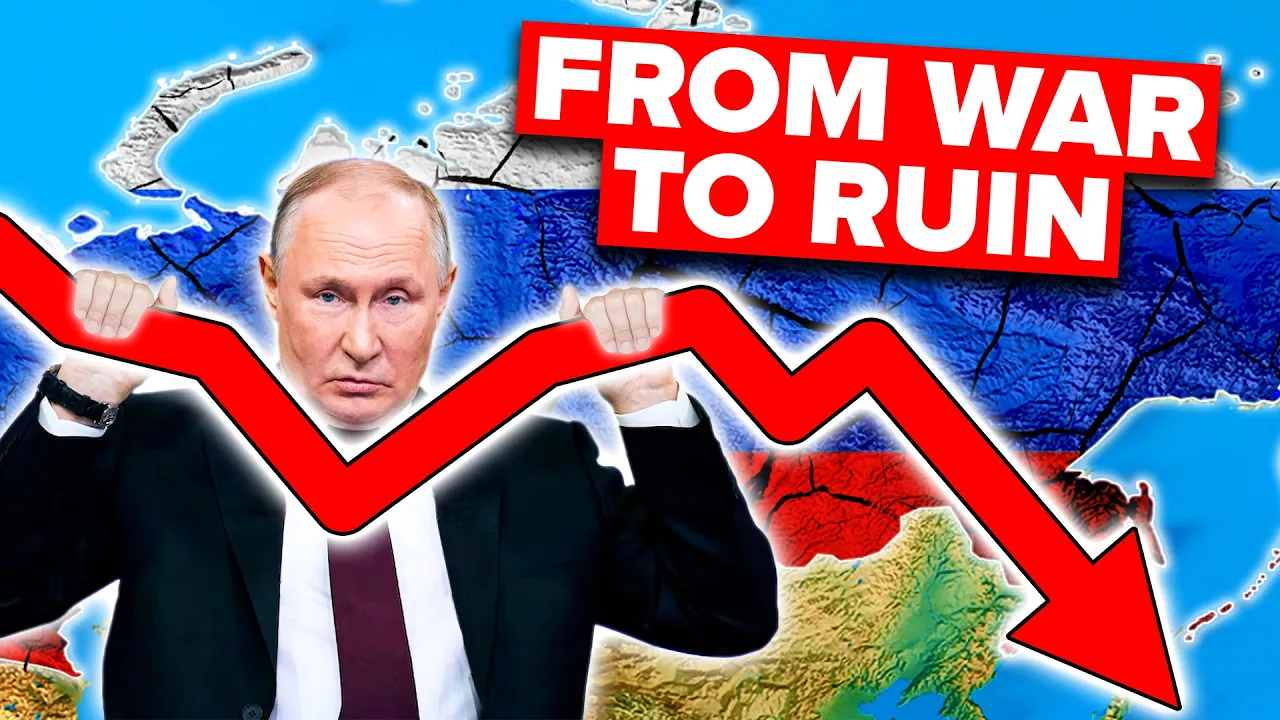
The Soviet Union's notorious economic blunders led to its collapse, yet Russia seems to have learned little. President Vladimir Putin's recent decisions show that economic mismanagement is still rampant, threatening to doom the country once again. This time, these mistakes might also drag down the Russian Army.
Putin's war economy aims to sustain military operations, but a fully militarized economy can only go so far before collapsing under its own weight. Ignoring practical realities and the well-being of the forces only accelerates this downfall. Poor decisions are fracturing the structure meant to project power, jeopardizing military effectiveness and national stability.
In this video, we explore how these economic missteps are undermining Russia's military and the nation's future. And this is precisely what’s happening in Russia. And precisely what this video will look into.
But before we get to the unraveling, let's trace the path of Putin's economic missteps and the misguided decisions setting the stage for this looming collapse. Though Putin has never been particularly wise in his economic strategies, his ruthless invasion of Ukraine is undoubtedly what triggered the beginning of the end for the Russian Army. You see, when Putin first launched the invasion against Ukraine, he expected Kyiv to crumble in a matter of days, securing a swift and decisive victory.
Instead, he was met with unyielding resistance both on and off the battlefield. The resistance off the battlefield – the formidable response from the international community – was what tanked the Russian economy faster than Putin expected Kyiv to fall. Immediately after the invasion, the economic activity in Russia contracted by 4.
4%. In a matter of days, the Russian currency – the ruble – lost over 40% of its external value. After that, it was one thing after another.
Western companies soon started pulling off from Russia left and right. The country’s assets were frozen. Its energy exports were targeted.
And ultimately, the Russian economy was isolated from the global financial systems. The sweeping international sanctions that made all this possible had a single goal – to weaken Russia’s ability to wage war against Ukraine. And at first, it seemed that they would be successful.
After all, there was no doubt about it – Russia’s economy was on the brink of collapse. But in an unexpected twist, these sanctions, described as “crippling,” “debilitating,” and “unprecedented” by Western commentators, didn’t bring about Russia’s anticipated downfall. Instead, the Russian economy displayed a surprising resilience in 2023, allowing Putin to continue his aggressive stance.
Quite expectedly, the Russian authorities bragged about the economy’s 3. 6% growth loudly and publicly, praising themselves for avoiding a deep recession in 2022. Much of this growth can be attributed to a single factor – the expansion of the military-industrial complex.
It’s probably after seeing that the military was the one to save the Russian economy from a more severe downturn that Putin decided to make it the foundation of the country’s economic strategy. On paper, this decision seems to be a successful one, as the International Monetary Fund – the IMF – forecast a 3. 2% growth for the Russian economy in 2024.
This prediction, made in April 2024, was even higher than the organization’s January estimate, which saw Russia’s gross domestic product, or GDP, rising to 2. 6%. What was perhaps even more shocking than the optimistic growth forecast was that Russia was expected to surpass some of the strongest economies in the West in terms of GDP growth.
According to the IMF, the U. S. is expecting a growth rate of 2.
7%, France 0. 7%, the U. K.
0. 5%, and Germany 0. 2% for the same year – 2024.
But let’s remember one thing – Russia has always looked better on paper than it performed in reality. As history shows, superficial economic metrics like these frequently obscure deeper vulnerabilities that can lead to sudden and severe destabilization. That’s why many experts warn that the talk of Russia’s “miraculous” economic resilience is severely misguided.
As Mark Sobel, the U. S. Chair of the Official Monetary and Financial Institutions Forum puts it, “Russia is masking a process of significant economic degradation that will continue well into the future and further marginalize its global footprint.
” But – in a surprise to no one – Putin is doubling down on his economic strategies, driven by the belief that further militarization is the key to maintaining power and influence. With this in mind, let’s take a closer look at his war economy and its main pillars, exploring how it’s setting the stage for the Russian Army’s collapse. A single principle lies at the core of Putin’s war economy – when public money is allocated wisely, it delivers results.
Putin seems to believe that the wise allocation in question is massive military expenditures, while the desired result is saving the country’s economy rather than bankrupting it. Of course, this principle is nothing new. This economic model has been shaped by decades of Soviet-era fallacies and delusional beliefs.
This model is only new in the sense that Putin has never used it before the invasion of Ukraine. You see when Putin assumed power in Russia, it was in the wake of the 1990s liberal reforms. In his early years in office, he even appeared to advocate for significant restructuring and liberalization of the Russian economy.
Today, you can only find the faintest traces of liberalism in who Putin chooses to keep in charge of various aspects of the Russian finances. Now, Anton Siluanov, the Minister of Finance, Elvira Nabiullina, the Governor of the Central Bank of Russia, and Maxim Oreshkin, Putin’s Economic Advisor, are in no way liberal. However, they can be described as rational technocrats who prioritize stability.
So, why does Putin keep them around? Well, Putin might be a lot of things, but he isn’t stupid. He knows the importance of maintaining strong macroeconomic indicators and economic stability to preserve his grip on power.
He was taught well by several liberal economists at the beginning of his rule, including Alexei Kudrin and Anatoly Chubais. But the question is – how long will Putin be able – or willing – to sustain this precarious balance? As things currently stand, it seems that he’s gradually moving away from any balance and diving headfirst into a risk-laden economic strategy.
This shouldn’t be surprising given how strongly the people around Putin believe in Russia’s so-called “special military operation” in Ukraine. This misguided, cult-like belief singlehandedly fueled the conviction that exorbitant government spending on the military-industrial complex can not only sustain the war effort but also sustain – and even grow – Russia’s economy. So, how exorbitant are we talking?
So exorbitant that it almost reached the scale of the Soviet-era military spending during the Cold War. Of course, we’re referring to the total amount of money being spent, and not the share of GDP used for what Russia shamelessly calls “defense and security” purposes. After all, it’s well known that the Soviet Union spent upwards of 20% of its GDP on defense while trying to portray itself as the Boogeyman to the West.
Today, only Ukraine exceeds this percentage, allocating as much as 37% of its GDP to its defense amidst the ongoing conflict. As for Russia, the country is committing roughly 7% of its GDP to “defense,” amounting to around $140 billion. For comparison’s sake, Russia was spending “only” $65.
91 billion on defense in 2021 before the invasion, which was around 3. 72% of its GDP at the time. Even when the invasion first started in 2022, the military spending couldn’t come close to what it is today.
In 2022, Russia’s military budget was $86. 37 billion, or 4. 06% of its GDP.
However, it’s important to note that a huge portion of Russia’s federal budget – almost a quarter of it – is still kept secret. Given everything we know about Putin’s plans, it’s safe to assume that the actual war-related spending in Russia’s federal budget is even higher. Significantly higher.
It goes without saying that such an absurd scale of military spending is only feasible under an autocratic regime. A regime willing to prioritize “guns” over “butter” to achieve its end goal, which, in this case, is Russia’s “special” mission. If you aren’t familiar with the “guns versus butter” model, here’s a brief explanation.
The “guns” are the government’s investments in military capabilities. The “butter” is civilian needs and welfare. So, the “guns versus butter” argument simply refers to the trade-offs between these two competing priorities.
Under this model, an autocratic regime like Russia’s can skew heavily toward “guns” and neglect “butter” almost completely. After all, it’s not like it will face any public scrutiny or opposition. To Putin’s credit, he hasn’t entirely given up on the butter.
At least not publically. What he did was instruct his economists to find a balance between guns and butter. His exact words were: “While increasing our defense and security expenditures, we bear in mind that all our social obligations to the people must be fulfilled and that our national development goals must be achieved in all spheres, including in social protection.
” He further explained that he primarily referred to education, healthcare, and support for veterans. Of course, Russia’s federal budget lacks the necessary money for all this butter. So, this part will have to be handled by the market sector, which continues to function in Putin’s Russia thanks to the foundation laid by the reforms of Russia’s Former Prime Minister Yegor Gaidar over three decades ago.
So, we have a market economy, the dominant emphasis on the military-industrial complex, and state interventionism. This fascinating mix has prompted many analysts to conclude that Russia is on the path of adopting an economic policy resembling military Keynesianism. If you aren’t familiar with the term, military Keynesianism is an economic theory that advocates for increased government spending as a means to stimulate economic growth and employment.
The equation is simple. Invest in the military sector heavily, and you’ll get more economic activity, jobs, and technological advancements. Sounds familiar, doesn’t it?
For a prime example of military Keynesianism, all you have to do is look at the Nazi Germany or the U. S. during the Cold War.
In Nazi Germany, extensive military spending was used to prepare for a potential war with the Slavic nations. Under Adolf Hitler’s regime, military spending reached approximately 40% of Germany’s GDP by 1940, compared to 8% in 1935. This surge in defense spending was instrumental in reviving the German economy, reducing unemployment from over 34% in 1933 to under 2% by 1939.
Similarly, during the Cold War, the U. S. invested heavily in defense and technological advancements.
So, by the 1960s, defense spending reached close to 10% of the country’s GDP. Even then, there were numerous questions about how sustainable military Keynesianism truly is. Some experts believe that spending a lot of money on military production, which is essentially a form of high-tech production, leads to the development of the technological sector as a whole.
The result? The subsequent innovations benefit the civilian economy. Others, however, strongly believe that advances in military technology have almost nothing to do with the civilian sector.
Essentially, they claim that the military-industrial complex robs the civilian economy of vital resources – including workers – which can in no way help the economy overall. By now, it’s quite clear which side Putin is on. The one that believes – or tries to desperately cling to – the notion that military spending serves as a driver of development.
This was made abundantly clear by the shake-ups in Putin’s Cabinet, which have shocked the world. By this, we primarily refer to the dismissal of Sergei Shoigu as Russia’s Minister of Defense. Now, don’t get us wrong.
This move was by no means shocking from a strategic standpoint. Shoigu’s departure was the culmination of mounting criticisms and failures during the war in Ukraine, so there was nothing surprising about it. The shocking part is that Shoigu has been one of Putin’s closest allies for decades, a trusted confidant who had weathered many storms alongside him.
This has led some to believe he would be “safe” from such upheaval. Well, as it turns out, no one’s safe when a dictator’s country is unraveling after getting badly beaten by a supposedly inferior foe. In such dire straits, even the closest allies become liabilities, and the once-unshakable pillars of power are ruthlessly dismantled in the scramble to salvage a crumbling regime.
But who is Shoigu, and, more importantly, who was he replaced with? Sergei Shoigu, a seasoned figure in Russian politics, served as the Minister of Defense from 2012 to 2024. His tenure was marked by extensive military reforms and a significant buildup of Russia’s armed forces.
So, it’s no wonder Putin entrusted him with the invasion of Ukraine in 2022, ordering him to capture Kyiv in a matter of days. To be fair, this order was inherently impossible to achieve, as it underestimated both the resilience of the Ukrainian forces and the complexities of urban warfare. Can you really expect some 190,000 troops and tens of thousands of vehicles to effortlessly storm an area of 324 square miles with 3.
5 million residents in the dead of winter? Though a resounding “no” is the obvious answer, Putin was never the one to accept the obvious. So, he failed.
And Shoigu failed. However, Shoigu’s failure to secure a swift victory in Kyiv wasn’t the only issue at hand. As the war dragged on and Russian losses mounted, Shoigu’s position became increasingly untenable.
That was what eventually led to his dismissal in May of 2024. Well, it was at least partially responsible. You see, Shoigu’s failures, as well as the Russian government’s crackdown on corruption among the high-ranking defense officials, weren’t the only reason why he was removed as Defense Minister.
This move actually had more to do with who the new defense minister is rather than the missteps of the former one. If you need proof, all you need to know is that Shoigu wasn’t banished from the government altogether. Instead, he was appointed the Secretary of the Security Council of the Russian Federation, which is quite a high-profile – and dare we say, lucrative – position.
So, who’s the new defense minister that warrants all this intrigue? The answer is Andrei Belousov, an economic technocrat. Before he assumed office as the defense minister, Belousov served as the First Deputy Prime Minister from 2020 to 2024, an aide to the President in Economic Affairs from 2013 to 2020, and Minister of Economic Development from 2012 to 2013.
As you can see, there’s no mention of any military-related positions in his extensive resume. That’s because Belousov has no military experience whatsoever. From this fact alone, it’s easy to conclude that Putin is no longer viewing the Russo-Ukrainian war as a battle of military might alone.
Now, the war has become a battle of resources. In other words, Putin finally realized he couldn’t achieve a lightning victory – and it only took him two and a half years to come to that realization – and that he must brace for the long game. Of course, the mere notion of Putin preparing his country for long-term warfare terrifies both Ukraine and the remainder of Europe.
This move only confirms what many in Europe have feared for months – Putin won’t stop at Ukraine. But many people fail to understand one thing. It’s not so much that Putin wants to continue fighting as much as he can’t afford to stop.
What do we mean by that? As Renaud Foucart, a senior lecturer at the Department of Economics at Lancaster University Management School, explains, the war in Ukraine has become “the main driver of Russia’s economic growth. ” However, this war is also responsible for decimating Russia’s economy in other crucial ways.
So, if Russia were to stop fighting, it would have to deal with the “economic reality” of a nation burdened by sanctions, a diminished workforce, and a deteriorating infrastructure. This might lead to social unrest and a potential collapse of the fragile stability that Putin’s regime desperately clings to. Paradoxically, even winning in Ukraine could spell trouble for Russia.
How so? The country simply doesn’t have the means to rebuild the occupied areas that would come under its control, nor to maintain security in them. So, for Russia, the only viable course of action is to keep fighting.
In Ukraine. In the Baltic. In the entire Europe.
That’s why Putin needs an economist as the defense minister, as only an economist can navigate the treacherous waters of sustaining a war-driven economy. Putin himself stated that only an economist can make the country’s military budget – which has now reached gargantuan proportions – efficient. With Putin’s commitment to the long war in mind, you can probably start to see why his new economic model spells doom for the Russian Army.
So, let’s finally dive into it. You’ve probably noticed that the focus of Putin’s new economy has solely been on the military-industrial complex so far. In other words, the focus is on the weapons and equipment.
But what about the people handling those weapons? The soldiers, the officers, the very backbone of any military force – how are they faring under this economic shift? In short – not great.
And that might be the understatement of the century. Only about 30% of the entire military budget is spent on the Army itself; the rest is allocated to weapons procurement and production. And not even the whole 30% is dedicated to military salaries – approximately 20% of the budget goes to pay.
At the same time, vast sums are siphoned off through corruption and inefficiency, a problem that Belousov is ostensibly trying to address. Of course, “trying” is the key word here, as Russia’s Minister of Defense still seems to act as merely an intermediary between the state budget and the military industry. The industry is the one that holds virtually all the power.
This particularly applies to one man. Sergei Chemezov Chemezov, an oligarch and the CEO of Rostec Corporation, a state-owned defense conglomerate, seemingly has more influence over Putin than Belousov. Putin confirmed this by appointing Denis Manturov, former Minister of Industry and Trade, the First Deputy Prime Minister after Belousov’s promotion.
Manturov is Chemezov’s close confidant, which means that his promotion allows Chemezov to continue heavily profiting from the surge in military spending. And while Chemezov – and his ilk – make absurd amounts of money, it’s the common soldiers that suffer. From the beginning of the Russian invasion of Ukraine on February 24, 2022, to July 19, 2024, 564,620 Russian troops became casualties, according to the General Staff of Ukraine’s Armed Forces.
That’s almost 0. 4% of the entire Russian population. The last time Russia experienced such extensive casualties was during World War II when approximately 8.
7 million military personnel died over six years of intense conflict. It’s worth remembering that World War II is the deadliest military conflict in history, involving over 100 million people from more than 30 countries. The war in Ukraine, on the other hand, has only been waged between the two countries for a little over 28 months.
The sheer fact that it has produced such staggering losses highlights the unprecedented ferocity and scale of the ongoing conflict. These shocking figures underscore another thing – the utmost disregard for the lives of Russian soldiers. Putin seems to be hell-bent on pursuing his strategic goals at any cost, even if it means sacrificing the very troops meant to achieve his ambitions.
That’s why the most common tactic employed by the Russian Army is the so-called “meat grinder” strategy, which involves overwhelming enemy positions with massive waves of infantry. Prioritizing sheer numbers over strategic precision, this approach has only resulted in one thing – horrific casualties. As far as Putin is concerned, he can always just get more soldiers.
After all, the boost in the economy allows him to hire contract soldiers who flock to the Russian Army for the $2,300 monthly paycheck. If all else fails, he can just carry out another wave of forced conscriptions, compelling more Russians to join the ranks and fill the gaps left by the staggering losses. He did so in August 2022 with 137,000 people and in December of 2023 with another 170,000.
This relentless churn of personnel underscores a grim reality. For Putin, human lives are expendable. And as long as his economy can sustain this horrifying soldier turnaround, that’s all they’ll ever be – mere cogs in his brutal war machine.
But what about Belousov? What’s his role in all of this? Well, as soon as he was appointed Defense Minister, he stated that equipping the Russian armed forces would be his first priority.
As he put it, “Everything that is effective in the country should be put to work to achieve victory. ” Now, to be fair, equipping the Russian Army isn’t a futile endeavor as many of the troops have complained about being sent into battle without adequate gear and support. Yet, Belousov’s focus on this aspect reveals a critical flaw.
He’s aiming to enhance a system that already devalues human life, rather than addressing the underlying issues that perpetuate the catastrophic loss of soldiers. The grim reality is that improving equipment without reforming the underlying strategy and leadership will only make the “meat grinder” more efficient – and more deadly. The Russian Army’s morale is already at a record low, so no amount of improved gear will prevent the continuing spiral into chaos and despair.
Especially when the improvements in question are coming from someone who is a complete outsider to the Russian Army. Remember – Belousov isn’t a military man; he’s a laboratory academic who hasn’t even served in the military as a conscript. In fact, he has probably never even held a gun.
So, how can he expect to inspire confidence or make meaningful changes when he lacks the most basic understanding of military life and combat needs? Belousov’s background in economics and academia, while valuable in its own right, simply doesn’t translate into an intuitive grasp of the realities faced by soldiers on the front lines. However, it’s also worth remembering that Shoigu has also never been in the military, which didn’t prevent him from sporting a general’s uniform decked out in medals.
But despite his lack of personal combat experience, Shoigu embraced the military traditions and an image crafted to exude authority and command respect. He seemed like he wanted to run the Russian Army himself. And as you already know, playing pretend goes a long way in Russia, a country where appearances and titles often overshadow substance.
So, while trying to get the black hole of military spending under control, Belousov is likely to only weaken the Russian Army, eroding what is left of its effectiveness and morale. Of course, there’s also the question of the long-term future of the Russian Army. Even though Russia is undoubtedly preparing for a long fight, Benjamin Hilgenstock of the Kyiv School of Economics believes that the war must end at some point.
When this happens, the “military spending will come down again. ” But what will happen to the army veterans? Will Russia have the funds to reward them and glorify them as it used to do almost religiously?
Not likely. As a result, the veterans might find themselves abandoned, left to face the harsh reality of what Russia truly is. And with the widespread disillusionment, both among those who fought and the general public, comes the shattering of Russia’s military legacy once and for all.
So, what was once believed to be the second-strongest Army in the world will inevitably crash and burn. And all of this because one man decided to play real-life Risk. Do you agree?
Is the Russian Army done for it, or can it still recover from this catastrophic gamble? Share your thoughts in the comments section below. Now go check out Why Russia Is On Edge of TOTAL COLLAPSE or click this other video instead!