Welcome to the Astria radio show the Astria radio show is brought to you by www. asria magazine.com Professor Jordan Peterson is a clinical psychologist licens in Massachusetts and Ontario he's also a professor at the University of Toronto and has been so since 1998 Professor Peterson is currently interested in the formal assessment and theoretical nature of self-deception Construing it as a voluntary failure of exploration rather than as repression he's also doing experimental work on creativity achievement personality narrative and motivation your host for the the next hour will be Guy [Music] Lee welcome to this edition of
asria magazine and web radio we're delighted to have here with us clinical psychologist Professor Jordan Peterson He's going to be telling us about his amazing book maps of meaning now first of all Professor Peterson welcome how are you good nice to be here great could you please tell us a bit first of all about your background well I'm a clinical psychologist trained at Mill University um I've been working as a professor since 1992 I taught at Harvard University in the psychology department for 6 years and then I moved to Toronto and I've been here since
199 1998 um I also do Consulting work uh for a variety of different companies now um that's what you're currently working on now um probably the most widely read book on psychology for the novice reader was yung's Masterpiece man and his symbols are you approaching a general audience with this book or your book uh maps of meaning or is this more suited to the student of psychology well I think it's suited for people who would like a book like man and his symbols And yung's books even the ones that were written for a general audience
were not particularly simple because they're so different in conception but I would say maps of meaning is aimed at the same audience that those books were aimed at they're similar to to books by um Eric nyman who was a a very astute student of Jungs and who took yung's thought farther in some uh directions than Yung himself had so I guess I see my work in part as an extension of uh yung's work And nyman's work um partly into the domain of neuropsychology and of course uh you could say that you've LED on from the
work of of uh luminaries such as lwi uh wienstein um with his book philosophical investigations in 1953 for instance where again he attempted to lay out the apparent structure of the mind and and the conditioning with cultural and historical variables would that be true to say you've moved on from that and expanded it even more one of viken Stein's contributions was the idea that a word was more like a um a piece in a chess game than it was like a label for an object and for viken Stein's perspective words were always to do things
with rather than to label things with and uh that's a conception that I share because most of our Concepts scientist like to think that our concepts are very much like theories about objects but in reality our concepts are much more action oriented Than that I mean we know for example that when you look at even a simple object like a cup the brain areas that are involved in motor action are activated at the level of perception so for example when you look at a cup the gripping action that your hand would make if you lifted
up the cup is partially activated merely when your eyes uh settle on the Cup itself so and Vicken Stein was the first philosopher although n knew this To some degree too Vicken Stein was the first philosopher to really point out the functional quality of our object categories and uh my work overlaps with his ideas to some degree because uh one of my uh preconceptions is that mythological ideal ideas and concepts are functional they're to do things with they're to act about they're not to label they're not descriptive like a scientific concept is uh that's why
religious mythology has to do with Morality because morality is about action in Psychology what role does the study of myth and symbols play and what is the relationship to human consciousness in say the treatment of mental illness for instance or what we class or classify in the western concept as mental illness well let's let's start with the first uh question about dreams I mean there's a lot of debate in the scientific literature about the meaning of dreams And perhaps there's even debate about whether it's possible for dreams to have meaning um I think partly the
debate exists because to do dream analysis properly as yung in particular pointed out uh you need a vast uh body of knowledge in the dream interpreter about comparative mythology and ritual and symbol and and art history and so forth because dreams of course use images as their primary means of Conceptualization now in order to understand what what dreams mean and how they can be useful in therapy apart from appreciating the fact that The Interpreter needs a broad body of knowledge that scientists generally don't develop it's also important to know what it is that scientists have
discovered about dreams so for example we know that dreams occur during rapid eye movement sleep uh you cycle into rapid eye Movement sleep about every 90 minutes when you're asleep um when you're in rapid eye movement sleep your motor centers so your action centers are very much activated in your brain but your body is paralyzed so that you can't can't move around um your eyes are moving because of course it doesn't really matter if your eyes move while you're asleep because they won't take you anywhere but if your legs were moving while you were Asleep
you'd run into walls while you were dreaming and uh scientists have actually manage to uh damage the motor inhibition systems in cats so that they do move around when they're dreaming anyways if you wake up when someone's dreaming their brain is about as active as it is when they're awake so there's a tremendous amount of neural processing going on in the dream state if you wake Someone up when they're dreaming there's about an 80% chance that they'll report the emotion of anxiety uh dreams tend to focus on threat processing now a threat is anything that
might hurt you but it's more than that too a threat is anything that doesn't fit into your current conceptual scheme you imagine that you have a theory about the way the world is and then you act on that theory and sometimes things work Out the way you'd like them to work out but often they don't and every time things work out in a way that isn't how you would like or how you predicted that indicates that there's some more about the world that you have to learn about and that fact first manifests itself in anxiety
now the dream focuses on anxiety and then it loosens up its the normal conceptual constraints that characterize waking thinking and it starts to uh play in a sense or hypothesize about how your Current categorical structure could be shifted around so that that threat could be accounted for okay now that means the dream is dealing with things that you need to understand but you don't yet understand so when you wake up and you remember the dream the dream doesn't really make sense because it's about something you don't understand now it's your brain's best guess at configuring
or understanding the unknowable but it's like it's it's like the first layer of a Multi-layered process which eventually would culminate in fully developed thought maybe over months or maybe over years or maybe you would never manage it at all the the unknown thing or the threat is just too great to really come to any terms with it whatsoever okay now imagine that you're dreaming about something and it produces enough emotion the threat produces enough emotion not only to produce a very Vivid dream but to wake you up and when you wake up you Remember the
dream and then you go tell someone about it well the dream is about something you don't yet understand that's that's upsetting and if you tell a bunch of people about it they're going to give you all sorts of opinions on the dream and that's a way that you can gather more information about the threat are we talking about an extreme case which is known as a nightmare or perhaps simply a dream which is um faintly troubling or puzzling because it's so Abstract could you differentiate between the two well I think I think it's clearer in
the case of nightmares and often too because nightmares tend to have archetypal themes you know people for example are often threatened by monsters in nightmares and a monster is a chimera that's made up of the different parts of fright different parts of frightening things a dragon is a chimera for example because it's made out of reptilian parts and it also uh Includes the idea of fire in transformation so a nightmare is a a dream that tends to use archetypal imagery to conceptualize a fairly powerful threat and if you recount a nightmare to a person with
no specific training they're going to have some opinion about about it and their opinion might be useful in terms of information gathering but if you recount a dream to someone who's psychologically trained and who's Also symbolically trained and who has you know great great depth of knowledge with regards to the structure of religious thinking and and comparative literature the light that they're going to shed on your dream is much brighter and and more profound and sometimes uh a dream interpretation can offer the person who's had the dream a Leap Forward in knowledge that might have
taken them five or six years to conceptualize by themselves an Insight You might say that they wouldn't ordinarily have had because the person who's the expert who's had the dream recounted to them knows and says ah yes I know of that place that they say they've been to that experience they've had that symbol and its meaning and above all what it feels like because surely it is um some people say say that me included um that one way to interpret a dream when you wake up is to to just like you would um taste um
a sip of wine Just hold the flavor and and hold the feeling what does it feel like and what does feel what feels the same in your real life and that's what the dream's trying to tell you with a collage of symbols and memories as well that it's drawn on in recent um conscious uh EXP experience to try and put it together hence the dream can be very abstract would you say that's the case sometimes well I think I think there's two things about about your comments that are are Really worth highlighting the first is
um the categories that a dream uses are generally based on emotional similarity rather than logical similarity yes so a dream for example might represent fear or the fear of something Unknown by using a juxtaposition of variety of images of frightening things so imagine that in the dream world the basic rule is all things that produce the same emotion are the same thing and so your uh description of a dream interpretation Process that relies on identifying similarities in emotional state gets right to the core of how dream thought works now secondarily I also believe that if
you are able to help someone uh uh construct a dream interpretation that fits they're also able to feel that it fits it it clicks or it makes sense or it's like the punchline of a joke in some way they can tell that the interpretation has uh put some missing pieces of the puzzle into place and I Think it's important to rely on that as an indicator of whether the interpretation is um actually derived from the dream or sort of just a theoretical imposition on its structure now we can go underneath that too and and I
mentioned already that basic categories are more action oriented than object oriented so basic categories the basic categories of the human mind are categories to do things with well by the same token they're also motivational and Emotional categories so the primordial mind like the animal mind thinks sort of axiomatically that all things that produce the same emotion are the same thing so there's things that make you happy or there's things that make you sad or there's things that make you anxious and the fact that all those things share the capacity to evoke that emotion speaks of
some essential identity between them now the identity is in relationship to the experiencer And not necessarily with regards to similarity between the objects but it's still how we naturally think and and it's certainly how mythology thinks and it's how drama thinks and how religion thinks and we've lost sight of that in part because we've become scientifically trained to some degree and we tend to believe that the real categories of the world are objective and uh that that just strikes me as it's wrong there's something about it that's Wrong and it's wrong because we have to
act sure there's something missing there maybe we've lost it along the way going back to emotional reactions people call them kneejerk uh response for instance if you take the base emotions surely one could go way way back to the dawn of our uh Beginnings uh when we came down from the trees and moved through the forest out onto the plains hunter gatherers uh and animals do share this with us because uh uh the everyday dog and cat Does have emotions um are emotions born out out of originally just pure instinct is this where emotions came
from do you think uh because Instinct causes uh reaction you have the old out age of uh uh fight or flight for instance depending on what you make a decision to do okay so let let's make a a a conceptual definition here so that we we we agree on the terminology um let's say that motivations are state of being that Indicate a goal that are indicative of a goal so for example if you get hungry I would say that's a motivational State rather than an emotional state and it's a motivational state that sets the acquisition
and ingestion of food as the goal all right and so there's a variety of motivational States hunger thirst uh sexual desire um jealous aggression especially defensive aggression predatory aggression um and the desire to eliminate essentially Uh the desire to play those are all motivational States and then there's emotional states and the primary emotional states are positive and negative and positive emotional states are experienced when you're moving towards a desired goal and negative emotional states occur when the goal becomes uncertain or the pursuit is somehow frustrated or or interfered with okay now you asked about instincts
well I would say both motivations and Emotions are instincts they're very very archaic um if you think about the positive and negative emotions as being approach versus withdrawal um animals going all the way back to single cell organisms have approach versus withdrawal s systems so they're unbelievably archaic they go way back before uh we split evolutionarily from um our chimpanzee like ancestors so they are instincts and They're very deep and they the fact that those instincts exist has all sorts of strange and that they're evolutionary based have all has all sorts of strange uh implications
so for example you can understand a dog and communicate with a dog because the dog shares motivational and emotional structure with you to a great degree it's a animal it knows about dominance it knows about dominant striving it feels anxiety and pain and uh it knows how to play and it likes to Play and there's a lot about a human being and a dog that are the same which is why we can live together but you can go way down the evolutionary chain so say if you go all the way down to lobsters well lobsters
know about dominance hierarchies and they have approach and withdrawal systems and the law Lobster nervous system which is is very primitive compared to the human nervous system is so similar to ours that you can give lobsters Anti-depressants and it stops them from feeling hurt after they've been defeated in a physical dominance dispute is that right yeah it's absolutely amazing so typically if two lobsters are in a dominance dispute and one loses it will withdraw and then it'll it kind of folds its body up it it it goes into a depressed like Crouch whereas the winner
will expand his body and look bigger okay and when the lobster is defeated it won't fight with any other Lobster for at least 20 minutes even one that it had defeated before but if you give it anti-depressants in the aftermath of its defeat it doesn't contract plus it'll fight right away it just well it just shows you the the the idea of of evolutionarily determined instincts in my opinion is not a theory at all it's an absolutely self-evident fact and it manifests itself in all sorts of strange ways so for example we know with Chimpanzees
chimpanzees basically go to war they're they're wired up to regard chimpanzee conp specifics who aren't in their tribe as something to react against with fear and hostility and if a Wandering group of chimpanzees say numbering three or four at the periphery of their territory comes across an isolated individual or two from another group they'll tear them into Shreds and that that primordial response to the stranger sheds substantial light on how it is that human beings demonize and then person persecute their so-called enemies so we still we've still retained this ability to objectify a target for
our resentment our our hatred and our fear as well and that can be demonization as as you say is that correct well part of it you can you can break it up into two two uh aspects I Think and this is something I go into great detail about in maps of meaning in some sense this is what the book is about because I was interested in territoriality and cruelty and now uh animals are Territorial and if another animal of the same species trespasses onto a complex animal's territory there'll be a fight and I think that's
really understandable because animals need territory and human Beings are clearly territorial we're territorial about our actual physical space and we're also territorial about our ideological or cultural space and it's because we need to inhabit a physical territory and we need to inhabit an ideological territory and we react to challenges to the Integrity of our territory with fear and with defensive aggression and I think that can be understood uh quite appropriately using Analoges from animal behavior and animal neurophysiology but you talked about resentment and hatred well those emotions I think are much more specifically human there's
lots of uh examples from 20th century history of the persecution of enemies going far beyond what was merely needed to ensure territorial integrity and examples of course of that sort of behavior abound in the Holocaust literature where the Nazis went out of their way not only to Era eradicate the Jews and the Gypsies and so forth but to torment them and torture them and crush them in ways that were even uh that weren't even in the best interests of the persecutor and that's a lot more difficult to understand sure uh I mean he had the
ability to be able to conceptually dehumanize them to treat them as no better than um animals or UNAM mention as they called them um but not forgetting that there were earlier Examples before I mean the Holocaust in terms of numbers sure uh and its scale and its cold-bloodedness but if we go back to um times of say one of the earlier ones um tyrants that I thought were horrific was uh Vlad de Impaler who used to enjoy sitting eating his breakfast and having his victims impaled before him uh and that's Psychopathic uh really is there
difference between that and say uh the crimes of the Nazis well I don't think There's a particular difference between that and the crimes of the Nazis and I also think that kind of behavior is far more normative than anybody ever likes to think I mean are in in in modern times the Holocaust has sort of become archetypal of totalitarian evil more than just brutality but my sense after having researched this for for a lengthy period of time is that the the behavior that characterized people who were involved in the Holocaust was uh Essentially normative and
even in 20th century history um the numbers that the numbers involved in the Holocaust per se aren't um of any order of magnitude they're they're not special they're they're not they're not immense by any stretch of the imagin um Soul nson estimated that Stalin's brutality killed something in the neighborhood of 60 million people sure and there's estimates from Mao that he Killed 100 million people and in Cambodia we know that at least 4 million people died with the kar Rouge yes so I mean like the Holocaust is is the the the prime Exemplar of that
kind of behavior but it typified the 20th centur C and as you already pointed out it it's not like it arose in the 20th century it's it's part of our it's part of our nature but what about the diff what's the difference between uh someone who would be a Concentration guard concentration camp card who who would um put these appall victims into the gas chamber or the guy who pressed the release button on the first atomic bomb from that aircraft that he knew would Slaughter thousands or hundreds of thousands of people uh because both those
two people believed in something is this where it really boils down to the the difference between good and evil I think people use their their claim that they believe In something to look people will protect what they believe in using the same mechanisms that they'll protect territory so for example if you own your house and someone walks into it at night under English common law you have the right to say leave and then you have the right to say leave I have a gun and then you have the right to say leave I have a
gun and fire a warning shot and then if they don't leave you have the right to shoot Them and you can't be prosecuted for that okay and everyone would say well you were within your rights because you were protecting your territory okay so I think people have a right to protect their territory and they have a right to protect their ideological territory and there's Rules of Engagement that could uh govern disputes of that nature but when you're there's there's other sorts of Acts and many of those characterize Behavior in the concentration camps in the Nazi
era that can't be explained by mere territoriality and that's when it's necessary as far as I'm concerned to bring in conceptions derived from myology like the difference between good and evil and I think that you can Define evil and evil is an act that is designed to produce a negative outcome for everyone who's involved is it that includes the victim and the perpetrator Sure but where does evil come from in your concept of this professor is it there another reason why it's very useful to look at mythology because if you look at the first few
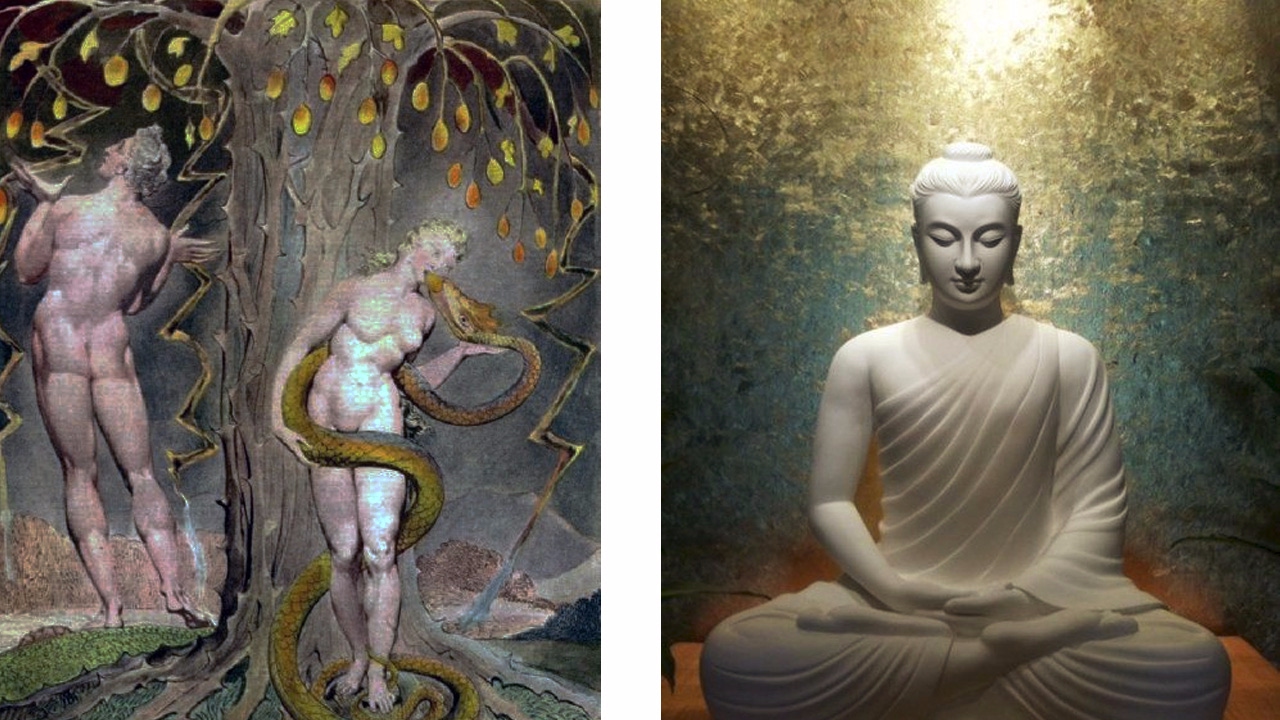
chapters in Genesis is a very clear story so let me tell you one of the stories it's really worth knowing okay so as far as I'm concerned when Adam and Eve eat the fruit of the tree of the of uh the knowledge of Good and Evil their eyes open and the first thing that happens is That they notice that they're naked okay so what does that mean it means they're illuminated with regards to their own vulnerable nature because to be naked and to know your name naked is to be exposed and vulnerable and to know
it and often people for example will dream that they've been stripped naked in front of a crowd it means their material vulnerability is exposed for everyone to see okay the first thing Adam and Eve do once they discover that they're naked is To clothe themselves they cover themselves up and human beings are the only creatures that wear clothes and clothes separate our vulnerability from the natural and social worlds they're protective in reality and they're protective symbolically all right the next thing that happens is that um God comes walking through the garden it's in the morning
and he looks for Adam and Adam is hiding behind a bush and God says Adam where are you I'm used to walking with you and Adam says um I'm too afraid to come out because I found out that I'm naked and God says who told you that you were naked and Adam blames the woman okay so then you think well why would Adam hide from God all right so imagine God uh God symbolizes a a Transcendent totality and this story indicates that at some point in human history there was an unbroken relationship between the Transcendent
tot Al ity and the individual but when the individual became self-conscious that totality was threatened so why does Adam hide well he knows he's naked and vulnerable so he hides from he hides from the demands of of Destiny he hides from what's Best in himself because he looks at himself and thinks I'm nothing I'm weak I'm I can be easily hurt and therefore when God calls I have to hide well the next thing that happens is that Adam and Eve are thrown out of paradise and God says well you know life is going to be
difficult now okay so that sets the issue up the next chapter starts with the birth of Cain and Abel now Cain and Abel are the first two humans born in history right because everything that happens in the Garden of Eden is preh historical human history starts with the fall of Man the rise of Self-consciousness and Cain and Abel are the first two humans and they're symbolic of two attitudes towards the revelation of vulnerability now Abel is a shepherd and Cain raises vegetables and they're both required to make sacrifices to God okay now why would you
make a sacri rice well it's an archaic idea you burn something smoke Rises up to heaven God's in heaven and he can judge the Quality of your sacrifice by evaluating the smoke we think well that's a very archaic idea and what could a modern person do with that well a modern person could give these archaic people some credit first so let's say why is God in heaven well it's because when you look at the sky at night it fills you with awe you see an unlimited expanse of being and that's the closest you get to
directly experiencing the unnamable totality okay why should you make Sacrifices to God why would he be pleased with sacrifices well I would say you already know that because if I asked you well what sacrifices have you made to make things better in your life no doubt you could immediately tell me now archaic people had to act that out because they didn't really have the philosophical conceptions in verbalizable form but they still had an intuition that it was necessary to make the right sacrifice in Order to maintain an appropriate relationship with the totality of being okay
so Abel makes some sacrifices and Cain makes some sacrifices now Abel takes the best things he has and offers them to God so they're the firstborn of his FL loock and the choicest cuts of meat when Abel's called on to make a sacrifice he doesn't hold anything back he puts himself on the line and he sacrifices uh courageously and clearly and Cain by contrast he brings in some Ratty little you know uh wrinkly old vegetables and sacrifices those so God Smiles on Abel's sacrifices and frowns on Caines so what does that mean well Abel's making
the right sacrifices so Everyone likes him his his Enterprises flourish he has good Intimate Relationships he he uh produces a thriving family because he makes the right decisions and Kan on the other hand everything goes wrong for him so this makes him mad it says in the Old Testament his countenance Falls what does that mean he gets bitter and resentful and angry and depressed he's mad about how things are turning out so he goes and he has a little chat with God and he says look you know I don't know what's going on here I'm
working myself to the Bone I'm making sacrifices left right and center and everything is not turning out for me like what gifts and God says pay attention here it's your Problem that things aren't going well uh the the monster of sin crouches at your door and you welcome it in you could reject you could do things right you know exactly what the right thing to do is yet you refuse to do it so all the trouble you're having is your fault don't come along and blame me just get yourself put together properly and do things
right and so that's the end of the conversation well that isn't what Cain wants to hear he wants to hear that The world's a miserable place and that the reason that he's failing is is because of the structure of reality he doesn't want to hear that it's his problem so this just makes him absolutely boiling mat and the first thing he does is go and kill Abel well that's the difference between territoriality and evil and he wants what Abel has he even wants to be abble but instead he destroys them all of Spite and resentment
and revenge Against the nature of reality well then God gets wind of it and marks Cain he says no one kill him and you might think well why because it's God who says an eye for an eye well the next little bit of the story which is barely there anymore it's it's so edited out explains exactly why Cain wanders away and he gets married and he has a family but if you mess around with any of Cain's family if you annoy them or bother them or make Them resentful or angry they don't just kill one
person they kill seven and then those children have children and if you annoy them they kill seven 70 and at the end of that uh acceleration of Revenge oriented killing God comes along and floods everything and that's when the story of Noah and the Ark kicks in and the story is very clear it says this if you act improperly and if you do the things that you know to be wrong if You don't make the right sacrifices your life will not turn out well you'll be punished all the time for your foolish and your weakness
and that will make you resentful Twisted bitter and murderous when you act on those uh motivations because of Spite and resentment you'll you'll initiate a cataclysm of Revenge oriented killings and if no stop is put to them that will spread through the entire society and invite the Apocalypse and that's the second third major story in Genesis indeed there it's exactly right there's some some very very strong uh what do you call it moral teaching there or is it more than that I mean whoever wrote that had the ins it's moral for sure you know I
mean because it it but it's it's it's moral in a weird way you know it's it's it's more like a description of moral reality than a story that says well you should act like this because that would be good It's imagine this story of Cain and Abel this is a really old story it's been around for we have no idea how long um in written form it's been around for several thousand years it's undoubtedly part of a larger oral tradition it was edited by many many people and told and retold and all that's left of
that story is what's intensely memorable because otherwise it wouldn't have been forgotten and it just says something blatantly it says That you can accept your you can accept the need to make sacrifices in order to keep your life on the right track or you can fight against that and act improperly if you fight against that and act improperly then you're going to compromise your relationship with the totality of being and as soon as you do that you might as well essentially you're living in a hell if you if you Subject yourself chronically to a hellish
existence that will make you turn your thoughts towards really towards revenge against existence itself well you know stellin was setting himself up to blow up the entire planet I mean there's good evidence from the KGB archives in the late 1950s that he was gearing up with his multiple pre uh pre-apocalyptic genocidal practices he was gearing up enough courage to turn The whole world into a conflagration well this is no uh trivial matter and the only stories that I know that have enough profundity to lay out the real seriousness of the issue are these archaic stories
nothing in modern culture has the requisite profundity now we're just pausing for some exciting news about Astria magazine.com stay with us by the way don't forget to grab your own copy of our fascinating 40 page Asria magazine just visit our magazine web page at www. asria magazine.com and download it for hours of fascinating enjoyment and do visit us again soon because as asrian magazine.com is full of fresh news information articles free audio interviews your very own copy of the latest issue of Astria magazine and also we have a message board if you want to leave
your own news or discuss some of the articles with other people from Across the internet www. asria [Music] magazine.com well this is no uh trivial matter and the only stories that I know that have enough profundity to lay out the real seriousness of the issue are these archaic stories nothing in modern culture has the requisite profundity sure we we do have sayings such as you get out of life what you put into it and Another one that comes to mind is he who lives by the sword dies by the sword uh in the East they
have their uh concept of uh and tradition of karma yeah well karma karma is a karma is a really good example because the idea behind Karma it's it's very interesting I think from a neuros psychological perspective because karma is predicated on the idea that it is fundamentally impossible for you to get away with anything that and there's an idea in Christianity that's Like that too it's it's a little more archaic and more dramatic than the idea of Karma and the idea in Christianity is that all of your actions and motivations are in some manner recorded
and that you'll be brought to task for them but and modern people look at that especially when it's represented metaphorically as say a wise old man writing in a book and they just discount it entirely but I've Certainly come to believe as a consequence of studying what I've studied that you you it is absolutely absolutely impossible for you to get away with anything whenever you make a mistake and you know it's a mistake you will eventually pay for it you might not notice that that's what you're paying for because often the punishment and the crime
are so distant in time from one another that the causal connection is virtually impossible to Identify but that doesn't mean it isn't there now one of the things I attempted to lay out in maps of meaning in some detail was Soulja nen's insights into um the processes that led to the establishment of the gulag archipelago prison camps in the Soviet Union where so many tens of millions of people were killed I mean it was Soulja nen's uh belief and this is a belief that Yung shared and and as well Eric nyman That it was the
cumulative sins of the individuals that made up a population that culminated in these absolute totalitarian catastrophes so just as Cain's unwillingness to make the appropriate sacrifices in his individual day-to-day life culminated in the degeneration of his entire society and the and the uh uh uh and the and the bringing fourth of an apocalypse so in everyday life each individual moral errors accumulate and Manifests at a social level and play themselves out in this immense in this immense uh Forum now we don't like to think that way because no individual likes to feel that their localized
foolishness and weakness conscious foolishness and weakness reverberates through the entire social structure but everything that I've ever read that was serious with regards to this kind of subject indicated precisely that I mean Even Hanah run she wrote uh the banality of evil well you know I think it's the evil of banality personally but she she the the the architect of the of the final solution was a Meek negligible resent ful non- entity and what that shows you is just how horrifying it is morally to be a weak resentful judgmental non- entity it it's it's so
catastrophically wrong that under the appropriate conditions it can endanger the structure of being going on To another thesis of yours in maps of meaning um you talk about the the fact that we're comfortable with the known what is known uh around which we build all our cultural traditions and from which our myths are uh propagated and then there's exploration of the new if you like and how we can act on that could you tell us a bit more about that because you're insinuating I believe in your your work that in your book uh that to
do so can make one some kind of of a It's some some kind of heroic action you you you've mapped out something whereby we can reach out for what is unknown to explore our potential and uh our creativity is that correct that I think that's a good summary I mean imagine imagine that in life you have you have some one obvious thing to rely on and the obvious thing you have to rely on is the traditional knowledge and wealth of your culture it contains most of the Knowledge that you have and allows you to make
your life uh as comfortable as it has been made within it but there are other sources of strength too and they're more subtle so your culture provides you with what's known and what's knowable but culture is never mapped everything out perfectly there's many things that remain to be to be known and many of the things that remain to be known are valuable and what that means Is that if you search after what is yet unknown you can also derive strength from that because that's the domain in which new discoveries are made and so if I
face you with evidence that you're wrong about something which means there's something that you don't know that you're not taking into account that can frighten you because it shows you that the knowledge structures that you rely on Are dangerously incomplete and that can make you very angry and that can make you very resentful or you can say oh isn't that so fascinating the fact that something isn't known here means that I could go and discover that I could voluntarily encounter that and I could derive something new and valuable and I could use that and the
hero in mythology is the person who voluntarily encounters the unknown and and this is a unbelievably Old concept it's the oldest concept we know that human beings have created it stems all the way back to the anuma Elish the Mesopotamian creation myth which is the oldest written document we have and it's the enuma Alish is the story on which the first story in Genesis is based now here here's a way of thinking about things and this is a mythological way and it's extremely useful so forget for a minute the idea that the world is made
out of matter and Forget that it's made out of objects look at it from a different perspective we'll say the world of experience which is the world you inhabit is made out of three things it's made out of the fact that no matter how much you know there are going to be phenomena and occurrences that uh exceed your capacity for comprehension and that's always going to be the case and so we're going to call that uh A category that's the category of the unknown and then there are always going to be things that you know
and understand and that's part of your tradition we're going to call that the known so wherever you go wherever you are there's a balance between the known and the unknown and then the third thing is the fact of you there's a conscious Observer there and the conscious Observer is the place where the known and the Unknown interact that's the mythological actors the known that's the great father the unknown that's the great mother and the individual ual and the the dsts represent that as Yin and Yang or Chaos versus order people think about that as masculine
versus feminine and that gives us a bad interpretation or an insufficient interpretation of dowst thought the Dost say experience is made of Chaos and Order and the proper place to stand is Right between them and you can tell when you're standing right betweena Chaos and Order because that's when you feel that things are meaningful and that means that meaning is the Instinct that tells you that you're standing in the right place now people are vulnerable and they're afraid because of that and they can be challenged and hurt and they can be made angry and Murderous
but I would say well if you stand between Chaos and Order properly your life can become so meaningful that the meaning gives you confidence and power and the ability to overcome your sense of shameful vulnerability and I would also say that's what religious stories are telling you to do now we go back to Genesis in the beginning God makes order out of chaos and that story is based on an Older architecture derived from the Anum Alish in the Anum Alish a god named Marduk Cuts up the dragon of chaos and makes the world out of
her pieces well the dragon of chaos recurs as a mythological Motif frequently um generally in the guise of Leviathan say and yahwah is envisioned as the deity that derives order habitable order from chaos and immediately after yahwa deres habitable order from chaos he Announces he makes human beings and then he announces that they Are Made In His Image male and female Made In His Image well we think that means that God is like a human being but what it really means is that the human being is like God in that the human being has the
capacity to make order out of chaos and when we say that there's something Divine about a person that gives them intrinsic rights what we mean is the fact that each human being can Make order out of chaos means means that every single person is deserving of a certain kind of respect even if they're murderous even if they're criminals even if they're prostitutes or tax collectors they're still they're still embodied with the kind of dignity that only identity with God can provide and that identity is the capacity to make order out of chaos and it's not
just a metaphor mhm what about the people who uh of the extreme criminals of whom it Said they have no conscience or their conscience is dead what's happened with those sort of individuals is it so just very suppressed or has it really died something in them died a spark gone out well you know that that's such that's such a difficult question you know because we know for example that um certain kinds of extreme brain damage can cause a kind of criminal Behavior so for example if you're uh prefrontal cortex is damaged then that can make
you Impulsive and criminal and so from a scientific perspective I would say it's very difficult to judge the culpability of certain people because they've been damaged in some way that we don't really understand and so the limits on their capacity to choose are compromised and it's very it's a it's it's it's a situation that has to be judged carefully in each individual case but then mythologically I would say what Soier niton said and what he said was that in every person no matter how good there is an little corner of corruption and evil that still
hasn't been overcome and then in everyone no matter how evil and corrupt there's a little bit of a little corner of good that's still a possibility that might be made to manifest itself and I don't exactly know how to reconcile those two different viewpoints you know and I think I think each of them are right even though They're ju to position makes them makes a paradox now so looking at Paradox you know like I read about Ted Bundy mhm you know about Ted Bundy go on tell us he was a law student in um in
the US very good-looking young man and uh he raped and murdered a number of young women and one of his tricks was to put on a fake cast and to elicit a sympathetic to stop someone someone Young and Beautiful who was driving a vehicle to use their Sympathy as a means of getting them compromised he was a terrible person but I read about his journey downhill you know and he said he first started to get involved in violent pornography and that as far as he was concerned that was what opened the door and I think
that's a good metaphor I mean one of the things Yung talked about continually when he was attempting to explain what had happened in Nazi Germany was the fact That a person moving ra moving downhill to some horrific end point like a concentration camp guard say makes a little mistake knows it's a mistake makes a little mistake little compromise and then that puts him in a position where another compromise is more likely and then that puts him in a position where another compromise is more likely and 300 compromises later he's there's a great book called Ordinary
men it's a study of a police Battalion in Poland And these men started out as normal middle-aged policemen most of them um adults before Hitler even came to power so not victims of hitlerian prop propaganda in their maturing phase they went from perfectly ordinary policemen to men who were taking naked pregnant women out into fields and shooting them behind the head and the book details their descent into this hellish Place step by Step well I think that's how people descend you know it's step by step and I believe under most circumstances that every step is
conscious even even though the memory of making the step might Fade Into unconsciousness and the full cataclysmic consequences of each moral error aren't necessarily evident so what happens in uh in the case of uh looking at the individual as opposed to the the group Consciousness uh very quickly um when someone has what's known As a nervous breakdown is that when they just can't make order out of anything they just can't cope they just um withdraw sure that's I mean what we could look at that neuropsychologically or we could look at it um descriptively so here's
what happens neuropsychologically there's a little brain organ called the hippocampus and the hippocampus helps you know where you are and what you're doing and it Inhibits a whole array of more primordial emotional structures particularly the amigdala and the hypothalamus now the amydala is responsible for anxiety and fear and the hypothalamus is responsible for all different kinds of motivation now as long as you know where you are and what you're doing which means that when you act the outcome you desire occurs because that sort of defines knowing where you are and what You're doing then the
amydala and the hypothalamus remain inhibited now as soon as things aren't turning out the way you expect them to then the amydala is disinhibited and so is the hypothalamus and then the hypo then you get afraid and paralyzed and the hypothalamus starts to produce a stress hormone called cortisol now cortisol is in some ways a stimulant it'll stimulate exploratory Behavior and in small doses it's pretty good for you but in large doses it hyperactivates your physiology shuts off your immune system it compromises your long-term cognitive ability and it's toxic it starts to destroy the hippocampus
and as it destroys the hippocampus the ability of the hippocampus to inhibit your negative emotional responses is increasingly compromised and that turns into a cycle and if the cycle gets instantiated with Enough intensity then the entire negative emotional system can get this inhibited and the knowledge structures start to become demolished and when people talk about a nervous breakdown which is usually a post-traumatic stress disorder or chronic repeating depression that's basically what they're talking about which is why if you have a conversation with someone who goes through regular bouts of depression their perception of Reality is
distorted they just see everything NE negative about uh anything you can think about yeah well and and what happens is Imagine imagine if you're doing some small task oh let's say you're cutting up uh broccoli for dinner and you um you you cut your finger and I say to you what is what does the fact that you cut your finger mean um here's some possibilities it means you should be More careful when you're cutting broccoli it means that you're actually not very careful the fact that you're not very careful about cutting broccoli indicates you're probably
not as careful as you should be about most things you do the fact that you're not as careful about most things you do as you should be is an explanation for why all the things that have gone wrong in your life up to this point have actually gone Wrong people like you who have had lots of good of things go wrong and who aren't sufficiently careful um tend to go downhill over time plus they're very not very good people uh maybe they shouldn't even be around okay that's how a depressed person thinks sure and that's
uh quite a wide scale there isn't there well what happens is that their ability to inhibit the spread of the meaning of the negative event is completely Compromised because their nervous their nervous system has it's they're supposed to be a threshold for the transmission of negative information across different levels of abstraction you're supposed to be somewhat resistant to that spread you know it could easily be that it could easily be true that the fact that you cut yourself is an indication that you're not living your life properly but it isn't necessarily the first Conclusion that
you should leap to but for a depressed person you know that's that's often inevitable they can't help it yes they they they're on a sort of downward slope a slippery slope now uh moving on and they're overwhelmed by chaos yes that's the mythological explanation yes now you were just at a a major conference on Consciousness in Arizona I gather now what new ideas did you see presented in this field that you found interesting at that Conference well it's funny you know this conference uh I've been to that conference several times and I really think the
last time I went I had I learned things that were more directly relevant so let me give you let me give you an example of that instead uh there a researcher named volen Wier who has been investigating the mechanisms of action of hallucinogenic drugs uh hallucinogenic drugs have been used as you no doubt know throughout History to produce mystical experiences of one form or another and volen Wier actually provided an explanation of why that might be and that was very interesting to me so your when your your senses are each somewhat independent systems but the
the content of your sensory experience is Unified in a brain area called the thamus now so imagine your your sight and your vision and your touch uh and Your sense of your body and space are all integrated in the thelus but there's a lot of information coming in from all of your senses okay now imagine that your prefrontal cortex which is a relatively new part of the brain it sets up a plan what you're going to do next and it tells the hypothalamus only let information relevant to the plan through into Consciousness so for example
if you walk Into the kitchen and you're going to make yourself something to eat you're not going to notice the floor and you're not going to notice the paint on the ceiling you're going to notice the refrigerator and the stove and the few implements that you need to undertake the task related to eating so the prefrontal cortex Gates the thamus now there's a million things you could pay attention to in the kitchen cuz the kitchen's a very complex visual Environment well if you take a hallucinogenic drug it inhibits the prefrontal cortex's capacity to gate the
thamus and all sorts of sensory information flows through now most of the time when you look at the world you hardly see any of it you filter it out yes exactly your your brain is exactly as eldis Huxley proposed your brain is actually a sequence of extreme extremely complex filtering Mechanisms and most of what's out there is eliminated well following on volen Wier I would say that the ground of mystical experience is the partial apprehension of the richness of potential experience beyond beyond what's expected so when you look at the world what you see is
mostly relevant to your current plan and shaped to a tremendous degree by Memory and if if those systems are inhibited or shut down in some way and you have the opportunity to apprehend what's actually there what the sensation it produces which is the disinhibition of certain kinds of emotion is very much associated with what people describe as awe now I would say too here here's something interesting in that regard you know people say people ask themselves for example do you believe in God and I would say that's actually a nonsensical question I would say whether
or not you believe in God you're more or less stuck with him he's there whether you believe it or not and it has nothing to do with belief and and I'll tell you why it's actually straightforward okay so let's go back to the ancient Israelis Israelites now they had some rules they believed that there was a Unity behind Everything and that Unity was unnamable so it was against the rules to speak the name of God why well because as soon as you speak the name of something you categorize it and as soon as it's categorizable
and understandable then it's not the totality it's something you've parceled off and made into a concept the totality of being is beyond all conceptualization okay so then you might Ask yourself well is there a totality of being well the answer to that is well obviously because everything there is sums up to one totality well what's the nature of that totality well it's unutterable you can't say it's too complex it's too rich it's it's it's not with in human ability to grasp is it there well it's there just like a room contains the objects in the
room it's there for sure okay so there is a totality that's Unnamable the next question would be well do you have a relationship with it well the answer to that is of course you have a relationship with it because every part has a relationship to the whole because you're alive basically well and and you're you're in you're you're inside the totality now then you might ask well what's the nature of your relationship with that totality and I would say well you tell me it's easy to know is your Life rich and meaningful and worthy of
sustaining in in your own from your own perspective do you believe that life is worthwhile do you live it in a manner that makes it worthwhile and if the answer to that is yes then I would say well you have the proper relationship with the totality and if the answer is no you doubt the value of life you're hostile and resentful you're bored you're afraid you're hurt well then there's something wrong with your Relationship with the totality well what's what's so complicated about that it's it's it's it's self-evident and it's stunning to me that it's
the subject of so much constant dispute now you might object well you have a relationship with the totality but it's not a personal relationship which is what the ancient isra Israelites uh claimed and of course what the protest modern Protestants claim Even more dramatically and I would say well you could be right but let's consider it an experiment here's the experiment try to establish a personal relationship with this totality and here's here's the criteria I will say that whenever you're doing something that's intensely meaningful then you've established a personal Rel relationship with this totality and
if all you ever did were Things that were intensely personally meaningful well you'd live an ideal life and you wouldn't be afraid of death and you wouldn't become bitter and resentful and it's also doable I think with every choice you make you decide whether you're going to do that or not it's difficult to do meaningful things everybody doesn't always agree with them they're kind of idiosyncratic there's no necessary uh reason that you'll be Rewarded by the culture with material success if you do meaningful things um so it's a shot in the dark it's a leap
of faith but it's right within your grasp you can you can do it just by deciding to what I learned from writing maps of meaning was that the fate of the world literally depends on the choice that each individual makes with regards to the relationship to the totality of being and that's that and that's what that's The central message of profound religious system says there's more to you than you think a lot more there's more more for evil way more than you think and there's way more for good and whether you know it or not
you're always choosing between those two and whether you know it or not the fate of being itself rests on your choice well who the hell wants to believe that exactly we we have too weight it's too weighty well I don't Care if it's weighty or not um when you're trying to investigate the reasons behind something like the Holocaust things get weighty very rapidly what about 9/11 the the shock of people seeing that unfold on their TV screens or people who were there uh now that was a a group experience it wasn't an individual uh just
purely individual experience um how do you think uh um we handled That well I think you can think of two recent events uh in an Illuminating way 911 would be one and uh the flooding of New Orleans would be another so with regards to 911 the most interesting thing to note about people's responses to that catastrophe was there um unconscious need for repetition I mean everyone I know watched the Trade Towers fall 50 times or 100 times in shock uh unable not to watch and I think the reason that that's So Illuminating is because it
shows you how complicated it is to see what you don't understand so mythologically speaking the fall of the towers was equivalent both to the death of the king and to the reemergence of chaos and when the King dies and Chaos reemerges it's very difficult to see what's there and I'm not speaking metaphorically precisely people wouldn't have had to watch The Towers fall over and over if they could see them fall and on a Trivial level a building collapsed but what the events that characterized 9/11 were far more than merely a building falling when the event
happened no one knew what fell no one knew if the financial system fell no one knew if the economic system fell no one knew if the world order had collapsed and everyone watching those buildings fall was trying to perceive all those others of levels of reality at the same time well that's Really really complicated well and then Bush offered people an easy out and a prepared way out he said well the people who did this were evil and perhaps they were the people who did this were evil we're good there should be a war now
as far as I'm concerned well that's a mythological explanation and it's it's it's very easy for people to instantly put forth a mythological Explanation when chaos makes itself manifest well of course the problem with our response to 9/11 was that every almost almost every bit of it was a lie um we know that the American government utilized the events of 9911 to justify an invasion on Iraq that had been planned at least 10 years before the historical documentation of that is is available from the people who did the planning they're still part of Bush's government
Um so you asked about our response well you can't I mean I think when when Bush first went into Iraq people had a legitimate debate about what should be done about Tyrant like Saddam Hussein CU he was obviously a horrible person and his sons were even worse but the idea that a catastrophe consisting of the re Emergence of chaos could be met by dissimulation and conscious lies and that that would work out successfully well that's uh I would say that's willfully blind uh corrupt and naive all at the same time and that's what characterized our
response right wasn't that response planned by a group who were disciples or followers of a Phil philosopher called Strauss is that correct yes that's right that's right and and they had put a Manifesto together that uh back in the mid 1990s I mean the whole group had written Clinton you know uh expressing their their need to invade Iraq um which which I don't really think is the issue like I said because Saddam Hussein was a terrible person and it isn't clear that the International Community exactly knows what to do with barbaric dictators the problem wasn't
necessarily the idea that going after Saddam Hussein was justified the problem Was that an event that had absolutely nothing to do with him was utilized in an absolutely deceitful manner by people who had a pre-existent agenda to deceive their entire populace and to justify and to use that as justification for doing something that they had other reasons for doing then they can um win the if it seems they can win the justification uh for judging it seems that you have to be a Victor in order to be able to judge uh as in nurenberg the
victors judged uh They've judged um Hussein you know they put him on trial uh but otherwise as you said the world Community don't seem to know what to do otherwise with's power well it's a complicated problem right I mean it's part of the problem we're talking about is what's the appropriate response to the manifestation of evil well I would say generally speaking evil is something best Corell in your own life and once you've more or less Corell it in your own life if you have in fact Managed that because that is a very very difficult
thing to do well then maybe you have something to say about it on a social level but um we we con people put the cart before the horse and many many individuals who are unable to make peace in their own house are perfectly willing to go out and try to make peace in the world well there's more and ideology in that than there is um intelligence and and uh and caution Unless there's something else you want to add about uh either maps of meaning Jordan or whether you want to uh talk more about uh new
ideas you're working on well there's just just one thing I wanted to uh because I mentioned 911 and New Orleans yes well New Orleans is another example of the death of the king and the reemergence of chaos being the same thing the chaos in Genesis is watery and it's watery chaos that causes Floods and the flood that God caused with regards to Noah was the reemergence of chaos because of a corrupt social order well the same thing happened in New Orleans on the one hand it was a storm so the storm caused the flooding but
on the other hand had the levies been 4T higher there wouldn't have been a catastrophe so the fact that there was a flood in New Orleans is as much evidence that order was insufficient to hold Chaos back as it is evidence that the chaotic hand of God is perfectly capable of causing natural disasters there was too much disorder there on the side of order uh exactly there was too much and it was not just disorder but corruption right so it's archaic cultural systems the the levies they're too old and starting to deteriorate so there's they
deteriorate of their own accord plus the deterioration is sped Along by the fact That the people who are putatively in charge of them aren't taking the responsibilities seriously on the Sim metaphor sure on a similar basis it's not about flooding but uh that reminds me in in Australia on the in certain beaches uh there have been shark attacks where they have shark fences out in the um in the sea which have not been repaired and there are holes in the fences and so sharks are getting through and attacking surface is exactly the Same the same
right and that's in fact you know I would say the reason that example popped into your mind is because of the mythological equivalence you see because the underwater creature the terrible human devouring underwater creature is a prime mythological representation of chaos so for example Tiamat in the anuma Elish who's basically the model for the Leviathan is an underwater Dragon an underwater devouring dragon and she's This Prime symbol of chaos and so I would say your example was brought to mind by the mythological equivalent between the two between the two occurrences well Professor Peterson it's been
a great pleasure hearing you discuss your ideas and your work maps of meaning could you please tell us where this book is available well I would say the simplest place to find it is at Amazon um if you go to my website which is mapsof meaning.com right there are Lectures on the book televised by Canadian public television and uh links to places the book can be purchased so that's probably the simplest thing to do okay and um what's your next project what are you working on are you writing some more or are you concentrating on
uh your your um lecturing or are you touring or what's happening now well I've written recently a few papers on um the nature of self-deception uh which is a very Paradoxical concept um self-deception implies that at least in its classical formulations that a person knows something and doesn't know something at the same time which is uh problematic conceptually for a variety of reasons I've been trying to crack that problem um I've also been attempting to recast our models of neuropsychological functioning um starting from the presupposition that what the Mind encounters ERS is much more properly
Conceptualized as an information Rich Matrix of relationships than it is conceptualized as a place of material objects and that's following to some degree the ideas of the physicist wheeler who was a student of Nils bore I believe who who has hypothesized that the fundamental elements of matter are more like bits more like computer bits of information than they are like something classically material could this explain how We um they conducted uh exper experiments with quarks is it in quantum physics where the Observer actually causes the event to happen well it does seem related to that
in some Manner and and I I believe that um that idea is l L to the notion I described earlier about the capacity of human consciousness to make order out of chaos like I personally believe and this is partly because of what I've learned from Reading religious mythology that Human consciousness realizes the world in in some non-metaphorical sense like I I'm not a materialist and I truly believe that if human consciousness did not exist the idea that there would be existence is is in some manner wrong I think existence is dependent on Consciousness and I've
been trying to work out the implications of that idea in a scientifically rigorous Manner and and that constitutes partly what I've Been writing about recently that sounds very very interesting and of course we all take for granted if you are I can sit here and talk about let's talk about for instance think of the first world war okay and we think that this happened that happened Etc you can think about the Great Depression neither you nor I were alive at the time yeah right but we take it for granted that it Happened yeah now if
you go from now today and you go forward 100 years is neither you nor I will be alive then but that shouldn't worry us should it well I would say the the fact of our being would still be embedded in The Matrix of reality right I we because the things fold up in a way the past folds up and is still present in the present and the future is not yet unfolded it's implicit in the present and I would say just as none of your Deeds you just as you cannot escape from the consequences of
any of your Deeds the record of your being and the and the nature of that being is embedded in the fabric of reality permanently because possibly what we conceive of as a timeline is a man-made abstraction maybe there is no such thing as time well there is for us and but what that means in some ultimate sense is obviously not uh conceptually accessible To us indeed I think that's part of the reason why uh it's possible to realize that the implications of your behavior and your conceptions reverberate far past you things are not necessarily precisely
what they seem like Ripple on a on a pond Professor Jordan Peterson it has been marvelous discussing these subjects uh with you and listening to your views I'm sure our listeners will find this most interesting and on behalf of all The staff here at asria magazine.com and asria web radio I'd like to extend our thanks and we hope that uh you'd be able to submit an article for us at some stage if you wish for our magazine in the due course of time and maybe you'd like to come back for another discussion at some point
in the future but on behalf of everyone here thank you very much for this Most Fascinating discussion thanks very much for the opportunity thank you Professor Jordan Peterson author of maps of [Music] meaning well that brings us to the end of this show thanks for listening and we hope you enjoyed it do join us regularly for all the latest ideas news review VI and discussions and free audio downloads all here at Astria magazine web radio your right click to knowledge and Discovery you might also want to download our feature packed Astria magazine asria magazine has
got 40 pages Of high quality articles by well-known authors Scholars and Progressive thinkers and it only costs a trifling £3 Sterling or a couple of dollars or so simply purchase your download via our secure protected PayPal system and it's yours to print out and keep we're sure you'll have hours and hours of enjoyment and Fascination reading Astria magazine so just go to our magazine page and grab your very own copy Www. asria [Music] magazine.com


![Chris Langan - The Interview THEY Didn't Want You To See - CTMU [Full Version; Timestamps]](https://img.youtube.com/vi/9miVG2xT5jY/maxresdefault.jpg)