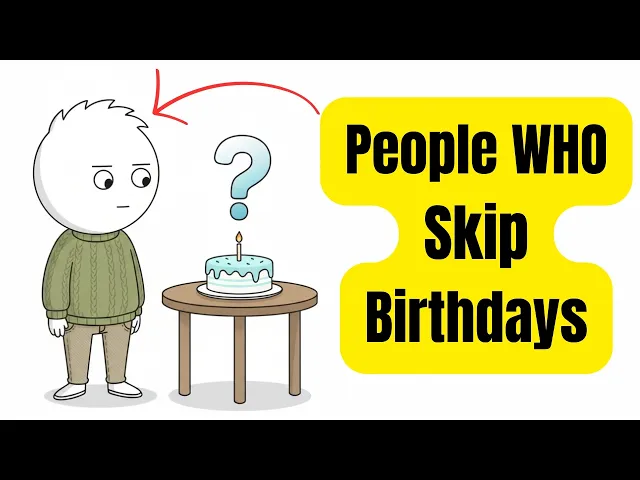
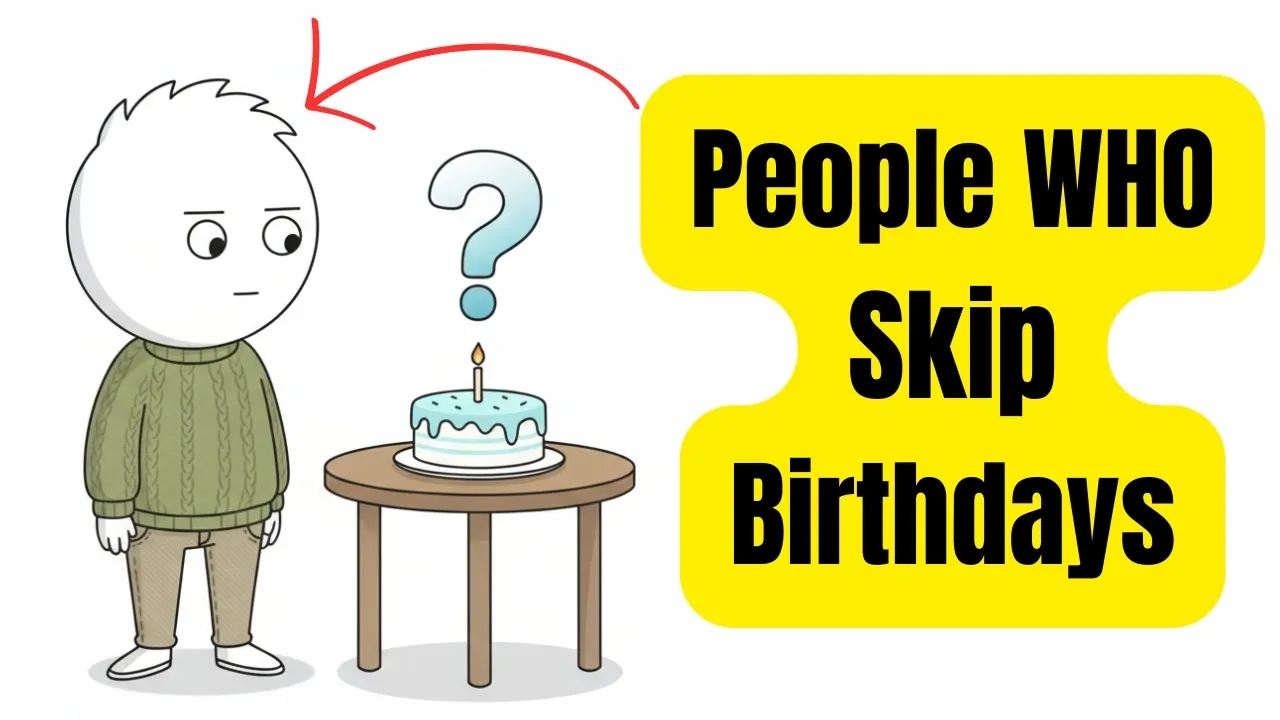
Your birthday's coming up. Someone asks, "So, what are you doing for your birthday? " And you say the one thing that apparently confuses everyone.
Nothing. It's just another day. And suddenly, you're the weird one.
Your friends think something's wrong. Your family says you're being difficult. Society acts like if you don't blow out candles and post a smiling photo, something must be broken inside you.
But what if nothing's wrong with you? What if you're actually more evolved than people give you credit for? Because psychologists have actually studied this and what they found says a lot more about the people who judge you than about you.
This video was made for you. Whether it's sadness, maturity, or something much deeper. Stay with me.
Let's start with the group nobody talks about. The ones who stopped celebrating not because they chose to, but because life taught them not to hope. In 1967, psychologist Martin Seligman discovered something unsettling.
He called it learned helplessness. When someone experiences repeated disappointment with no control over the outcome, their brain eventually stops trying, not because they're weak, because they're efficient. And birthdays, birthdays are basically a prediction error machine.
Here's the science. Your brain runs on predictions. Neuroscientists Schultz, Diane, and Montigue showed that your dopamine system doesn't just respond to rewards.
It responds to the gap between what you expected and what you got. So imagine this. You're young.
You expect the party. You expect your friends to remember. You expect to feel special.
And when none of that happens, not once, not twice, but year after year, your brain does the math. It stops predicting the reward. it stops releasing the dopamine and eventually you stop caring not because you don't want to care but because your brain decided that hoping hurts more than forgetting.
So when someone says it's just another day, listen carefully. That sentence wasn't born from apathy. It was built from scar tissue.
And the fact that they can say it calmly, that's not coldness, that's armor. But not everyone who skips their birthday carries scars. Now the second group looks completely different on the surface.
These are the people who genuinely forget their own birthday not because of pain but because their brain is running 17 tabs at once. Psychologists call this time blindness. And it's more common than you think.
When you're deep in a project, a deadline, a life that demands every ounce of your attention. Dates blur, weeks blur. Your calendar looks less like a schedule and more like abstract art.
And here's the thing, these people aren't avoiding their birthday. They're not suppressing anything. Their brain simply filed it under not urgent, right next to that dentist appointment they've rescheduled four times and that to-do list that's basically a novel at this point.
It's not that they don't care about themselves. It's that they care about so many things that one day just slips through. Sound familiar?
And then there's the third group. The ones who didn't forget. The ones who aren't hurt.
The ones who looked at the whole concept of birthday celebrations and simply said, "I'm good. " Not because they're cold, not because they're lonely, not because they're trying to prove something. They just genuinely don't need it.
And if that sounds like you, here's the science behind it. Psychologists Ryan and Dishi spent decades studying something called self-determination theory. And one of their core findings is this.
The most psychologically healthy people are the ones whose happiness comes from within, not from external events, not from social rituals, and definitely not from a song you never asked 30 people to sing at you in a restaurant. These are people who figured out what researcher Philip Brickman called the hydonic treadmill. That cycle where you chase the next celebration, the next milestone, the next external hit of happiness.
and it never quite lands the way you hoped. People in this group stepped off that treadmill. They're not missing anything.
They just stopped outsourcing their joy. Think about that for a second. While everyone else is waiting for one day a year to feel special, these people figured out how to feel whole on a random Tuesday.
And here's the part that trips people up. When you don't need a birthday to feel valued, it makes other people uncomfortable because it challenges their assumption that everybody needs the same things, that celebration is universal, that you should want the cake, the attention, the fuss. But people in this group already answered that question for themselves.
They don't need a calendar to remind them they matter. They don't need 30 people singing off key to feel loved. They already know.
But not everyone arrived at this place peacefully. Let me paint a picture. You're 8 years old.
It's your birthday. You've been counting down for weeks. You told everyone at school.
You imagined the balloons, the cake, the moment when everyone gathers just for you. And then the day comes and it's quiet. Maybe the people you hoped would show up didn't.
Maybe someone forgot. Maybe the whole thing felt smaller than the version you built in your head. And you didn't cry about it.
not where anyone could see. You just quietly adjusted your expectations and the next year you expected a little less and the year after that even less. Here's what most people don't know.
Researchers at John's Hopkins found that our brains don't just remember painful dates, they relive the emotion every single year. It's called the anniversary effect. Your calendar moves on.
Your brain doesn't. That eight-year-old is still in there waiting. But here's the plot twist.
Not everyone who skips their birthday is doing it from a place of strength. Psychologist Jennifer Crocker at the Michigan University studied something called contingencies of self-worth. And she found that some people disconnect from celebrations not because they're free, but because they're afraid.
afraid that if they let themselves want it and it doesn't go perfectly, it'll confirm something they already suspect about themselves. So, they opt out, not from confidence, from protection. And that distinction matters because there's a difference between someone who doesn't need the party and someone who wants it desperately but won't admit it.
So, if you're watching this, ask yourself honestly, is it freedom or is it fear? Only you know. And the fact that you're paying attention to yourself right now, that already says something.
And maybe that's the real point. We've been taught that celebration equals caring, that if you don't make a big deal out of your birthday, something must be wrong with you. But what if we've been measuring the wrong thing all along?
What if the truest form of self-love isn't throwing a party, it's not needing one? Maybe someone watching this right now spent their last birthday alone. Not because no one cared, but because the silence finally felt enough.
If that's you, you're not broken. You belong to a quiet tribe that doesn't need permission to feel whole. But just in case, here it is.
You're allowed. If this video found you today, it wasn't an accident. Leave a quiet comment if you've ever spent a birthday alone and felt perfectly fine about it.
If you want more like this, subscribe. The next video might explain even more about you than this one did.