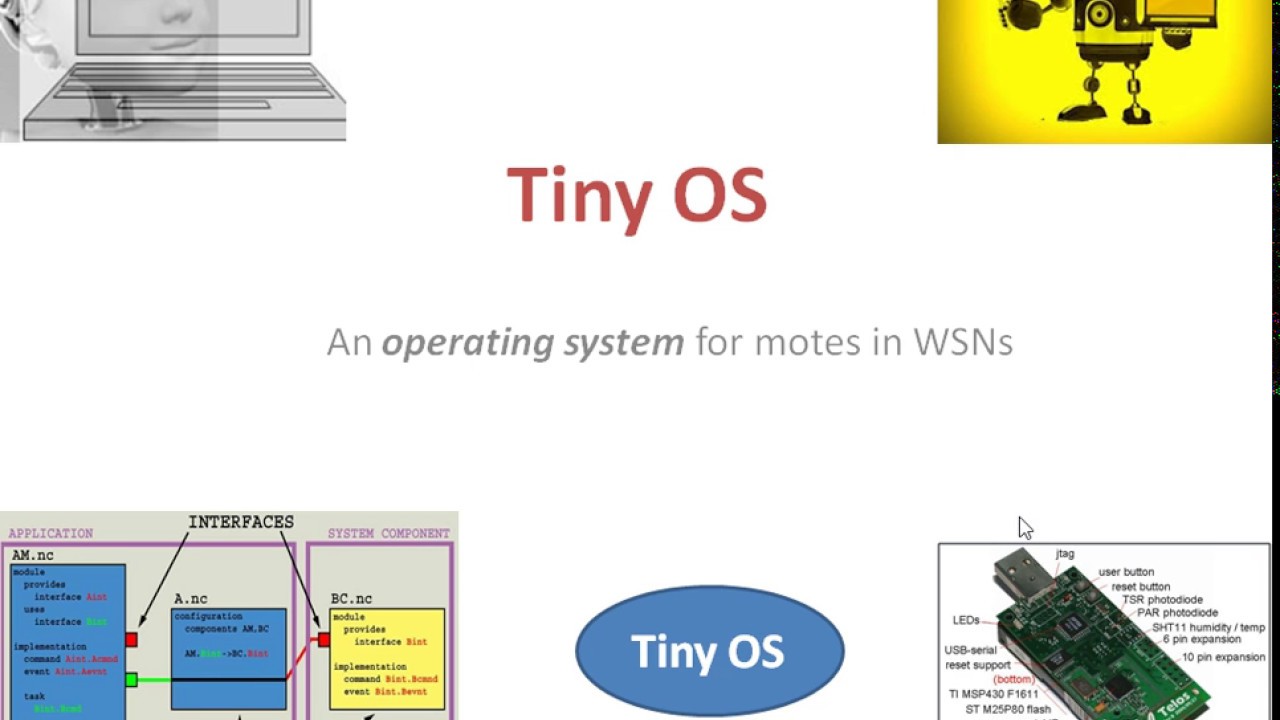
good morning I'm David Cena in this lecture we are going to discuss about Thai new OS and operating system example in wireless sensor Network wireless sensor Network operating system examples tiny OS this tiny OS is especially designed for wireless sensor Network by any lawyers is an open source flexible component based and application specific tiny OS architecture is represented in this diagram tiny OS supports concurrent programs with very low memory requirements the OS has a footprint that fits in 400 bytes tiny quiz falls under the monolithic architecture class tiny OS uses the component model and according
to the requirements of an application different components are glued together with the scheduler to compose a static image that runs on the mood a component is an independent computational entity that exposes one or more interfaces components have three computational abstractions events and tasks tasks are used to express intercomponent concurrency a command is a request to perform some service while the event signals the completion of the service tiny OS provides a single share the stack and there is no separation between kernel space and user space tiny OS programming model YouTube versions of tiny OS did not
provide any multi-threading support tiny OS version 2.1 provides Provide support for multi-threading and these tiny OS threads are called the toes threads the TiVo is threading package provides the ease of threading programming model coupled with the efficiency of an event-driven kernel Davos spreads a Backward Compatible with existing tiny OS code TiVo is threads use a competitive threading approach that is TiVo is threads relay on applications too explicitly yield the processor application Level threads in tiny OS can preempt other application Level threads but they cannot preempt tasks and interrupt handlers for communication between the occasion threads
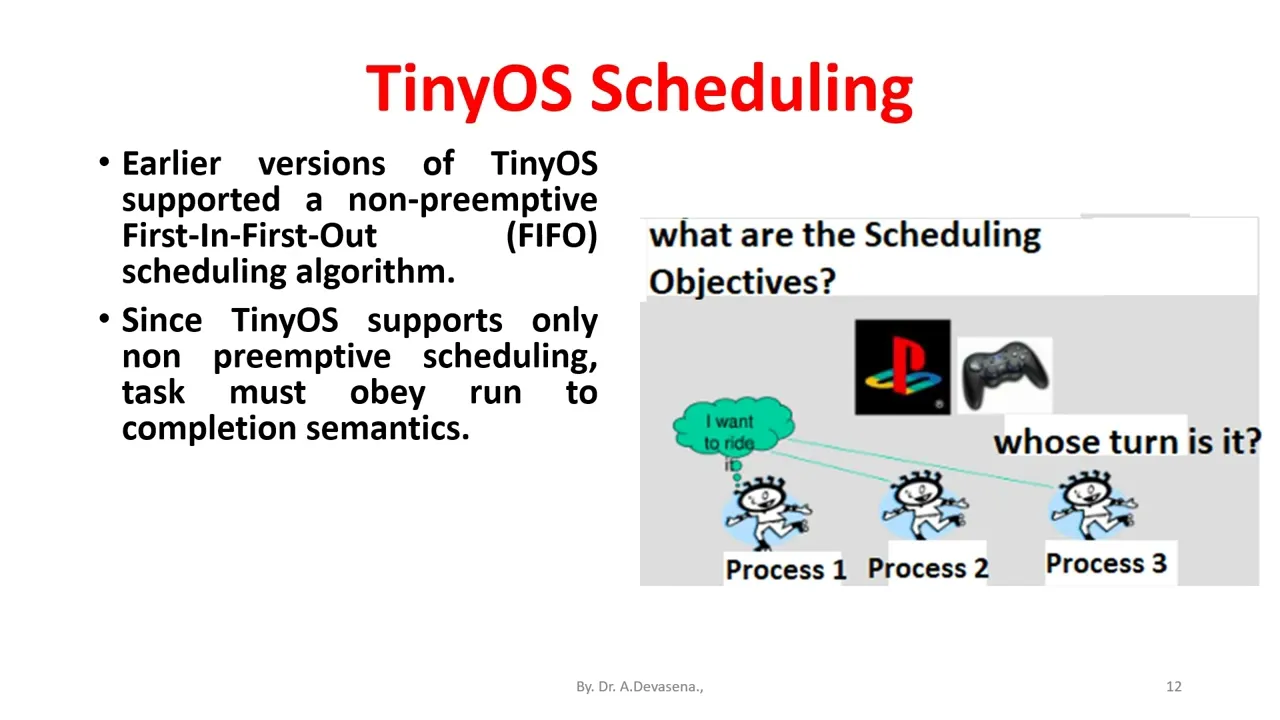
and the kernel tinyo is 2.1 provides Sage passing tiny OS scheduling early versions of tenuous supported a non preemptive fyu food scheduling algorithm that is first in first out is scheduling algorithm since Tinus supports only non-preemptive scheduling task must obey run to completion semantics as tinyos uses F5 for scheduling disadvantages associated with FAA full scheduling are also associated with the iOS scheduler two level scheduling task scheduling for scheduling art and priority scheduling and preemptive scheduling are also done in tiny OS scheduling in tiny OS version 2.1 memory safety is incorporated the goals of memory safety
are trapped all pointer and array errors provide useful Diagnostics and provide recovery strategies implementation of memory safe tiny OS uses the concept of a deputy the deputies yeah resource to Resource compiler that ensures type and memory safety for C code BYU is communication protocol support yearly versions of tinyos provides two multi-hub protocols calls they are dissemination and tymo that is Tiny OS Dynamic magnet on demand the dissemination protocol relably delivers data to every node in the network tiny OS uses two mechanisms for managing shared resources they are virtualization and completion events virtualized resource appears as
an independent instance that is the application uses it independent of other applications foreign that cannot be virtualized or handled through completion events there is no explicit support in 10 uas for real-time applications is not a good choice for sensor networks that are being deployed to monitor real-time phenomena thank you very much for listening this lecture if you like this lecture means kindly share this video to your friends for further updates kindly subscribe my channel thank you





![IEEE 802.15.4 in WSN -MAC Protocol- (EC8702-UNIT-3)- [Tamil]](https://img.youtube.com/vi/exKnnRfPR44/maxresdefault.jpg)