On the 7th of November, 1916, the streets of Boston were crowded with people. The results of the 33rd United States presidential election were due to be announced, and tens of thousands of residents were waiting for news with baited breath. Before that news could arrive, however, another more immediate event would demand their attention – Boston was about to witness the worst public transit disaster it had ever seen.
In 1916, trolleys were a common means of transportation in Boston. These vehicles were fast and efficient, and could carry dozens of passengers in reasonable comfort. They ran on rails that criss-crossed the city, using power drawn from electrified lines suspended overhead.
Though quite loud and rattly, they were a definite improvement on the horse-drawn vehicles which had been the norm for much of the previous century. Electrified trolleys were in common use in 1916, but radio and television were still in their infancy. When people wanted to know what was happening in the world, they turned to the newspapers.
That’s why, on the 7th of November, the streets of Boston were quite so busy. Workers trying to get home to their families were hampered by huge crowds which formed outside newspaper offices, hoping to be among the first to hear any announcement. As darkness fell on this unusually warm day, the city was heaving.
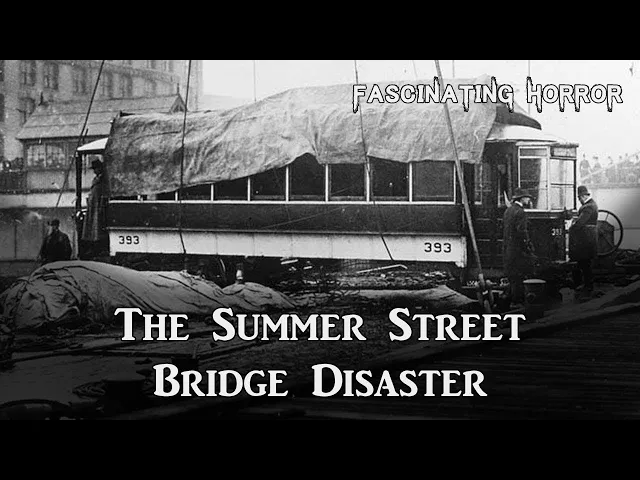
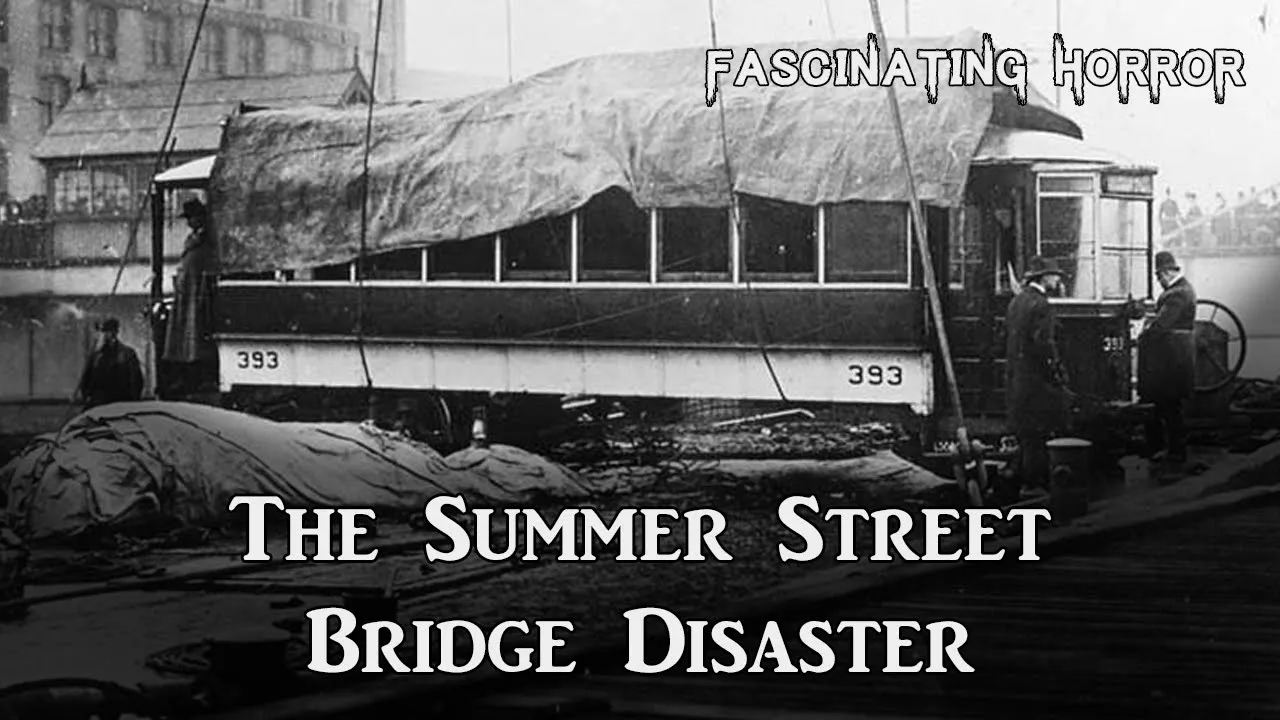
Things were so busy, in fact, that several extra cars had been added to the trolley system to help deal with the crowds. The 393 was one of these. It was added to the schedule at the last minute, due to follow a route through the industrial areas of South Boston, where hundreds of workers were waiting for a ride home.
At the controls was motorman Gerald Walsh, assisted in his duties by conductor George McKeon. Neither man had worked this exact route before, but they were familiar with the neighbourhood and it was standard practise for them to sometimes drive new routes to help cover for absent colleagues or fill gaps in the schedule. Despite the heat of the day and the crowds thronging the street, they set about their work as briskly as they could.
Walsh drove the car at a rapid 24 kilometres (or 15 miles) per hour between each stop, taking on passengers at a rate almost faster than McKeon could ticket them. By the time the 363 started approaching the Fort Point Channel it was very nearly full. There were seats for around 30 passengers inside the trolley… but it was now packed with more than twice that number, with riders standing on the back platform, and filling the aisle too as the trolley rattled along towards the Summer Street Bridge.
The Summer Street Bridge was a retractable bridge – something that would be a thoroughly unusual landmark today. Instead of lifting up like a drawbridge or swivelling to one side to let boats pass, the Summer Street Bridge was mounted on rails which allowed the roadway to slide diagonally to one side when required. Indeed, this was exactly what was happening as the 363 approached.
The bridge was fully open, waiting for a barge to pass through. Metal gates had been pulled across the road to stop traffic… although in the gathering dark they might have been difficult for motorman Walsh to see. In theory they should have been illuminated by a red lantern… but there are conflicting reports about whether this lantern was put in place, and whether it was working correctly if it was.
One thing Walsh definitely didn’t see was the stop sign located some way down the street from the bridge. This sign was supposed to make trolley drivers come to a complete halt, so that when they did approach the bridge they would be doing so very slowly. Walsh, however, drove the trolley straight past the stop sign without even a moment’s hesitation.
Between the stop sign and the bridge, Walsh did slow down… but he did so only to allow an additional passenger to board. Once the man had safely climbed up onto the trolley Walsh accelerated again… before suddenly slamming on the brakes as the open bridge came into view. The sight of the sheer drop in front of him must have been terrifying, because Walsh pumped the brake lever so hard that it bent in his grip.
The wheels of the trolley locked and it careened onwards, smashing through the gates. It reached the edge of the bridge, overran it, and teetered there for just a moment. As it lost contact with the electrical wires above, the power on board failed.
The passengers were left in the dark, shaken and off-balance, with the vast majority unable to see what was happening. One person who could see what was happening was passenger Christopher Thompson. He had been fare-dodging, and – fearing that he was about to be caught – had jumped nimbly down from the back of the trolley as soon as he felt the brakes being applied.
He landed in the roadway and turned around just in time to see the teetering trolley plunge down into the water below. While some of the passengers on the platform at the back of the trolley were able to leap clear as it fell, those inside were not so lucky. From the moment the trolley hit the water the odds were stacked enormously against them.
Many had already been knocked over or injured in the fall, and as water flooded in through broken windows, they found themselves in a blind and panicked scrum, with everyone packed into the car lashing out blindly as they tried to escape. Miraculously, some did manage to make it out from inside the car. Arthur Smith, a fish salesman, was one of them.
After being repeatedly kicked and slammed into by other passengers, he found himself next to a window. He used the back of his own head to smash it open and clambered through. On the way out the sleeve of his coat became caught and he was dragged down with the sinking trolley.
Eventually, after a great struggle, he wriggled free, swam to the surface, and was hauled out by rescuers. Nelson McFarlane, an amateur boxer, was able to push one person clear of the trolley before it fell. .
. but his act of heroism came at a cost: he himself went down into the water with the trolley. After getting clear and swimming to the surface, he rescued an elderly man who was struggling to stay afloat, and towed him to safety.
They were both hauled out of the channel, at which point McFarlane, despite serious injuries, started running back towards the water. Before he could do anything else, though, he collapsed from exhaustion and was taken to hospital. These survivors were among the lucky few.
The vast majority of those on board simply didn’t stand a chance. Rescuers were quick to the scene. Passers-by grabbed ropes from a riverside factories, and a tug boat dragged several surviving passengers from the water.
Even with the very best efforts of everyone present, though, there was little to be done. The crash had happened so quickly, and those who hadn’t managed to exit the car within the first few moments of it sinking were beyond help. It would be a long time before the final death toll of the incident was known.
Several bodies washed out of the car and were found some distance away. Others were recovered by divers one by one, in a painstaking process that lasted early into the morning of the next day. While most of the bodies were recovered, one victim of the accident wouldn’t be found until their body surfaced in the channel the next year.
Despite wildly varying numbers in the newspapers, the final death toll was 46 – a loss of life greater than in any public transit accident in Boston before or since. In the aftermath of the disaster, motorman Walsh (who had survived the incident) was put on trial. He had failed to stop at the stop sign – a huge factor in the disaster.
In his defence, however, it was argued that no red lantern had been on display on the gates, and that he hadn’t known to look for a stop sign. Some similar bridges didn’t have stop signs, or had them in different locations, or used completely different systems for managing traffic. The stop sign at the Summer Street Bridge was tiny, and mounted two-storeys up in the air.
It was no wonder that a driver unfamiliar with the route had missed the sign. Walsh was ultimately found not guilty. Following the revelations during his trial the signage at retractable bridges across the network was standardised.
Now each and every one would use the same process to warn approaching traffic that the bridge was open – even if a driver was unfamiliar with the route, they would know what signs to look for, where those signs would be, and what to do when they saw them. The trolley itself was lifted from the bed of the channel, refitted and put back into service. Passengers, however, were unwilling to set foot on board what they often referred to as “The Death Car”, and so it was put to work for maintenance purposes instead.
The Summer Street Bridge is still in place today, although the mechanism which made it retractable has been removed. Boston no longer has a trolley system, but buses still run over the bridge on a regular basis. There is nothing to mark the site of this disaster.
Indeed, when compared with other tragedies that have taken place in Boston, the Summer Street Bridge Disaster is all but forgotten. National papers at the time were dominated by the results of the election, and on a more local level the disaster was surpassed in magnitude by the Cocoanut Grove fire several decades later. Though somewhat lost to history, the incident nonetheless touched many lives, and is a part of Boston’s past that should not be entirely forgotten.