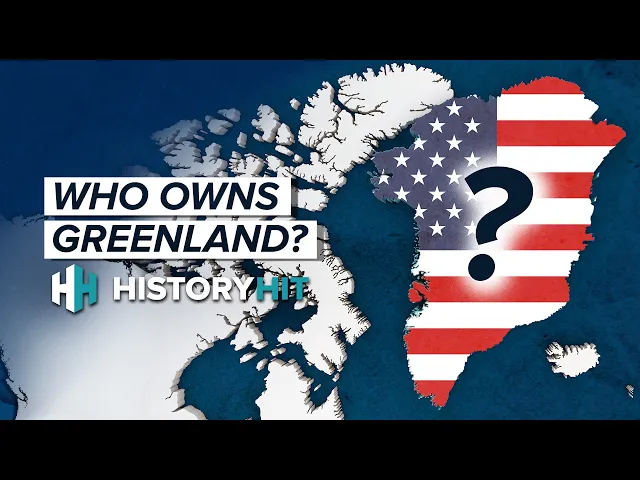
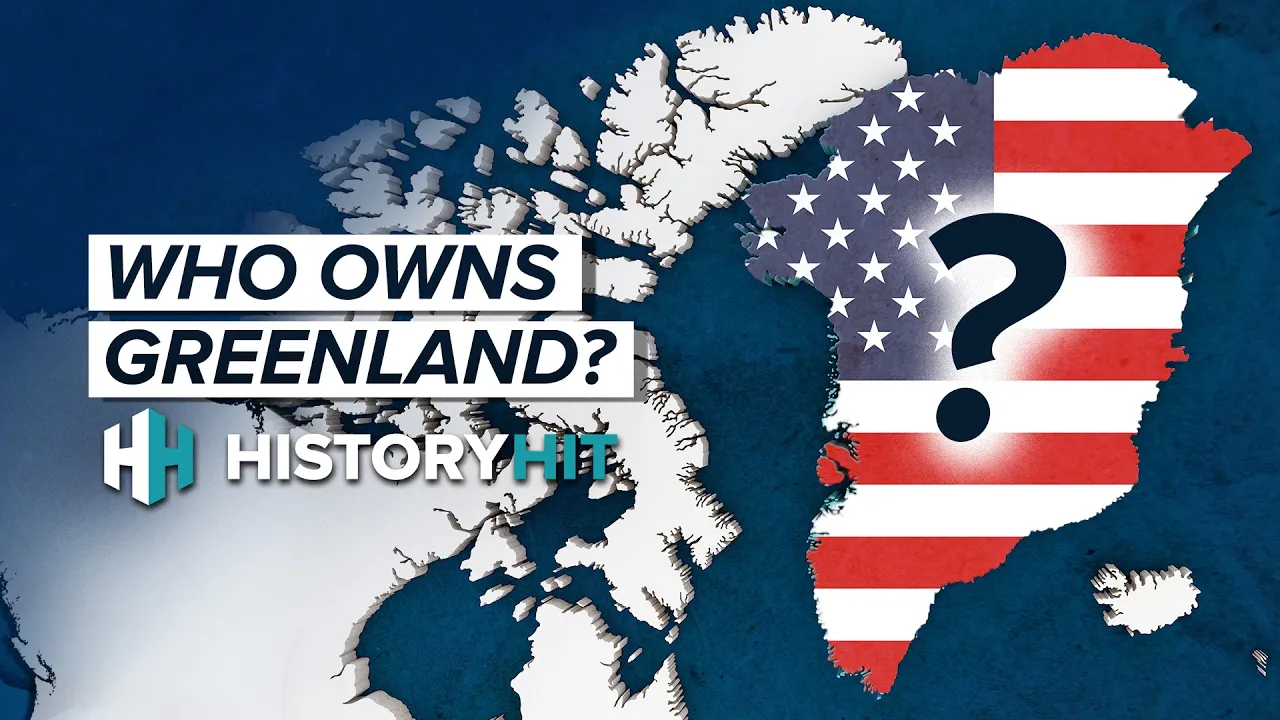
Greenland is the world's largest island. At just over 2. 1 million square kilmters or more than 1.
3 million square miles, its northern coast is the most northerly piece of land in the world, too. Technically part of the continent of North America, Greenland has had closer political and cultural ties with Europe for over a millennium. Despite its size, Greenland has a population of just 57,000 people.
The capital city, Nuke, is like most of Greenland's inhabited areas near to the south coast in the southwest of the island. Greenland has been associated with Denmark for centuries. It was a colony of the Kingdom of Denmark from 1953 before being granted home rule in 1979.
Further powers were devolved to Greenland in 2009 and recent political discussions and elections [music] have become increasingly focused on the question of independence from Denmark. The strategic location and natural resources of Greenland have made it a focus for international attention and attempts to control it for a long time. The story of how somewhere so cold became such hot property is a long and fascinating one.
The earliest known inhabitants of Greenland are believed to be the Inuit peoples who crossed from North America via the islands that are scattered off the coast of modern Canada. A number of waves of migration took place from around 2500 B. CE.
representing different Inuit cultures. The periods of migration which frequently overlap have been categorized as [music] independence one which began in around 2,500 B. CE and lasted until about 1,800 B.
CE. Then there is Sak from circa 2,300 B. CE to 900 B.
CE. Independence 2 from 1200 B. CE to 700 B.
CE. Dorsit 1 from 600 B. CE until 100 AD and Dorset 2 from 700 AD until 1200 AD.
The final Inuit migration is known as the Thul Culture [music] which arrived around the beginning of the 12th century AD. This group interacted with the Norse settlements [music] they found on Greenland's southwest coast. More on that in a moment.
and gave rise to the Inguk culture which centered on West Greenland in the upper Narvik district and saw greater reliance on hunting on the water by kayak. The Norse people encountered by the Thu were Vikings who had been on Greenland for more than a century by the time the Thu arrived. The settling of Greenland by Norsemen is usually dated to the arrival of Eric the Red in around 982 AD.
Eric, probably nicknamed the Red for the color of his hair, had a saga written about his life, imaginatively titled The Saga of Eric the Red. It tells a colorful story of its protagonist's life. Eric was originally from Norway, but when his father was found guilty of manslaughter in about 960 AD, the family were banished when Eric was around 10 years old.
They sailed west [music] and settled in Iceland. Following in his father's footsteps, Eric got into trouble with the law, too. After a dispute with a neighbor led to several [music] deaths, Eric moved to an island just off Iceland.
When Eric got into another fight and killed several more men, he was banished from Iceland. He might have wondered where he could go now, but there appear to have been stories of land even further west that no one had managed to settle yet. Low on options, Eric packed his young family into a ship and sailed west.
Sure enough, they found land, but it was frozen as far as the eye could see. Sailing around the southern tip, Eric worked the ship up the western coast until he found some land that wasn't just ice and snow. The saga of Eric the Red says he spent the next 3 years building a home and exploring the new land he'd found.
After the third year, his exile was over and Eric returned to Iceland, but only to try and encourage others to come with him and settle the new territory. Presumably, he'd be the ruler, but he needed people that he could rule. The saga tells us Eric called the new place Greenland to deliberately deceive the Icelanders he was trying to convince.
His sales trick worked. 25 ships left Iceland, though only 14 arrived in Greenland, demonstrating how dangerous the journey was, they established an eastern settlement, now Kakortto, and a western settlement near the modern capital of Nuke. Life was hard, but over the years, it's estimated that between 3,000 [music] and 6,000 Vikings lived on Greenland.
They hunted seals, walrus for the ivory in their tusks, and whales, all incredibly valuable commodities. Eric's son, Leaf Erikson, would sail further west and be credited with being the first European to discover North America. He would also Christianize Greenland, his mother having been a Christian.
The first bishop Rick was established in Greenland in 1126. Precisely what happened to the settlements on Greenland is unknown. The last written [music] record appears in 1408 and relates to a marriage on the island.
In 1540, a ship landed on what had been the eastern settlement and recorded discovering the corpse of a Norse man with these words. Dead man lying face downwards on the ground. On his head, a hood well-made and otherwise good clothing of freeze cloth and seal skin.
Near him was a sheath knife bent and much worn and eaten away. Why the settlement failed after half a millennium is unclear, though it's possible the Little Ice Age, a period of global cooling [music] that began in 1300 and lasted until the middle of the 19th century, made life there increasingly impossible. The mystery surrounding the fate of Greenland's north settlers led to centuries of speculation.
What if there were real oldworld Vikings still in Greenland? That was a mystery someone was bound to explore. The last wave of migration by North American Inuits arrived during the Viking settlement.
The Thu arrived during the 14th century. Like the other Inuit before them, they kept mainly to the northwest of Greenland. Here they hunted seal, walrus, and narwhal.
The extent to which they had contact and trade with the Norse settlements is unclear, but the Inuit lived in the parts of Greenland the [music] Norse never settled. The late 15th century's explosion in exploration saw a number of attempts to find a northwest passage to Asia. None were successful, but there were largecale whaling operations in the area around Greenland by the 16th century, led by English and Dutch ships.
The increased ice coverage and frozen [music] seas of the Little Ice Age made it almost impossible to find, let alone settle Greenland. In the early 18th century, King Frederick IV of Denmark sponsored a religious mission to Greenland. There was a belief that Vikings isolated there for centuries still live there.
If so, they would still be Catholic, whereas Denmark was now Protestant. They might even have reverted to paganism. The mission found no Vikings and struggled to convert the Inuit population they encountered.
However, they did begin to settle the southwest coast [music] again and operate trading posts out of those settlements. In 1776, the Danish government claimed a complete monopoly on trade with Greenland, and the island became a colony of the Kingdom of Denmark. Greenland was closed to all foreign traders, and this restriction and monopoly would only be lifted in 1950.
The Northwest Passage was finally discovered during a voyage between 1903 and 1906 by Rald Ammonson. During the flourishing of polar exploration in the late 19th and early 20th centuries, American expeditions began to venture into northern Greenland, which had always been inaccessible to anyone but the Inuit. One expedition led by Robert Perryi dispelled the long-standing myth that Greenland stretched to the North Pole by charting its northern coast.
These visits have formed part of an American territorial claim to Greenland. When the US purchased the Danish West Indies, now the Virgin Islands, from Denmark as part of its desire to shore up control in the Caribbean, the US gave up any claim to Greenland as part of the sale. The purchase of the Danish West Indies was preceded by threats to take the territory by force until the Danish government agreed to a sale to avoid an invasion.
The US believed control of the Danish West Indies was necessary for its national security. Although Greenland was viewed similarly, the claim was dropped even if the desire to control the island remained. In 1905, Norway laid claim to Greenland on the basis that it had been a Norwegian possession prior to 1815.
The dispute resulted from the break up of the Union of the Crowns of Denmark and Norway that lasted from 1537 until 1814 and rumbled on for many years. A Norwegian meteorologist named Halvar Devald occupied part of the uninhabited east coast of Greenland on his own accord in 1931. The Norwegian government then backed Devold's move to formally claim Greenland.
After 2 years, the Permanent Court of International Justice decided the case in Denmark's favor and the Norwegian occupation ended. World War II saw the strategic importance of Greenland rise to even greater prominence. In 1940, Germany invaded and occupied Denmark, cutting off Greenland.
Its position in the high north Atlantic made it a vital region that the Allies and Axis powers sought to control. It offered a base for shipping, particularly for the Allies to hunt yubot, [music] and was considered important for forecasting weather in the Atlantic, too. In April 1941, the Danish ambassador to the USA signed a treaty giving the US permission to place military bases on Greenland.
The ambassador refused to acknowledge German control of Denmark. And when the Danish government accused him of treason and ordered him to return to Denmark, the ambassador declined to do so, probably wisely. Greenland became a United States protectorate.
The US established 14 military bases along the west and eastern coasts of Greenland, which were used by American, Canadian, and British forces. It became the core of the effort to attack German submarines and allow traffic across the Atlantic. During the war, disconnected from Denmark, Greenland enjoyed a period of relative autonomy.
In 1941, in response to German forces establishing weather stations on its east coast, Greenland established the sledge patrol. Greenlanders with dog sledges patrolled the areas locating German bases. They would either attack themselves or coordinate with US air and sea units to assault the installations.
By 1944, Germany had been forced to abandon its interest in Greenland. The Sledge patrol suffered only one casualty [music] during its years of operation. At the war's end, Greenlanders welcomed Denmark's liberation and a return to control from Copenhagen.
However, the experience of autonomy had left a strong mark on the people of Greenland. The Danish ambassador to the US did now return to Denmark where treason charges against him were dropped and his treaty with the US was ratified. In 1951, it was replaced by a new treaty allowing the US to maintain a military presence on bases in Greenland.
During the Cold War, Greenland remained a place the US considered vital to its national security. In 1946, the US offered Denmark $und00 million in gold bullion for Greenland, but Denmark refused to sell it. In 1955, the joint chiefs encouraged President Eisenhower to pick the idea up again, but it came to nothing.
Greenland sits about halfway between Washington DC and Moscow. The US believed it was an important position from which to counter Russia's control of Arctic seaports. It was also thought that any intercontinental missiles would most likely travel over the North Pole and therefore Greenland before reaching America, making it a vital radar and observation point.
The new treaty of 1951 made Thor air base in the northwest of Greenland permanent. In 1953, some of the Inuit residents were forced from their homes by the Danish government to make room for the base's expansion. This is part of the reason the base has become a source of lingering friction between Greenlanders [music] and the Danish government.
Shock, fear, and outrage were caused in 1968 when a US Air Force B-52 bomber crashed in Greenland. It emerged that the plane had been transporting four hydrogen bombs and radioactive debris from the crash [music] contaminated the surrounding area. There was a large-scale cleanup operation, but it was further revealed that only three of the four bombs had been found.
The fourth remains missing to this day. In 1995, the Danish Parliament was rocked by a scandal known as Thulgate. It was revealed that in the years prior to the plane crash, nuclear weapons had been routinely flown over Greenland.
The Danish government were discovered to have tacitly allowed this to happen despite the country's position as a nuclear-free nation. As the US continued to develop the base at Thul and improve its radar capabilities, inhabitants on the island began to raise concerns that it would make Greenland a prime target for any strike, nuclear or otherwise, that would put the population at severe risk. Despite these concerns, the base remains in place [music] and is considered a vital national security asset by the US.
Greenland ceased to be termed a colony of Denmark in 1952 when it was recognized instead as an autonomous overseas province. It's since been considered a constituent part of Denmark, in effect an [music] overseas county of the kingdom. Greenland was for the first time permitted to elect representatives to the Danish Parliament.
In 1973, Greenland as part of Denmark joined the European Common Market, the forerunner [music] to the European Union. This was despite Greenland itself voting against membership by a majority of 70%. The island's concerns were realized when free trade meant other nations had access to its waters and they became heavily overfished.
Under increasing pressure, Denmark granted Greenland home rule in 1978, [music] establishing a representative assembly known as the Lannsteing. The name of the capital [music] was changed from Gutop to Nuke and Greenland got a new flag in 1985. In 1982, 53% of Greenlanders voted to leave the European [music] Economic Community, a process completed in 1985.
From 2008, Greenland's devolved powers were extended, including allowing the withdrawal of Danish as the official national language in 2009. The home rule government in Greenland has remained concerned about the presence of the US Thu base. Around the turn of the millennium, there was a growing desire to renegotiate the 1951 treaty between the US and Denmark and to push for the United Nations to be given control of the base in place of the US.
Elections in Greenland have frequently focused on a growing interest in full independence. In 2025, elections delivered a shock result as the center-right Democratic Party tripled its vote and took the largest share. The Democratic Party and Nalarak, a party that came [music] in second, campaigned in favor of independence for Greenland, though Democratic favored a more cautious and gradual move than Malarak.
No party has an overall majority and any further move towards independence will depend on the makeup of the coalition that's [music] formed. Recent polls have suggested that 85% of the population of Greenland opposes becoming part of the United States and more than half consider recent comments from America to be a direct threat against Greenland. So why does Greenland remain such a prominent concern for the USA?
Recent statements have continued to position it as vital to the national security of the United States. despite President Trump insisting he has a strong relationship with Russian leader Vladimir Putin, that Russia wouldn't attack the US and that the US is no longer interested in being an international policeman. There is another reason why Greenland is of interest to the USA and why the interest might be framed as relating to national security.
According to the US Geological Survey, Greenland has an estimated 17. 5 billion barrels of oil beneath it and significant reserves of natural gas. However, environmental considerations and objections from indigenous peoples mean that oil and gas extraction is currently banned in Greenland.
In 2023, a European Commission survey established that Greenland contains 25 of the 34 rare earth minerals considered critical raw materials. These deposits are believed to be considerable and are materials vital to the production of electronics and green technologies. The extraction of these rare earth minerals is currently dominated by China.
The US [music] has demonstrated an interest in securing access to rare earth minerals in Ukraine in order to assist in finding a solution to Russia's invasion of that nation. The importance of Greenland to the US might now lie in the existence of oil, gas, and rare earth minerals. And rather than being viewed as vital to military security against Russia, it might be economic security against China that is really driving US attention once more towards Greenland.
Thank you very much for watching. I hope you've enjoyed this brief history of Greenland. If you want to find more explainers like this, you can head over to our YouTube channel now where you'll also find a very similar explainer about Ukraine and Russia's interest [music] there.
I've been Matt Lewis and this is History Hit.