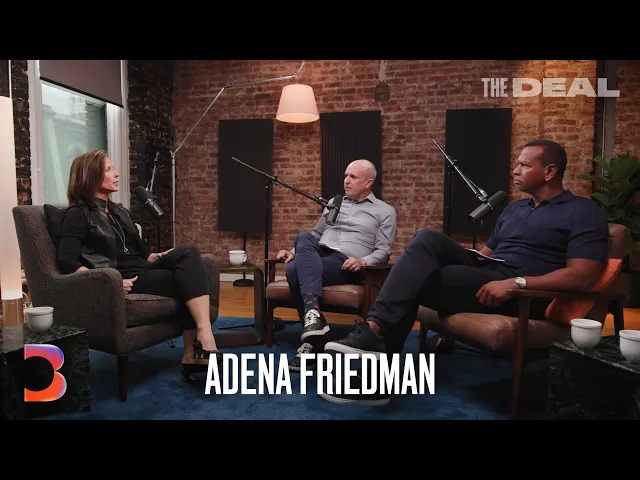
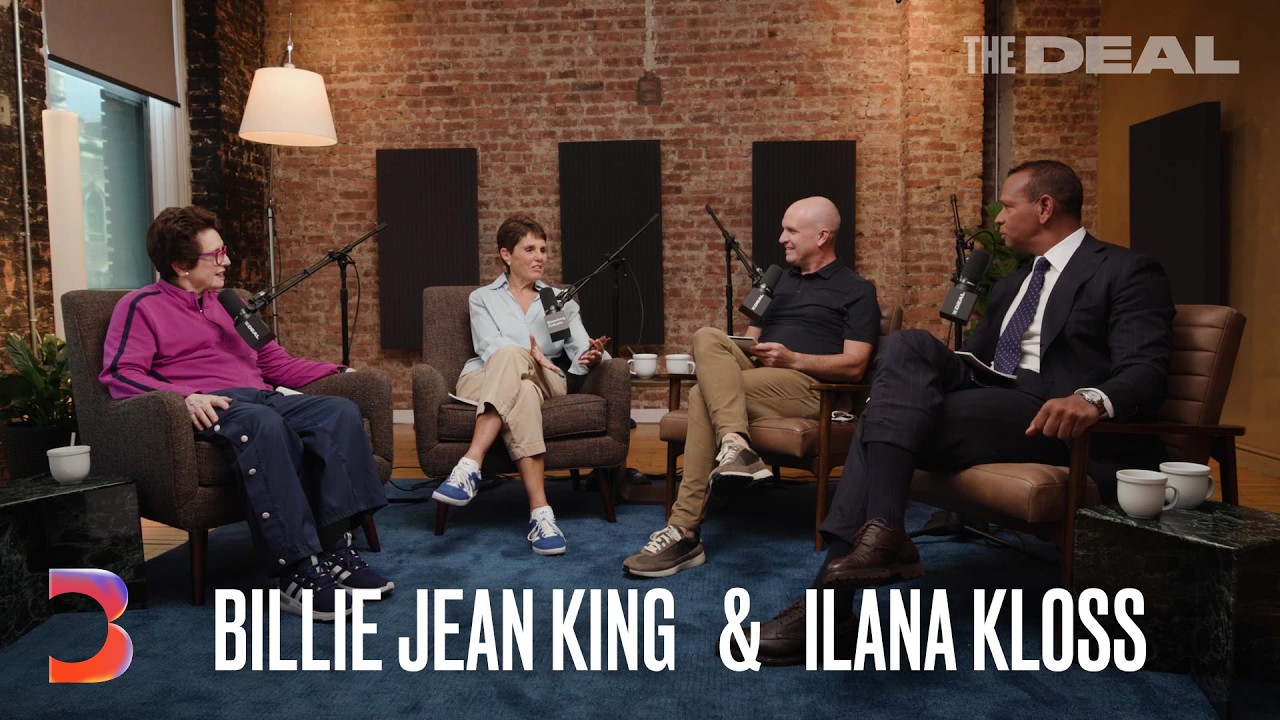
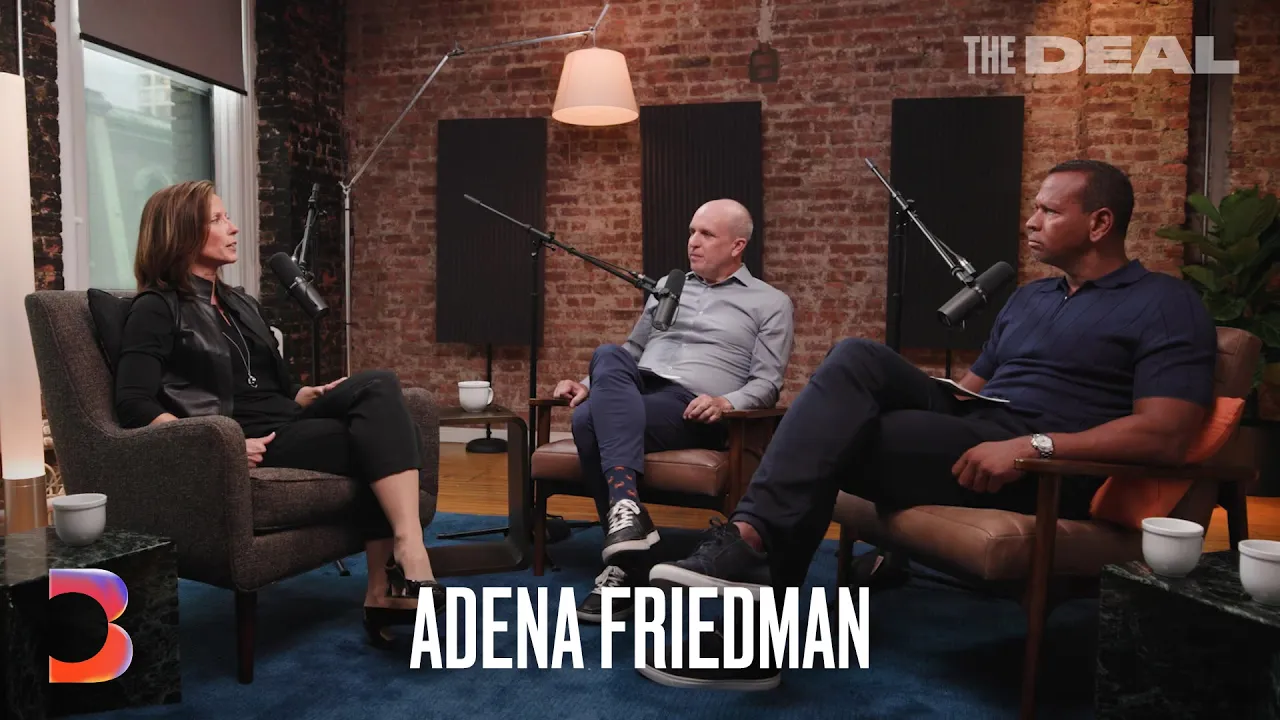
I'm Jason Kelly. I'm Alex Rodriguez, and we are here in New York. We're gonna talk Nasdaq, the CEO of Nasdaq. Adina Friedman is gonna stop by and tell us all about the deals that she's making, including in the world of sports. She loves sports and she understands the cross between sports, entertainment and culture, which is what her show's about. And I actually think we're a little bit ahead of the curve because franchise values are going up at such a high rate That a lot of these conglomerates that people are building, it may end up in
the Nasdaq and I think she's prepared for it. Right. Atlanta Braves, my Atlanta Braves. Yeah. They are publicly traded on the nasdaq. Yeah. The only MLB team to be. So you have to expect that they're gonna be more such teams and this idea of a sports ecosystem that is much bigger than the teams themselves. DraftKings are publicly traded on the Nasdaq plus all the technology that's underneath all these sports teams. And as you say, access to capital is gonna be massive Around the world of sports coming up. Absolutely. The public markets are there, they're waiting.
And I believe Jason, that a lot of teams are watching very carefully to see this is maybe a possible outcome for them. And what's interesting too is Adina is a deal maker at her core. NASDAQ is in the business of deals. You know, a public listing is often one of the most important moments in a company's history. She's right there. She sees it all. I, I think the audience is gonna be very interested And surprised to see the scale of nasdaq, how they make money, which she explained beautifully. But the other thing to remember is
she's a role model and fascinating pivot from NASDAQ to CFO Carlisle back to CEO. Right. And that's, that's awesome. She's also black belt at TaeKwonDo And a huge, huge Washington Commanders fan. That's right. We get into that as well. Alright. Coming up on the deal. Adina Friedman. Alright, so we like to start this show by having the guest introduce themselves. So tell us who you are and what you do. I'm Adina Friedman. I'm the chair and CEO of Nasdaq. And so what do you do? Like what, what, what does that job entail? Well, NASDAQ Today
is a global technology company that serves the entire financial ecosystem. So our exchanges are our foundation. And then on top of that, we have a whole suite of data and software solutions that serve the industry. So when I go to work every day, you know, I focus our team on how are we making sure that we're driving our strategy? How are we executing? What are our clients asking us for? Are we meeting the needs? We literally spend every minute of the day focusing on that. And it's, it's been fun and it's, honestly, it's a great,
great team effort. So what does a great day look like and what does kind of a so, so day look like? Well, every day I feel like I have to earn my living. You know, I always said that every single day you have to make a difference, and it can be small. So in the days that you make a bigger difference, where maybe you, you win a big deal Or you launch a new service, or you do something that's totally unique and different in the industry, like the first to, you know, create a new capability
in trading or whatever it is, those are big days, fun, exciting days. And then the days that are eh, are the days where you get you to the end of the day and you go, okay, what exactly did I do to further the business today? Right, right. And you sometimes have days like that too. Is that sort of your mo was that your mentality coming in or was that something that you Sort of learned along the way? I got at, got to NASDAQ in 1993 as an intern, and then made, made it so that I
became a permanent employee after that. And I did come to work every single day with the attitude of, I've gotta make a difference every single day to earn my keep. Like they're giving me a, they're giving me a paycheck. Yeah. I better earn it. And I really did think about it every single day. I mean, it is actually what has driven me throughout my entire career. Where does that come from? I mean, is that like your upbringing? What's inside or underneath that? Yeah, I do think that it comes from my family. My parents, my dad
worked so hard his entire career. He spent his whole career at Te Rowe Price. He was an investment manager, but he came from a very different background. His father was a missionary minister and he grew up in Portugal. Mm wow. - And so he came to college on a scholarship and he started with very little. And then my mom went back to law school when I was nine and became a lawyer when I was 11. So I gotta see her launch her career and see how much effort it took to kind of come into the
legal profession. And then she became the first female partner in her law firm. And they never took anything for granted. I mean, and I, since I grew up seeing that, we, we started with little, a little and ended up doing well. You know, I also saw the, the benefits of all that hard work over time too. So I think all of that really parlays into my, my work ethic and my attitude in life. And so your, you're a kid. Are you playing sports? Because, you know, one of the commonalities I know we find when we're
talking to top executives is they played sports, they have some interest or some dedication that is underneath this drive and, and discipline, Right? Is you? So I, I did play sports and it was interesting. When I was young, I wanted to do everything. I wanted to do gymnastics, and I wanted to do ballet, and I wanted to do karate, and I wanted to do tennis. And I, my mom was like, you just have to start to focus. She Let me try everything and then say, okay, what is it that you really like? What do you
wanna go back to? So I ended up studying ballet for 10 years, and I played varsity tennis in my high school, but I did not take it beyond high, beyond high school. But those two things were very good at focusing me and making it so that I had that discipline of always striving for something bigger, striving For the win, and being very competitive. All right. So this is gonna be the toughest question by foreign interview. I'm obsessed with this thing that I read about you. You're a black belt in TaeKwonDo, but Jason and I are
white belts, But, but see sub white belts, I think whatever the sub whatever is less than That. I feel like if we ask the wrong question, we're gonna get dropped to. Yeah. So be careful. No, But Adina, seriously, like how long did it take you to go from start to black belt and is that something that you think has helped you in your career? Yeah, actually I think I do think it has helped. It took me 10 years to go from starting to getting my black belt. Wow. And I found that it was an incredible
discipline. Honestly, the thing that is the hardest thing about TaeKwonDo is sparring. You know, the skills building was the fun, easy, not easy, but fun part for me. The sparring was the scary part for me. And one of the things I've always really focused on is getting through your fear. Mm. You - Know, fear has always been a driver for me. So how do you get past your fear? How do you conquer that? And I cannot say that I've honestly ever conquered my fear sparring by learning how to play offense and defense simultaneously is one
of the most important things you can let learn in sparring. Similar to like chess, you know, every offensive move, there's a counter to that. So I sparring, if you focus too much on, on, oh, I'm gonna, how am I gonna land that kick? How am I gonna get that punch in? They could come and kick you in the gut in the meantime, and then you're, you're done. So learning how to play offense and defense simultaneously, I think is the best thing I've been able to learn in terms of parlaying that into business. All right. So
you just settled a couple things that I wanna unpack. I mean, one is this idea of fear drives you. Tell us about that. Yeah. You know, it's interesting. I've had moments, you know, in my life where my parents were always in, in the right way pushing me outta the nest. Hmm. Right. So when I was 10, as I said, my, my dad grew up in Portugal, and my dad, my parents just put me on a plane by myself to Portugal and said, go find your grandparents at the other end. And, you know, and, and when
you're 10, I mean, I know a lot of kids have done that, but for me that was a, a moment of fear. I don't know if A Lot of kids have a lot of, But you know, you get on that plane by yourself and you go, I can't do this. And then you get to the other side and suddenly they're there. Yeah. And you have the experience and adventure of your life, you know, and, and it was an amazing thing. I'd only met them a couple times before, so it was just a great opportunity. And
I kept back on the plane on the way back and I'm like, I know what I'm doing. And so you, you learn to conquer fear. My parents were very good at putting me in situations where I had to conquer fear. So I then learned how to fly when I was in college. And you have moments when you have to conquer fear. When you're learning how to fly, you kind of face a little bit bit of mortality and getting past that and making sure that you realize that you have to, like, you have to figure this
out. It's not like you can give up. You have to figure out how to land the plane. And so those are the types of situations I put myself in up Until I started work. And there, that was when, you know, there were moments in my career where I was offered an opportunity and I'd be like, Hmm, how am I gonna do that? But at the same time, you have to find, I found fear of failure was what actually drove me to succeed. Interesting. It's interesting because thinking about someone like you with a father who's one
of the top investors in the world, and your mom who's a professional and a and a lawyer, you would think someone like you would be Equipped not to have imposter syndrome. Did you ever have imposter syndrome professionally? I had two moments in my career where I, I think the word imposter syndrome, that wasn't really a term that was used because I've been in the, in the career of my career over 30 years long now. But there was a moment when at age 30 I was given the opportunity to run one of the business divisions at
nasdaq. They reoriented the business into three divisions, and they asked me to head one of them. I was a little shocked. I was super excited. But I also sat there and said to my boss, awesome, I can't wait. And then I went home to my husband, I was like, oh my God, how am I gonna do this? Yeah. And, and then you have to sit down and say, okay, how am I gonna do this? Who do I need to get around me who's really great at what they do and can help me teach me and
who I can learn from? And I think though, that at that time I, I thought, okay, what do I know? Why did they choose me? You have to say they choose you for a reason. Right. So what, what have you done to successfully that They want you to continue that success? What do I need to learn? And who's the best person who's gonna be able to teach me that? And or people. And once you kind of get a path, you find a path forward, the fear's gone. Right. So, and then you just have to make
sure that you're performing against that path. And a second time I was running the data division and Bob Reinfeld, who was the CEO at the time, asked me to become the head of corporate strategy in addition To running the data business. And again, I'd never done a m and a deal in my life. So, and I was gonna run at m and a. Wow. And so I went to a trusted friend and I said, Hmm, how is that, how exactly am I gonna do this? And he just said, oh, Adina, it's just a bunch of
PowerPoints, you'll be fine. But I did use that as a way to conquer, conquer my fear. And by the time I became CEOI honestly was very ready for the job. I was very ready. So one of the clear through lines So far in your story is a sense of competitiveness. Fair. And, and where do you think that comes from? I definitely am a competitive, yeah. So I mean, life is competitive as humans. We are competitive, you know, and so therefore, healthy competition, keeping it in check, making sure you're, you're using it to drive you in
a positive direction, making sure it is a driver. Yeah. I think it's a wonderful thing. And, and I also think That if you only though focus on your competitors, you actually are not at all reaching your highest height. So I say to the team, and so, and I say this in life, like you have to have a vision of where you wanna go, have a strategy in how you're gonna get there and engage your clients. They don't know exactly what you should be doing, but they do know what they need. And so how do you
then parlay that need into a capability? And how do you focus on them? Then you look at your competitors, then you look left and right, and you say, okay, well What are those competitors doing that you might wanna take and say, this is actually something I should be doing, or how can I make sure that I, I leave them in the dust. Yeah. You know, and I, I'm always staying ahead of them, but it's always in the context of a bigger vision and, and, and a bigger part of your life. I'm competitive, but I don't
think it's maniacal. So along those lines of driving vision and strategy, talk to me a little bit about the difference when you're running one of the corporate, you know, divisions versus the CEO. Is it driving vision, strategy, and maybe recruiting? How would you describe your three or four main goals and duties as the CEO? Taking it from the CEO perspective, the first thing is you really have to have a vision for where you wanna go as a business. And that can be something that just comes solely from within you. Or if you're not quite sure
where you need to go, engage the team, have the right people in the right seats to help you define that vision. But whether you're bringing it to the table or, or you're getting it from the, from the team, once you have That vision, you have to get everyone on board. You know, so how do you make it so everyone relates to that vision and feels excited about it? And how do you, you know, kind of verbalize it in a way that motivates the team. The hard part though, is executing against that vision. That's when you
really gotta roll those sleeves up and get engaged. You can't just assume the team's gonna figure that out. You have to get engaged, establish a, a routine, establish a cadence of driving that vision forward and and engaging everyone along the way so you, That everyone's coming with you instead of dragging people behind you. Now I learned all of those skills from running a business division because within nasdaq, the division leaders do have a lot of autonomy. And certainly I grew up with a lot of autonomy. My, my first boss was awesome. Yeah. To Be like,
here, here's a problem. Can you go solver for me? Sure. I don't know how I'm gonna solve this, but okay, I'll figure it out. And then he, I come back and say, here you go. You know, he was, he didn't sit there and tell me, here are the 10 steps you need to take to solve this problem. Go, just go figure it out. Mm. - So I, I definitely had some good problem solving skills early then I was handed this data division. First time ever we had a business called data. And so setting a vision
for what that was and learning those skills was part of running the division. Then I ran corporate strategy, which at the time was actually more of an m and a job. I think Bob Reinfeld was awesome And he created operational excellence. He really grew the business tremendously. His mantra was always good. Execution beats a great strategy all every day. And my view is, why not have both? So if you have that great strategy and then you drive good, good or great execution, then you can even go further. So let's take a beat on Bob Feld
because he becomes, I think, arguably the key mentor of your career. I mean, so first of all, he was the most important mentor Slash sponsor that I had in my career. And, you know, Bob was and is in my life. Like, I mean, you know, we've known each other now for 20 years. Yeah. I worked for him for 11 of those years. I learned so much from him. He positioned me to be a winner. You know, he positioned me to grow and expand. He was always willing to give feedback. You know, he, he, what I
actually really liked about it's, he said, you know what you're good at. Let me talk to you about what you can get better at. And I love that. I mean, how was I, How was I gonna learn if I just, if he just sits there and blows, you know, sunshine at my face, that's not Gonna happen. And what did he say? You can get better at The fir very first thing I remember I had just taken the, the head of strategy job and I was having to negotiate an acquisition. But my negotiating experience up until
then had been as a, a participant in this industry consortium where having to face off against all our competitors every single day and deal with a lot of contention. And so I was a very defensive negotiator and I was like, don't hold the line. You know? Yeah. - That kind of orientation towards negotiation. And, and so he said, Adina, you're good at defense, but you gotta start playing offense. Like we gotta actually get the deal done. You know, you've gotta find a path to the finish line. Mm. Yeah. And so that was his first thing.
It was so good. Great advice. Such good advice. And then the second one was when I became the CFO and he said, this is the first time where you're not gonna know everything. And so you're gonna have to figure out, you know, How you're gonna bring your team along and make sure that you know what you need to know, but that you're empowering your team. And so it was, you know, those were the types of things that he told Me. It's funny, Jason, what what Adina just described is what she's learned from mom and dad,
but also a little bit of TaeKwonDo. He's teaching you how to play offense and defense. Right. Exactly. He was so good at cutting through the noise and seeing the things that mattered. And he was excellent at that. So I think that we were good partners. 'cause I would bring him, you know, and when we were working on deals, I would work through all of the details of how to get it done. And he would though always see the finish line. You know, so just, I think that we were very compatible. And then I learned a
lot from him and he positioned it so that when I became CEOI was ready. Yeah. You Know, he had done everything perfectly to position me to be the CEO Wow. Came in as president And then he gave me the present COO job. He started just not being as many meetings. And Oh, Idina, you go figure that out. And yeah. You know, just stepping back and stepping back. And so two and a half years after that journey started, you know, he's like, okay, you're ready. I had been at NASDAQ for 17 years. I had become the
CFOI was two years into being CFO and I was very happy. And actually a headhunter called me. Ah. But at the time, you know, I, I'm working in New York, but I, my family and we're in, we're in the Washington DC area, so I live in the DC area. I raised the kids in the DC area and I was commuting up to New York every week. And, and they called and they said, there's this, you know, private equity firm, they're interested in finding a CFO to help them go public. And I said, well, which one
is it? And they said, it's Carlisle. And Carlisle is the, the largest, most successful private equity firm in the Washington DC area. It's a global brand. It's an amazing firm with great leadership. Yeah. And of all of the jobs, like I had obviously gotten calls from a lot of headhunters over time. I think any executives do, this was the only time I'd actually returned the call to say, yeah, I actually would be willing to talk to them. But My calculus was, it was time for me to prove myself somewhere else. Could I actually be a
successful elsewhere? I needed to know that for myself. That competitiveness. I was gonna say this competition, this is, this is running deep. I wanted to learn about the other side of the, of the financial world. Yeah. You know, To get, become an investor. My father's an investor, my brothers runs a hedge fund. So I really wanted to understand that side of the financial industry had an opportunity as CFO to take a company public, which is a unique opportunity. And I could live and work in the same city. Yeah. So, you know, it just was the
opportunity That was just meant for me at that time. So what's that conversation like to go and quit the only place you've ever worked? It was very hard. Bob was amazing at it. He was amazing. He didn't say, oh, please stay. He said, Adina, this is a great opportunity for you. I think it's a great opportunity for you to learn and expand and good luck. You know, he Was great. Do you think he had in his mind that he was gonna get you back? No. Really. I mean, I dunno. I, I guess, I don't know.
Yeah. I don't know. I, I did not have in my mind that I would come back. Really? - No. Wow. When you make a decision like that, that's a, you've gotta look at as that's a 10 year decision. Yeah. Yeah. You know, if you're gonna commit to a company, you, you better be ready to commit for a long time at that role in particular. And I loved it. I mean, it was a really great opportunity. So when you think about a pivot like that, I mean, it's like you're going from Red Sox to the Yankees
to great organizations, right. But can you talk a little bit about the differences in Culture, strategy, work ethic, all all the stuff that we, that you have to deal with as a, you know, high level employee? That was what was so interesting. It was the cultural difference. 'cause I'd only worked in one place now while NASDAQ had had several iterations of its existence, it was very much a, a, a pretty singular culture, command and control culture. A lot of focus on the top decision makers and Carlisle, I would call it a collaborative culture because it's
a partnership. So you have a hundred partners in a firm and three founders. And of course there's a lot of decision making that happens with the three founders. But there's also a, a diffusion of decision making down in empowerment across a hundred partners who are all owners in this business. And it's private company. So very different culture. And I have to say, I like elements of both cultures. I think that in a company like Nasdaq, critical infrastructure provider to the financial industry and the economy, you have to make decisions fast. And you have to make
very concrete decisions. So command and control And that whole hierarchy, that whole ethos I think is actually an important part of the culture. But the collaboration comes from, I can't just sit in the top corner office and decide what to do. I have to engage the team and make sure we're bringing people along. And while decision making can be slower, you ultimately through that debate, you get to hopefully a better decision. So I do think that we've been trying to infuse both of those back into nasdaq. Yeah. When I came back to Nasdaq, having had
That experience, like, you know, we can do this a little differently. We can bring more opinions in the room Mm. But still move fast. Mm. And, and that's what we've been focused on. You know, given that we are here on the deal, you had been doing some deals, I obviously, so you had been in that m and a role at Nasdaq prior to Carla, right? Do I have that timeline There? Yes, that's correct. Yeah. So then you go into a business that the deal's the thing. Yes. I mean literally that is the business of, of
that. What did you learn about deal making there that that maybe sort of elevated or accelerated that part of your resume or skillset? Yeah. Well it was interesting because when you buy a company as a corporate, you have to have a forever thesis on that company that you're buying. Yeah. I Meaning you're infusing it into your organization and you're becoming a different organization and you're gonna carry yourself forward differently when you're buying a deal as a private equity Firm, it's all about the exit. Yeah. So I'm, I'm coming in, what can I do over a
very defined period of time to reshape this company? And what is my exit? That's what I learned. The most important thing in the investment committee process is they're an incredible focus on the exit as they're making the decision to enter. Yeah. You know, and that's a very different orientation, a very different way of thinking about driving value and return. Right. - But I also got very comfortable with this thesis Of IRR and moic and these, these words that are Right. You know, underpin the private equity world. And I was able to bring that back into
nasdaq. So thinking about the return Return on every Deal, Internal rate of return. Yes. - Multiple of invested capital. Thank you. Right. Sorry about that. Oh my. I was like, going back to my private equity days, I was like, oh, do I have this? Yes. 'cause we mostly talk about like RBI anyway, sorry, Go ahead. Yeah, no, that's right. Now to translate That back into a corporate m and a, you, you think about instead of multiple of invested capital, because that assumes an exit, you think about return on invested capital, right? And, and you think
about the overall return that you're delivering over time in addition to the strategic value you're creating. See that's the thesis within corporate m and a that's so different Yeah. Than PE is the strategic side. Right? So you come back to NASDAQ and what is that decision? Like, what's in your head at that moment? By the time that Bob and I started talking about coming back to nasdaq, he was starting to think about succession. But you know, he wasn't ready. But he was thinking about it and he had offered to have me come back as president
of nasdaq. So super compelling. Right. So I, I'd had a great experience at Carlisle working With them to go public, helping them mature as a public company. And then he called and, and I think that at the time I realized I like being a CFO, but I like being a business owner better now. I really love clients. I love working for them, I love working with them. I love defining the future, the pressure of the p and l, the competition. And, and having that as my every day was really, I miss that a lot. Being
A CFO is both being a risk manager And a risk taker simultaneously. Yeah. - You know, I really enjoy being the risk taker with someone helping me manage the risk. This offense defense thing is really like a cool through line that through your, your whole career. I mean, you like that balance? I do. I really like the balance. And I have to say I love the, the pressure of the p and l and I love the pressure that the clients bring to you to make sure that you're always striving to be better. Right. - And
so he offered the opportunity to run all of the business units except for the trading division. It was a really smart decision. 'cause trading is an amazing business and it's a fascinating part of the business, but it's, what I call it can be a little bit of a rabbit hole. It's so fascinating. It's so intricate and it's, and it's all encompassing. But we had grown to do other things. And so how do we make sure that we're really honestly focusing our capital allocation and our decision making on driving the growth of the rest of the
business. So he asked me to come in and, and be that person. And then about a year and a half in, then he asked if I would be the COO, which then meant encompassing all the businesses. Right. So, and then a year after that I became the CEO. But the decision was, again, I was running towards something you, I always say to people as they're going through their career, don't run away from things. Run towards them. So if you're unhappy where you are, don't just take the first thing that comes along, really focus on what's
gonna make you happy, What's gonna get you excited, what's to get up every day and find that before you, before you just jump ship. And I was very happy where I was at Carlisle, but this was an opportunity to do something that I'd always wanted to be able to do and to have the opportunity ultimately to be the CEO. And at that moment I knew that that was an opportunity. Yeah. So for someone that hasn't really been in business or doesn't understand what NASDAQ does, how does, on layman's terms, how does NASDAQ make money? So
we have three divisions within nasdaq. We have our markets division, which is trading. So we make money as an exchange operator. We take a tiny little bit of every, every share traded or every option contract traded. And that's, that makes, actually generates about a billion dollars of revenue a year. Wow. Somewhere in that range. And then we have a lot of services we offer corporate to list on NASDAQ and investors who invest, you know, in the capital markets generally we have the listings business and then a whole suite of capabilities that help the corporates have
better relationships With investors like IR and and governance. So those are kind of part of our transparency suite in our capital access platforms business. And then on the flip side with investors, we help them make smarter asset allocation decisions and then we create investible products through our index Business. So that whole collection of capabilities is about, one was, you know, pro forma for 23, about $1.8 billion. Wow. And then the third part of our business is our FinTech division, which is where we provide a whole suite of software That really power the capital markets around
the world and provide a complete suite of risk management technology to broker dealers and banks. And that's about a billion and a half dollars of revenue. Wow. And that's really software. And so you come back and it seems like that part of what you do as the CEO, you start to be a bit more aggressive in terms of, alright, how do we build this and grow this faster? Is that a fair assessment? We were actually pretty aggressive in m and a under Bob's tenure, But I did, I did take a different tack to it. Okay.
So I kind of came back and I said, okay, we are operationally excellent and we have this amazing foundational exchange business with some, a suite of services around it. When I went out to talk to the clients, let's, let's hear from the clients. 'cause everything I just mentioned to you, we didn't have all of that right when it came back. So we were a niche provider of software, two portions of the broker dealer community and the, and the, and the exchange community. We had capabilities offering to the corporates that, some of which were highly strategic,
some of which were not. And we didn't actually have a deep relationship with the investment community. So we, we sat down and said, okay, what do we wanna become in the next 10 years? What are the technology trends that are gonna drive our industry forward in the next 10 years? And where are our clients? What are the trends that are driving our client needs Over the next 10 years? And if we look at that and we say, okay, then therefore, what do we need to become as a provider of capabilities in order to be able
to meet our vision? We are a technology company that's serving the world's financial System. Right. We want to be the trusted fabric to the world's financial system. And when you are talking about clients, you're talking about the big financial institutions mostly in this case, or? No, so Actually we look at it as corporates Yeah. Investment managers and then the, the banks broker and fmi, FMI are financial market intermediaries. Like Man, and we Exchanges, I know I'm an acronym. You're we're nailing these acronyms. I love it. So anyway, so we, so it's really kind of those
three constituents. Okay. And so we actually undertook a strategy to say, if we are a technology company, how are we gonna drive ourselves as a technology company? We're gonna rewrite our software and modernize our tech, And we're gonna embrace cloud. And we have done that. We have taken all of our solutions to cloud. We're gonna be an agile technology development organization. So we're gonna bring agile and, and propagate that across the whole company. We're gonna start to measure ourselves in what I'll call technology oriented measure KPIs and measurements like annualized recurring revenue. Right. Do one
of those. And we wanna make sure though we're doing all of that in the context of delivering critical systems to our clients in ways That are unique and better than anyone else. You know, in the process of doing that, what I found when I got back to NASDAQ is great foundation critical infrastructure, very good operational excellence, but we wanted to drive, I would say, more of an innovative growth spirit into the organization. So we start, actually, we had to focus first on organic growth. How do we get that organic growth engine going? How do we
think more deeply about our clients and our capabilities? How do we modernize what we're doing for them and get that engine going really well? Then we can start to think about what does that mean in terms of how we can expand our sales through m and a? So we kind of took it a little bit of a different tack. Yeah. If that makes sense. And I mean, I think one of the things that is most fascinating to me, again, in, in the construct of the deal is your business' deals. I mean yes, you're, you're doing
a lot of things with clients and the fabric Of the financial system, et cetera. But I would bet that most people listening are watching, they know the NASDAQ is like, oh, it's traded on the Nasdaq. Yes. You know, or they've walked through Times Square and they've been like, whoa. Okay. Nasdaq. Or they've seen people, you know, ringing the opening or or closing Bell. What's fascinating to me, and, and Alex and I have talked about this, is you are often present for one of the most meaningful moments in a company's life, one of the most, you
know, catalytic moments. Tell us about that and, And sort of how Nasdaq sort of fits into that narrative for a company. Well, it is the most amazing part of our business to be able to be there and to help define the best moment or the most important moment in a company's life. You know, it's just this amazing thing. Like who gets to have that? You know, and, and you realize that Every Day, practically every day, you know, you have this great opportunity to watch a company transform and help them transform. Yeah. And then have this
moment when you get to celebrate that transformation. And then when I go to their offices years later, I still see the picture from the market site on their desk or on their wall or in their, you know, employee book or whatever it is. It, it def it is like this defining moment in their history, in their lives, both personal lives and professional lives. And we get to be a part of that. And it's pretty amazing. And that is that part of the business is this forever opportunity. Like that part of the business is, is constant
deals. Yeah. As you said, it's a constant flow of deals and it defines our brand. Yeah. - You know, we've got the most innovative companies in the world to sit on Nasdaq. So everyone therefore looks to us and says, you're an innovator. So we get that great halo. We decided we have to be an innovator. Yeah. Like if we have the halo, let's be an innovator. And that's what actually I used to drive the business forward and really get that innovation engine going Inside of nasdaq. We also get to work with all these great companies.
They're listed on Nasdaq. So we have these deep relationships and we get to work with, you know, the AWSs and the Microsofts and the Googles and the NVIDIAs and the Intels of the world. Like we have this incredible ability to bring them in as partners and work, and they help, they help us. So when I think about Nasdaq, it sounds like you're there to celebrate a championship almost daily for these companies. I mean, this is their championship, right? And talking about championships, the Atlanta Braves Yeah. Braves Fascinating team, great, great front office. They built an
incredible compound around that stadium. Talk to us about that process and and how rewarding was it to see the Braves not only go public, but we continue to be very successful Yeah. And listed on the Nasda. Yes. And they're listed on the nasdaq. We were so excited when Liberty Media decided To basically take that company and that that business public and listed on Nasdaq, because of course we had the chance then to use our, all of our facilities in Times Square to have this great moment for the Braves franchise for Liberty Media and everyone. But
what's really cool about having a sports team be public is that it allows the team to engage the fans in a totally different way. You know, the fans have an opportunity to become owners in a company that is their team. And so it's been fascinating and I think that first of all, It's an incredibly well run organization. As you said, it has a real estate arm to it too. So there's a whole development that goes around the stadium that's important to the franchise value. And you also have this, I mean, it's one of the best
performing teams, you know, in sports and so, and recognizable brands and recognizable brands. And they've done a fantastic job of driving the brand. So to have this great, this great team choose to do it like a team and a position of strength to say, you know, what, we're gonna make our stock available To everyone is just fantastic. I think it does change the notion of what teams can become as, as value creators and investible assets. And so it's, it's really cool. So let's dig into that because I mean, it is a seminal moment. I mean,
you know, I'm sitting here next to a sports team owner who knows a a lot about, you know, what it means to, to own a team, what the opportunities for value are within, you know, within sports ownership, as you've said, a lot of your job is looking around the corner to see where this is going. Where is this going? Yeah. Where is this going when it comes to sports? Well, we've been focused, very focused on what I call the sports economy. And, and we've talked about this, this intersection of entertainment, right? Culture and sports. And
sports is a huge business. And it's not just the teams, it's everything around the teams. It's, it's the merchandise, of course, the team values all the entertainment that comes from sports. And then on top of that, you also have sports betting, you know, like a whole new industry that's kind of popped up on the back of sports and become a really big business and The media component And all the media. So I look at it as watch the effect that Drive to Survive had on viewership of F1 in the United States, you know, or all
or nothing. The Amazon Prime show on the Premier League, and then Barclays sponsoring the Premier League into onto TV every Saturday. Trust me, I wake up every Saturday And listen to the, the roaring of the Premier League crowd Hots first. Is that your Team? Yeah, it's the Tottenham Hots firsts. Yeah, yeah, yeah. And so, so the, the ability to bring it into the living room to make it so that it's not just the team that you're following, but you know, the, the athletes, they become human. They, you have this, and social media, of course has
had a huge impact on this too. They become humanized and, and you wanna be them and you wanna learn their routines, understanding What it really takes to be that elite athlete. And it makes it so much more accessible. Well, that's the entertainment side or the media side of it that has blown up the value, the franchise values of these teams and these, these organizations. What that means though is that individuals are gonna have a really hard time being the owners of these teams going Forward, right? Like meaning a single person, as an owner of a
team with the franchise values getting as big As they are is harder and harder. So you're starting to see more professional investors coming in, starting with private equity and that type of ownership base, but also public equity. You know, you're starting to see the opportunity. You have a, a tracking stock in F1 on listed on NEX for Liberty Media too. You have all these opportunities now to be engaged in sports in new ways. Play that out. Like what, what does that mean for the future of sports? We know you a little bit, you're a sports
fan. You, you know, you engage just like we do with your favorite teams as we do with ours. Like how does that fundamentally change the business? You see what happens when, when companies go public? So what's gonna happen here in your estimation? Yeah, so first of all, I think it'll create this massive escalation of value. And because the more you get people engaged in different ways with a franchise, as Wes saw, even just with sports betting, the more you get engaged, the more value that's created for the franchise. Right? So it's not just seats, it's
all the merchandise, It's the TV rights, it's the globalization, it's all the media that comes around it and the licensing values that come. And so if you have new ways to engage as a, and now as an owner, the potential for you to be an owner of a team, like, like Green Bay Packers, you know, that the fans are owners. It's not public, but that changes the relationship that the fans have with the team. So, so then it just feeds on itself and I think it becomes this, what I call virtuous cycle, Right? And I
think now you're seeing women's sports coming in too, and you know, women's sports. I say that we've gone from having a moment to having a movement in women's sports. You know, I think in the last few years they finally had a moment of everyone realizing it's a great product, it's a great viewer experience, right? And now they have this movement of being able to escalate franchise values using social media and, and broad-based media using ownership as a way to engage people in new ways. So I think that it, if I were To roll the roll
things forward 10 years, I think you're gonna see teams in multiple sports being public. I think certainly you're gonna see maybe even a changes in the structures of these leagues and organizations to make it so it unlocks more value and it brings more professional people into the mix and maybe different ownership bases. Like, you know, there's certain member owned organizations still there. We used to be a member owned organization. It was definitely not something that maximized value. And then I also think you're gonna get more and more people around the world engaged in sports and
that, I think that's the one thing that's bringing us together. If money wasn't an issue, you had all the money in the world, and you could be a general partner to one team and one team only here or around the world, what team would that be? Well, I have to pick my favorite team, which is the commanders, Washington Commanders. So Josh Harris competition. That'd be 12 billion. Yeah. I mean, we moved to Washington out of my husband. I moved to Washington out of school specifically because they were called the Redskins at the time. But specifically
because we wanted to be season ticket holders for the Redskins. No kidding. That's awesome. I think like us, you look at sports through a business lens, I mean, not just as a potential listing, but help us understand, you've talked a little bit about this, but like as you think of the Commanders Or what's happening in Major League baseball or what's happening in the, in the Premier League, like when your business brain kicks in Oh yeah. Like what are you seeing there that can help explain what we're seeing right now? Well, first of all, it's funny
that you say that because every time I watch any game, I look at all the advertising, right? I, and it drives my kids crazy. They're like, just focus on the game mom. I'm like, yeah, but look at that sponsorship. Why do you think they sponsored? So I do actually think about the business of sports all the time. You know, when I think about the business of sports, and we could take maybe the commanders, I mean, you've got this, what I think is an undervalued asset. Yes, they bought it for a lot of money, but it's
an asset that if they invest in it, they're gonna be able to create a lot of value, right? And you've got the stadium, you've got the actual team itself that you have to focus on making it a, the best team in the sport. You have all the merchandise that, that, that virtuous cycle then drives merchandise sales, it drives licenses, you know, media licenses. It might get an interest from a show that wants to do a, you know, a feature on you. It drives the athletes get more value out of that. And then ultimately the fan
base just gets a better, more complete experience that then draws them in and makes them bigger fans. And then they buy more during merchandise, right? And then they get 'em more games and they watch more of the shows and they wa And it just creates this incredible virtuous flywheel that I think in, you know, we're just seeing the beginning of it, Right? Because these teams and these leagues have gone from being really pri super private individual owned to starting to bring professional money in with a return orientation. An investment orientation, a real estate orientation, you
know, a licensing orientation. And it's just, I think it's gonna change. I think it's gonna continue to change And evolve in a great way. What would be your team? My team, general partner leaving Bloomberg. I mean, I would buy, I would actually buy a women's sports team. Ooh, right now. Nice. Which one? You wouldn't buy the Liberty. Probably Vegas. 'cause he wants to go to Vegas. Well, what's interesting is Liberty, I mean, Liberty is one of the, is one of the highest valued teams at this point. Yes. I mean, I might go in for an
expansion team. Okay. Oh, that's A great idea. Philadelphia buy an expansion team. That's like a Philadelphia Value. Creator. Creator. Exactly. I like that. And so you're a builder. You're a Builder, right? Yeah. Well, I mean also, I mean, if you, if you think about, I mean the numbers in the NWSL are fascinating, right? So Willow Bay and Bob Iger are friends, like they just, you know, Bought Angel City. Yes. They did $250 million valuation, highest valuation ever paid for a women's sports franchise globally. But what was it worth just a few years ago? Two 2
million. 2 million. It went from 2 million to 250 million. Unbelievable. Right? But that's what I mean is that with women's sports, it's gone from having a moment to being a movement. Right. And you're seeing these franchise values really, but they're still so, Right. They're - Still affordable at the individual level, at the, you know, at the super wealthy. Right. But you know, you're still able to shape an entire league right now. Right. So you are a builder. I like that. I Think that's, well, and, and also, I mean, you see it with the links
and the WNBA and you know, what's happening there in terms of like an explosion of value. Yeah. Given more media exposure, fans engaging. It is a movement and it is moving fast. And what's underpinning it is a great product. I mean, when you go to a women's basketball game, it's a great game. And I, I mean, I watched every, the NCAA tournament, like was on our TV the entire time the women's NCAA Tournament Yeah. Was on more than the men's was in in March. Wow. And actually the Women's Olympic Basketball, we watched that as much
as if not more than we watched the men. And just because it's a really great product. Now, one woman told me recently, I hadn't thought about this, title IX was created Essentially 50 years ago or somewhere like right around when, you know, I was little. And, but we've had 50 years of investment in women's sports now where women have grown up and, and getting better and better coaching, more resources, more focus. And so now that you've got this flywheel effect of having all these great athletes coming outta college and coming outta high school and college,
and, but that machinery had to turn, take time some time to turn on. It's on. So now you've got, you know, And we have globally look at the Women's World Cup. Right. You know, we actually have competition around the world, Right? So you've got these ama amazing products, and now you've got really interesting owners coming in, Right? You've got media coming in, and I think that it's, it's that virtuous flywheel's just getting started. You recently gathered a group around women's sports at, at the Nasdaq to sort of dig into this. I mean, that, that feels
almost like venture investing to say, you know, like you're, you're trying to get to get in early. How and why do you do that sort of thing? Like what's the business case There? Yeah, no, it's a great question. So the listings business is a relationship business. Yeah. And it is, while it ultimately ends up in a transaction of something going public, you know, it all is underpinned by trust and relationships. So I think that we work very hard to develop relationships with companies very early in their life with industries as they're coming up. So with
sports, you know, we are seeing this like we're on the cusp of a different era of sports as a business, Right? And so we're engaging with every element of the sports economy, including women in sports. That dinner wasn't just about women's sports, but it was about women in sports. So women were Engaged in sports. Ah, interesting. Okay. But we, so we had executives from men's leagues and women's leagues and agents and it was, and teams and everything else to come together and say, okay, what can we do to, to really continue to elevate that product?
And so how do we make it so that that virtuous cycle gets accelerated, but then also just getting people connected, Right. Getting us to have relationships with, with women executives and men's sports as Well. Right. Well, because I mean, I think it's fair to say that throughout your career, you know this as, as an investor as well. I mean, part of this is, is very basic access to capital. It sure is. I mean, and like that you have that Exactly. I look at everything through a business lens. Yeah. So this, these are amazing businesses. So
how do we get them better access to capital to grow and, and expand? How do you get more parts of the ecosystem engaged? And access to capital is, is the, is the driver Of every economy. And these are very entrepreneurial companies, right, by the way. And so also seeing themselves not as a league or a team, but as a company, Right? It's an entrepreneurial company. So helping them engage and learn from each other is also another thing we like to do. I mean, let's be honest, enlightened self-interest. Right? You want them to list on the
Someday it's, we always say it's long term lead gen. Right? Long term. That's good. That's good. All right, so this is, we're gonna move to the lightning round now. Okay. So we gotta keep it tight. We're gonna go through and we'll just bounce back and forth. All right. What's one word to describe your deal making style? Persistent. - What's more important? Instincts or data. Data. What's the hardest part of deal making? The beginning, the middle, or the close? Definitely the close. What's The best piece of advice you've ever received on a deal or a business?
Is making sure that you're focusing on the close. Like how do you get to the close? You gotta focus on how you get to the close. I remember Henry Kravis once said, don't congratulate me when I buy a company. Congratulate me when I sell it. See, it's all about the exit. Yeah. For them, not for us. Right. What's the worst advice you've ever been given? I think that I did get advice once that you have To always balance price and strategy. Can I say it that way? But the worst advice was don't worry about the
price. They'll figure it. You'll figure that out later. You've gotta focus on price and strategy. Right? You gotta look at the financials and the strategic side. Alright, so what's your hype song before you go into a big meeting or negotiation? Well, I really, I have a couple, but I listen to an actually a playlist, a girl's anthem playlist. Ah. And So it's all about like pump me up songs from women. Gimme one artist that's in that list. One artist. Oh gosh. Well Beyonce is in that list. Okay, for sure. If you can only watch one
sport for the rest of your life, only one. What is it? Football. Football. Sorry Alex. I think this one's gonna be easy. What team do you wanna see? Win the championship more than anything. Definitely the commanders. Okay. Yeah. Do you have a fun fact about yourself That your colleagues would be surprised to hear? Some people know this, but not everyone, but when I was in college, I learned how to fly. Yeah. Why? I really want, I, for a while I wanted to be a fighter pilot until I found out that at the time when I
was growing up, women weren't able to be fighter pilots. So, but I, but I decided that I really loved, if I could be any animal, I would be a bird. Lemme just say it that way. Yeah. So I, you know, I love being able to look down and see the world from up above. Well, this has been really fun for us. Thank you so much for spending some time being so candid and, and thoughtful. Thank you. Great. Thank you. Thank you. Thank you.