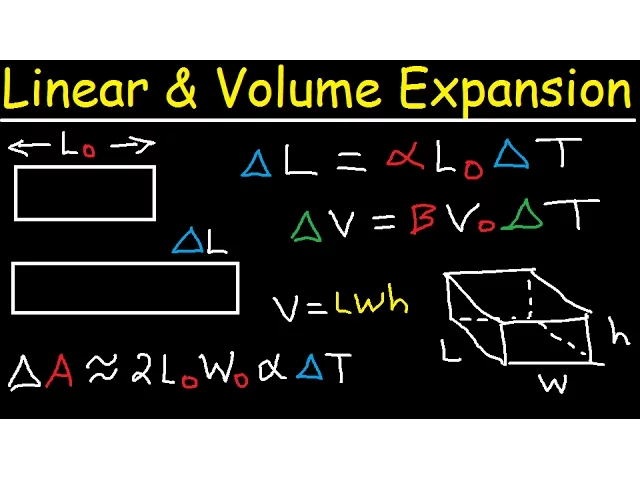
in this video we're going to talk about thermal expansion what happens to objects when they're heated or cooled well let's find out let's say if we have a bar that has a length of L and what's going to happen if we raise the temperature whenever you increase the temperature a solid will expand it's going to get B bigger and if you cool it it's going to contract it will get smaller so if we raise the temperature this bar will increase by an amount called Delta L which represents the change in length so as you increase the temperature Delta L increases if you decrease the temperature Delta L will be negative it will contract so the bar will be smaller if you cool in Now Delta L is not only proportional to the temperature but it's also proportional to the length if you increase the length of the rod the change in length will also increase if you of course increase the temperature the equation that relates these two is this equation the change in length is equal to Alpha which is the coefficient of linear expansion times the original length times the change in temperature Alpha is a coefficient or a constant that depends on the type of material so the change in length depends on the material how long the bar is the length of the bar and also how much the temperature changes by so let's work on some practice problems and aluminum bar is 1. 25 M long at 20° C the coefficient of linear expansion is 25 * 10- 6 and that's supposed to be Celsius min-1 if the temperature is increased to 75° C how much will the length of the bar change so we're looking for Delta l so Delta L is equal to Alpha * l0 * Delta C the coefficient of linear expansion is 25 * 10 to Theus 6 and the units are Celsius minus1 which is basically 1 over Celsius the original length is 1. 25 M and the change in temperature final minus initial 75 minus 20 the change in temperature is positive 55° C because it increased by 55 going from 20 to 75 so notice that the unit Celsius cancel so whatever unit l0 is in that will be the unit for Delta l so l0 could be in meters centimeters it doesn't matter these two will have the same unit so in this problem since l0 is in meters Delta L will be in meters so now let's go ahead and calculate the answer so 25 * 10 - 6 time 1.
25 * 55 is equal to about . 00 17 2 m so the length doesn't change much so this is the answer uh to part A that's how much the length of the bar changes less than a centimeter so now what is the new length of the bar at this temperature to find the new length we need to add the original length plus the changing length so it's going to be l0 plus Delta l so that's 1. 25 M plus 0.
172 M so this is about 1. 25 17 but you can round that to 1. 25 2 if you want so this is the new length of the bar as you can see it increased uh slightly let's work on this one a solid plate of lead is 8 cm x 12 CM at 15° C and we have the coefficient of linear expansion it's 29 * 10 - 6 um 1/ Celsius now what is the change in area and also the new area of the lead plate if the temperature increases to 95 so let's draw a picture so the lead plate is 8 by 12 so this side is 8 cm and this side is 12 CM if we multiply 12 * 8 that's a current area of 96 square cm now it's important to understand that once we raise the temperature we know it's going to expand but it's going to expand in all directions so if let me draw a new picture if this side is l0 then it's going to expand by Delta L and if this side is w0 for the width then it's going to expand this way by Delta w so not only will expand to the right but it will also expand down as well so the length and the width will increase so let's calculate the change in left first and then we'll calculate the change in width so Delta L is equal to Alpha * l0 * Delta C so Alpha is 29 * 10- 6 the original length is 12 CM and a change in temperature final minus initial 95us 15 is 80 so the temperature increases by 80 so the change in length is going to be 02784 CM so what is the new L the new L is going to be l0 plus the changing left so that's going to be 12 02784 now let's do the same thing for the width let's calculate the change in width so that's going to be Alpha which is 29 * 10 10- 6 times instead of l0 it's going to be w0 which is 8 and the change in temperature is still positive 80 so this is equal to [Music] 01856 cm so now what is the new width so w which is W initial plus the change is now 8.
01 856 so now we can calculate the new area which is simply the new length times the new WID so let's make some space first so it's going to be the new length which is 12. 27 eight4 times the new width which is uh 8. 01 856 it's not going to change much but it does increase a little so the new area is now 96.
44 6 if we round it square meters so therefore the change in area is the difference between these two values so Delta a is about 446 square meters if you want to come up with a formula that can help you to get this answer here's what you need to do the formula is Delta a is equal to l0 w0 * 2 Alpha Delta t plus Alpha 2 Delta t^2 now because Alpha is so small it's 29 * 10^ - 6 Alpha squar is going to be very small so the contribution of this term is negligible so we could say that Delta a is approximately equal to l0 w0 time 2 Alpha Delta T now l0 is 12 w0 is 8 Alpha is 29 * 10- 6 and since I'm running out of space let's move this somewhere else and the change in temperature is 80 so 2 * 12 * 8 * 29 * 10 - 6 * 80 is about. 4454 as you can see this answer is very close to this one now keep in mind I rounded this answer so they're very close so that's how you can approximate Delta a but if you want to derive the equation here's what you need to do so we know that Delta L is equal to Alpha l0 Delta C and the new L value is l0 plus Delta L where Delta L is Alpha l0 Delta T so we can factor out l0 if we do it's going to be 1 + Alpha Delta T so that's L if that's L we could say that W is W * 1 + Alpha Delta t now the original area is the original length times the original width the new area is the new L times the new wi so therefore the change in area is the difference between the new area and the original area which is LW minus L wo so Delta a is equal to the new L times the new W now the new L is basically this value it's l0 1 + Alpha Delta T so we replace L with that new value now we're going to replace W with what it's equal to here so w is wo Time 1 + Alpha Delta T and then minus l0 w0 so notice that we can take out an l0 and we can Factor out a w0 so let's go ahead and do that so this is going to be l0 w0 and notice that we have these two terms which since we have two of them we can write them as 1 + Alpha Delta T squar since we have two of them and we took out both l0 and w0 so we're left with1 so now let's uh clear away some space so now what we're going to do at this point to find the new Delta a let's foil this term so 1 + Alpha * delta T * another 1 + Alpha * delta T it's going to be 1 * 1 which is 1 and 1 * Alpha Delta delta T that's simply Alpha Delta T time plus Alpha Delta T * 1 which is another Alpha Delta T and finally Alpha Delta T * Alpha Delta T that's Alpha 2 Delta t^ 2 so we're going to replace this term with this expression now keep in mind we can add these two terms so it's really one + 2 Alpha Delta t + Alpha 2 delta T 2 so the change in area is equal to the original length times the original width and then 1 + 2 Alpha Delta t plus Alpha 2 Delta t^ 2 and now let's not forget about this one that we have here so minus one now we can cancel these two and so we have the equation that we had before so that's uh l0 w0 to Alpha Delta t plus alpha s Delta t^ 2 so when we use the equation l0 w0 and times 2 Alpha Delta T we got an answer that was like. 4454 for the change in area let's see what will happen if we this term so it's going to be 12 * 8 and then 2 * 29 * 10 - 6 the change in temperature was 80 plus 29 * 10 - 6^ 2 * 80 2 2 * 29 * 10 - 6 * 80 this part is about 0.
464 29 * 10 - 6 * 80 and then if you square it you're going to get a very small number of 0. 0 0 5 38 2 and 12 * 8 is 96 so including this term this is going to be equal to 44 59 6 which rounds to the first answer that we have 446 so as you can see the contribution from this term is relatively insignificant so thus we have the equation the change in area is approximately equal to 2 l0 w0 Alpha Delta T now what about volume expansion so let's say if we have a rectangular solid the volume of this solid is equal to the length time the width time the height now if you raise the temperature the entire volume will increase the length will increase the width will increase and the height will increase it turns out that the equation that you can use is this equation Delta V the change in volume is equal to the coefficient of volume expansion times the original volume times the change in temperature now for most solids B is approximately 3 time Alpha if you go to the textbook you could see that it's roughly the case it may not be precise but it's approximately three times Alpha for example aluminum has an alpha value of 25 * 10- 6 but it's beta value is about 75 * 10- 6 anytime you raise the temperature the volume will increase if you decrease the temperature the volume will decrease so let's work on the problem by the way this applies for not only solids but liquids as well a rectangular solid of brass has a coefficient of volume expansion of 56 * 10 - 6 and I forgot to put the units that's Celsius to theus1 so this is our beta value now we have the dimensions of the rectangle so we can calculate the initial volume it's going to be the length time the width time the height so that's going to be 5 * 6 * 8 5 * 6 is 30 and 3 * 8 is 24 so 30 * 8 is 240 and it's going to be cubit feet * * 3 * is Cub feet so that's the initial volume so now let's calculate the change in volume using this equation so it's going to be beta the coefficient of volume expansion times the original volume times the change in temperature so B is 56 * 10- 6 the initial volume is 240 cubic feet and the change in temperature final minus initial 90 - 10 which is a change of 80 so the change in volume is 1 1. 75 cubic feet so the new volume is the original Volume Plus the change in volume so that's 240 plus 1.
75 so the new volume is 241. 7 cubic feet here's another one a cup contains 85 Mill of water at 80° C what is the new volume at 15 so we can see that the temperature is decreasing so the volume of water should decrease now we have the coefficient of volume expansion is 210 * 10- 6 so let's use the equation the change in volume is equal to the original volume times the coefficient times the change in temperature so the coefficient is 210 * 10- 6 it's pretty large relative to the solids now the original volume is 85 Mill and the change in temperature the final temperature is 15 the initial temperature is 80 so the change is -65 which means that the change in volume will be negative so the change in volume is about 1. 16 milliliters so the new volume which is the original Volume Plus the change that's going to be 85+ 1.
16 or 85 minus 1. 16 so the new volume is 83.