welcome back in contrast with the process of creating law through custom which we've just discussed treaties are a more modern and a more deliberate method article 38 refers to International conventions where the general particular establishing rules expressly recognized by the Contracting States treaties are known by a variety of different names ranging from conventions International agreements pacts General acts Charters through to statutes declarations and Covenant all these terms refer to a similar transaction the creation of written agreements whereby the states participating bind themselves legally to act in a particular way or to set up particular relations
between themselves a series of conditions and arrangements are laid out which the parties oblige themselves to carry out the obligatory nature of treaties is founded upon the customary international law principle that Agreements are binding paent Sanda treaties are Express agreements and are a form of substitute legislation undertaken by States they bear a close resemblance to contracts in a superficial sense in that the parties create binding obligations for themselves but they have a nature of their own which reflects the character of the International System the number of treaties entered into has expanded over the last century
and they fulfill a vital role in international relations parties that do not sign and ratify the particular treaty in question are not bound by its terms of course however where treaties reflect customary law then non treat nonp parties are bound not because it is a treaty provision but because it reaffirms or restates a rule or rules of customary international law similarly non-parties may come to accept that Provisions in a particular treaty can generate customary law depending always upon the nature of the agreement the number of participants and other relevant factors the possibility that a provision
in a treaty May constitute the basis of a rule which when coupled with the opino Urus can lead to the creation of a binding custom governing all states not just those parties the original treaty was considered by the international Court in the North Sea continental shelf cases and recognized as one of the clear methods of formulating new rules of customary international law this is provided that the particular provision in question was of a fundamentally Norm creating character that is capable of forming the basis of a general rule of law it is now established that even
where a treaty rule comes into being covering the same ground as a customary rule the latter will not simply be absorbed into the former but will maintain its separate existence the court in the Nicaragua vus case did not accept the argument of the US that the Norms of customary law concerned with self defense had been subsumed or uh supervened by article 51 of the UN Charter it was emphasized that even if a treaty norm and a customary Norm relevant to the present dispute were to have exactly the same content this would not be a reason
for the court to hold that the incorporation of the customary Norm into treaty law must dep deprive the customary Norm of its applicability as distinct from the treaty Norm the court concluded it will therefore be clear that customary international law continues to exist and to apply separately from International treaty law even where the two categories of law have an identical content the concept of the general general principles of law recognized by civilized Nations was inserted into article 38 as a source of law to close any gaps that might be uncovered in international law non liette
most writers are prepared to accept that general principles do con do constitute a separate source of law but a fairly limited scope and this is reflected in the decisions of the permanent Court of international Justice and its successor the international court of justice it is not clear however in all cases whether what is involved is a general principle of law appearing in domestic systems or a general principle of international law one important and accepted principle is that stated in the cha Factory case in 1928 where the court declared that it is a general conception of
law that every violation of an engagement involves an obligation to make reparation the most fertile Fields however for the implementation of municipal or domestic law analogies have been those of procedure evidence and the Machinery of the judicial process couple of examples will suffice in the kfu channel case the international Court when referring to circumstantial evidence pointed out that this indirect evidence is admitted in all systems of Law and its use is recognized by International decisions International judicial reference was also made to the concept of raise judicat that is that the decision in the circumstances is
final binding and without appeal the question of raised judicata was discussed in some detail in the genocide convention between Bosnian herzo and Serbia Montenegro here the court emphasized that the principle signifies that the decisions of the Court are not only bounding on the parties but are final in the sense that they cannot be reopened by the parties as regards the issues that have been determined save by procedures of an exceptional nature espcially laid down for that purpose the court has also consider the principle of estole which provides that a party which has acquiesced in a
particular situation cannot then proceed to challenge it in the temple case and in a number of subsequent cases such as Cameron Nigeria the court has emphasized that an estole would only arise where one state had by its Acts or declarations made a position consistently clear and the other state had changed its position to its own detriment or has suffered some Prejudice perhaps the most important General principle underpinning many International legal rules is that of good faith the international Court in the nuclear tests case 1974 underlined that just as the very rule of paa s saand
in the law of treaties is based on good faith so also is The Binding character of an international obligation assumed by unilateral obligation however good faith as a concept was not in itself a source of obligation where none was would otherwise exist and subsisted rather as a background principle in forming and shaping the observance of existing rules of international law the concept of equity has been referred to in several cases in the Run of cut arbitration between India and Pakistan in 1968 for example a tribunal agreed that Equity forms part of international law and that
accordingly the parties could rely on such principles in the present ation of their cases while the international Court in the North Sea continental shelf cases directed a final delimitation between the parties in accordance with Equitable principles however what is really in question here is the use of Equitable principles in the context of a rule requiring such an approach the relevant courts are not applying principles of abstract Justice to the case but rather deriving Equitable principles and solutions from the applicable law the court declared in the Libya Malta case in 1985 that the justice of which
Equity is an emanation is not an abstract justice but Justice according to the rule of law which is to say that its application should display consistency and a degree of predictability even though it also looks beyond it to principles of a more General application Equity has been used by the courts as a way of mitigating certain inequities not as a method of refashioning nature to the detriment of legal rules it existence therefore as a separate and distinct source of law is at best highly controversial the use of Equitable principles however has been particularly marked in
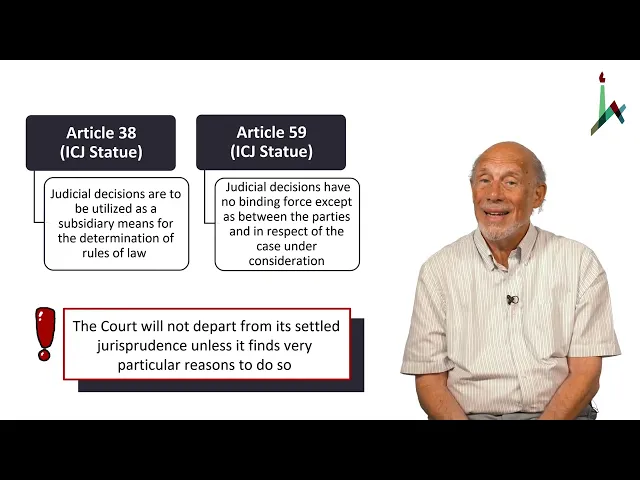
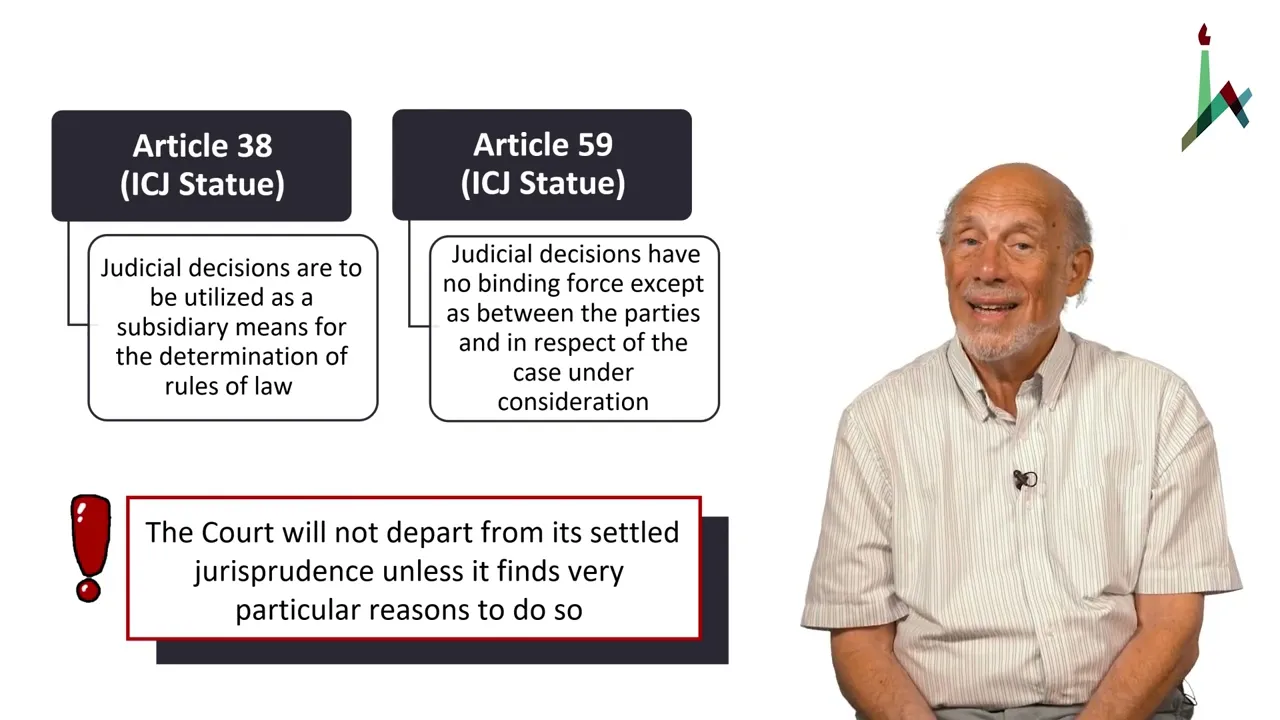
the 1982 law of the sea convention where it is specifically referred to concerning conflicts between Coastal and other states regarding the exclusive economic zone and with regard to the delimitation of economic zones and Continental shelves between two or more States Equity may also be used in certain situations in the delimitation of non-maritime boundaries where there is no evidence as to where a boundary line lies an international tribunal May resort to equity although judicial decisions are in the words of article 38 to be utilized as a subsidiary means for the determination of rules of law rather
than as an actual source of law they can be of immense importance while by virtue of article 59 of the statute of the international Court the decisions of the Court have no binding Force except as between the parties and in respect of the case under consideration the court has striven to follow its previous judgments and insert a measure of certainty within the process as noted in a number of cases such as camaron V Nigeria preliminary objections and the cro Croatian genocide preliminary objections case the court will not depart from its settled Juris Prudence unless it
finds very particular reasons to do so decisions of the international Court have been seen as authoritative expressions of international law examples would include the reparation case which recognized the international legal personality of international institutions in certain cases the genocide case which dealt with reservations to treaties the notab BAM case which considered the role and characteristics of nationality and the range of cases concerning Maritime delimitation in addition to the permanent court and the international court of justice the phrase judicial decisions also encompasses International arbitral Awards and the rulings of national courts there have been many International
arbitration tribunals such as the permanent Court of arbitration created by the hag conferences of 1899 and 1907 and various mixed claims tribunals including the Iran us claims tribunal and although they differ from the international courts in some ways many of their decisions have proved extremely significant in the development of international law as has already been seen the the decisions of Municipal Courts domestic courts May provide evidence of the existence of a customary rule they may also constitute evidence of the actual practice of states which while not a description of the law as it is been
held to apply nevertheless affords examples of how States actually behave in other words the essence of the material act which is so necessary in establishing a rule of customary law article 38 includes as a subsidiary means for the determination of rules of law the teachings of the most highly qualified publicists of the various Nations historically of course the influence of academic writers on the development of international law has been marked in the Heyday of natural law as we have seen seen it was analyses and juristic opinions that were crucial while the role of State practice
and Court decisions were of less value at that time with the rise of positivism and the consequent emphasis upon State sovereignty treaties and custom assumed the dominant position in the exposition of the rules of the International System and the importance of legalistic writings began to decline this one finds the text books are used as a method of discovering what the law is on any particular Point rather than as the found or source of actual rules academic writings also have a useful role to play in stimulating thought about the values and aims of international law as
well as pointing out the defects that exist within the system and making suggestions indeed as to the Future it is sometimes argued that particular nonbinding instruments or documents or non-binding Provisions in treaties form a special category that may be termed soft law this terminology is meant to indicate that the instrument or provision in question is not of itself law but its importance within the general framework of international legal development is such that particular attention require Rees to be paid to it soft law is not law that needs to be emphasized but a document for example
does not need to constitute a binding treaty before it can exercise an influence in international Politics the Helsinki final Act of 1975 is a prime example of this this was explicitly not a binding agreement but its influence in Central and East Eastern Europe in emphasizing the role and importance of international human rights proved incalculable certain areas of international law have generated more soft law in the sense of the production of important but non-binding instruments than others here one may site particularly International economic law and international environmental law the use of such documents where term for
example recommendations or guidelines or codes of practice or standards is significant in signaling the evolution and establishment of guidelines which may ultimately be converted into legally binding rules in in certain situations the unilateral acts of States including statements made by relevant State officials may give rise to International legal obligations such acts might include recognition and protests which are intended to have legal consequences unilateral acts while not understood as sources of international law in terms of article 381 of the statute of the international Court May constitute sources of obligation but for this to happen the intention
to be bound of the state making the Declaration in question or doing the act in question is crucial as will be the element of publicity or notoriety such intention may be ascertained by way of interpretation of the Act and the principle of good faith plays a crucial role here the international court has stressed in the nuclear test cases of 1974 that where states make statements by which the freedom of action is limited a restrictive interpretation is required recognition will be important here in so far as third states are concerned in order for such an act
or statement to be opposable to them Beyond this such unilateral statements may be used as evidence of a particular view taken by the stating question the question of the hierarchy of sources is more complex than appears at first di although there does exist a presumption against normative conflict international law is not as clear as domestic law in listing the order of constitutional Authority and the situation is complicated by the proliferation of international courts and tribunals existing in a non-hierarchical fashion as well as a significant ific expansion of international law both substantively and procedurally judicial decisions
and writings clearly have a subordinate function within the hierarchy in view of their description as subsidiary means of law determination in article 38 while the role of general principles of law as a way of complimenting custom and treaty law places that category fairly firmly in thir place the question of priority however as between custom and treaty law is more complex as a general rule that which is later in time will have priority Lex posterior derat priori treaties are usually formulated to replace or codify existing custom while treaties in turn May themselves fall out of use
and be replaced by new customary rules however where the same rule appears in both a treaty and a custom there is no presumption that the latter is subsumed by the former the two coexist there is in addition a principle to the effect that a special rule prevails over a general rule like specialist derat Lei generali so that for example treaty rules between states as Lex specialis would have priority as against general rules of treaty or customy law between the same States although not if the general rule in question was one of Yus coogans the position
is Complicated by the existence of norms or obligations deemed to be of a different or higher stated status than others whether derived from Custom or treaty these may be obligations against all ero omnes or peremptory Norms rules of just coens while there may be significant overlap between these two in terms of the content of rules to which they relate there is a difference in nature the former concept concern concerns the scope of application of the relevant rule that is the extent to it states as a generality may be subject to the rule in question and
may be seen as having a legal interest in the matter it has therefore primarily a procedural Focus rules of Yus kogen's perem Norms on the other hand are substantive rules recognized to be of a higher status status as such the international Court stated in the Barcelona traction case in 1970 that there existed an essential distinction between the obligations of a state towards the International Community as a whole and those arising Visa another state in the field of diplomatic protection by their very nature the former concerned all states and all states can be held to have
a legal interest in their protection they are obligations omnes the court said examples of such obligations included the lawing of aggression and of genocide and the protection from slavery and racial discrimination to this one may add the prohibition of torture furthermore the international Court in the East teamour case stressed that the right of people's to self-determination has an erga om's character while saying in the genocide convention Bosnia against Serbia case that the rights and obligations enshrined in the convention our rights and obligations erer omnes with regard to all this easing of the traditional rules concerning
local standi in certain circumstances with regard to the pursuing of a legal remedy against the alleged offender state may be linked to the separate question of superior principles in international law article 53 of the Vienna convention on the law of treaties 1969 provides that a treaty will be void if at the time of its conclusion it conflicts with a peremptory Norm of General international law further by article 64 if a new peremptory Norm of General international law emerges any existing treaty which is in conflict with that Norm becomes void and terminates this rule us coens
will also apply in the context of customary rules so that no derogation would be permitted to such Norms by way of local or special custom such a peremptory Norm is defined by the Convention as one accepted and recognized by the International Community of States as a whole as a Norm from which no derogation is permitted and which can be modified only by a subsequent Norm of General international law having the same character the concept of yogan is based upon an acceptance of fundamental and Superior values within the system and in some respects is akin to
the notion of public order or public policy in domestic legal orders it also reflects the influence of natural law thinking rules of Yus kogens are not new rules of international law as such it is a question rather of a particular and Superior Quality that is recognized as belonging to an existing rule of international law various examples of rules of Y kogens have been provided particularly during the discussions on the topic in the international law commission such as an inter an an un awful use of force genocide slave trading and piracy the international court has stated
that in its opinion the prohibition of torture had also become a per Norm however no clear agreement has been manifested regarding other areas and even the examples given are by no means uncontroverted nevertheless the rise of individual responsibility directly for international crimes marks a further step in the develop velopment of Yus Hogan's rules of particular importance however is the identification of the mechanism by which rules of Yus Hogans may be created since once created no derogation is permitted a two-stage approach is here involved in the light of article 53 first the establishment of the proposition
as a rule of General international law and secondly the acceptance of that rule as a peremptory Norm by the international law community of States as a whole it will be seen therefore that a stringent process is involved and rightly so for the establishment of a higher level of binding rules has serious implications for the international law Community the appropriate test would thus require Universal acceptance of the proposition as a legal rule by States and recognition of it as a Ru of Y kogens by an overwhelming majority of States Crossing ideological and political divides it is
also clear that only rules based on custom or treaties may form the foundation of Yos kogen's Norms this is particularly so in view of the hostile attitude of many states to general principles as an independent source of international law and the universality requirement of Yus kogen's formation as article 53 of the Vienna convention note a treaty that is contrary to an existing rule of Yogen is void from the start whereas by virtue of article 64 an existing treaty that conflicts with an emergent rule of Yus coens terminates from the date of the emergence of the
rule it is not voided from the start nor by article 71 is any right obligation or legal situation created by the treaty prior to its termination affected provided that its maintenance is not in itself contrary to the new peremptory Norm article 412 of the ic's articles on state responsibility of 2001 provides that no state shall recognize as lawful a serious breach of a peremptory Norm reservations that offended aulus kin May well be UNL lawful while it has been suggested that state conduct violating a rule of your coens may not attract a claim of State immunity
thank you