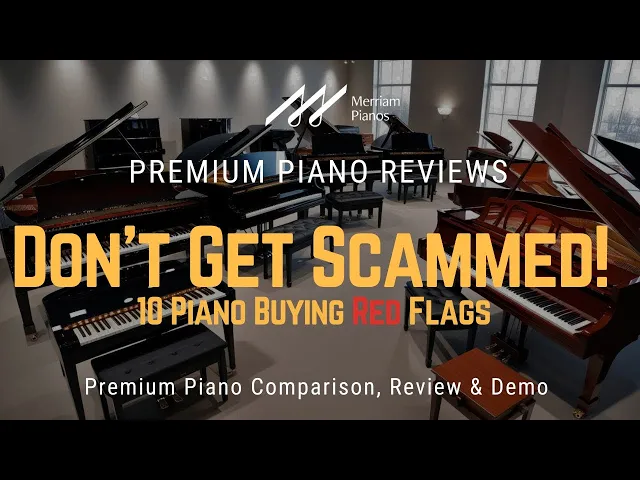
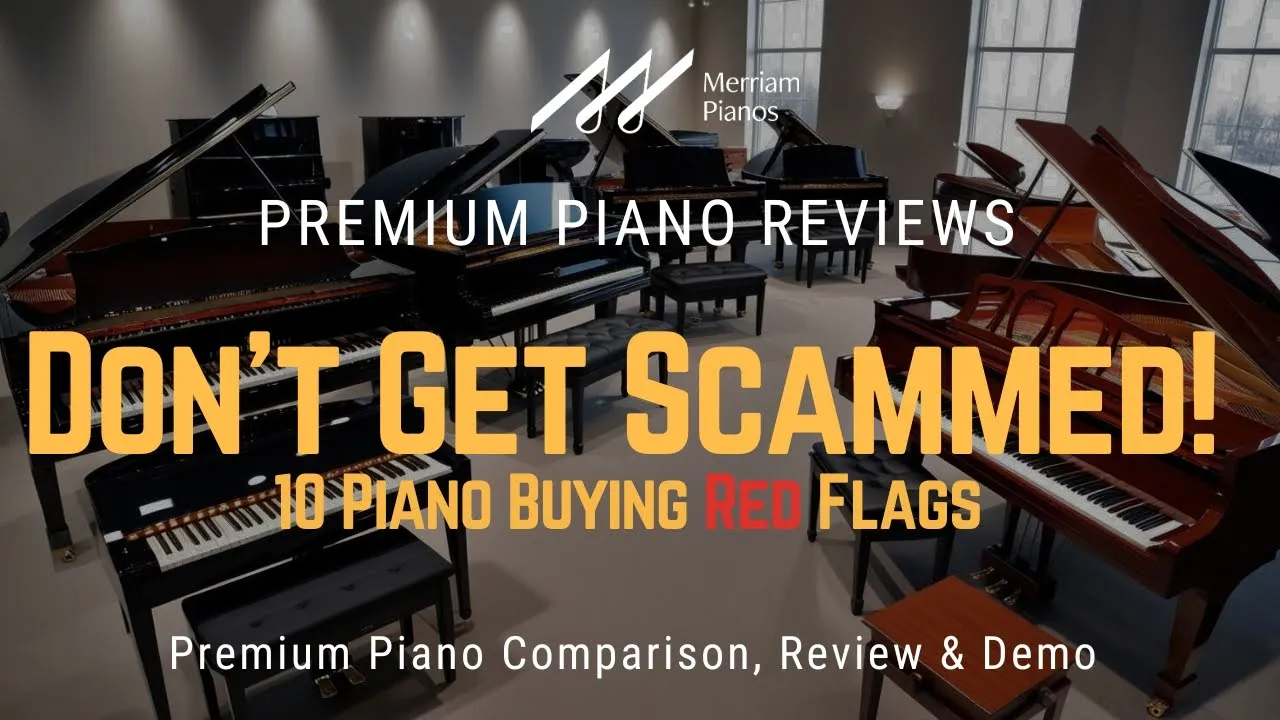
In today's video, we've got 10 red flag warnings to ensure that you get the right piano from the right place. From empty warranty promises to overpaying for your instrument to completely inaccurate information about your instrument, we have heard all of the horror stories. And so, this video is all about avoiding those.
Let's get started right away. Red flag number one, a store that offers a warranty that's longer than it's been in business. Why is this a red flag?
Well, because warranty coverage is a real thing. It's absolutely part of the value that you're investing in when you buy a piano. And when a issue comes up with your piano at year 5, 6, or 7, which is entirely possible, you need to know that you're actually covered.
Manufacturers warranties are great, but if part of what you're relying on is a store's additional level of coverage, you need to be confident that that store actually understands what it means to make that commitment and live up to it. So, while there may be some exceptions for some really great new stores out there who have every intention in the world to fulfill those commitments, generally speaking, track record is the best predictor of your safety as a customer. So, while it shouldn't eliminate new businesses from being on your list of prospects, if a six-month-old store is offering a 10-year warranty, you at least want to give that some extra scrutiny.
[Music] The second red flag is if you walk into a store and you don't see any evidence of new, recognizable, reputable products in their offering. Now, why is this a red flag? Any store in the piano business wants to be able to have new product there because not only is it easier to sell, but the manufacturer is taking on the after sales liabilities in a lot of cases.
When a store sells a used piano, it has to issue all of the warranty coverage and it's a harder business to deal with. You're constantly sourcing instruments on a peacemeal basis from the open market or dealing with other used dealers. So, while that may be a necessary part of the industry, for stores where they have only been able to deal with used instruments, it could be a sign that their reputation or their way of doing business simply is not acceptable to major suppliers out there.
The third red flag for me is what I'll call review fraud. We all know how important five-star reviews are in every industry, whether we're shopping online or looking for a new restaurant. But in the piano business in particular, because of how expensive these purchases are and how long people use the product, reviews can be particularly telling in one way or another, especially when it comes to the stores that stand behind those purchases.
If you see a store that hasn't been in business that long, has a perfect five-star rating, and all of those reviews showed up in a fairly short period of time, there's a good chance that may not be an authentic picture of what that business is actually doing. So, take the time, make sure reviews are part of the assessment process of choosing a retailer or store, and do your best to figure out whether they're real reviews or not. [Applause] Next on my list is something that wouldn't be very obvious but can be quite telling, which is how old is the average floor model on that store's floor.
Now, in our business, we usually try and circulate floor models out every 1 to two years. And that's done for a number of reasons. First of all, we want to make sure that customers are in front of a product that's really representative of what they're about to get from the factory.
And as things slowly evolve from every factory in the world, a product that's 8 years old may not necessarily represent what the factory is going to deliver to you today. Or second, they're not doing enough business to actually have turned that floor model more recently. Neither one is a particularly good thing.
So, even though it might not be on the top of your mind to think about it, make sure that you're not playing an exceptionally old floor model. A couple of years old is very normal. 10 years old, you might want to ask some [Music] questions.
This next one is very telling for me. If you're dealing with a retailer and the only way that they're selling their product is to make outrageously negative comments about other suppliers or dealers, there's a good chance they don't have a lot of good things to say about their own pianos. Now, we have heard some real doozies here coming from customers who have just spoken to other retailers from your pianos are made of plastic garbage bags to your supplier is about to go out of business.
And while none of those things are true, to me, what it really says is that other retailer doesn't actually understand or maybe doesn't have any reasons why their piano is worth buying itself. To me, someone should be able to explain to you why a piano they're presenting is going to be musical benefit, is going to be mechanically a sound investment, and why buying it from them is going to be a great experience without ever having to deflect to negativity about other brands or retailers. This next one is somewhat related to the previous point, but I'm going to separate it out.
If you're in a store and a single piano is being used to represent an entire brand or line of pianos, that's a little suspect. I don't know a single piano from any manufacturer that accurately represents the entire musical experience and ownership experience of other products in that line. For example, if someone has a Yamaha B1 in the showroom, sits you down and tries to explain that this instrument is indicative of what someone might experience on a U1, a U3, or even a Yamaha Grand, that's just incredibly disingenuous, never mind inaccurate.
Likewise, sitting you down in front of a perfectly prepped Steinway B or Shaguru Kauawaii SK6 shouldn't really be indicative of something you're going to experience on a low-end upright of the same brand. As soon as you have those broad comparisons that just defy logic, I would discount that feedback and probably move on. Next on my list is beware of showrooms that don't let you play nice pianos unless you declare yourself a real customer.
I've been hearing about this since I entered this industry, and I still continue to hear about it. Now, having spoken to store owners that have these kinds of policies, this is the logic. Well, could you just walk in and test drive a Ferrari if you weren't actually qualified to buy a Ferrari?
Well, here's my problem with that. Test driving a Ferrari puts that car at significant risk of damage for absolutely no benefit to the dealer. But what is the risk of damage for somebody to come in and experience what $100,000 piano sounds like?
Even if they don't have an intention to buy that instrument anytime soon. Well, the point is there is no risk to the piano, but it is going to drive up the tuning and maintenance costs of that instrument because the more it gets played, the more the dealer needs to maintain it. To me, any dealer that doesn't have the budget to keep a few really nice instruments fully in tune at the expense of making sure that every customer can experience your entire store is probably not handling their finances very well and may not be a reliable partner in the long run.
[Music] Next for me is any retailer who is uncomfortable or unwilling to discuss alternate points of view, especially if those points of view are coming from credible third-party sources. There are a variety of opinions in the piano world, just as there are with any other retail industry, from electronics to cars. But somebody who's totally confident in what they are selling you and completely conversant in the expertise of the industry itself should have absolutely no problem hearing about a concern or alternate opinion and having a nice objective balanced conversation about it.
Somebody who aggressively dismisses alternate points of view or is simply unwilling to even talk about it should probably tell you something about their own discomfort with what they're selling. This is an oldie but a goodie. Anyone who claims that buying a piano is an actual monetary investment.
I will be the first to acknowledge that purchasing a great instrument is an investment in your soul. It can be investment in your family. It has all sorts of non-financial benefits which may have incredible levels of value over the long run.
But no piano, and this includes brands that begin with S as well, are actually going to make you money when you measure that against real depreciation and inflation. It is absolutely true that some instruments have stronger resale values and that some instruments are going to be easier to liquidate if that came up. But in no case are you ever actually going to realize a real return on that purchase with the caveat that I'm not talking about one-offs or limited editions which might actually have collectible value.
And this final red flag is one that tends to eb and flow depending on in a lot of cases the political climate of the day. And that is how open retailers are willing to be about country of origin. Whether that be where the instrument is assembled or maybe questions about certain parts.
There is absolutely nothing wrong with making the argument that where an instrument is made may not have a meaningful impact on its quality or musical output. Now, I would argue that might not necessarily be the case, but there's nothing wrong with at least having that conversation. Where it's a concern is where there is a concerted and repeated attempt to obscure the information in the first place.
That usually indicates that either the retailer doesn't actually know or they've been instructed to deflect that conversation. In any case, it should not fill anyone with a lot of confidence. if something so basic as asking where an instrument is made results in a whole flurry of excuses.
Hopefully today's red flags can help you decode whether you're in front of a retailer who's ethical and invested in your long-term success as a customer versus one simply trying to tell you whatever they need to to get a deal done. Let me know what you thought of the video and we do read and respond to as many comments as possible. My name is Stu Harrison.
This has been Marian Pianos on YouTube. We'll see you again soon.