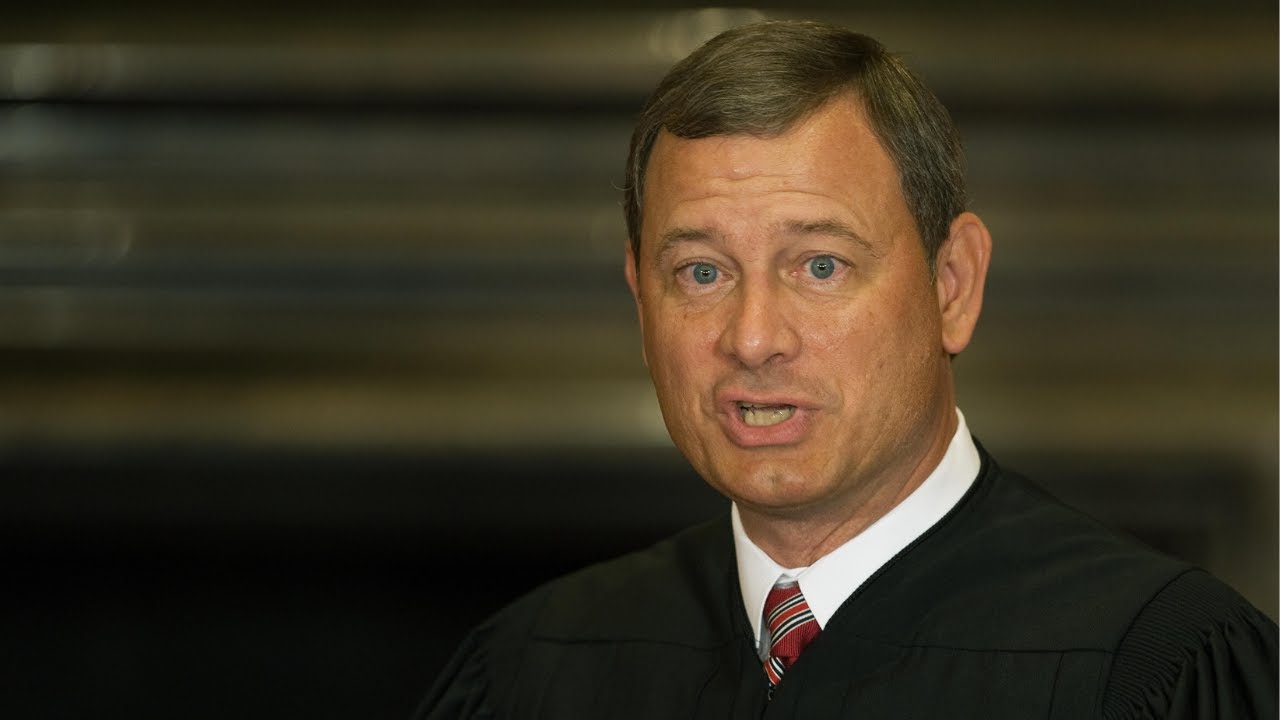
The Supreme Court chamber fell completely silent as Chief Justice John Roberts delivered what legal analysts would later call the most unexpected ruling of his nearly two decade tenure. His voice, measured yet authoritative, echoed through the ornate room as he read the court's 6-3 decision in Federal Communications Commission v's Olympus Media Group for the deliberate and sustained violations of federal broadcast regulations. This court upholds the FCC's statutory authority to impose a civil penalty in the amount of $500 million against Olympus Media Group and its principal owner.
Denzel Washington, Roberts stated, looking directly at the Oscar-winning actor seated in the front row of the gallery. Washington, dressed impeccably in a tailored navy suit, maintained his characteristic poise, but those seated nearby noticed his jaw tightened almost imperceptibly. The renowned actor had acquired the media conglomerate 3 years earlier, expanding from film production into broadcasting with a network of television and radio stations.
What began as a celebrated move by a Hollywood icon to create more diverse media ownership had now culminated in the largest civil penalty ever levied against a media company. As Roberts continued detailing the systematic regulatory violations involving undisclosed political content and unauthorized data collection practices, Washington remained perfectly still, his expression unreadable. Reporters frantically typed on their phones.
Financial analysts calculated the immediate impact on Olympus Media's stock. And legal experts exchanged shocked glances at the unprecedented scope of the penalty. What no one in that chamber could have anticipated was what would happen next.
Within 72 hours, Denzel Washington would make a move so surprising, so strategically brilliant, and so contrary to the expected legal and public relations playbook that it would not only neutralize the court's massive penalty, but fundamentally transform the relationship between America's entertainment industry, regulatory agencies, and the judicial system for decades to come. Before we dive deeper into this extraordinary confrontation, make sure to hit that subscribe button and turn on notifications so you won't miss our analysis of the pivotal moments reshaping America's legal and cultural landscape. Chief Justice John Roberts, 69, had cultivated a reputation as the court's institutional guardian since his appointment in 2005.
The Harvard educated jurist had navigated the court through increasingly polarized political waters, often positioning himself as a moderate force despite his conservative background. Roberts had become known for carefully calibrated opinions that sought to preserve the court's legitimacy while gradually advancing his judicial philosophy. The Olympus media case represented a significant test of Roberts's approach to regulatory authority in the digital age.
As traditional media evolved into complex digital platforms, the boundaries of FCC jurisdiction had become increasingly contested. Roberts had expressed concerns in previous cases about both regulatory overreach and the inability of existing frameworks to address novel technologies. For Roberts, the stakes extended beyond this specific case.
The court's ability to meaningfully check the power of both federal agencies and massive media conglomerates would significantly impact its relevance in the digital era. A ruling perceived as either too differential to regulators or too accommodating to media giants would undermine the court's carefully maintained balance of power. Denzel Washington, 69, had transcended his status as merely one of Hollywood's most acclaimed actors to become a cultural institution.
With two Academy Awards and a career spanning four decades, Washington had evolved from actor to director, producer, and finally media executive when he leveraged his considerable fortune to acquire Olympus Media Group in 2022. Washington's acquisition had been hailed as a watershed moment for diversity in media ownership. His stated mission, creating authentic representation across entertainment platforms while building sustainable wealth in underserved communities, had garnered praise from across the political spectrum.
The Olympus network of regional television and radio stations had expanded rapidly under his leadership, often entering markets traditionally overlooked by larger conglomerates. The regulatory troubles began when several Olympus stations aired documentary series about environmental justice and voting rights without properly disclosing the political organizations that had partially funded the content. Simultaneously, the company's digital platforms were found to be collecting viewer data through methods that circumvented disclosure requirements.
The FCC's initial fines had been relatively modest, but Olympus's continued non-compliance, reportedly due to executives believing the regulations were selectively enforced, led to escalating penalties. For Washington, the Supreme Court case represented an existential threat, not just to his business venture, but to his legacy. The $500 million fine would significantly deplete Olympus's operating capital, potentially forcing the sale of multiple stations.
More damaging would be the reputational harm to Washington himself, whose personal integrity had been central to the company's brand and mission. Financial analysts had predicted a conventional response. Olympus would appeal for a penalty reduction, implement compliance measures, and possibly divest certain assets.
Washington would likely distance himself from the regulatory decisions, emphasizing his role as investor rather than operator. No one anticipated that Washington, drawing on the same strategic thinking that had made him one of Hollywood's most successful actors and producers, was formulating a response that would reframe not just his company's predicament, but the entire relationship between media ownership, regulatory compliance, and public interest. As Washington left the Supreme Court that historic day, he made no statements to the press swarming the plaza.
Instead, he entered a waiting vehicle where a team of legal experts, media strategists, and technological innovators had already begun implementing a plan that would soon leave America speechless. Chief Justice Robert's majority opinion had methodically dismantled Olympus Media's legal defense. The 57page decision acknowledged the important role of diverse media ownership while emphasizing that fundamental regulatory obligations applied regardless of an entity's social mission or ownership structure.
The respondent's contention that its social impact objectives should mitigate its compliance obligations finds no support in either statutory text or this court's precedence. Roberts wrote, "Equal application of regulatory requirements without regard to an entity's perceived social value remains a cornerstone of administrative law. " The opinion had drawn support from both conservative and liberal justices, with only Thomas, Alito, and Stoayor dissenting.
The latter arguing that the penalty was disproportionate to the violations. This unusual coalition suggested that Washington would find little relief through further legal challenges. As legal analysts dissected Robert's opinion, Olympus media released only a brief statement, expressing disappointment and noting that the company was evaluating all options.
This uncharacteristic reticence from a company known for transparent communication sparked intense speculation. Industry insiders expected either a major corporate restructuring or a negotiated settlement with regulatory authorities. Instead, 72 hours after the court's ruling, Denzel Washington called a press conference at Olympus headquarters in Atlanta.
Rather than appearing with attorneys or executives, Washington stood alone at the podium, his commanding presence immediately silencing the room of journalists. First, let me be absolutely clear. I accept the Supreme Court's ruling without qualification, Washington began, his distinctive voice carrying the same gravitas that had defined his most powerful film performances.
Chief Justice Roberts's opinion correctly states that no enterprise, regardless of its ownership or mission, stands above regulatory requirements. This straightforward acceptance, devoid of the qualifications or subtle criticisms typical in corporate responses to adverse rulings, caught observers offguard. Financial analysts had predicted a protracted legal battle.
Instead, Washington appeared to be conceding defeat. But what followed transformed the narrative entirely. Today, I am announcing not just Olympus Media's compliance with the courts ruling, but a fundamental reimagining of media regulation for the digital age, Washington continued.
The $500 million penalty will be paid in full without appeal or delay. But that payment represents only the beginning of our response. Washington revealed that Olympus would create a firstofits-kind open compliance framework, a da publicly accessible system that would document every aspect of the company's regulatory compliance in real time.
This technological platform would allow regulators, competitors, and the public to monitor Olympus's adherence to broadcast and data privacy regulations through a transparent dashboard updated continuously. Rather than viewing regulatory compliance as a burden to be minimized, we will transform it into a competitive advantage and a public good. Washington explained, "Every piece of content, every data collection practice, every commercial relationship will be visible through this system, exceeding federal requirements for transparency by an order of magnitude.
The announcement sent immediate shock waves through both the media industry and regulatory circles. Competing media conglomerates recognized that Washington had just established a new standard for transparency that would create market pressure. for similar disclosures across the industry.
The FCC found itself in the unexpected position of having its enforcement mechanisms potentially rendered obsolete by a private compliance system more comprehensive than the AY's own monitoring capabilities. But Washington was just beginning. He announced that Olympus would establish the Center for Media Ethics and Regulation, an independent research institute with a $200 million endowment, nearly half the court's penalty, dedicated to developing next generation frameworks for ethical media ownership in the digital age.
The current regulatory structure was designed for a media landscape that no longer exists, Washington noted. Rather than merely complying with outdated frameworks, we intend to help create new ones that better serve the public interest while enabling innovation. Most surprisingly, Washington extended a formal invitation to Chief Justice Roberts to deliver the inaugural lecture at the center upon his eventual retirement from the court.
The invitation, which everyone understood Roberts could not accept, while serving on the court, was a masterful strategic move. It implicitly reframed Roberts from Olympus's judicial adversary to a potential thought partner in solving larger societal challenges. As Washington concluded his remarks, the implications of his response began to crystallize for observers.
Rather than merely accepting defeat or fighting a rear guard action, he had pivoted the entire conversation from Olympus's specific violations to the broader question of how media regulation should function in the digital age. In doing so, he had positioned his company not as a rule breaker, but as a pioneer in reimagining compliance for the public good. The initial market response reflected this transformation in narrative.
Olympus Media's stock, which had plummeted after the court's ruling, stabilized and then began to climb as investors recognized that Washington's approach might ultimately strengthen the company's market position despite the massive financial penalty. As media outlets and social platforms exploded with reactions to Washington's announcement, the ball shifted back to Chief Justice Roberts court. Not in a legal sense, but in terms of public narrative.
How the Chief Justice would respond to this unexpected move would determine whether Washington's strategy represented a genuine turning point in media regulation or merely a sophisticated public relations maneuver. Two weeks after Washington's press conference during oral arguments in an unrelated case, Chief Justice Roberts made a rare unprompted statement from the bench. Without directly mentioning Olympus media or Washington, Roberts addressed what he called recent discussions regarding the evolution of regulatory frameworks.
This court's role remains consistent to interpret and apply the law as written by Congress, not to engage in regulatory design or to endorse specific compliance mechanisms, Robert stated. While private entities are certainly free to exceed minimum regulatory requirements, such voluntary measures neither replace nor diminish the authority of duly established regulatory agencies. The measured statement reasserted the court's institutional role while carefully avoiding either endorsement or criticism of Washington's specific initiatives.
Legal observers immediately recognized the statement significance. Roberts was establishing boundaries around judicial engagement with Washingtons. Invitation while leaving room for the substantive ideas to develop outside the court's purview.
This delicate response reflected Roberts's historical approach to institutional conflicts, maintaining the court's authority while avoiding unnecessary antagonism. By neither embracing nor dismissing Washington's proposals, Roberts had preserved the court's dignity while allowing the conversation about regulatory evolution to continue. For Washington, Roberts's measured response represented neither victory nor defeat, but opportunity.
The Chief Justice had effectively acknowledged the legitimacy of discussing regulatory reform without seeding judicial authority or appearing to coordinate with a former litigant. Within days of Robert's statement, Washington executed the next phase of his strategy. Olympus Media transferred the full $500 million penalty to the Treasury, accompanied by a comprehensive compliance report documenting remediation of every violation cited in the FCC's original complaint.
This swift and complete compliance without the prolonged negotiations typical in large regulatory settlements caught both regulators and industry observers by surprise. Simultaneously, Olympus unveiled the first version of its open compliance framework, a technological marvel developed in partnership with leading data transparency firms. The system provided unprecedented visibility into the company's content sourcing, funding disclosures, and data practices across all its properties.
Most significantly, the framework was released as open-source software, allowing any media company to implement similar transparency measures at minimal cost. This combination of full compliance with the existing penalty and radical innovation in future compliance mechanisms created a narrative that transcended the original legal conflict. Washington had effectively transformed a punitive fine into an investment in redefining media accountability.
The media industry's response revealed the strategic brilliance of Washington's approach. Major competitors initially dismissed the open compliance framework as an expensive overreaction, but advertisers and consumers quickly began questioning why other media companies weren't providing similar transparency. Within months, several midsize media groups had adopted versions of Olympus's framework, creating market pressure for industry-wide adoption.
The FCC found itself in an unexpected position. The agency had won its case at the highest judicial level. But Washington's response had shifted the regulatory landscape in ways that potentially diminished the FCC's traditional enforcement role.
The AY's leadership recognized that adapting to this new paradigm of transparency would require reconsidering regulatory approaches developed for an earlier media era. Most remarkably, Washington accomplished this transformation while enhancing rather than diminishing his personal and corporate reputation by accepting responsibility, paying the full penalty, and then innovating beyond regulatory requirements. He had converted a potentially legacy destroying legal defeat into a demonstration of visionary leadership.
As one media analyst observed, Washington didn't just comply with the rules. He's rewriting them entirely with the implicit consent of both the regulated and the regulators. The culmination of Washington's strategy came 6 months after the Supreme Court ruling when Olympus Media hosted the inaugural symposium of the Center for Media Ethics and Regulation.
The event brought together industry leaders, regulatory experts, consumer advocates, and technological innovators to begin developing new frameworks for media accountability in the digital age. While Chief Justice Roberts did not attend as expected for a sitting justice, his former clerk and respected constitutional scholar delivered a keynote address that explored many themes from Robert's judicial philosophy regarding regulatory authority and institutional responsibility. The subtle connection was lost on no one, creating the perception of an ongoing dialogue between Washington's initiatives and the judicial perspectives that had produced the original ruling.
In effect, Washington had accomplished what few would have thought possible after receiving the largest regulatory penalty in media history. He had transformed a punitive relationship with regulators and the judiciary into a collaborative exploration of how media accountability might better serve the public interest in the digital age. For industry observers, the message was clear.
Washington hadn't simply responded to a legal setback. He had fundamentally altered the landscape in which all media companies would operate going forward. The confrontation between Chief Justice Roberts and Denzel Washington, beginning with a historic penalty and evolving into an unexpected re-imagining of media regulation, produced effects that extended far beyond either the Supreme Court or Olympus media.
Legal scholars began referring to the Roberts Washington framework when discussing the relationship between judicial enforcement and voluntary compliance systems. The case became required reading in law schools with particular focus on how institutional conflicts could potentially catalyze regulatory innovation rather than merely resolving specific disputes. For Roberts, the case came to represent an important evolution in his judicial philosophy regarding regulatory authority.
While maintaining his emphasis on textual interpretation and institutional restraint, Roberts began incorporating more extensive discussions of implementation challenges in his opinions on administrative law. This subtle shift recognized that the court's authority depended not just on the legal correctness of its rulings, but on their practical effectiveness in complex regulatory environments. In a rare public lecture at Harvard Law School 2 years after the Olympus decision, Roberts acknowledged that the judiciary must remain cognizant of how its rulings translate into practical governance.
Textual fidelity remains paramount, but we do the law no service if we ignore the practical contexts in which it must function. For Washington, the aftermath brought both enhanced reputation and concrete business benefits. Olympus Media's transparency initiatives created substantial competitive advantages in advertising markets increasingly concerned with brand safety and ethical media practices.
The company's commitment to exceeding regulatory requirements attracted quality journalists and content creators who valued editorial integrity over traditional profit motives. Perhaps most significantly, the open compliance framework evolved from a single company's initiative into an industry-wide standard. Within 3 years of its introduction, over 60% of American media companies had implemented versions of the framework, creating unprecedented transparency in content funding and data practices.
This marketdriven transformation accomplished regulatory objectives that decades of traditional enforcement had failed to achieve. The political implications proved equally profound. The case had defied traditional partisan framing with both progressive advocates for media accountability and conservative proponents of market-based solutions finding aspects to admire in Washington's response.
This unusual alignment created space for legislative reforms that had previously seemed impossible in America's polarized political environment. Congress ultimately incorporated elements of the open compliance framework into a bipartisan update of media regulations, creating a hybrid system that combined traditional enforcement mechanisms with incentives for transparency and self-regulation. The legislation, which passed with support from both parties, was widely viewed as vindicating both Robert's insistence on clear regulatory authority and Washington's vision of innovationdriven compliance.
For ordinary Americans, the most tangible outcome was a media environment increasingly characterized by transparency rather than opacity. Consumers gained unprecedented visibility into content funding, algorithmic recommendation systems, and data usage practices. This transparency didn't eliminate media bias or controversy, but it provided tools for more informed consumption and accountability.
5 years after the Supreme Court ruling, Washington and Roberts appeared together publicly for the first time at a conference on governance innovation hosted by Georgetown University. Though both men avoided directly discussing the Olympus case, their joint participation symbolized the evolution from adversarial confrontation to institutional collaboration. During a panel discussion, Washington reflected on leadership during institutional conflicts.
The hardest challenge isn't winning or losing specific battles. It's maintaining enough perspective to see how apparent setbacks might open pathways to better solutions than victory would have provided. Roberts responding later in the same panel offered his own perspective.
Institutions function best when they maintain their distinct roles and authorities while remaining open to how other institutions might complement their work. Judicial decisions represent endings in one sense, but they often mark beginnings in another. For a nation navigating increasingly complex governance challenges, the Roberts Washington confrontation offered a valuable template.
how principled institutional conflict when managed with wisdom and strategic foresight could drive innovation that neither accommodation nor antagonism would have produced. The lesson transcended the specific personalities and issues involved. In a functioning democracy, effective governance often emerges not from institutional dominance or surrender, but from the creative tension between authorities adapting to emerging challenges while maintaining their core principles.
As new technologies from artificial intelligence to immersive media presented fresh regulatory challenges, this lesson would prove invaluable in the decades ahead. If you found this analysis of the historic Roberts Washington confrontation insightful, please like and subscribe to our channel for more indepth coverage of the pivotal legal and business developments shaping America's future. Share your thoughts in the comments.
Do you believe voluntary transparency initiatives like Washington's can effectively complement traditional regulatory enforcement? Your engagement helps us continue bringing you thoughtful analysis of today's most consequential stories.