Hi, my name is Catherine and welcome to my channel where we talk about books you should read instead of stuff you should buy. As promised in my last video, today I'll be discussing what I learned from The Divide, a brief guide to global inequality and its solutions by Jason Hickle. This is a broad topic that led me down multiple trains of thought, so I decided to break it up into two videos.
In this video, we're going to dig into the problem with the poverty line and the ways in which capitalists manipulate poverty statistics to suit their narrative that capitalism is wonderful and amazing and um actually lifts people out of poverty as if. And next week, I want to extrapolate a bit and look at what degree of wealth redistribution is required to achieve Jason Hickle's vision. So stay tuned for that.
I first read this book years ago and remember having my mind blown by how the global capitalist system works. Like I was somewhat familiar with the concept of neoc colonialism at the time, but it was this book that really deepened my understanding of it. Neoc colonialism, if you're not familiar, is state control over a nominally independent state through indirect means rather than direct military control.
On paper, colonialism ended, but in reality, it just took a new form. Money translates to power, so wealthy countries have more bargaining power in decisions made by financial institutions like the IMF and the World Bank. They're able to write the rules of finance and trade in their favor, which in turn screws over poor countries.
Under colonialism, resources and labor were directly stolen from the global south. Under neocolonialism, they're indirectly stolen via unequal exchange. To quote Wikipedia, due to biased terms of trade and the undervaluation of labor and goods from the global south compared to the north, poor countries are forced to export a much larger quantity of labor and resources than they import to maintain a monetary balance of trade.
This enables the global north to achieve a net appropriation through trade, fostering development in the former while impoverishing the global south. Another major way the global north exerts control over the global south is via structural adjustment aka predatory lending. Global south countries in financial crisis had no choice but to take out highinterest loans from these financial institutions.
And the conditions of the loans required them to privatize industries and neglect their own people in order to make interest payments. So on paper, the global south is indebted to the global north. But in reality, it's the other way around.
What's crucial to understand about extreme poverty is that it's not a natural phenomenon that we must find a solution to. Extreme poverty is created, so the solution is obvious. Stop creating it.
Though life was by no means easy for hunter gatherers or subsistence farmers, it was in many ways better than it is now for people living in extreme poverty. Because those living in extreme poverty today are not only deprived of the good things that have come out of industrialization like modern technology. They're also deprived of the basic means of subsistence living that their ancestors had.
And for the ways in which life is better now for those living in extreme poverty, you can thank science, not capitalism. Though the world's poorest lack adequate sanitation infrastructure and healthcare, the limited access they do have makes them better off than their ancestors who didn't understand germ theory. I'm not a primitivist.
I'm not saying we should go back to subsistence farming or hunting and gathering. I'm saying we should share the wealth that capitalism created and move forward with a fair and democratic economic system. Wealth redistribution isn't stealing from the rich.
It's taking back what was stolen from the poor. But capitalists don't want you to be informed about the true nature and cause of extreme poverty. Because then their [ __ ] narrative that capitalism is wonderful and amazing falls apart.
In order to maintain this narrative, they manipulate poverty statistics in two ways. One, they downplay poverty. And two, they claim that extreme poverty is declining because of capitalism.
It's not that bad, they say. And don't worry, it's getting better. What led me to pick up the divide several years ago was Jason Hickle's open letter to Steven Pinker and Bill Gates debunking these very claims and explaining that it's actually very, very bad.
And by some measures, it's getting worse, not better. But the good news narrative, as Jason Hickle calls it, is good for capitalists because it allows them to evade accountability and justify further exploitation and economic growth in the name of poverty reduction. Side note, if you know me, you know I love a spicy back and forth between public intellectuals.
Does anyone else remember when Sam Harris published his email exchange with Nam Chosky where he got absolutely clobbered and somehow thought he came out looking good? Anyone? Anyway, this little spat between Steven Pinker and Jason Hickle was instigated and shared by this random Pinker fanboy named Jerry, who wrote, "Hickle winds up arguing that the claim that poverty has decreased as madness, and no amount of mansplaining from billionaires will be adequate to justify it.
" I was a bit suspicious, not just about the data, but about Hickle's motivations. The phrase mansplaining from billionaires suggests a social justice agenda. God forbid he have a social justice agenda.
These people are [ __ ] ridiculous. So, let's unpack how they downplay poverty. First, it's important to distinguish between relative poverty and absolute poverty.
Relative poverty is defined by social exclusion. It relates to where you fall compared to others. Absolute poverty is defined by a lack of access to basic needs.
The poor in the United States are often treated as though they aren't truly poor because compared to the extreme poor in the global south, they are significantly better off. The implication is that absolute poverty does not exist in wealthy countries. But a significant number of Americans lack access to basic needs such as food, housing, and healthcare.
Like sure, absolute poverty is relative in the sense that there's a spectrum of severity, but absolute poverty is absolute poverty. Also, telling the relative poor who have their basic needs met, but just barely, that they should be grateful for what they have in the face of such massive disparities of wealth is gross. though not as stressful as absolute poverty, relative poverty is still a stressful existence.
And that stress could be easily alleviated with basic wealth redistribution. What pisses me off is that a lot of these rich douchebags who push this narrative would feel impoverished if they had to live on 10 times the US poverty line, which currently sits around $16,000 a year for a single person and 22,000 for a twoerson household. What's ironic is they think advocates of degrowth are living in voluntary poverty and want to force their monastic lifestyle on everyone else, which to be clear, we're not.
Yet, they simultaneously downplay poverty in the United States. Like, which is it? Are we forcing you into poverty by not allowing you to live in opulence, or are poor Americans not actually poor?
Not only do they downplay the experience of poverty, they also downplay the extent of the problem by setting the poverty line so incredibly low that it's meaningless. There are many people living above the poverty line whose experience is not just of relative poverty but of absolute poverty as their basic needs are not being met. If a significant number of people living above the poverty line are not able to meet their basic needs, they are not mere outliers spending irresponsibly.
This tells us that the poverty line is set too low. In the United States, for example, the poverty line is based on a formula developed in 1963. At the time, families spent about a third of their income on groceries.
So, the poverty line was calculated by multiplying the minimum adequate annual food budget by three. But this metric is outdated because while the numbers are adjusted for inflation, they're not adjusted for purchasing power, which is insane because the cost of housing and healthare have increased well beyond the standard inflation rate since the '60s. Another thing to consider is that because those living at or below the poverty line qualify for benefits like Medicaid, food stamps, and child care subsidies, they're actually better off than people making 10 to 20 grand above the poverty line.
So there are loads of people who are not counted as poor who are for all intents and purposes poor. Then there's the international poverty line which supposedly measures extreme poverty currently set at $3 a day PPP. PPP stands for purchasing power parody which is a very convoluted attempt to standardize prices across countries with vastly different costs of living.
$3 a day in cash gets you jack [ __ ] in the United States but it goes slightly further elsewhere. Rather than get into the nitty-gritty of how PPP is calculated, I'll just simplify it for you. $3 a day equals dirt [ __ ] poor.
It's fair to say that what the World Bank defines as extreme poverty is arbitrary because living on triple the poverty line is still extremely [ __ ] poor. Extreme is a relative term, but it should be noted that the $3 a day poverty line represents the bottom tier of those living in absolute poverty. The point is, when you conjure up an image of what extreme poverty looks like, the statistics leave many people unaccounted for.
To quote Hickle's letter to Steven Pinker and Bill Gates, using the $1. 90 line, and keep in mind this translates to $3 today, shows that only 700 million people live in poverty. But note that the UN's FAO says that 815 million people do not have enough calories to sustain even minimal human activity.
1. 5 billion people are food insecure and do not have enough calories to sustain normal human activity and 2. 1 billion suffer from malnutrition.
How can there be fewer poor people than hungry and malnourished people? If $1. 90 is inadequate to achieve basic nutrition and sustain normal human activity, then it's too low.
Period. It's time for you and Gates to stop using it. Lifting people above this line doesn't mean lifting them out of poverty, extreme or otherwise.
Hickle elaborates in the book that hunger stats are also very conservative as people who are hungry for months at a time are not counted as hungry since the definition of hunger only captures hunger that lasts for over a year. As someone who has never gone to bed hungry a day in my life except for that one time in high school when my mom and I did a 30-hour fast just to see what hunger felt like. I can't even fathom undereating for weeks, let alone a whole year.
A cousin of mine who grew up poor told me about her experience with hunger and having to eat ketchup and jelly by the spoonful. Horrific. It's appalling that kids like her are not represented in global hunger stats.
In an article published in the annual review of economics, Robert Allen observes that the total material consumption of those living at the international poverty line is lower than the consumption of enslaved people in the United States in the 1800s. To quote Hickle, "It is striking that anyone would accept this as a reasonable benchmark for progress in a civilized society. Many economists, including Hickle, have proposed that we should raise the poverty line to better reflect reality.
" In the book, which was published in 2017, Hickle suggests that at the bare minimum, the international poverty line should be set at $7. 40 a day, PPP. That's equivalent to $10.
30 today. And this number is not arbitrary. It's based on the minimum income required to reach the lower end of a normal life expectancy.
This would provide a much more accurate picture of how many people are living in extreme poverty. Now, let's unpack the claim that extreme poverty is declining thanks to capitalism. This is what Hickle calls an illusion of accounting.
In the year 2000, the United Nations got together and drafted the Millennium Declaration, which consisted of eight concrete development goals. Goal one was to cut poverty and hunger in half by 2015. In 2012, they declared victory on goal one three years early.
This, of course, made headlines, but if you look at their methodology, you'll be less than impressed. Rather than base the target on absolute numbers, they based it on the proportion of people in poverty. This differed from how poverty had been tracked beforehand and made it easier to achieve.
And the same year the declaration was signed, the World Bank updated the international poverty line, as they do periodically to adjust for purchasing power depreciation. It was raised, of course, but not to the level it should have been. In other words, in real purchasing power terms, the poverty line was lowered.
The poverty headcount dropped dramatically overnight, even though nothing had materially changed. A year later, the goals were refined, and the subtle tweaks they made flew under the radar. Even though the Millennium Declaration was signed in 2000, they shifted the starting point to 1990, giving themselves more time and claiming credit for gains made in China during that decade.
They also shifted the target from halfing the proportion of impoverished people worldwide to halfing the proportion of impoverished people in developing countries only because the population rate in the developing world is growing at a faster rate than the rest of the world. This increased the denominator, making the proportion appear smaller. And similar deceptive tricks were used to manipulate hunger stats.
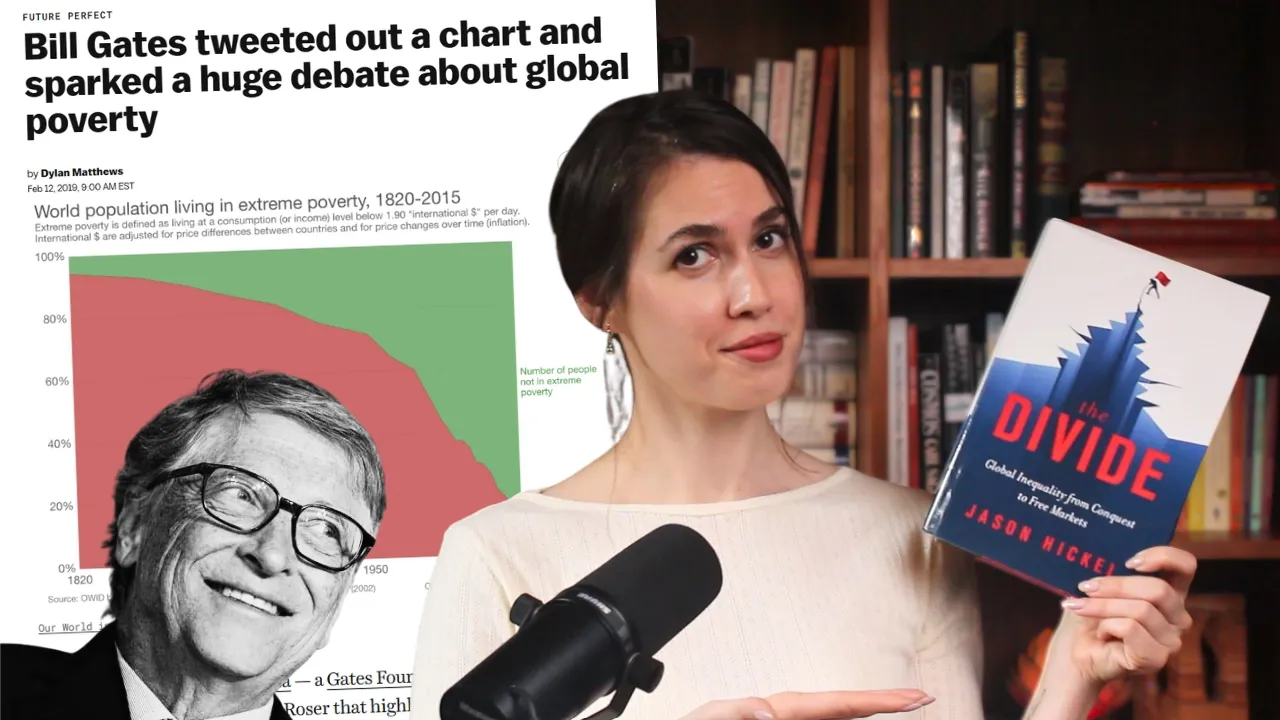
What this all shows is that they met their goal not by making genuine progress, but by moving the goalposts. The graph from our world and data shared by Gates and Pinker shows a steep decline in extreme poverty since 1820. But there are many problems with this graph as Hickle points out.
The first being that global poverty wasn't tracked prior to 1981. So data going back to 1820 is a rough estimate based on different measurements. Combining data sets measuring different things is methodologically unsound.
Second, it tracks poverty at $1. 90 a day. Again, this number is so obscenely low that it's offensive.
Lifting people above this line is like giving pennies to a homeless person. Like it's such a modest improvement that you can't even call it an improvement. When you raise the poverty line to $7.
40, a much more meaningful threshold, the decline is not nearly as steep. Third, most gains in extreme poverty reduction over this time period occurred in quote unquote communist China, which was not subjected to structural adjustment programs aimed to reduce poverty. When you remove China from the data, the steep line flattens.
And fourth, when you look at absolute numbers rather than proportions, there are far more people living in extreme poverty today than in 1820. But the real metric of poverty reduction, Hickle says, has nothing to do with proportions and nothing to do with absolute numbers either. He quotes philosopher Thomas Pog.
The morally relevant comparison of existing poverty is not with historical benchmarks, but with present possibilities. How much of this poverty is really unavoidable today? By this standard, our generation is doing worse than any in human history.
This is what Hickle means when he says that poverty is getting worse. He acknowledges that there have been marginal increases in income of the world's poorest. But given the fact that the majority of economic gains are going to the world's richest, society as a whole is worse off.
Our capacity to alleviate poverty is greater than it's ever been. In large part due to capitalism. Yet the capitalist solution to poverty, trickle down economics and charity is laughably inadequate.
If we were to follow this prescription, we would have to grow the economy to an absurd size to eliminate extreme poverty, let alone poverty. And as I discussed in my previous video on degrowth, the earth can't even sustain the economy at its current size. If we continue on this trajectory, the small gains we've made will be reversed by the impacts of climate change.
Capitalists love to point out the ways in which people, including the poor, are better off now than they were before capitalism because they have longer lifespans and own things like TVs and cell phones. To them, inequality doesn't matter because a rising tide lifts all boats. Capitalism, they claim, has raised everyone's standard of living.
While it's true that capitalism has raised our living standards in aggregate, these higher standards came at the expense of people in the global south who were pushed to an even lower standard of living than that of subsistence farmers prior to capitalist enclosure, which they conveniently ignore. I don't deny that most people are better off in the year 2026, but people give capitalism far too much credit. We owe most of our gratitude to science.
Honestly, the relationship between science and capitalism could be a whole video. Have good things come out of capitalism? Undoubtedly, the bonme is the result of the French colonizing Vietnam.
We can all agree that Bonmese are delicious. But that doesn't mean the fusion of different cuisines wouldn't have been possible without capitalism. Likewise, the scientific discovery of germs coincided with the industrial revolution.
But that's not to say that we wouldn't have developed modern medicine and sanitation in an alternate universe. You could argue that capitalism accelerated technological advancement. I mean, that's kind of undeniable.
But that doesn't justify a system of violent exploitation. Animal testing, for example, has resulted in useful scientific discoveries. This does not mean that Elon Musk is justified in implanting microchips in monkeys brains and subjecting them to cruel experiments.
And again, much of the progress that we can attribute to capitalism is being threatened by climate change. And that, not poverty reduction, will be capitalism's true legacy. Thank you so much for watching.
Please give this video a thumbs up, and I hope you give this book a read. All right, peace out. [music] Yeah.