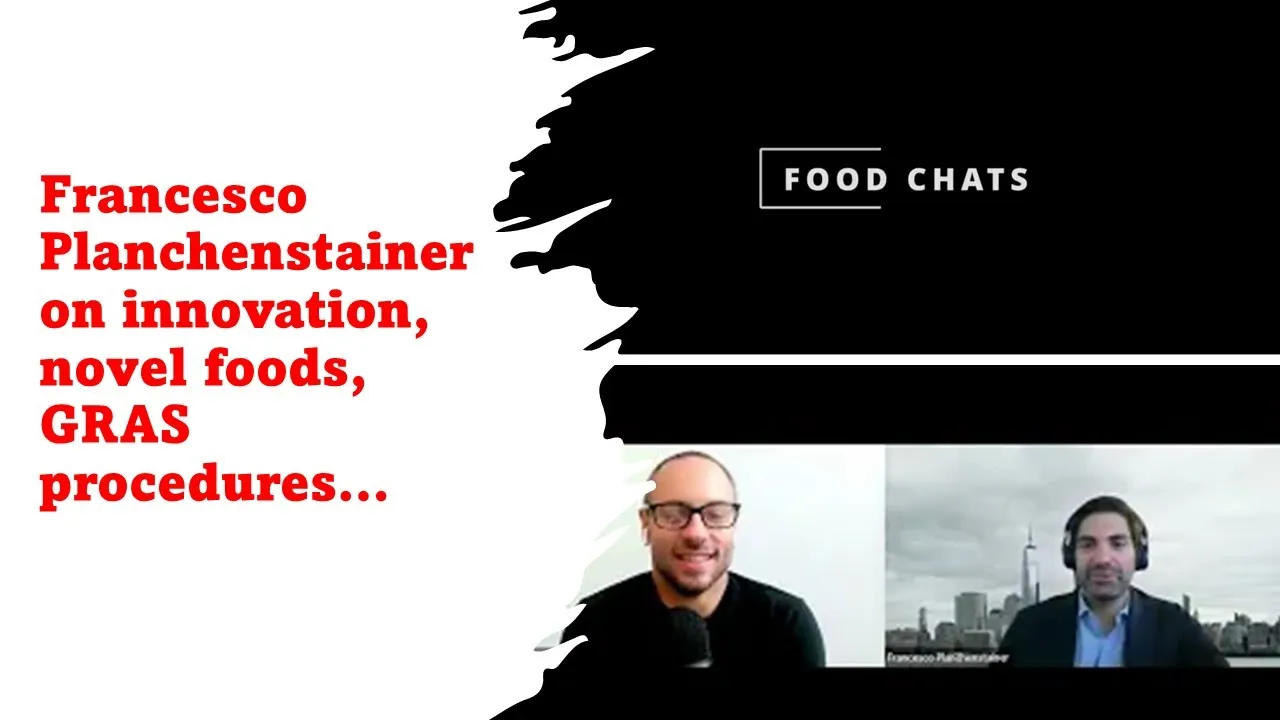
[Music] thank you good morning Francesco it's a pleasure to have you here with us today where it is interview finds you I would say New York from the back yeah that's where I'm located although my team is based in California so I'm kind of stretch between the two coasts of the United States right now wow it's a lot of traveling and what is your current role for our public so my my role is a director of Regulatory Affairs uh with the impossible foods and obviously I need to make here a disclaimer because anything I will say and communicate in the next hour or so it doesn't necessarily represent what my company think about the topics we will deal with so this is only my point of view of course um that's great of course we won't dig into confidential info but you have a really very interesting career we met I guess the first time around 2010 when you finish your uh yeah it was PhD probably correct in a catholica at a university Catholic and piagenza so if you can tell us more about your your career your former experience in in other companies it would be great yeah so um I started with a legal education like Hugh cesare in Italy although in a smaller University at the University of Toronto which is located close to Austria although is part of Italy um so towards the the last year of my uh law degree I decided to invest my time in studying food law and back then there was no uh formal curriculum or education and food law and so I decided to develop my food law cheeses with Professor Rizzo and Professor Mattel Ferrari who is now professor of food law at the University of Toronto on drinking water and bottled water it was an interesting research about comparing regulation both in the European Union and the US and then I went on as you mentioned with the PHD the Agro system PhD School in piagenza which is a branch of the Catholic University and the reason why I joined that PhD is because it's one of the few experiences in Europe of multi-disciplinary PhD so not only it welcomes law students but also students in agricultural economics food science animal production and so on and so forth and it was an excellent experience because uh not only it was exposed to food science and a cultural science there which obviously during the regular legal curriculum in Europe you don't have any contact with but also I had two opportunities to intern abroad first one was the European commission what then was Digi Sante sorry Digi Sanko which nowadays is this is ante correct and then um I moved to the US for the first time and I did an internship at me Johnson Nutrition which is a global leader in pediatric nutrition and uh while doing my internship I also finished my PhD and uh I was gladly to have as advisors uh besides Professor talakini I had also a professor Martino who's now a professor of food law at the Hamburg University of applied sciences and Professor Neil Ford you know his Professor Associated professor of food law I mean she can State University um and I I did my PhD dissertation on the policy model to manage for safety crisis and this was also a comparative work between European law and U. S law and so then I ended up joined me Johnson Nutrition that I was a regulatory senior regulatory specialist but towards the fourth year with me Johnson I decided it was time to come back to Europe which I did and I pass afterwards I passed three years with Ferrero in Luxembourg where the headquarter of Ferrero International is located and I was senior Council that was a unique experience because I supported Innovation um which I started to support also me Johnson Nutrition but with Ferrero was the specific focus of my task and I gladly supported the sugar reduction platform which work with within Ferrero and the open Innovation team which had recently established in Ferrero so I I touch upon a lot of topics dealing with Innovation novel Foods and Innovative ingredients um to work and then also what was interesting in that period is that I had the opportunity to participate in several food industry organizations such as to drink Europe cow bisco but also the counterparts here in the U. S consumer Brands Association and American Baker Association and so towards uh the third year with the Ferrera then I move again to the U.
S uh with Ferrero USA and I was there for two years um which led me to deal more with uh let's say consumer facing problems labeling a communication of products here in the U. S and also supporting the new acquisition that Ferrero had done in the previous years in the field of uh cookies and baked goods and then recently this year I decided to leave Ferrero for this new adventure with impossible food which is one of the leader in the plant-based food here in the U. S and and this move was also let's say driven by an interest and desire to investigate new ingredients and Technology because impossible food obviously is one of the most Innovative companies right now at least that's what I think in the U.
S and uh on the global scale let's say superb you have really an invaluable expertise you know on both sides of the oceans you had great mentors like martinola and faltering so this should be enough to let understand the people online uh the level of your expertise but I have to say that Francesca is one of the honestly uh top professionals I work with along these years we met in several conferences also at Michigan State and he has really a broad view of these problems linked to Innovation and new product formulation from a business perspective from a regulatory perspective so this interview will be very very interesting but um before digging into the technical topics I know that you are again also studying in in us that's true that's true I never stop studying feels like um so I'm currently enrolled for them law school and I'm doing my llm and U. S law and it's very interesting because despite is not specifically focusing on the food law is still interesting for me to enrich me with a broader perspective of U. S law um which is especially important in a jurisdiction where case law is much more relevant than in Europe and a lot of principles are developed by courts more than administrative bodies and so I felt that I needed that and at the same time while I'm a student I'm also somehow a teacher because I collaborate from time to time with the University of Toronto although remotely and a couple of years ago with my colleague elizo Charlie from Ferrero we were the first one to develop a food law legal clinic there are not those many legal trainings around the Europe in Italy so we developed these Legal Clinic with the University of Toronto to help students to touch with their own ends problems of the food industry and we simulated the case uh of interaction between a legal team and a marketing team I think the students had a secret had the excitement of being able to go above and beyond uh what they were studying on books and uh having a bit more practical learning about how things are going on in the food industry and it was a great experience yeah the education is different in Europe and the us because in Europe at least in the civil law countries we tend to go to law school right after high school I mean well in the U.
S you can enter a law school only after you're done with your undergrad students and so a study sorry and so despite a JD is only three years long at the end of the day once you're done with your JD you probably have between six or uh five years of University education in the US so to some extent is comparable uh to Europe or civil law countries in Europe um although I would say in a as an example Italian law school you focus your entire time on legal topics meanwhile uh at least in the U. S is possible to have an undergrad in Sciences or biology and then going on with the Jade um so in my career I come across Experts of patent law or Experts of food law where the opportunity to further deep and food science topics meanwhile I think that uh Italian and European students have lost this opportunity because of the core economy of law schools in Europe we should do another degree in food science then Francisco when you finish up I don't know I don't know if I'm ready for that but yeah well we'll see we'll see no it's it's very true what you are saying about the advantage of knowing the two systems I don't know if you're aware that my degree thesis was about alternative dispute resolution systems and it was on comparative procedural criminal law so it was about plea bargaining in U. S and equivalences alternative disk resolution systems around the world so it was really interesting for me also to understand how common law uh works because when you face consumer issues it's uh it's it's you have to know it it's totally different than than the European civil law legal system so yeah it was great yeah and I'm not surprised because to some extent um quite some people in the legal department of the University of Toronto uh started their career at University of Turin with the comparatives called ayani and the entire School of comparative laws so there's a lot of connection between Toronto and the universe tutoring so not no surprise that we can have similar background from an educational standpoint yeah yeah anyway yeah ever exposure to both system is very important also for food law because basically we have codex alimentarius the European system the American system and all the rest of the world it's I'm not saying copy pasting from from the two big food law structures but if you manage to understand both systems you you you you certainly have the instruments to understand how much of the policies around food are our shape in in all the countries in the world um but coming back to innovation in your specific expertise you always follow very closely these these differentials of the food law Innovation new products development so you are very familiar probably with um novel food applications in new grass application in U.
S so can you maybe elaborate a bit more about your experience and especially try to explain in simple terms why we always heard that EU system is based on the precautionary principle so it's praise for its high food safety standards but on the other side is heavily criticized because it's uh sometimes stopping or slowing Innovation well on the other side the US system at least in Europe is seen as something extremely liberal where you can place on the market more or less everything and in my opinion it's not exactly like that you have procedures you have you have certain principles okay you cannot exactly Market what you want anytime so I'm eager to know your your yeah and uh yeah again as a disclaimer I I won't talk about any of impossible food automation but I'm I'm happy to share a couple of ideas um on what I've experienced over there yes so first of all I would like to say that I um take a bit with a grain of salt uh these overly broad assumption about the two systems um and the more you deep dive into the two the more you realize that there are more things in common than differences and I think people tend to over emphasize differences just based on semantics or different terminology um because uh some people obviously um the grass system is not an approval system and we all know that um that doesn't mean there is no involvement of FDA in the review of the summation um and so and and increasingly more and more companies decide to uh do a self-glass notification but with a notification to FDA without just doing a self grants assessment by themselves because of the importance of having an authority endorsing the safety and the rigorous assessment that the company has done and additionally we know that a few years ago FDA finalized and it took 20 years almost for the agency to finalize the rule on the grass program which requires uh quite some rigorous let's say burdens in convening the expert panel for evaluating the grass status for unintended use of an ingredient so it's not that in the U. S it's like the Far West where everyone can go to the market with any type of ingredients I would say that this is probably more for small player but big players cannot afford that but on the other end I can see even in Europe I've seen a lot of small Enterprises over the years they didn't have a clue that what they were doing could have been possibly another food in Europe or they were importing foods from third countries and they didn't even know that a certain plant variety could have been considered knowledgeful and then I think there are interesting um you know interesting examples on um how the two system proceed yet so in Europe people tend to believe that uh European food is safer on a as a general assumption but if you think to the passionately hydrogenated fats which are notoriously unhealthy for consumers while FDA was quick enough to say they're no longer grass in the United States the European Union hasn't determined that with a legal binding tool or instrument that they are not longer can be used in in food production so that's very interesting because there's no debate there about the safety um and I wonder why in this case a lot of people are not more vocal about the fact that the European Union should protect safety of consumers on the other end a lot of people tend to over emphasize the U. S as on for innovation but if we think to the system of the standard of identity in the U.
S and how old they are because some of them they even date back to the 40s or 50s when adulteration was quite common and some of them were developed even after the Great Depression so um a lot of things yeah but I think like chalking flowers or doing this gross food fraud yeah so uh funny enough these are still there and they curb significantly the ability to innovate in certain space like their ingredients um so I wonder whether uh the assumption that the US is on for food Innovation is correct in that space so these are just few examples of um how I think that we tend to over emphasize differences and then there is also another element um that I think is Food For Thought is that um what I notice is that uh as a trend I see we always have a villain ingredient and there are pattern of of these stigmatizing single ingredients and funny enough um the reason why uh partial hydrogenated fats were developed were back in between the 50s and the 80s was because uh obviously because of cost Factor but also because we were trying to get away from animal fats we thought the saturated fat were the evil and in order to replace that we ended up with something there was even worse than what we had before um so one noticing and this is I think a trend that is I see around the world is that while a lot of people advocate for precaution and banning single ingredients and I'm thinking about The Saga of the titanium dioxide in Europe I was thinking the same exactly the same the minute after you Banner ingredients you start to replace it but the interesting thing is that we don't do an equation to understand whether what we replace the old ingredient is equally safe or whether their benefit of staying with the old ingredients instead of replacing with the new and um and that in particular that Saga to me was very interesting um because another time it showed me um how science is used sometimes in a political way uh especially on the European uh uh on the European scene because we're funny enough uh for many years uh as I rebutted any concern about the social ingredients including the last report of answers and then once she it was reevaluating the additive it was like 183 shifts and they say we don't have enough data to conclude that the ingredient is safe um which to some extent to me anticipate the precaution to the assessment phase which is kind of scary to me because I'm wondering do all food ingredients undergo the same burden of proof do we have to demonstrate that any and whatever ingredient we use is absolutely safe and we need to demonstrate it above and beyond any doubt or was all these uh tests only used for this specific ingredients um and in fact it was interesting that the way other authorities around the world reacted and I'm more interested about Canadian authorities Australian authorities that are probably closer to the European Union the way they deal with risks and they confirmed that the ingredients they didn't have elements to conclude that the ingredient was unsafe they didn't say we don't have enough elements to demonstrate safe they say we don't have elements to believe that is unsafe so to some extent the burden of proof was shift in that case um and I found it extremely interesting also because it let me think about some classes of philosophy that I took when I was at High School from Carl popper that he was saying that any scientific theory is subject to be Revisited and reverted by new new evidence so what I I feel is that consumers and citizens on average we like to have a food 100 safe with absolutely no risk which to some extent reminds me these classes of uh popping which was saying you know if you have a Dogma or an axiom you're not any longer in the scientific space you're in a sort of religious space or another space um instead I think that people should be educated to understand the risk assist is part of our life and uh and we need to understand uh the balance between risks and and I think one of the shortcoming of certain risk analysis model is that they don't take into account the benefits for the consumers um because we all the time Focus only on the safety of the ingredient where we don't also consider other elements uh in the equation who have a broader risk analysis model and so we miss out I think on another benefit from food Innovation yeah a lot to chew on also this aspect of the consumers that uh would like to have or think they have food that is 100 safe it's interesting because it's a lot about also communication of the risk scientific communication that is a topic that we we face with other guests as well so it's uh sometimes what is uh perceived by us in the with the technical knowledge it's completely different from what is perceived by consumers the scientific assessments are not communicated properly and so there is a huge gap in my opinion between our work and the consumers and that's despite certain efforts from our FSI in Europe and other authorities you know we have to work a lot I I think on consumers education to to try to to to bridge this Gap because otherwise uh the the the situation might become dangerous because as you mentioned in in Europe This precautionary principle has been often instrumentalized for for political reasons and uh my perception and I raised this question recently in several conferences speaking of new Gene editing techniques and other you know kind of innovative um processes is uh my my perception is that we are moving to a system where the pre-market authorization is uh is becoming the rule in Europe and that's that's scary for Innovation because we're speaking of uh of procedures that might take two or three years uh need a lot of the Investments and uh and as you mentioned is this shift of the precautionary principle to a phase that is even preceding the risk the risk evaluation in the risk assessment phases is very it's very dangerous because risk to to block a lot of or things on on the other side I I want to pick up on another idea that you raise the fact that in the U. S you can do a self-assessment grass so a self-assessment safety evaluation of an ingredient might be a pro in certain situation but another is a big con because I assisted a lot of startups developing Innovative products and if you want to find investors if you want to partner with big companies if you need support sometimes it's much better to have an approval a piece of paper that say that you can do that this has been approved or at least has been evaluated by the FDA so that's why I would send my grass for instance to the FDA at least to have an answer where the FDA said well I have nothing against your ingredients your assessment look look you know reasonable the ingredient is safe well in in Europe despite this rigid system many companies are Flying Blind are putting on the market ingredients without knowing exactly if they are novel or not novel and we have now blatant cases of non-compliance like for CBDs for instance but it's clear that the new position and I know also in U. S you speak a lot about CBDs is that those you know chemical extracted CBDs are novel you cannot enrich the products with CBDs you cannot Market them as such but still the market is floated so uh you know yeah I'll try to tackle um your thinking from the beginning because it was yeah so um let's go back to uh consumer expectation um and I would like to to give another powerful example that senses me makes me laugh so over the pandemic we witness a sudden spike in baking abilities of people at home doing all kind of experiment with sourdough selecting all kinds of strain and so on um so let's think about a moment about that um what's going on in our own kitchen what is the level of hygiene that people have in their own kitchen and what strains they're dealing with and on the other end we really bother ourselves with the QPS system um assessing um microbial microbial culture the safety of microbial culture and so on but consumers don't realize that even in their own homes they can have significant risks not to mention more the people who were trading exchanging sourdough and every time they explain to people that when they you know get some sourdough with some random friend they also get any ecosystem they might have in their kitchen and it's to me it's quite gross to be honest with you but people seem not to realize that this is equally dangerous and um but why why because that ecosystem of our kitchen feels our under control and there are studies on uh risk perception and I think the officer is doing a great job in trying to communicate better understand risk perception by people meanwhile other when the people are not in control any longer because the shoe is overly complicated for them to understand or is way too remote from them uh this then is when they start to have distrust um and so I think it's extremely important to um invest in education especially scientific education and if you look at the most recent Euro parameter reports on science and citizen it was extremely extremely interesting there are a lot of Mediterranean countries are very very low science acumen and guess what is where some unethical player can thrive on that and developing marketing strategy because we don't have to think that is the evil companies and the consumer on the other side there are evil company is their good companies and consumers that even company equally taking advantage of these situations so um there's a lot of competition there so uh that's uh that's that's a point then getting to the other topic of um self-self class one thing that people I think don't fully appreciate is that uh the grass status generally recognized as safe generally means by experts and based on public proceedings which means published data um so unless they're published data out there that support your conclusion you are not able to come to the conclusion that you're ingredient safe and it's very interesting if we compare the European system to the grass system because technically speaking a company could submit and it's probably whatever like entire reports of studies twasa without publishing them and so at the end of the day uh they would be obviously evaluated by the expert of FAFSA and then subject to under the neutral status rule to the public comment but technically they don't those data don't undergo first uh peer review process they don't undergo first to uh they could let's say could not undergo a public debate first which that's typically what happens in the U.