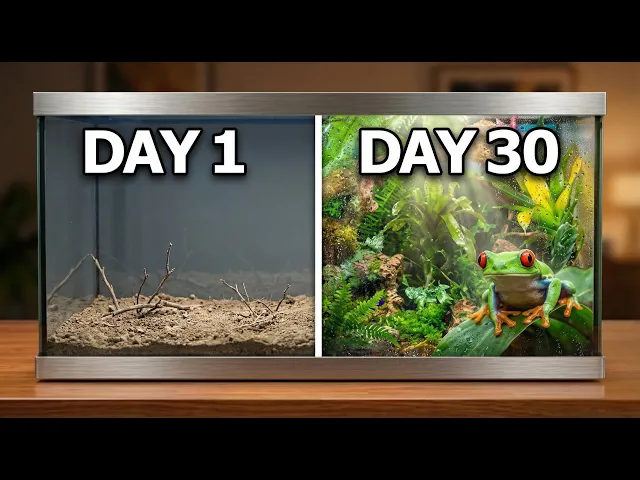
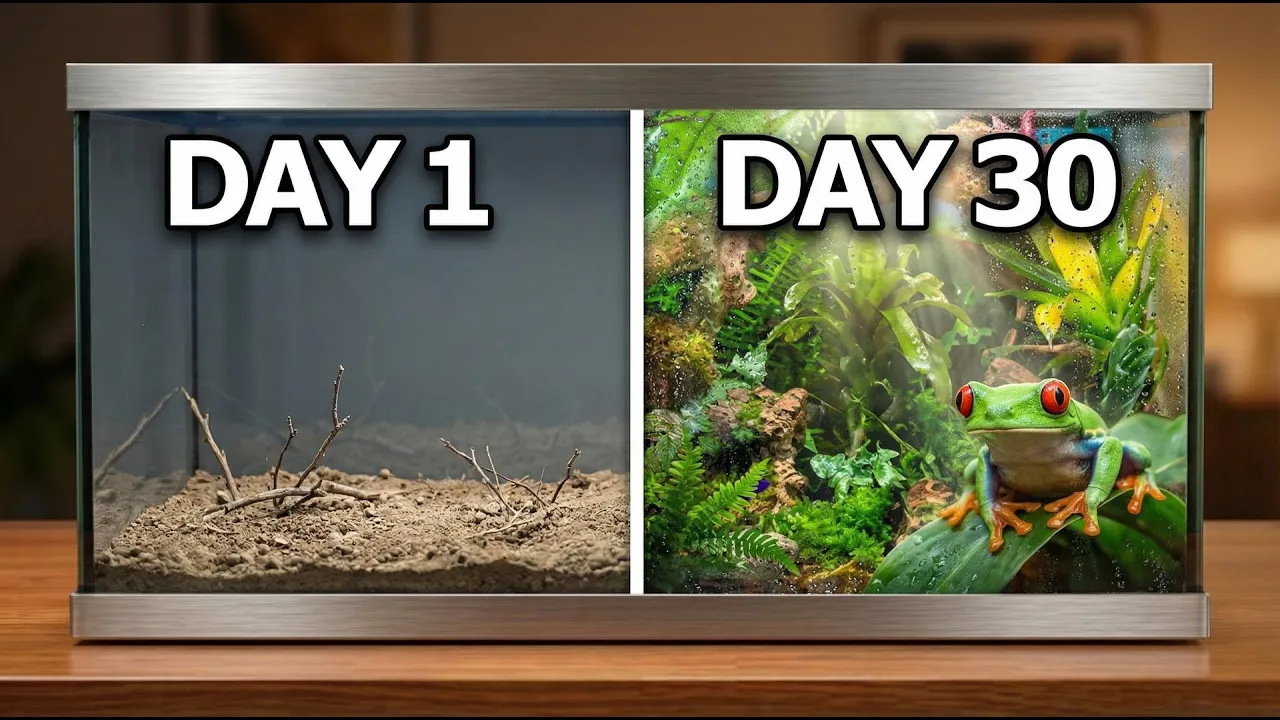
One month ago, this rainforest was nothing but an empty container. But as time went on, predators evolved, prey multiplied, and natural disasters threatened everything. Yet, despite the chaos, something incredible emerged.
Although it started from nothing, every blank slate holds a story waiting to unfold. So, here is the tale of my 30-day rainforest simulation. On day one, the foundations of the rainforest were laid.
Fresh soil was layered, creating the perfect substrate. Moss carpeted the ground. And then plants emerged, ferns unfurled, vines began to climb, and greenery slowly conquered the empty space.
As the forest took shape, our journey into life was only just beginning. Because hidden deep beneath the soil, something was already alive. Earthworms.
These underground engineers are expert dirt excavators, tunneling through the soil and helping plant roots spread. As they dig, earthworms break down decaying matter, transforming it into food for the plants above. With just these tiny worms and the growing vegetation, this ecosystem could sustain itself for years.
But little did these worms know, there was something else lurking in the lush vines of the jungle. Crickets were breeding and while they might look harmless, these crickets were ravenous. They began devouring every plant they could find, stripping leaves at an alarming rate.
Over the next few days, the plants started vanishing. The ecosystem was spiraling out of control, and the earthworms could do nothing to stop it. The balance was broken.
Are you serious right now? The ecosystem desperately needed saving. I had big plans for this simulation, so I had to act fast.
It was time to introduce an apex predator, a creature that would demolish the cricket population. Meet the Australian whites tree frog. This fierce hunter should handle the problem perfectly.
And as soon as I released him, the hunt began. The crickets could sense his presence. They tried to hide, but it was no use.
The frog had locked eyes on multiple targets, and the insects could do nothing. It only takes one lightning fast strike from the frog, and with it, he earns himself a nice, tasty meal. The cricket population finally began to plummet.
There was a new king of the jungle. And as the days passed, the ecosystem started healing itself. Everything was sustainable once again.
Balance had been restored. But along with this new found peace, something else appeared. A thick fog began rolling in.
While the rainforest had seen some rain before, today it was about to experience its biggest storm yet. Out of nowhere, thunder cracked and rain poured down. This would be a long storm, so the animals had to hunker down.
The frog retreated behind a log while the worms burrowed deeper underground. The wind howled, tearing away leaves. It was intense.
But after two days, it finally began to calm. As the rain clouds receded, it was obvious what they had left behind. A tiny pond had formed.
And while it was small, this water would allow for an entirely new type of life to thrive. In fact, if we zoom in, that life is already visible. Springtails all across the water were these micro insects.
In just a few days, it rained. These creatures rapidly reproduce throughout the forest. But thankfully, these guys have no bad intentions.
Their main purpose is to break down organic matter, dead plants, and debris, helping the ecosystem thrive. The little springtails even ventured onto this log to clean it. But this sustainability wouldn't last long because under this very log, something bad was brewing.
Over the next few days, an odd sound kept growing louder. There was a new creature alive under this log. So on day 17, I lifted it up to expose what was underneath.
Meal worms. They were in full breeding mode. These meal worms are different from the earthworms.
Their numbers are far greater. And because of this, they're stripping too many nutrients from the soil, tipping the balance once again. The plants started disappearing.
By day 19, these meal worms were everywhere. The frog noticed and immediately started hunting. He tried eating as many as he could, but it was no use.
Meal worms breed rapidly, and the frog couldn't keep up. The ecosystem was collapsing again. And this time, even worse than before.
It was time to introduce a new predator once again. Meet the green anol. Our ecosystem is about to be introduced to two of these coldblooded hunters.
and hopefully everything will be fixed soon. So I added them in. Almost instantly they sensed the worms.
Now they may look small, but these lizards are incredibly fast, allowing them to ambush any worm they see, the green anol perched on a vine, waiting for an unlucky worm to appear. And while they waited, one even turned brown to blend in with a stick. It didn't take long until their first victim appeared.
And of course, the encounter didn't last long. The mealworm population finally started falling. One after another, our lizard duo had successfully saved the ecosystem.
As day turned to night on day 25, I decided to release a few more crickets to show you just how quick these green anolles really are. Within seconds, the lizards noticed the insects. Their tiny eyes locked onto their targets.
The crickets had mere moments left. All of a sudden, one lizard dashed toward its prey through the darkness so fast that I didn't even catch it eating the cricket. The earthworms, frog, springtails, and lizards were now thriving together.
The ecosystem had reached balance. And on the final day, day 30, I woke up to something magical. Flowers had bloomed.
Luscious plants filled every corner. The rainforest was complete, and our animals could live happily together. Thanks for watching.
And I wanted to let you all know this is actually my second ever video. So to show that you want to see more, it would mean a lot if you could subscribe to the channel. Also, I'm looking to create a lot of videos similar to this.
So if you have any ideas you'd like to see, comment them down below. Once again, thanks for watching.