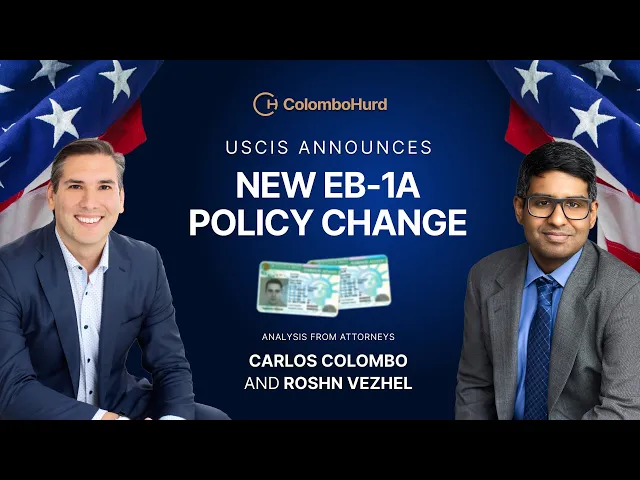
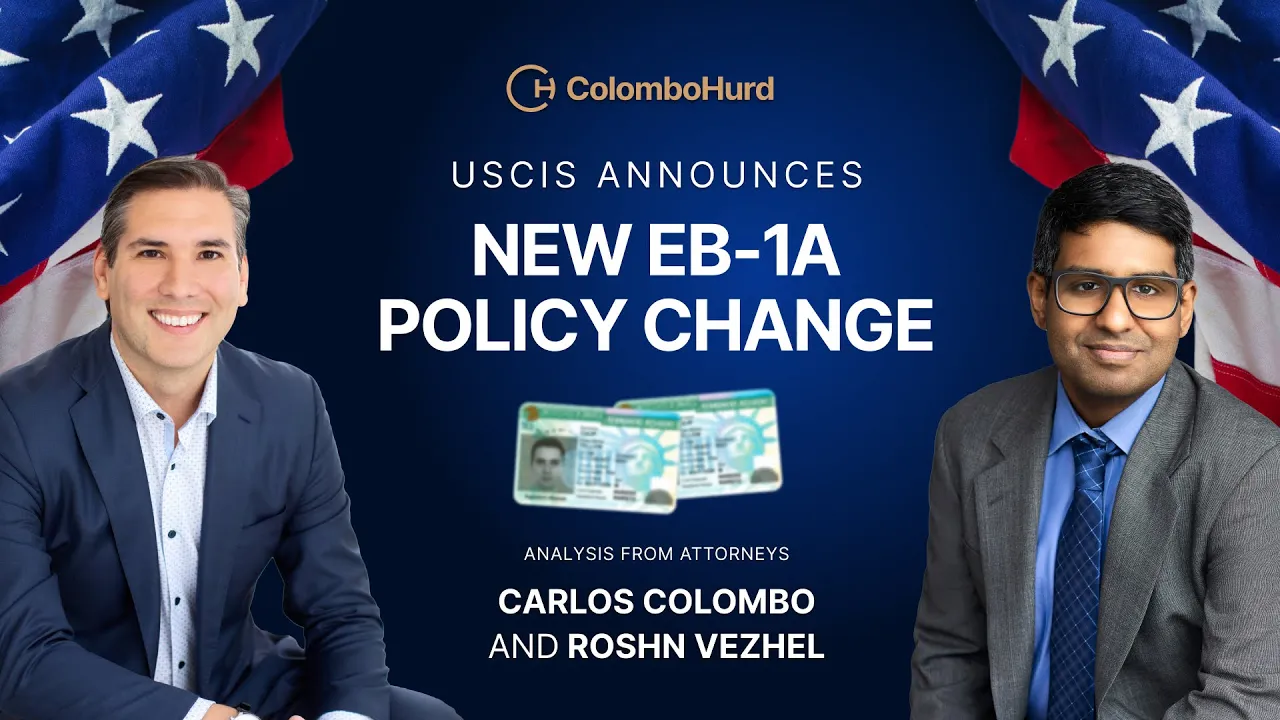
[Music] [Applause] [Music] hi attorney Carlos Columbo and today we are going to cover a very interesting topic a new guidance that USCIS has issued regarding eb1a applications and we have a special guest rashan one of our attorneys here rashan if you can introduce yourself hi I'm rashan vashell uh I'm the rfy department director here at Columbo and herd I'm happy to be here no and rashan you know today we're going to be talking about something that hopefully will make some of those rfes that you sometimes get a little bit easier to respond with regard to
eb1a um it's interesting you know it's the beginning of the new fiscal year so happy 20202 for for USCIS as many of you know USCIS fiscal year starts October 1st and the very next day on October 2nd uh USCIS issued new guidance on eb-1 eligibility criteria uh they announced that um the second day of the fiscal year which I think it's a positive uh thing that we're seeing from the Biden Harris Administration um especially about a month before the elections to see that in this new fiscal year USCIS is perhaps making it a little bit
easier rashan with regard to eb1a what what's your take on this yeah I definitely think it's a trend to try and make not only make them easier but clearer um an important thing to note is that last last year September 12 2023 that's when we had another policy manual update and that's when they took a lot of what was in the appendix and just put it straight out there for everybody to see that was really helpful to clarify what the USCS valued however this additional update further clarifies what they value in these criteria and most
importantly makes it very clear that you know it's not just you having been doing everything by yourself because a lot of what people do is inde teamwork and that part of this is further clarifying that if you're part of a team that's accomplished something extraordinary it's still valuable and you can still qualify for this type of um petition and and that's a great point because they're you these guidance are not changing the law right because USCIS can't change the law Congress must change the statute uh so if we're going to see major changes we're we're
going to have to see some kind of a congressional action which as we all know with uh the way the politics is right now we're we're not going to see any changes passed by the US Congress anytime soon uh especially regarding immigration so these guidances that they send over is to try to uh clarify what sometimes us as attorneys what we need to do maybe in responding to an RF which is you know your expertise and your department sometimes you you can get an RF where they're questioning certain types of evidence and some of the
criteria for an eb-1 so um a lot of times we don't give USCIS a lot of credit for uh maybe not doing their job but this time I think we have to give USCIS and the Biden Harris Administration some credit that they're maybe listening to some of the stuff that we Tred to educate uh some of the uh USCIS officers on with regard to how the criteria should be uh identified in the real world because part of the problem we haven't had a major change in USC Law in so long that how over 30 or
40 years how this has developed uh over time it has changed and we have to be more practical about how uh USC is going to weigh that evidence so let's get into the the the the meats of this and and the bones um can you walk us through what criteria USCIS actually uh has tried to clarify with his new guidance yeah I I can certainly do that there's four criteria that they've worked on here and I'll start by just listing them and then I can go into each one so the first one that they've worked
on here is receipt of lesser nationally or internationally recognized prizes or awards for excellence in the field of endeavor so that's the first one second one is membership and associations in the field for which classification is sought that require outstanding achievement of their members as judged by recognized National or International experts in their dis disciplines or Fields the third is publish material about the person and professional or major trade Publications or other major media relating to the person's work in the field for which classification is thought and the last one is display of the person's
work in the field at artistic exhibitions or showcases um so what the USCS has done here is they haven't edited too much but what they have added is actually pretty important as well as what they have removed for the first one receipt of lesser nationally or internationally recognized prizes or awards for excellence in the field of endeavor the USCS here has pointed out not just to us but to their officers that nothing in this criteria allows the officer to um not take into account something that a person reive as part of a team and that
if somebody was part of a team that received the reward as long as they're one of those recipients of the award it should be counted the same as if they individually received it and that's very important last year they added this to the published material which I'll informally call media coverage or coverage because they wanted to make clear that just because you're part of a team that doesn't mean that you don't deserve credit for something it's very rare for somebody in the field to just receive something entirely for themselves and I think this is part
of a reaction to uh what people informally call this uh type of Visa the Einstein Visa that's clearly not the intention um you don't have to be Albert Einstein to receive this Visa it's not that exclusive that nobody could actually achieve it so importantly here they're saying you can be part of a team and because you're part of a team and you got a team award that means that that award should be considered here and that's a and that's a great point because USCIS maybe if if you won the World Cup in cricket or in
soccer and you're a team member you know you're one of those team members maybe they would not RF you or they may not question that because you're one of those players and it's you know it's it's the cricket or soccer World Cup so it's it it's something fairly obvious but in when you have an award that maybe it's in robotics or AI or you're a scientist or you're a doctor or you're in something maybe a little bit less recognized it could be something more artistic or cultural I the problem there is that the officer may
not know what that award really was and and really how you could you you have contributed as a member of that team and so you would have to give further explanation uh and sometimes they would dismiss it as not being uh something that that that would be recognizable so I think that this makes it easier for the less obvious uh situations uh and I think it's not only just this part of the guidance I think it's actually all of them that would make it a little bit easier but let's go through through the second one
on membership uh Criterion which is something that we we see pretty often yeah definitely uh again a very small but important change what they've done here is they've added past memberships as well and clarified it's present or past and this is pretty important because memberships in these types of associations people may not be able to maintain them for many reasons but they were still part of that Association they met their requirements they had the outstanding achievement but something changed and I think that they wanted to make clear that it's about the field not about you
know what you're currently engaged in professionally in that sense because these associations could have high levels of fees they could have location requirements like you're no longer in that country so you cannot be part of it if you went from Academia to industry or industry to Academia maybe you can't be part of that Association anymore so they're opening it up so that you know you don't actually have to be part of the asso right now you were already found to be outstanding by being able to join so it's making it easier for people and also
clarifying for officers that memberships in my opinion that they should be taking them a little more seriously indirectly as well instead of uh questioning them more often than they really should clearly if somebody's been judged by recognized experts in the field that means that you know they've had outstanding achievement if the association is you know prestigious enough then it doesn't matter if they're no longer part of it because something changed in their life they were still part of it at some point and that speaks to them having extraordinary ability all right and then number three
the famous or sometimes not so famous published material part of the criteria yeah and this is the one that's a little more extensive so what they did here is they actually removed a sentence which is any materials the petitioner submits must demonstrate the value of the person's work and contributions it must not be solely focused on the employer organization that the person is associated with it's still the case that it can't just be about the employer and the employer's work it still needs to be about the person however they remove the part that said demonstrate
the value of the person's work and contributions I think that in my opinion why they've done this is because when they use the word contributions it kind of Treads closely to original contributions and made significance that's a very different Criterion and using that same word and trying to make it seem like you have to meet original contributions M significance to even meet this criteria was clearly wrong but maybe that USCS had thought that officers would not be confused in this manner but they clearly were and I think this is going to make uh again along
with the teamb based version from last year this type of coverage should be much more important it'll be a lot easier to meet the plain language requirements for this Criterion um it's just again showing that in the modern world people are usually working as parts of teams uh and if there's going to be coverage about somebody's work they might not go that far into like why this is you know super significant for the field it's enough that it's in major media and it's you know given for the lay man it's not going to go that
far into that explanation so I think that this is going to be a lot easier for people to meet the plain language criteria for right and it's also you know if if there's going to be published material about you you don't control uh how they're going to present that information um it may be a major publication that has a significant impact but you can't say oh and by the way can you please add this additional language because I may need to use this down the road with USCIS uh which is just you know not like
you said it's not the modern world it's not the real world um so so kudos to immigration for finally understanding that the real world is a little bit different than how uh some of these uh criteria were uh were developed and then the final one on exhibitions this is a little bit more of a narrow uh criteria that may not apply to to a lot of applicants necessarily unless maybe you uh doing some kind of exhibition for artistic purposes Etc yeah exactly the only real change they've done here is that they have made very clear
that this is really for people that are doing artistic Works um I think that initially there was a bit of a confusion I could see it a lot where people would be doing things like you know presenting at conferences scientific conferences and then thinking that it might fit here the USCS is making clear that this is only for artistic exhibitions if you have something else you can try using it for comparable evidence and indeed in comparable evidence they brought up specifically uh you know if you've done significant numbers of conferences where you've given presentations that's
comparable evidence because it doesn't cleanly fit but this is more of a clarification on their part to reduce confusion right well I we have to give USCIS credit for doing this I I must say I like that the beginning of the fisal year for the eb1a uh if you're considering the eb1a it's a good start to the fiscal year 2025 um you have uh for the rest of the world you have current Visa availability which is a major major issue there's only two categories right now that I can think of um that are currently current
uh with the Visa bulletin and that's eb1 for the rest of the world um and the eb5 and certain categories of eb5 also because as you know we have different um set as sides for eb5 eb2 is is is somewhat backlogged for the rest of the world eb3 is very backlogged so if you are in a category and even for uh those applicants from countries such as China or India The eb1a Remains probably the fastest way to a green card right now USCIS making the criteria a little bit clear to begin 2025 is a positive
positive uh development so if you're considering this I would encourage you to consult with an experienced attorney uh you have the link to uh our web page so you can set up a free evaluation of your profile uh so we can take a look to see if you meet some of these criteria for eb-1 eligibility uh it would be obviously a pleasure to be able to help those with extraordinary ability to come to United States russan I want to thank you that was a very very good explanation of this news that we received yesterday from
USCIS um and hopefully we will see maybe less rfes on some of these criteria in the future uh making your life and of course our client's lives a lot easier going forward um but thank you rashan and thank you all for watching us until next time