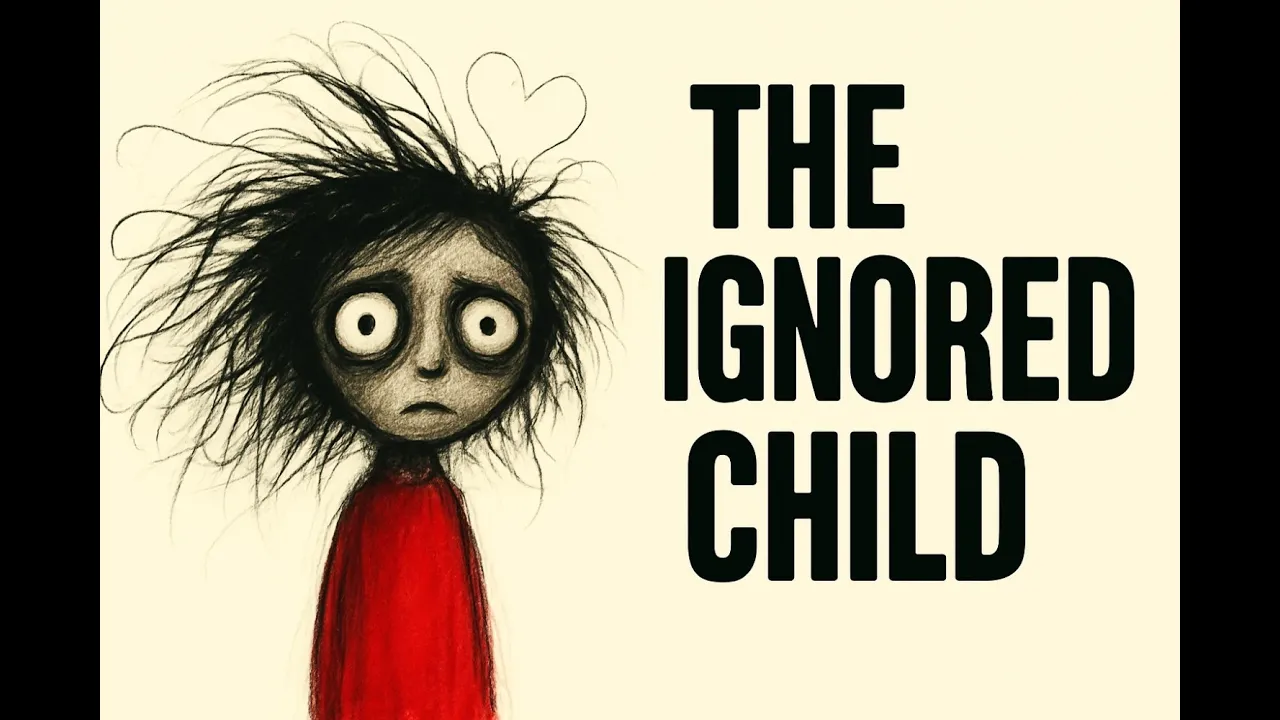
There's a quiet truth about children who grow up ignored. They often become adults who struggle to believe they deserve attention at all. They walk into a room and feel like they must shrink.
They enter relationships and wonder if they're too much. They succeed in something, but instead of celebrating, they wait for it to be overlooked, as if invisibility is their natural state. This is not because they lack talent or worth, but because the foundation of their sense of self was built in silence.
Psychologists call this an internalized neglect schema. It means that over time the brain wires itself to expect neglect, to anticipate dismissal, to assume that needs are a burden. A child who is ignored enough times eventually learns not to ask.
They convince themselves that wanting love, affection, or understanding is somehow wrong. [Music] Have you ever seen a child standing in a crowded room, quietly tugging at their parents' sleeve, waiting for even the smallest glance, the smallest acknowledgement? Maybe you've noticed it on a playground, in a classroom, or even in your own family.
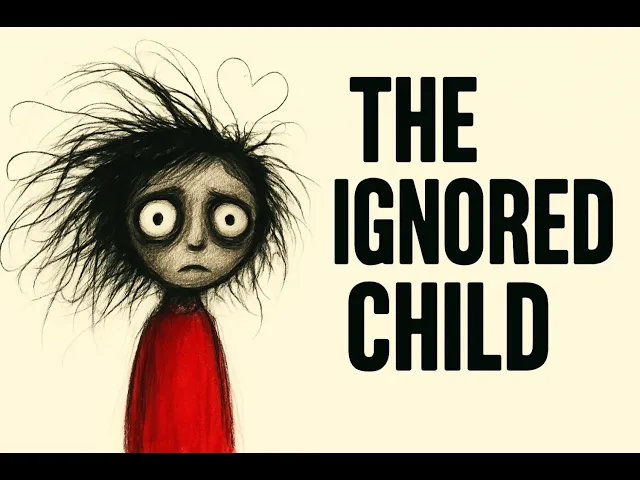
The child who doesn't cry the loudest, who doesn't demand attention, but instead retreats into silence. On the surface, it might seem like nothing dramatic is happening. But inside that child's mind, something profound is unfolding.
Because for a child, being ignored isn't just an inconvenience. It feels like a deep fracture in the very foundation of their sense of self. And here's the painful truth.
Childhood neglect, whether intentional or unintentional, doesn't always look like abuse. It doesn't always look like cruelty. Sometimes it's simply absence.
Sometimes it's the unanswered questions, the lack of eye contact, the forgotten birthday, or the parent too busy, too tired, too distracted to notice. But the psychology of the ignored child runs deep. It shapes how they see themselves, how they view the world, and even how they build relationships decades later.
We often assume children are resilient, that they bounce back from almost anything. And yes, children do adapt. But adaptation is not the same as healing.
When a child learns to live without acknowledgement, they adapt by shrinking themselves, by hiding their needs, by convincing themselves they don't matter as much as others. And this adaptation, though it allows them to survive childhood, can quietly haunt their adulthood in ways they may not even recognize. From a psychological perspective, acknowledgement isn't just about feeling good.
It's about survival. Research in developmental psychology consistently shows that children need three core things to thrive. Safety, stimulation, and connection.
If one of these is missing, their development is affected. But connection, being seen, heard, and valued, is the one that shapes the child's sense of identity most directly. John Bulby, the founder of attachment theory, argued that secure attachment, formed when a caregiver consistently acknowledges and responds to a child's needs, creates a foundation of trust.
That trust then becomes the blueprint for future relationships. But if a child is ignored, if their needs are met with silence or inconsistency, they don't just feel disappointed in the moment. They internalize a dangerous belief.
Maybe I don't deserve love. Maybe I'm not important. This isn't exaggeration.
Studies in neuroscience show that when a child's attempts at connection are repeatedly ignored, their brain interprets it as a threat. The stress response is activated. Cortisol floods the body.
Over time, this can rewire their nervous system to expect rejection. Their baseline becomes anxiety. Their emotional regulation becomes fragile.
And yet, from the outside, they might just look like a quiet kid. When a child is outright mistreated, the harm is obvious. But when a child is ignored, the damage is more invisible, more subtle, but just as real.
A child might stop asking questions because they expect no answer. They might stop showing excitement because no one responds. Over time, they begin to disappear, not physically, but emotionally.
Psychologists sometimes call this emotional neglect. Unlike physical neglect, which leaves scars you can see, emotional neglect leaves scars hidden beneath the surface. These scars often don't fully appear until adulthood when the ignored child tries to build intimacy, chase dreams, or find meaning and run straight into the quiet, unhealed wounds of their past.
For example, many adults who grew up feeling ignored report struggles with low self-esteem. They hesitate to share their thoughts, believing nobody really cares. They may fear rejection so deeply that they avoid relationships altogether.
Or conversely, they may desperately chase approval, bending over backwards to keep others happy because deep down they're still trying to earn the acknowledgement they missed as a child. Imagine being 8 years old and running home from school with a drawing you're proud of. You hold it up to show your parent, but they're busy on the phone.
You try again at dinner, but the conversation passes you by. Eventually, you put the drawing away and you never mention it again. Now, imagine this happening not once, but dozens, even hundreds of times over childhood.
The child learns that excitement, pride, even joy are things best kept to themselves. And years later, as an adult, that same person might struggle to celebrate their own successes, dismissing them as unimportant. The ignored child becomes the adult who ignores themselves.
Research confirms this. A 2019 study in the Journal of Child Psychology and Psychiatry found that emotional neglect in childhood is strongly correlated with chronic feelings of loneliness in adulthood regardless of social environment. In other words, even if that adult has friends, family, or a partner, a quiet emptiness often lingers inside.
Most parents who ignore their children don't do so out of cruelty. Often it's the result of stress, economic hardship, mental health struggles, or simply not understanding how critical acknowledgement is. A parent working two jobs may have little emotional energy left.
A parent dealing with depression may struggle to notice their child's bids for attention. And in the modern age, digital distractions, phones, screens, endless notifications pull focus away from family life. But intention doesn't erase impact to the child.
The absence feels the same regardless of why it happens. That's why understanding the psychology of the ignored child matters so much. Because awareness is the first step to breaking the cycle.
Ignored children often develop coping mechanisms that at first glance can even look like strengths. Some become fiercely independent, learning to take care of themselves early. Others become high achievers, striving to finally earn the acknowledgement they crave.
Some become peacekeepers, avoiding conflict at all costs in order to keep a fragile sense of connection alive. But beneath these strengths is often exhaustion. The independent child grows into an adult who struggles to trust others.
The high achiever becomes the perfectionist, never satisfied. The peacekeeper becomes the people pleaser, unable to say no. And perhaps the most heartbreaking adaptation is the child who stops trying altogether.
The one who concludes, "If no one cares anyway, why bother? " This child often carries apathy into adulthood, struggling with motivation, ambition, and hope. Ignored children rarely talk about their experience because how do you explain what it feels like to be invisible?
There's no dramatic story to tell, no event to point to, no scars to show, just silence. Just the memory of moments that should have mattered but didn't. And that silence itself can become a barrier.
Adults who grew up ignored often hesitate to seek help, fearing they'll be dismissed again. Therapy clients sometimes minimize their experiences, saying, "Nothing really bad happened to me. " But the absence of something essential is itself a trauma.
It's like growing up in a house without air. Just because you survive doesn't mean you are breathing freely. The long-term effects are real and they're measurable.
Research from the National Institute of Mental Health shows that adults who experienced emotional neglect as children are at higher risk of anxiety, depression, and difficulty forming close relationships. Another study from Harvard Center on the Developing Child points out that consistent acknowledgement in childhood strengthens neural pathways related to resilience while neglect weakens them. Put simply, acknowledgement isn't a luxury.
It's a developmental necessity. This doesn't mean every ignored child is doomed. Many grow into compassionate, thoughtful adults precisely because they know what it feels like to be unseen.
But it does mean their journey is often harder. It means they have to spend years unlearning beliefs that were planted in them before they even knew how to question them. So where does healing begin?
Not with perfection. Not with instantly becoming confident, but with recognition. With the simple but powerful act of saying to yourself, "What happened to me mattered.
My needs were real. My pain is valid. " For the ignored child who grew into an adult, the first step is often giving themselves the acknowledgement they didn't receive.
And though that may sound abstract, it can be surprisingly practical. It can be as small as pausing to celebrate your own wins. As small as saying your feelings out loud, even if only to yourself, as small as daring to believe that what you think and feel matters.
Because the truth is, acknowledgement isn't something you outgrow. The need to be seen doesn't vanish with age. It just goes underground.
And the journey of healing is about bringing it back into the light. Think about how this shows up in friendships. An ignored child often becomes the quiet friend who listens deeply but struggles to share their own struggles.
They may be the person who always shows up for others but rarely asks for support in return. To the outside world, they may seem selfless, but inside there's often a lingering ache. Why don't I matter as much as others?
This isn't selfishness. It's simply a longing for balance that was never given. In romantic relationships, the patterns can be even more profound.
Some adults who were ignored as children become desperate for affection, clinging tightly to anyone who shows them attention. Others go in the opposite direction, keeping emotional distance because closeness feels dangerous. Both reactions come from the same route, the fear that love will disappear, the expectation that their needs will not be met.
And yet, here is the paradox. The ignored child often becomes one of the most empathetic adults you will ever meet because they know the sting of being unseen. They have a heightened sensitivity to the emotions of others.
Studies in developmental psychology have shown that neglected children often develop strong observational skills. They learn to read faces, tones of voice, and small shifts in mood because their survival depended on it. They had to sense when it was safe to speak or when silence was the only option.
That hyper awareness can become a gift in adulthood. But it also carries a heavy cost. They may tune in to everyone else while tuning out themselves.
There's another layer to this, one we rarely talk about. When a child is ignored, their sense of identity can remain blurry. They weren't mirrored back, meaning their emotions and thoughts weren't acknowledged enough for them to feel real in the eyes of others.
So as adults, they may constantly search for validation, not because they're shallow, but because they were never given the chance to fully see themselves reflected in the love of another. Identity grows in connection. Without that reflection, selfhood becomes fragile.
But here's where something remarkable happens. The human mind has a resilience that is almost poetic. Even when a child grows up ignored, they still carry a quiet hope.
That's why so many ignored children as adults seek healing. They read books about psychology. They dive into self-discovery.
They go to therapy or they journal their deepest thoughts. They are not content to live in the silence they were raised in. They want to break it.
That desire alone is proof of strength and healing is possible. Neuroscience has shown us that the brain is not fixed. It adapts, changes, and rewires.
This means that even if a child grew up ignored, as an adult they can build new patterns. Every time they speak up and are heard, the brain registers safety. Every time they set a boundary and it is respected, the nervous system learns trust.
Every moment of healthy connection becomes like a drop of water wearing away the stone of old wounds. Healing doesn't always look dramatic. Sometimes it looks like finally telling a friend, "I need you to listen to me right now.
" Sometimes it's daring to say, "I feel hurt. " instead of swallowing the pain. Sometimes it's sitting alone and whispering to yourself, "My feelings matter.
" Even if no one taught me that before. These small moments are actually revolutions because they push back against years of silence. And the truth is, none of this is easy.
Ignored children often grow into adults who fear rejection more than anything. So speaking up can feel terrifying. Setting boundaries can feel like betrayal.
Asking for help can feel like weakness. But the courage to do those things despite the fear is what slowly repairs the self. It's important to say this too.
Parents who ignore their children are not always cruel. Sometimes they themselves were ignored. Sometimes they were overwhelmed, lost in their own struggles, or simply unaware of the impact of their absence.
This doesn't excuse the wound, but it reminds us that cycles of neglect often stretch back through generations. When an adult begins to heal from being ignored, they are not only healing themselves. They are breaking a chain that may have lasted decades.
Think of it this way. Every ignored child who learns to listen to themselves becomes a parent, a friend, or a partner who listens better. Every ignored child who learns to value their needs becomes someone who teaches others that their needs matter, too.
healing ripples outward. And this brings us to one of the most important truths. An ignored child often feels like their existence didn't leave a mark.
But in reality, their story carries immense power. Their journey of invisibility and their fight to reclaim visibility can inspire others in ways they may never know. By sharing their truth, they remind others who have been silent that they're not alone.
By daring to heal, they open the door for others to heal, too. So if you were that child, if you ever sat in your room waiting for someone to notice you, if you ever felt like your emotions were too heavy for anyone to carry, if you ever wondered whether your presence mattered, let me say this to you now. It mattered then and it matters now.
You matter now. Healing is not about erasing the past. It's about giving yourself the love you deserved all along.
It's about learning to see yourself not through the eyes of neglect, but through the eyes of compassion. It's about realizing that being ignored shaped you, but it does not define you. The psychology of the ignored child is a story of pain.
Yes, but also of extraordinary resilience. It's the story of how silence can create wounds, but also how breaking that silence can create wisdom. It's the story of how invisibility can feel like a curse, but can also fuel a deeper empathy, a deeper drive to connect, and a deeper hunger for truth.
In the end, the child who was ignored often becomes the adult who refuses to ignore others. And in that choice, imperfect, messy, brave, they discover something profound. They were never truly invisible.
They were simply waiting to be seen.