I'm right-handed. I've always been. I admit that I know few people who are left-handed, but it has always fascinated me, especially since in my family they told me my great-grandfather's story who, at the end of his life was paralyzed in his right hand and for the purposes of the case, he had learned at an advanced age to write with his left hand.
I was a child when they told me this. Then afterwards, I gradually realized that there were plenty of expression wich clearly expresses that the left isn't the same thing as the right: "Pass the weapon to the left" "Stand up with the left foot". Someone who is awkward is even said to be "clumsy", while one who is agile is said to be "right-handed".
Moreover, the word "sinister", as in the formula "sinistre individu" comes from Latin, sinister meaning left-handed. Some affirm that Latin word sinistra derives its origin from "sine dextra", meaning without right hand. Moreover, it wasn't until the 16th century that the word "senestre" in French gave way to left-hander.
Over time, the Latin "sinisteritas" will mean misfortune, hence the expression I mentioned of "sinister individual" that we still use today. If we go back a little further, in Old and Middle French the word "gauche" is derived from a Frankish verb wankjan which means to vacillate, either "accross", "bypassed", or even "which has lost its shape". In Italian the word "mancino" means both left-handed and thief, while in English we find an anthology of negative expressions such as "He must have been baptized by a left-handed priest", or the proverb: "Left-handed luck is ill luck", which means a chance on the left is bad luck.
For a long time, awkwardness was equated with an evil abnormality. This makes the link between the use of the left hand and evil. Pierre-Michel Bertrand's book, Histoire des gauchers, des gens à l'envers, published in 2001,.
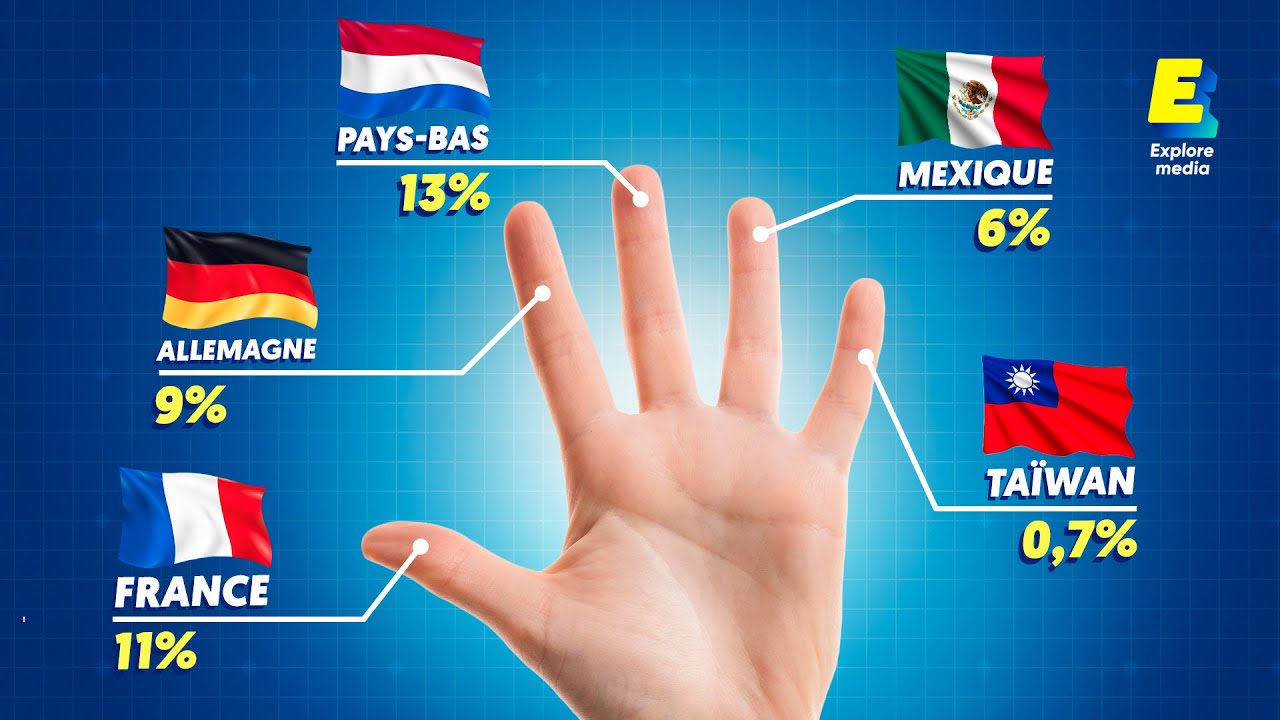
explains this heavy trend in history. In iconography, the Fruit forbidden is often held in the left hand by Eve, symbol par excellence of temptation and evil. Today it's estimated that between 13 and 15% of the world's population is left-handed and we often like to remember that some great minds are left-handed, such as Leonardo da Vinci, Paul Verlaine, Winston Churchill, Jimi Hendrix, Barack Obama, or even Sigmund Freud.
For some, being left-handed is a sign of genius, for others it's rather synonymous with exclusion and abnormality, and for still others -and there are more and more of them- considers that it's simply a difference, nothing more. Yet, left-handers have long been ostracized from society, which leads me to ask myself several questions. The most obvious: why this discrimination?
But the one that jumped out at me when I started working on this subject is: why are we more right-handed than left-handed in Western society? Let's go, today on History will tell us, the story of left-handed people. Subtitles: salvadorarmandoul@gmail.
com how do you become right-handed or even left-handed? The first answer is undoubtedly to be sought from the side of medicine. We'd not become left-handed, we'd be born left-handed.
Several reasons would explain this fact by evoking the position of the fetus or an overexposure to male hormones before birth. Sure, education matters and it's around 4 years-old that we can determine if a child is left-handed, right-handed or even ambidextrous. Medical advances have made it possible to know a little more today, but this has not always been the case.
For a long time, we didn't know why some were left-handed and others right-handed, but we noticed that right-handers were largely in the majority. So, we've sought to explain the right-handed preeminence in society and three major theories will dominate. The first by doctor Xavier Bichat, who at the end of the 18th century by observing combat techniques, made the link.
According to the latter, the prehistoric warriors would have realized that wounds inflicted on the left side, i. e. , the heart side, would have been more fatal than those on the right side.
In order to protect the heart, the shield have been placed on the left arm, leaving the right hand to handle weapons and thus develop a dexterity that would have reinforced the right hand's preeminence. Have you noticed the word dexterity, Latin derivative of Dextra, then meaning the right but also help, friendship, and gift. I could have used the word "adroit", but let's see again that the word is charged with a very positive meaning, for the right of course.
But back to Xavier Bichat, according to him the custom of using the right hand would be transmitted from generation to generation to become an invariant, at least in modern conceptions. The second theory is related to ancient cosmological myths. Several cults are related to the sun.
The sun rises in the east, so it's good and pleasant, while in the west, where it sets, it represented darkness and danger. During prayers, the faithful had the right hand towards the east and the left towards the west. Then come monotheistic religions which will take up the diagram, the so-called right- hand regions being bathed in divine light while those on the left are plunged into darkness.
Hildegarde Bingen in the 12th century summarized this idea well, and I quote her: "So God turned Adam's face towards the east when he awakened him and erected him. His right hand points to the shores of the south, those of bliss, his left hand to those outer darknesss that has a name: aquilon. Finally, the third great theory explained by anthropologist Robert Hertz at early 20th century, that ancient civilizations were built on the notion of polarity.
The idea is simple: the universe is divided into pairs of opposites. Day/Night, Male/Female, Water/Fire, Earth/Sky, Birth/Death, etc. .
. As he writes, and I quote: "society, the whole universe had a sacred, noble, precious side, and another profane and common; a male side, active, strong, and another female, weak, passive; or in two words, a right side and a left side. Beyond these different theories, we note above all that left is systematically devalued compared to the right.
The left is the worst hand, the one that's left aside, while the right is associated with the divine, defense and straightness. for Western world, the source of social constructions is often traced back to the Bible. We could add references from the Greco-Roman or even Germanic world which reserve an unenviable fate for the left hand.
For the Bible, we could cite St. Augustine who reveals that in the scriptures and I quote him: "the right is taken in good part or in good, in justice, and the left in bad part, in evil or in injustice". However, at certain times, especially in the Old Testament, the left is synonymous with liberation, as when Ehud rids the Israel's people rof theis enemies, Eglon, king of Moabites, with his left hand.
This being the interpretations made of the Scriptures will over time be mainly in favor of the positive value of the right hand, as St Jerome who affirms, and I quote him: "The right hand represents the first movements of the will and the sensitivity which tend to make us realize in action what we have conceived in thought. Bernard de Clairvaux, in the 12th century, expressed this clearly when he wrote, and I quote him: "Oh good Jesus! Be always on my right and never leave this hand: because I know that no adversity can harm me and no iniquity will dominate in me.
Even more, in the representations, care is taken to place Christ oat the right hand of Father and the outstretched hand is always the right, a symbol of blessing. The other side, the left, is therefore that of disfavor and perversity. Still in the Bible, a passage from the Gospel of St Matthew struck the men and women of the Middle Ages of the last speech delivered by Jesus, and I quote: "before him all the nation will be assembled, and they'll separate one from another, as the shepherd separates the sheep from the goats; and he'll place the sheep on his right and the goats on his left.
Then he'll say to those on his left: "go away from me, cursed ones, into eternal fire". James Hall on The Sinester Side. How left-right Symbolism shaped Western Art published in 2008 shows how this was staged in the Western art.
In art, the left hand becomes the image of the enemies of Christ, and by extension, of those who hurt him, as his judges or his executioners, such as Pilate, to take only an example. We also notice that Cain kills Abel with his left hand or even Dalila shaves Samson's hair with his left hand. The pictorial representations also induce a marked conception for the left hand.
Take the painting by Hubert van der Goes, The Original Sin, dated from the late 15th century. We see Adam and Eve in a divine paradise. Eve grabs the forbidden fruit with her left hand, further reinforcing the idea of evil that she represents.
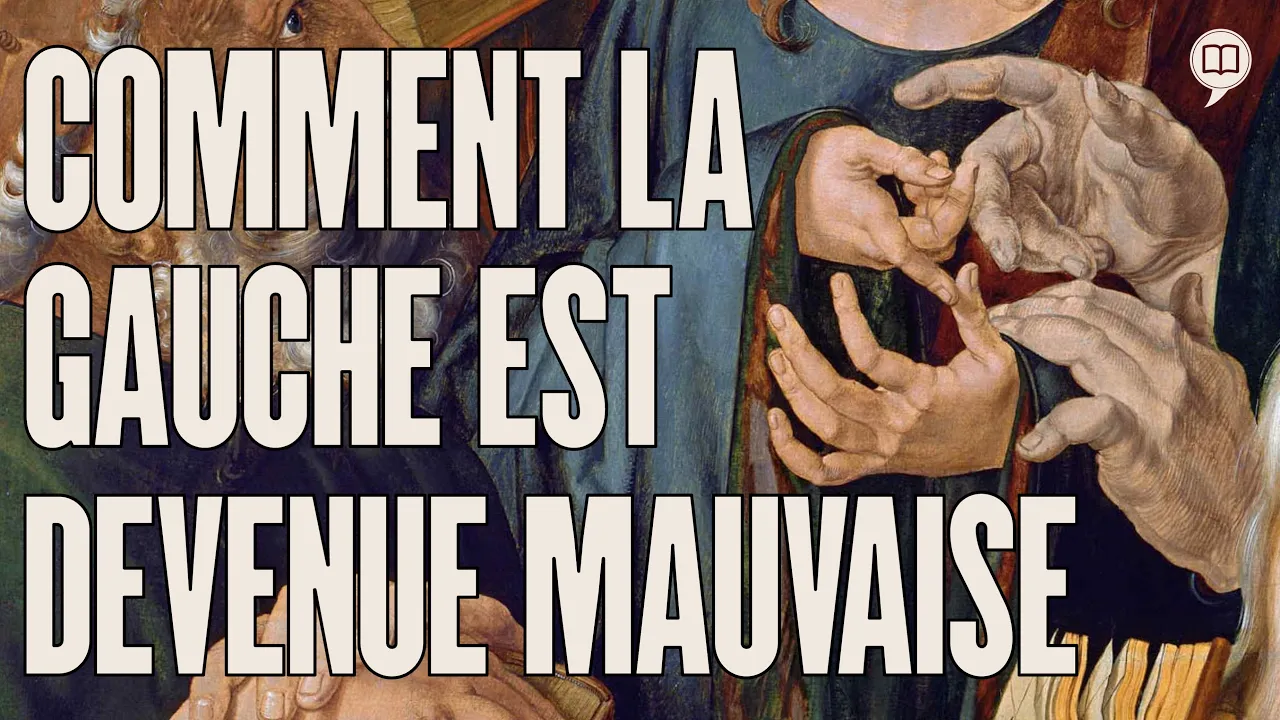
Consequence is then fatal: the human genre's fall. We also notice on the representations of the Last Supper, that Judas has over time become left-handed. However, at no time in the Scriptures is this mentioned, but in Western symbolism, he'll gradually become so, so Judas will become left-handed.
Yet, as historian Michel Pastoureau points out about the number of representations on left-handed people in medieval imagery, and I quote him: "if quantitatively the harvest remains meager. Qualitatively it's instructive: all left-handed people in medieval iconography are, in one way or another, evil characters. Among these a few examples: the butchers, guilty of touching blood, executioners, jugglers, moneychangers, and the prostitutes.
Another element about the Judas's representation: the traitor is sometimes represented on the Christ's left. The position of the latter indicating before the act is committed, the evil behavior of the character. This will be the case in Rubens's painting, but not in Leonardo da Vinci's one.
The left isn't systematically used. Why? Well, because the Middle Ages showed a certain form of tolerance towards left-handed people.
Be careful not to confuse tolerance with encouragement. All the evil symbolism around the left remains in the Middle Ages, however, there's not strictly speaking social repression. Despite a bad reputation, left-handers are tolerated.
Elsewhere, in the famous Bayeux Tapestry, dating from 11th century, we notice left-handers in different places. Historian Pierre- Michel Bertrand even speaks of medieval times as the golden age for left-handers. Archaeological research carried out in Yorkshire on skeletons dated between the 11th and 15th centuries has confirmed the proportion of left-handers resembles that which we have today, i.
e. , 16%, which implies that it wasn't coercive policy to "correct" them. That said, when and why things start to change?
In other words, why was there repression? The symbolism against left-handers being very strong, we're going to add techniques to frame it, thus normalizing daily use. The great transformation that occured at late medieval era and during modern era, from the 16th to the 18th century, was the deployment of a literature of civility.
In medieval times, there are some specific works, such as The Book of Manners. This literature which intends to set the limits of what's acceptable in the curial space, so in the court is after all limited and affects only a reduced number of individuals. During the Renaissance, and more precisely in Italy, curial standards were defined and extended more and more.
The courts of Florence, Milan, Rome, Venice of Ferrara enter into a competition that goes beyond the political and military deal. We see appearing a whole set of works whose function is to regulate behavior, determining which ones are expected and which are to be proscribed. Baldassare Castiglione, with his Il Libro del Cortegiano, then Erasmus with La civilité puérile, but also a whole group of authors, set new behaviors.
Prohibitions are more and more numerous, among them the left hand. On this subject Erasmus writes, and I quote: "Composing a dish as when pouring a drink, never use your left hand" All the negative representations on the left will be embodied here in the way of coding behaviors, but even more so to educate children, because several of these works are intended for their education. In the 17th century, Antoine de Courtin published a book called upon to set society standards, is the New Treaty of Civility which was practiced in France among honest people in 1670.
It was republished 15 times between 1670 and 1730. Another fundamental book, that of Jean-Baptiste de La Salle published in 1703 his Rules of decorum and Christian civility, divided into two parts for the use of Christian schools. This is the breviary that several Catholic schools will adopt during the 18th century, and even until the 20th century.
The left hand is taxed with all evils, it must be restricted. It's must favor the so-called honest ahnd and to turn away from the so-called dishonest ones. In these works, we also set guides for writing.
From the 16th century, literacy progressed and with it the way of writing well and holding the object well, which will make it possible to create the letters. While in the Middle Ages writing was less practiced in the popular categories, it spreads more widely in modern times. With the wider dissemination of civility treatises comes the standardization of right-hand writing.
Some masters simply don't conceive of writing with the left hand. Thus its tries to suppres its use. Here again, works appear such as that of Calviac, in 1560: Civile Honesty for children, with the way to learn to read, pronounced and write well.
Increasingly, the left hand is referred to as a bad hand, while the right hand is qualified as "good hand". Schools, those opened by Protestants, but also those of Catholics, especially Jesuits, will make the right hand the only one with which one can write. Gradually, we begin to contradict the left-handers so they fall into line.
That said, between the 16th and the 18th centuries we didn't yet witness massification of education, many peasants in the fields continued to work with their left hand, because not being subject to the normalization that takes place mainly in the city. However, in the 19th century, particularly with extension of education and the will to teach to read and write as many people as possible. we witnessed an increasingly marked phase of repression.
Education is then synonymous with right-hand hegemony. The era is one of national exaltation, glorification of behaviors that establish order and uniformity. In order to achieve this, we must standardize.
Even stronger, conservative ideology will channel the negative symbolism of the left to qualify its political opponents as dangerous. The notion of leftism is seen as a threat to the established order. By extension, left-handers must be confused.
The school institution is then seen as the most effective agent to fight against left-handedness. With compulsory schooling at late 19th century, comes the obligation to write with the right hand and here the most severe techniques are put in place, whether it's the violence of a blow of a stick on the "wrong hand" to reprobation in front all the others even going as far as objects to constrain the fingers and hold the pencil well, and sure, all that to write in accordance with the standards. The recovery methods are more numerous, and especially more severe!
Sometimes its goes from persuasion to incitement, then to deterrence, humiliation, guilt or even pure and simple brutality. Thus are born in spite of themselves, upset left-handers who sometimes continue despite everything to work with their left hand in secret. Let's not forget the ambidextrous either, who are sometimes difficult to isolate in the story, but who have a place of their own.
At the moment of strongest repression, we see the birth of a literature that attacks these bodily constraints. As early as 1880, the psychiatrist William Ireland wondered about the treatment reserved for left-handed children: "A left-handed child forced under threat to write with his right hand is in exactly the same situation as a right-handed would force to write with his left hand". More and more voices are being raised, as that of Georges M.
Gould at early 20th century who launched the slogan, and I quote: "Let the left-handed child alone! ", which mean: "Leave the left-handed child alone! " Gould like many others, tries to show that left-handers is in the order of nature, and it doesn't have to be corrected, but accepted.
Gradually we're lifting the bans on the left hand in schools. In Australia for example, while there were only 2% left-handers in 1880, we find the figure of 10% in the 1940s. We also note that with the World War I many soldiers returned from the war crippled, some having lost their hand or their right arm.
In order to facilitate their reintegration, they're taught to write with their left hand. We even see textbooks published on the subject. Psychologist Vera Kovarsky in the 1930s, embarked on a crusade to change negative perceptions about the left hand.
She writes, and I quote: "the world is made as much for left-handers as for right-handers". In 1949, she submitted to the Academy of Medicine a draft charter of fundamental rights for left-handers. However, it wasn't until the 1960s that mentalities changes.
The publication of many psychologists such as René Zazzo, Raoul Kourilsky, or Henri Hécaen paved the way for the liberalization and normalization of the use of the left hand in Western society. Today we could even say that there is a certain form of admiration for the left hand. It's not uncommon on the internet or in various magazines for people to remember that certain public figures are left-handed.
We contribute here to normalize the left hand, but also to explain some of their talents by this particularity. By the way, did you know that today the left-hander now has his day, August 13th! Today we can say that we're far from the negative view that has long prevailed, even if in our language we retain many expression that imply the left is less good than the right.
The past is sometimes a present that we can't get rid of. Ah yes. .
. Last example: Ned Flanders. .
. well yes, I couldn't mention his leftorium in The Simpsons series. Come on, that's over for today.
I hope you enjoyed it. If so, you know what to do: liking, commenting, sharing, you bring the video to life. You can go see the Patreon right here.
I'm Laurent Turcot from History will tell us and I'll see you next time. Let's go, bye!













![Comment s’est développée la plus grande entité politique slave du Moyen Âge ? [QdH#47]](https://img.youtube.com/vi/c1XvOe6LrRY/maxresdefault.jpg)