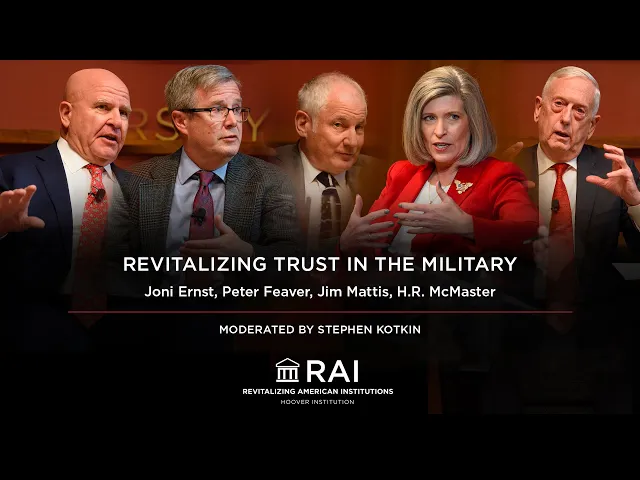
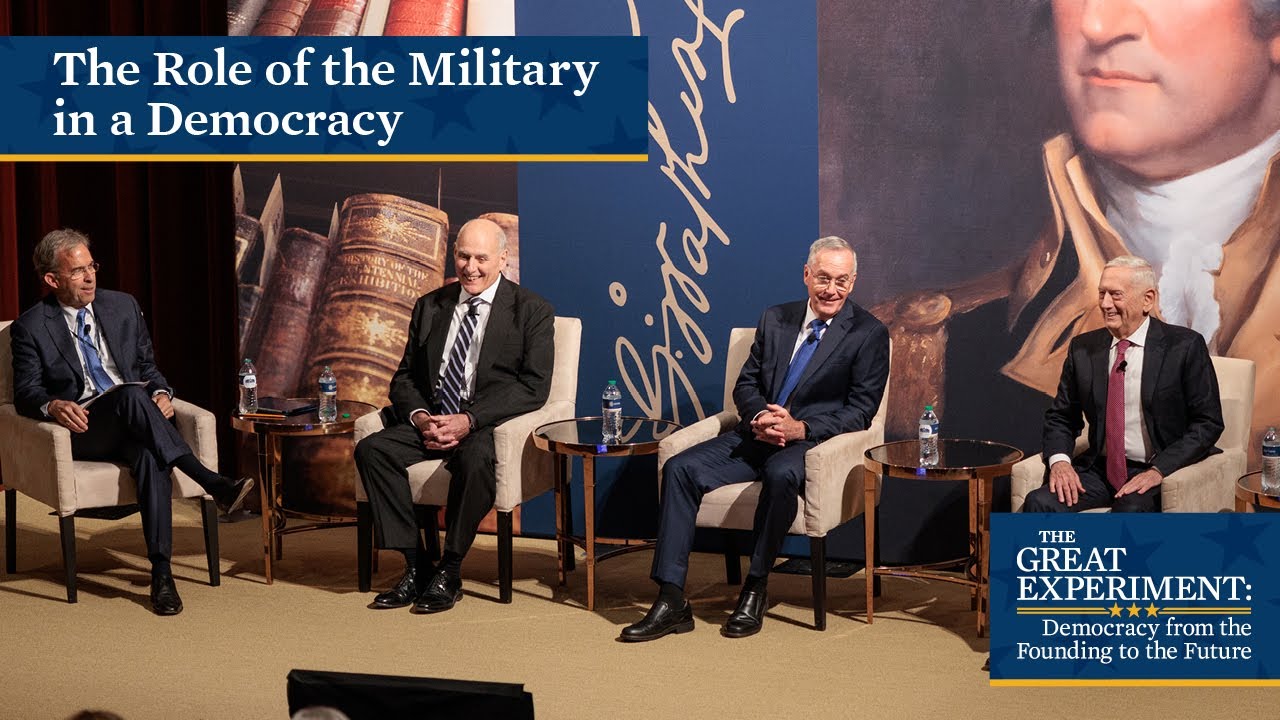
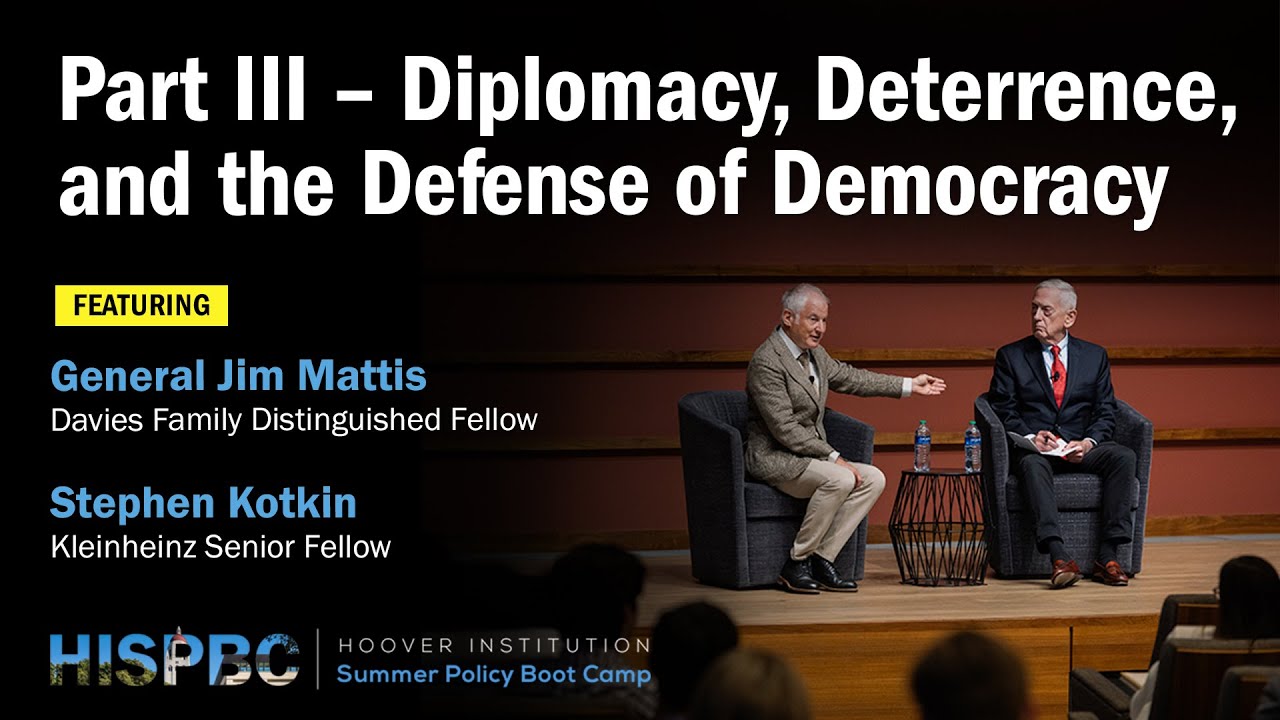
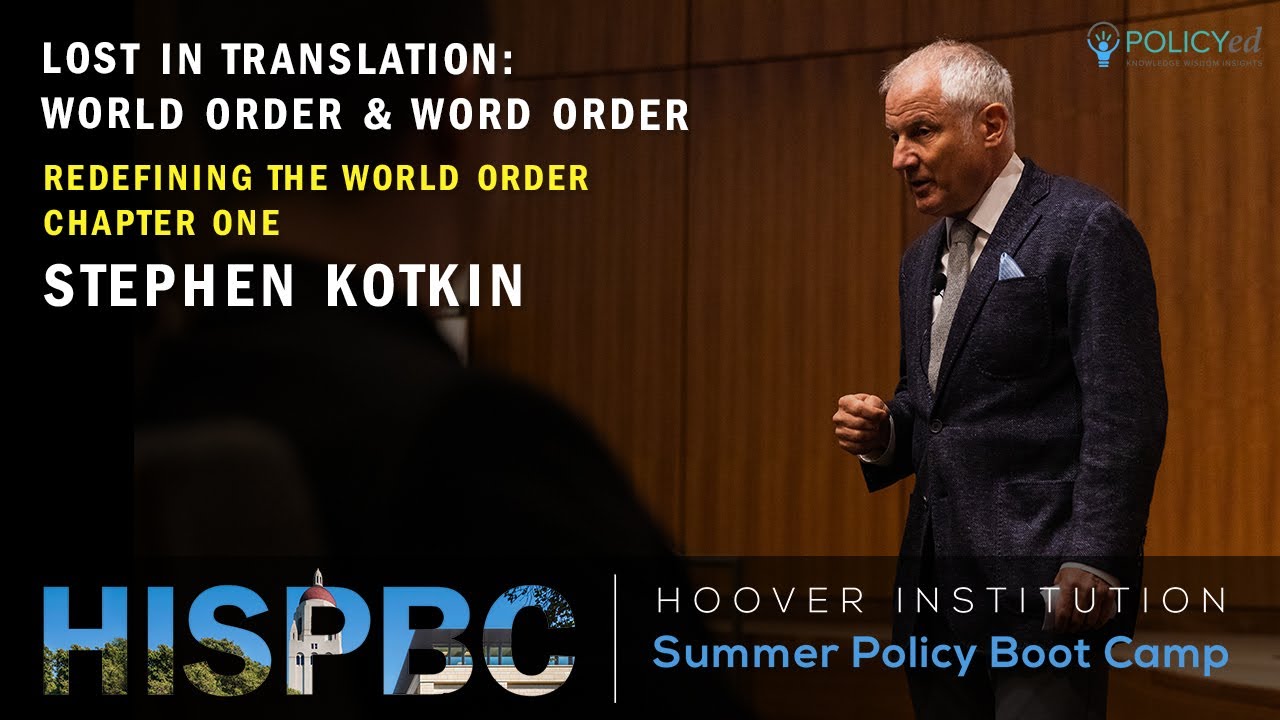
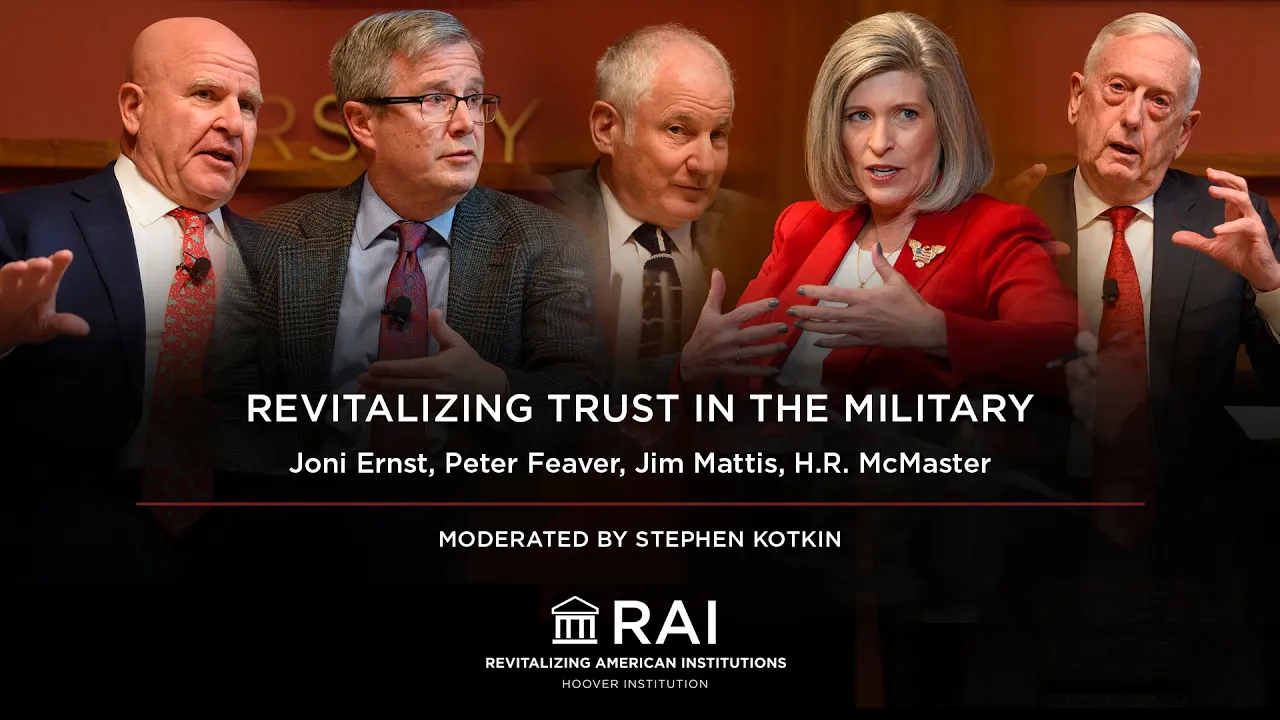
Ladies and gentlemen I'm Steven cotkin the Klein hind senior fellow at the Hoover institution and the director of the Hoover history lab our Center Director the revitalization of American institutions director Brandis kanes rone told me that there was a stellar panel on the military during the conference and I said to her oh I will not miss that for anything and she said correct you you're the Moderator and I said oh okay uh so this is obviously Invitation Only Our Thursday panel yesterday was a public event the panels today are Invitation Only um um in in
this uh day and a half conference the trust in the military is quite High by us institutional standards the June poll by Gallup had it at about 60% that number uh doesn't sound good except if you ask well what about Congress that's about 60 points higher Than Congress what about the president that's about 80 points higher than the presidency and I could go on the challenge however is that despite that high 60% trust in the military the direction is not good the trust has declined for several years running uh we're not at historic lows 60%
is by no means a rock bottom for those of you who live through the 1970s and Vietnam or who who were there for the um the failed hostage relief Effort uh in the Carter presidency you will know that that was our Rock bottom in the modern era in terms of trust in the military but still it's worrisome that this great institution uh is losing trust even though trust remains high so the challenge for us today is to talk about what we might do in regaining that trust rebuilding that trust rebuilding to the historic highs that
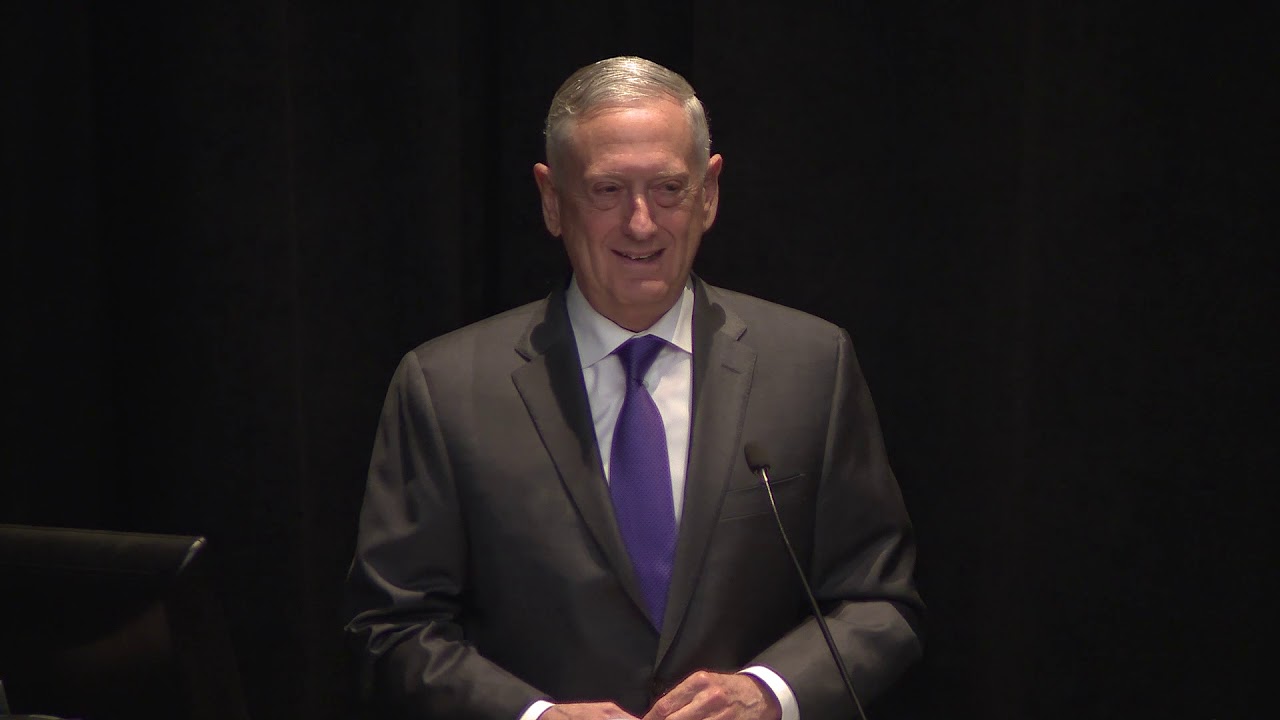
we've seen in the military and we have an extraordinarily distinguished panel Today our first speaker will be U secretary Mattis everyone knows secretary Mattis uh General Mattis a fourstar general served in the Marines um uh and became the Secretary of Defense in the Trump Administration you'll know also his book call sign chaos we'll now take a 15-second break for you to go on your phone Amazon to make sure that you have a copy uh coming to you Shortly and uh he's extraordinarily dedicated member of our Hoover Community speaking after him is the National Security advisor
uh HR McMaster HR retired also from the military Lieutenant General after 34 years in the officer Corps and a little bit longer as a rugby player uh was at at West Point uh the general has written Battlegrounds which is again 15 seconds now for you to make sure that that's page Turner Pig Turner we know that but we they they need to go on Amazon very quickly he's also the author of an important book the Vietnam War Der elction of Duty and we he's at work on a book I know because we're floor mates in
the tower on the 11th floor which we expect to see soon our third panelist will be the honorable Joanie an the senator from Iowa elected in 2015 and she chairs the Republican policy committee she's a member of the armed Services committee as well ranking member of the small business entrepreneurship committee and agriculture nutrition and Forestry uh the senator was in the RC program at Iowa State University and therefore has a very long relationship with the military she too served like uh our other panelists in Iraq and Kuwait she led a a company of national Guardsmen
Iowa National Guardsmen during operation Iraqi fredman and she retired as a lieutenant colonel in the Iowa Army National Guard after 23 years of service our fourth and final panelist is like me only better that is he's an academic uh Peter fever who's a professor of Duke and has had a very distinguished career six books he runs the grand Str American Grand strategy program at Duke and many other things his most recent book thanks for your Service is about precisely the question that we're speaking about today and so if you want to know his bio in
a single sentence he wrote the book I think also you should take this 15 seconds now while I'm blathering to pre pre-order no it's no it's out in fact not only is it out can we see it there you go so he's got his copy it's on you now to get your copy so we could go on with the introductions all the achieve achievements the the the Medals awards that everyone has won but instead we'll go right into the substance here the question for us as I suggested is what is the one thing you think
we should do of the many things we could do in reversing this trend and instead increasing trust in our military today as I said we'll start with uh secretary Mattis well thank you good to be here with all of you uh the one thing uh to quote the great Marine the senior Marine At Stanford for most of my years here Captain George Schultz uh coin to trust is the coin of the realm and I think what we have to look at is how do we maintain in the American people's minds that the US military is
truly subject to civilian control if we ever lose that then we're going to lose the whole thing and so I I would just point out starting out here that Governor cunu uh Governor Moore secretary rice last night made the point about institutions must stand the Test of time and if you look at the US military critical to the support and defense of our constitution protection of our freedoms uh let me start with an amazing statistic we have two and a half centuries it's a record of the US Military never being a threat to our Republic
now you may say well of course not and yet that's not the norm in most places and it was not necessarily how the founding father saw a standing Military I think there are three areas we have to look at won't surprise you that it's the military's role in restoring trust it's the president's role it's a legislator's role and on the military role I remember my first day in the military I had hair that was somewhat longer than the Senators uh for my first 40 seconds before I fell under the Tender Mercies of Marine drill instructors
sitting in the chair that disappeared and in those 40 seconds I Was looking at a wall in front of me of these Fierce looking crisply uniformed Prussian haircut sergeant majors captains Majors Lieutenant Colonels Colonels a general and then up above was a row of people in civilian clothes Secretary of the Navy Secretary of Defense president of the United States from my first moment in the Marine Corps through all the classes we actually get classes on civilian control of the military in the military as young Officer candidates as young lieutenants captains it even happens when you're
a colonel you get the class uh and I would just point out that i' I've been through a grand total of three years of University level education uh I've taken constitutional law I've been through history courses and other than hearing the word civilian control of the military I don't require any long discussion about it it's so much an accepted matter that we just Take it for granted I think frankly but the question here today is if we have 250 years almost of Civilian control of the military a little more than that if you count our
revolutionary wartime under the Revolutionary Army prior to the Constitution how do we build that build on that for the next 250 years in terms of the military's role I would just say that the lack of civics education today uh and the way we teach history in many parts of the country Which breeds no affection for This Magnificent experiment you and I call America the military needs to double down on the classes it holds it cannot assume that people coming in the military are imbued with a love of the Constitution a respect or knowledge as the
governor's pointed out yesterday uh if you can't don't know something you cannot defend that I think two retired Generals in particular Admirals uh need to go silent during elections the American people do not need Military Officers uh telling them how to vote or suggesting strongly how they vote uh General Bradley when he was chairman of the Joint Chiefs of Staff a beloved Army General said when Admirals and Generals retire their uniforms during elections they should retire their tongues and I agree with that 100% uh we have to recall that the founding fathers said the military
a standing military is necessary it's also A potential threat to the Republic and so I think if you look back at our Declaration of Independence I'm wearing the tie with all the signers names on it here uh if you look back at that they were military grievances that led us to that nasty argument with King George III you're quartering your troops in our houses without our permission you're giving them an independent role these military guys superior to the civilian Authority we don't like it so I think That uh the military is responsible for making certain
it teaches this that we do not become a threat in any way to the people the president's role I think the president himself has a responsibility and to make certain he never used the military to police the Republic we protect the Republic we do not police relas it uh and I think too that the line has been crossed president Trump handing out magga hats to uniform troops put on encouraging them to put Them on when he was visiting bases uh President Biden having uniform Marines standing on the stage during a political speech the president has
a responsibility not to do that sort of thing uh I would also point out we elect our commanderin-chief in this country and right now the all volunteer Air Force is in its biggest crisis in 50 years it is hundreds of thousands frankly short we keep changing the end strengths a little bit so it doesn't Look quite as bad but the US Army has missed its Mission and in some case had to lower its standards over the last 10 years the Navy has missed its Mission the Air Force has the Marines have not but that is
that is they take no refuge in saying we're good they say it's coming it's coming to the Marines the Army walks point for all of us on this sort of thing and so how many of you can recall the last time that President Obama president Trump or President Biden Said Uncle Sam needs you I can't recall once we leave to a sergeant down in Illinois or Iowa or wherever to go out and sell the military and that is not a way to keep trust with the American people the last point the legislator's oversight uh is
absolutely critical I'm I'm very reluctant to say much when we have one of the finest Senators here in terms of maintaining uh the legislature rightful role uh Senator and you don't get enough uh credit for it frankly but I would just point out that we are seeing in what Senator tuberville is doing right now probably I think it's for the first time in our history such a violation of the oversight role that it's going to take the Senate taking Special Steps more than likely to restore Integrity To That also on funding if you do not
fund that military it's hard for the military to maintain trust with the American people that we can do the job because we can Start selling you on some bill of goods that yes we can defend the country when in our heart of hearts we know we cannot do that and a Cavalier disregard for funding means we go to CRS and what that means to you when you hear the word CR continuing resolution you should no that means we're going to waste your money for this year that's what those words mean because we can't change anything
from last year can you imagine if your family had some lifechanging event you Were forced to spend the same amount on vacations restaurants and everything else right on through the year even if your medical bills have gone up or something that's what we're doing to the military that will break our trust with the American people when they see that level of uh of a lack of managerial Integrity uh very very important I think that that when the officers are sworn uh we have to give our word to the Senate that we will give our honest
opinion That when we give it we stay out of politics and we make certain that we're not punished for doing that the founding fathers recognized we had to have special rules they told the Congress you will make special rules for the military uh they recognize that the civilian imperatives of a democracy might be out of step with the military imperatives of a battlefield and yet sometimes we have people with no military back down trying to impose civilian imperatives that Actually endanger our young men and women on the battlefield that can not be allowed to go
on because when you're going into a family and telling them what is most beloved by them whe their son or their daughter is dead and when it starts being revealed that they weren't properly trained weren't properly equipped that will break trust but here's my key Point uh starting with George Washington at Newberg when he absolutely throttled his officers to Think they could confront the Continental Congress for breaking their word and they did break their word to the to these officers uh he th he said you will not do this we are on probation in front
of the whole world that our military will never do this and we remain on probation today he set the trajectory but as the great Dr Corey shaki uh the one of the brightest strategist uh in the western world today uh puts it the Congress and the President have have the right to be wrong objectively and strategically wrong that does not relieve the military from obedience to all lawful orders a final point I'll make on that I said lawful orders uh in the military it's not just illegal to carry out an unlawful order it is illegal
to give the order if somebody tells me to do something in the military and I know it's illegal if I give the order for someone else to do it even if they don't Do it I am now subject to the uniform code of military Justice that's Court Marshal so there is also a value in the institution to retain your trust that says they will not carry out illegal orders if they're given it and they cannot even give the order doesn't matter if it's carried out back over to you thank you secretary Jim really brilliantly setting
the table I like the fact how you hide really what you think straightforward and tell us uh we Parsed it out anyway somehow but brilliantly said the table for us uh General HR maybe you could build on that and your remarks please well first of all thanks for this amazing program here at Hoover and the opportunity to be on this panel with people I admire tremendously and I would just build on what Jim Mattis said in terms of the importance of the military the military's role in in preserving our professionalism our professional Military ethic civil
control of the military respect and the Covenant with the American people to say that our political leaders have that responsibility as well so the one thing I would say is for our political leaders to focus on what the military is for and preserve our Warrior ethos uh and to stop trying to politicize the military or distract the military that's a long one thing but they're all related to one another and I Think what we've what we have seen is a distraction in many ways of what about what the military is for I think if you
read our current secretaries priorities from each of the services you might wonder like what the army what is the Army for again is it for you know combatting climate change is it you know do we really need to change the culture in the military is is the military is the Army's culture the problem um in in connection with some of the maladies That we see across all the services but but I believe the culture is you know fundamentally hostile uh to you know to bigotry racism sexism and and uh and various forms of misconduct and
so I think there's this distraction about what the military is for I think that is one of the reasons why we see problems with recruiting but I think what we're seeing is the erosion of the warrior ethos associated with that Distraction but also associated with efforts to politicize the military and this goes kind of across the political Spectrum uh secretary Mattis mentioned a couple of the behaviors Associated uh with that but I think too often many of our politicians have tried to drag the military into the same sort of polarization we see in in our
society and I'll talk about you know three or four four ways that this is this is occurring but first I'd like to just Maybe talk about the warrior ethos what it is and why it's so important to preserve the war ethos is really a covenant it's a covenant and Jim has already alluded to this between the American Military and the people it's it is it is it is formed on on on trust and understanding of the military's role uh to protect our society and to protect our society based on the orders and directions from our
civilian authorities but it's also a cover Between Warriors between Warriors who are bound together by a sense of of common purpose mutual respect and a sense of honor and adherence to principles especially courage and willingness to self- sacrifice willingness to sacrifice for one another and willingness to sacrifice for those in whose name we fight and serve I believe that that ethos is under duress it's under duress because a lot of Americans don't understand the Military and the importance of of the ethos and they don't understand it because we get our information about the military less
and less from people who we know who serve and more and more from popular culture which tends to coarsen and cheapen the warrior ethos and I'm talking about movies and you know and and video games and and other elements of of popular culture so we don't know very much about why our Warriors serve why they're willing to sacrifice what is The nature of their calling and then compounding that I think are often very well-meaning organizations that portray our veterans as traumatized fragile human beings and create in in in in the minds of many of our
of of our of our people that service in the military is going to mess you up when in fact as we know even those who have experienced the most harrowing conditions of battle like secr Captain Schulz did for example uh in in World War II they emerge from that experience stronger and go on to make significant contributions to our society in in in other in other walks of of life so popular culture and the sense that our our veterans are traumatized fragile human beings the third I think is our political leadership's failure to commit to
winning in war and I think that this has an element of strategic incompetence associated with that and an inability to connect what we're doing militarily to The achievement of political aims that brought us into that war to begin with one of the thing that particularly irks me is that how even some of our general officer colleagues have taken up this phrase responsible end of a war right and I've said this before but you know I used to box you know at a much lower weight class by way you know but but but I but but
I I never got into a boxing ring and said I just want to bring this to a responsible end cuz you're going to Get your ass kicked right you're ask so so you know in in war each side tries to outdo the other right and we have to have a commitment to winning and our I think our political leadership should be as committed to winning as our servicemen and women and I think the true test of strategy is can that platoon leader explain to his or her platoon how the risk that they're taking in the
sacrifices they may make on a mission are contributing To an outcome worthy of those RIS and sacrifices and here I think there's a direct correlation between the humiliating surrender and withdraw from Afghanistan and the reduction in our recruiting numbers the third and the other aspect of this of this I think disappointment and and uh and maybe dragging the military into to politics is how current political appointees in this Administration in particular are pushing reified Philosophies associated with postcolonial postmodernist critical theories that are trying to teach our service men and women that you shouldn't judge the
Marine next to you based on their courage their toughness their commitment to the mission each other you should judge them by their identity category and there is nothing that is more destructive to unit cohesion and combat Effectiveness than that and so I think we we do have to certainly within Our military preserve our professional military ethic and award ethos but I think it's really important at at this time for us to lay that expectation on our politicians stop trying to politicize the military there's a narrative that feeds on each other across the political Spectrum right
what do you hear what do you hear in some on maybe the far right or whatever it is you know the military is woke on the farle year the military is extremist hey Our military is not woke it's not extremist and when you put those narratives out there it shouldn't be a surprise that the Army has 10% fewer white males volunteering for service that's the demographic that matters right here nobody's talking about it nobody's talking about that but it's that politicization of the military that has affected a demographic in our country in a way that
they don't see the rewards of service that await them uh if They enlist or seek a commission in our Armed Forces thank you so much for that General um Senator Ernst how does it look to you how can we build on those first two count I I could make this easy and just say ditto because I I agree completely uh with what's being s h said already um I'll add just a little bit more but it does keep in in theme with what HR and Jim have already said um and I'll start With and build
upon the wokeness in the military issue and the the original question is why does does uh the public not trust our military as much as they used to and we have seen a significant drop uh the wokeness now you hear that a lot but I have been pushing back on this because that is coming from people not in the military it's coming from Outsiders that are looking in and describing the military as woke not by actions coming from the men and women That are actually wearing the uniform but by political appointees those civilians that are
in charge of the military so I'll I'll use an example um you mentioned climate change um as one of the goals for our military to combat um I'm sorry when I served that was not a goal that I I was working towards I always thought our military was to be the most lethal fighting force on the face of the planet um I think that's why we were uh put into being but one of the Uh goals in this Administration has been to uh completely transition all non-tactical vehicles in the military's Fleet to Electric okay um
that great goal and to do that in the next few years and I'm not going to knock you if you want to drive an electric vehicle that's great but I can tell you you're not driving through a combat zone okay so and again this was the non-tactical vehicle Fleet but the goal Was to build and continue with the non-tactical vehicle Fleet to Electrify the entire force so I was a transportation company Commander so I led those convoys that were driving up into Iraq and I can never in a million years imagine 60 of my vehicles
Towing cargo up into Iraq desperately looking for a charging station okay no no way no how the technology has a long way to go before I would ever entrust my men and women in Electric electrified vehicles in a combat zone um so that that is a goal right now not to make sure that we have the best technology available to keep our men and women safe but to appease those that might be on the fringes of various ideologies okay again we need to be a lethal fighting force that's why the American public looks at our
military and says wow they are woke but those are decisions not being made by the men and Women in uniform those are the decisions being made by civilian leadership um I think we do have to be careful when we talk about wokeism in the military and redirect our comments to the fact that maybe the civilian leaders don't fully understand why we have a military you know they they maybe don't like the idea of engaging in War and what was that end what was that phrase a responsible end a responsible end okay no um that's that's
not the way I see the military um especially when it comes in defense of our our own nation and our people I wouldn't be asking for a responsible end to protect the people that I know and love and represent here in the United States of America it would be a con conclusive um finish okay uh to protect the people of the United States that's that's what we have to have but I would encourage everyone as we're talking About wokeism in the military not to phrase it like that please um I served in uniform my daughter
now serves in uniform uniform uh she is on active duty uh and I encourage that and I'm glad that she does um but I don't like it when when people from the outside will point the finger and say you're a woke military I can tell you my daughter's not woke she has a hardworking uh young Soldier she loves what she does and she's committed to our great United States of America um so I think that that is one issue is too often we throw terms around casually and eventually it does hurt the public trust in
that institution so I would just caution us on that um the leadership is very important the civilian leadership um you must uh lead by example and that needs to occur in the military as well and I think too often today our moms and dads and just general public out there when they look At leadership they don't see the type of leadership that they feel will actually lead and do good for our nation uh in the Army the and I'll paraphrase but the definition of leadership or a leader is someone who will inspire others towards a
common goal or objective for the good of the unit or the organization Inspire and when our public looks at military leaders who have become political when they look at political Leadership that they don't feel has the military's best interests at heart they're they're not inspiring and trust is lost so I think wokeism I think leadership um and I do think and HR I'm glad you brought this up because this is something I was going to comment on as well is that too often the public sees the quote unquote endless Wars that we have engaged in
and I'll I'll mention the global war on terrorism in Particular that has left a number of our military men and women um with injuries that they will have the rest of their lives so whether they've lost a limb maybe they've suffered from traumatic brain injury those are things they'll live with a long time and when we don't take care of our veterans um and that's on Congress okay when we don't take care of our veterans um why would the public trust the military if we're not going to be doing right by the very ones we
put Into Harm's Way so I think there are so many things that we need to work on and it's not just Congress but it's the the nation as a whole on how we address these issues uh but you know I would just leave you with this that we've got incredible men and women that serve in uniform you know they're not extremists they're not woke they are just Americans that love our country so much that they chose to stand up and raise their right hand um so I am I'm thankful for Everyone that chooses to serve
um to Peter I know I haven't read your book yet I'm looking forward to it I can help you with that yes and I and I know where to go on Amazon to get it but um you know when when we say thanks for service uh or thanks for your service one one thing that I like to do um when people say it to me is just to turn it back on them and say you're worth it that also is part of the equation is that we need to educate people on the fact that we
do Live in the greatest nation on the face of the planet our country is worth it and our men and women in uniform need to understand it um and I think by all working together then we'll develop greater trust in our military and the institution thank you Senator very well said Professor Peter you you've Decades of research you served in the National Security Council how does it look to you what's the way forward for US based upon your thank you and I want to begin with Some thanks I want to begin by thanking Duke Medical
School for teaching Senator Rand Paul the Heim yes which uh allows me to do this to give you this so thank you I I also want to thank uh you may donate to him at any time I also want to thank um a Hoover stalwart Bob AER who uh invested in the research made the research possible that's in that book that's amazing I'll just point out for the academics in the room that he he gave a very generous Gift in December uh and in March he emailed me and said how's the book coming so I'm
afraid it took me several years before I had a good answer for that that email but um I do encourage you to look at it it's a great gag gift as if you get it as an audio book cuz it has 160 tables and figures and the poor guy reading the Audi book has to read each one of those table so um it's it's worth it the the bottom line about the book is That public confidence is high but Hollow that is it's high relative to the other institutions as we know from what Steve said
and we've heard earlier this morning but it's Hollow because the drivers of it are likely to go down rather than up it it's driven up when you're at War there's a rally to the flag we're not at a traditional war frame now it's driven by close connections to the to the military but as HR mentioned those connections are Are are dwindling so we no longer have the greatest Generation the World War II generation where everybody had somebody in their family that served we're seeing a passing of The graft era and Vietnam Generations where many many
americ Americans did and increasingly we recruit into the new all volunteer Force Children of the old volunteer Force so that's a smaller and smaller dwindling uh um fraction of the American people have a connection and there's a a Great book that uh secretary Mattis and Corey shaki wrote uh a couple years ago that addressed this Gap question in some detail this is this is going to drive down public confidence in the military just inexorably because of these factors it's Hollow also because it's propped up by social desirability bias it turns out people say they have
confidence in the military because in part some people because that's what they believe is the correct answer to give and when you use Survey techniques that are meant to tap into latent attitudes that uh confidence their actual confidence drops 8 to 27 points so there's a hollow there that suggests that different moves if the permission space changes then you could see a dramatic drop and I would point to a changed permission space as of mid September 2020 which I think uh secretary Mattis will remember because this is a moment when the uh president of the
United States and the leading Republican candidate I mean the the Republican candidate for president and commander-in-chief attacked by name some senior military who had served in his administration and argued that the military uh senior generals wanted to go to war because they wanted to sell arms Etc you and that created a permission space for Republicans to look at the military differently then that got echoed in the woke military critique That you mentioned Tucker Carlson other prominent Republican opinion leaders messaging a very different message about the military that allows for that social design desability buas to
be popped and I think much of the drop in the last several years can be explained just with re respect to that so high but Hollow and and of course it is as HR said threatened by the politicization of the military and that's a a big concern I have one more thing to say about that at The end we should care about this so this is my second point we should care about public confidence in the military because it correlates with other things we care about it it does make recruiting harder when public confidence go
go down that's fewer people recommending to others to serve in the military so people with higher confidence recommend to others to serve and the recruiter's job which is already extremely difficult because of the labor market is that much More difficult when public confidence goes down and it's also correlated with high willingness to spend more on defense so providing the resources that the the military needs it's not an unal adulterated good so High public confidence can lead to pedestalize military on a pedestal and saying you are better than the rest of society that's why I love
your response to thanks for your service you're worth It it's a reminder to the military not to look down from the pedestal on the American Society and also it's a warning to the American people don't put them on a pedestal that you will then knock off and ignore calization can lead to alienation in either direction so what I call for is not lower confidence in the military but rather deservingness of high confidence by doing some of the measures that secretary Mattis and uh General McMaster and Senator Ern Suggested and then propping up public confidence in
the other institutions that for them to deserve higher confidence too that's the solution not driving down the military and knocking him down a peg what are the things the rest of us can do well I have one Modest Proposal here and it's a version of what HR suggested I want us to cultivate the norm that gives the uniformed military non-combatant immunity in the culture wars that is they are non-combatants in The culture wars the the hold you mentioned with Senator tuberville there's a legitimate policy dispute at the root of that I think uh it's reasonable
for uh pro-life uh caucus to be concerned about the policy Choice made by uh secretary Austin and I think secretary Austin had the authority probably and under the olc's ruling did have the authority to make the choice that's a policy fight has a culture War element that fight should be made by Civilians yes the military should have non-combatant immunity so that requires one party to stop targeting the military it requires another party to stop hiding behind the military stop asking the military to carry the water for issues that are uh controversial but if you could
get a military panach around a uniform wrap it in a uniform it's a little easier to sell uh and crucially it requires the military to talk about their values in ways that do not make Them sound like culture Warriors and this is hard because the mil the culture War language industry moves at warp speed there might even be a Moors law about uh it that is operating and the military training moves at the speed of glaciers and so you train up senior military leaders on the proper language that was acceptable a couple years ago that
language might be triggering today so the military needs to recruit across all walks of life in America we have to Recruit from all corners and we need to bring them together and Forge a cohesive fighting force that is Mission focused what I just describe I think everybody in the room would agree with that that's what some people mean and that's what some senior military mean when they say diversity Equity inclusion but if you use that phrase today it signals it triggers a totally different understanding and so you have to talk about your values if you're
military Without sounding like culture wars stop targeting stop hiding stop sounding like a cultural Warrior finally just to reinforce what secretary Mattis said uh about the importance of the public understanding civilian control the public does not understand what is meant by civilian control does and does not understand how precious is that it's a very dispiriting finding that's reproduced by me and many others who do this work that the public does not know What good civil military Norms looks like and they're not asking and holding the military accountable and holding political leaders accountable to the proper
Norms we need to improve Civics education and and secretary Mattis has made a contribution here he all and and all but one of the retired secretaries of defense and then allba one of the retired chairman of the Joint Chiefs of Staff wrote an open letter uh published in September of 22 that says here are the fundamental principles of Civilian control this is the grading rubric apply it to our record apply it to the current team then the current team would be Million Austin and let's have every future uh General and flag officer be held accountable
to this understanding of Civilian control this is what it means not what you're hearing on cable TV and I think if we push those kinds of forms of civic education I think we can Chip away at this and I'll stop there thank you so much we're going to come back to the panel going to want to comment on each other's comments I just want to get the room involved as much as POS this is the Hoover institution so we have active military members here in our audience we have veterans in our audience we have not
only generals up here on the podium uh on the Das but we also have Admirals in the audience I'm going to take this opportunity to turn To one of our Admirals yes the Marines are technically Navy but let's be honest never they'll never admit it let's really be honest about that uh Senator we're the men's department that's I want to bring the Navy in if I could uh uh Admiral James Ellis Jr thanks to this wonderful panel I I certainly you know is probably the guy who's been out of uniform the longest want to associate
myself with the remarks that I've heard so far and and And first amongst them is the point that secretary Mattis made is that the military needs to uh to conduct itself that it deserving of the trust that it receives from the nation that's absolutely essential and I would argue that it is deserving of that I mean it's got challenges and we've talked about them on the recruiting side but it is the most combat experienced military in the world it's the most combat experienced military this nation has Ever had and in terms of capacities to deter
aggression on the part of others uh we need to continue to expand on on that and give them the materials that they that they need but I I would also agree with Senator erns that and and Peter fever that you know this politicization has gotten out of hand I mean uh it's you see Senior officers being uh in in exercising the accountability that secretary Mattis described in civilian Accountability or oversight of the military uh that you see military leaders being pressed with questions that are carefully uh constructed so as to force uh one of those
when did you stop beating your wife kinds of answers that that put the the leaders in in a meu where they're quite frankly they're not experienced and they're not comfortable and uh you know I always remember that uh George Washington uh once said that uh you know uh it's Better to be alone than to be in bad company but unfortunately our military leaders don't have that option they have to appear in front of of Congress and the like and U and and they don't have the option somebody once said misery loves company and of course
with the congress with apologies to to Senator Ernst hovering it 8% approval rating in that poll that uh that Peter fever quoted uh misery loves company and the and the senior military doesn't have the Opportunity of declining the invitation uh in a sense so you you've got to go and they need to be more skilled as the senator has so powerfully said in in in navigating those uh those conversations but uh you know I also think that at the uh at the end of the day these things will go full circle and uh we don't
want the us or the American people to be challenged particularly in our leadership role that so important in the uh uh in the International Community but I'm reminded of that last verse from the from the the Kipling poem Tommy where it's Tommy this and Tommy that and throw him out the brute but he's savior of his country when the guns begin to shoot and so we've we don't want that to be the restorative force uh we need to find a way to to move back to a to a dialogue that extricates the military from the
inappropriate political conversations that they're increasingly being dragged into and I think that's an important Dimension of the conversation thank you thank you so much Admiral we have a very distinguished Professor here who likes to say that if nobody raises their hand she'll call on them but she just saved me from that by raising her hand Professor rice can we pass the mic up here uh Tom well thank you for a really wonderful panel and uh I especially want to thank Senator Ernst uh for being here and Peter for coming across the country Uh can you
speak to the role of the militarys and where we are now with the militarys uh that is a place that there has been a lot of concern about what is taught in the militarys uh what is expected of uh the military academy so um can pick any of them you can pick West Point Annapolis or uh the Air Force Academy but just what do you think is happening there yes and thank you for that secretary uh the concern that I have again is that we are projecting Thoughts from the outside into organizations and we have
heard many times over the last couple of years that the military is woke their teaching W classes at theems and so my daughter did graduate from West Point and so I often when I heard of these classes being taught at West Point I asked her I like okay Libby tell me about these classes that are being taught at West Point she's like I've never been to any of those classes So I think there's a lot of misinformation that gets pushed out there or it could be maybe they have a sharp day which is sexual harassment
um training uh how to report it things like so maybe they're going through a class on sexual assault sexual harassment um and somebody somewhere might view that as woke classes that they're forced to go to um so I think again it comes down to terminology and how we're phrasing it and actually Knowing before we start challenging these institutions really knowing and understanding what is it that you are doing um and teaching our young men and women um but again going back to the the overall issue of of the military and how we carelessly toss around
a woke military I I will share with you and I and I hate this I sat down a week and a half ago to go through the academy packets that come forward as Senators uh and congressmen we nominate we have so Many nominations we can give uh to students in our state for theem the service the Naval Academy uh the Air Force Academy and uh the military academy at West Point I normally have between 60 and 90 applications every year mind you Iowa is a very sparsely populated state but 60 to 90 that's kind of
typical this year 33 wow 33 application these are some of the finest four-year Institutions that we have in in the United States and it's concerning to me and if we continue on this path especially for these incredible ummies we continue I I don't know what we're going to do but it's it really is a signal to me that we have got to do better we have got to figure this out I'm glad we're having this discussion today we're going to continue this Discussion at the ra Regan National Defense Forum we've got to figure this out
because we have incredible young men and women that want to serve but maybe are being discouraged into not serving and so um collectively we need we need as a United States to figure this out General HR I know you've recently been re-engaging uh with with West Point where your alada give us some insight on what you saw I mean just to tout my bipartisan credentials I got fired by Two presidents president Trump and then President Biden fired me from the board of of visitors at West Point uh as he got rid of all Trump uh
appointees which I think was a mistake Trump didn't do that to Obama uh appointees for for example so uh just a small insignificant example but you I could be a great voice for West Point being on the inside with the board of VIs and and saying hey it's not happening but I am concerned again about civilian Leadership trying to push it on the Academy I think some of the problem has been with guest lecturers who are brought in who are proponents of various critical theories or you know to be anti-racist you have to be racist
I mean the Ibrahim Ki kind of arguments and and I think that you know while we our students ought to be aware of that and universities are an opportunity to expose people to a whole broad range of views I don't think that's the kind of You know philosophy that that our military should endorse for example I recently saw an advertisement uh for professors of History written by a civilian professor of history at the history department and what concerned me the most was not how they were seeking professors who had done their research in very narrow
areas of minority studies that you know that are important but of course how about an American historian who can talk about the black experience In in America and and and and the evolution From Slavery to to the present rather than someone who is a specialist in one particular area I mean I didn't really care about that as much as the description of West Point as a small Elite liberal arts college with about 4,000 students and I thought who the hell in the right mind would write that description you know and so so I I I
just think I think that again uh I have tremendous faith in the super inant at West Point the dean at West Point was one of my old lieutenants I'm telling you the academy is in great shape overall just it's important just to recognize there are these kind of pressures right to to drag it into as Peter said give them immunity man I mean give them immunity from it protect them from it the cadetes I know and I I'm kind of Mentor a little bit the rugby team there West Point who lost to Navy in in
extra time uh Navy's got an Amazing team I think I think Navy's gon to win the national championship again this year and I root for N I root for Navy all but one time you know in the year when they play army and Go Army Beat Navy this weekend football so but the but the uh but but the uh you know I I think that uh the word ethos is Alive and Well there um I just wrote the forward to a really neat book uh called called Brothers which is about uh the class of 2002
rugby team at West Point and and how that team went on to to serve and to make sacrifices uh uh after after the attacks of 911 and and uh and you can't help read that book but just think how fortunate we are to have young men and women who volunteer to serve our country and and so I feel really good about it Stephen and and and Madam Secretary you know I I I I I think that we're in good shape but those pressures do exist uh and we have to help I think help theem In
a positive way right help them get Grant be granted immunity from this can I add a word yes it would be wrong for the military academy to teach critical race Theory and thankfully they do not but it's not necessarily wrong for them to teach about critical race theory in and when my Republican uh fellow Republicans ask me about that I say one reason they have to do it is because they're asked by you in Congressional hearings about critical race Theory and The senior generals will come to me and say what the hell is that I
don't know what that is they may have to be briefed on what this thing is because it is in the political ferment and so there was one course an advanced American politics course at the military academy that taught one week the key readings of critical race Theory and the second week the key readings critiquing critical race theory for advanced students in American politics that's a reasonable I Think exposure you know I study this military uh secretary rice can identify with this since she's specialist in this area there was a Marxist military and they spent all
their time teaching Marxism yes to them they didn't really teach them how to shoot they didn't put them into physical fitness stuff but they were Haring them about Marxism classes at kulok bisi imperialism you know all the stuff that they teach here In the humanities at Stanford and uh then there was a war scare there was a war scare and and this document came in which was commissioned by the guy in charge and he commissioned the document about readiness and Etc and the document was done by the secret police on the military uh and it
was not a positive evaluation of their Readiness should Great Britain attack as the war scare Indicated might be a possibility and so what did he do this guy who's known to be a bit on the brutal side and and not really um a humanitarian uh he decided he was going to increase their military training he was going to cut some of the political commissars out of the loop reinforce discipline make sure the officer core new military Doctrine and so the guy who was in charge of marxist ideology globally his name was Joseph Stalin he Had
a panic over the lack of preparedness over his military in the late 1920s and he launched both on the industrial side and on the training side uh lethality a real military combat and ability to fight and when I first saw that document I said you know what we need that document now we need that same process to happen you know secretary madis you know this well that was your allal sign in in in many ways in terms of the policies that you try to Implement right get and so the purpose of the military is really
what we're talking about right why do we have we have a military so that we don't have to use it but if we do have to use it it better be good it better be able to do it social engineering doesn't help that much when the shooting starts and of if if if the guy that I'm talking about could figure that out well I think we can figure that puppy out too let's get two questions from the Audience here yes uh uh let's take them uh sequentially wait for the microphone I was wondering if you
could comment on the use of private contractors in the military and hr2 specifically after your discussion of the warrior ethos whether or not the use of private contractors has any effect or roads or uh that Warrior ethos private contractors next please right over Here Senator erns it's really exciting to have you on the panel and I I want to ask specifically to you because you served in the National Guard what role the National Guard and to some extent the res reserves play in this trust dynamic between the US Military and the US public especially since
they are your citizen Airmen your citizen Warriors you bet thank you okay so we got the private contractors we got the National Guard we got potentially one more and that would Be it before we go to the panel for a final word I see hey that was the awesome Jackie Schneider by the way who's a phenomenal scholar and also an Air Force officer all right thank you so just so you know her background we got many other people I know want to ask questions but but let's uh let's begin with Senator Ernst on the National
Guard and then let's come back down murderers roow here yeah AB absolutely And thank you and I served in both the Army Reserves and the Iowa Army National Guard retiring out of the Iowa Army National Guard and I think and I haven't seen the specific polling and and maybe Peter would know different but U because we have National Guardsmen and reservist out in our communities more so and and Iowa is a little different because Iowa is the only state in the United States that does not have either an active duty military installation or Coast Guard
Station we are the only state so our communities however are filled with Incredible National Guardsmen and in my own experience I served and commanded the same company that my father had served in as a sergeant mechanic um way back in the day uh I served with a solder that Enlisted the same the same month that my father enlisted in that unit um he actually this older gentleman actually deployed with us but had to retire when he got Got back we had cousins uh that served in my command I had a husband wife team that served
overseas in my command I had twin brothers that served in my so you get the the picture this is rural Iowa and because there are Guardsmen that come from the rural areas they serve together they're out in their communities they participate in parades they're doing open houses at the local armories um they're pitching in when there's a veterans funeral people see Them they are their neighbors um they are their friends and the trust and confidence I feel in our Reserve service and National Guardsmen at least in Iowa are pretty darn high it's pretty darn High
uh right now and I went back and specifically talked to our Iowa National Guard recruiters both air guard and Army guard and what we have found with the National Guard right now is that the highest numbers of recruiting are coming from the rural Areas there is a much higher level of patriotism in our rural areas and those are their words the patriotism in the rural areas is is higher than what they're finding from young men and women in the more Metro areas and we don't have many Metro areas in Iowa but they're large in part
pulling their numbers out of the rural areas um they are also finding great significance uh great greater numbers of recruiting coming from green card holders in Iowa and what you find um common theme there is that uh the the patriotism in the rural areas very high they want to serve their Nation their state and they see that they are valued in these in these units and by their communities their mission is a little different than active duty they're there to protect the local populations from natural disasters and otherwise um but with the green card holders
they want to be Americans And by serving in the military that's a fast track for them to become citizens and so they want to be citizens they want to serve and earn their citizenship um so I think the confidence in those men and women that put on the the uniform once a month you know for a weekend it's really really high at least from from where I sit it's really high and it's very much a appreciated thank you let's take General HR on the private contractors and then a final word from Professor Peter and secretary
Jim okay great hey David thanks for that question you know I I think that you're raising a really important point I think private contractors are NE necessity now but they ought to have roles that are narrowly circumscribed circumscribed to maybe Logistics or you know uh or you know I mean laundry bath uh facilities you know the kind of logistics facilities you need that you can really uh you can can use soldiers for for Other important tasks or for uh for those tasks in an expeditionary environment you know uh but then but then also they should
never be put on offensive operations and I would say that would include even security details for military personnel for example I'll just tell you one quick anecdote uh in and we we went to to the town of halah which is a a mixed uh Place between Sunni and Shia populations very contested area with you know a great Chief of police there who was ultimately killed uh by by uh sh militias uh uh under the you know the influence and control of the the Iranians and when I when I went to see him we were moving
through a crowd and it was a private security company detail that came with me because I was just a member of the staff then and they were pushing Iraqis out of the way and screaming and yelling at them and had you know had you know sunglasses on and and and I I I yelled For him to stop you know and I pulled him in I said you're not you're not not going to behave this way you know uh toward irais and they said well you're you're with me and like you know they acted like that
it wasn't my call and I said I'm leaving right now you know if if you continue this they said they had to project intimidation you know and these are these are you know people who maybe washed out of the service earlier you know and have Great War stories to Tell Uncle Bob at the barbecue you know but they they weren't soldiers in my view no right and and and and they were having a mission impact so I think some of them you know a perimeter guard right gate guards that that's that's that's worthwhile to employ
them but there's there are certain roles that they're completely inappropriate to employ them on and especially uh those that that where you expect soldiers Marines uh you know Sailors and Airmen to behave in a Way that's consistent with our Warrior ethos while they're in dangerous environments I think uh private security companies just can't they can't do that and and then I think that applies to Aid as well you know a lot of times we we we run Aid by just Contracting out to you know to service providers right and and uh and and often times
they don't operate as if they understand the competitions that are going political competitions in this case within for Example government Ministries and institutions we get we are too reliant on the quick easy contract button and then there are silly things can I say something really silly you know about this in in Afghanistan because these stupid troop caps that we had for so long we had situations where a US Army Aviation Brigade the secretary knows as well would deploy to Afghanistan leave its mechanics behind with no aircraft hire really expensive maintenance uh Services for that Aviation
Brigade while the skills of those Aviation mechanics are atrophying back at Fort Campell Kentucky right so so so I think that there are a lot of silly policies that are put in place at times that encourage the use of contractors uh in a way that is actually detrimental to the mission and detrimental to Readiness yeah Catch 22 wasn't written for nothing we're we're going to have Professor Peter and then we'll close out with secretary Jim I would just say that the American public knows in theory about the differences between the services between the guard active
and Reserve uh and between active and retired in theory but they're actually not very good at discerning who is who and who's what they don't know that the Navy is the finest service for instance and they don't know that the Norms that govern active duty don't apply to retired and that's why it's so Dangerous uh when we use the military in ways whether they're uh deployed in the Homeland to uh to suppress civil uh disorder that will look like it's the military doing that whichever group in uniform is doing it and that's why his name
is General first name is general for the rest of his life yours is secretary no I'm trying but secretary but General so what general McMaster says in retirement gets folded in the American Mind as that's what the military is saying and that means that the military has to be much more careful about his public um profile and I'll close that secret secretary Mattis yeah but uh Steven did introduce me as general people call me General once you're a general you can't S turn the hand of time back and say I'm not one you got to
act like you're General and keep your mouth shut in certain things uh HR hit the nail on the head if you want a Limited War limit your political ends that you're going for don't limit the military means to get there because when you put these ridiculous troop caps on people pretty soon you're putting tro are officers in a position where they have no reserves they have to commit everyone they have nothing to fall back on uh we're we're finding helicopters deployed with pilots and no mechanics who who could think up something like that would any
of you get on an airplane At San Francisco that had not been looked at by mechanics I think not so we've got to we've got to get over that thing but I think anytime you're going to put a weapon in the hands of somebody overseas with the American imprint like I we we were not in the US Army excuse me we were not in the army or the Marine Corps we were in the US Army the US Marine Corps we're answerable to you and if we're going to draw down and take a life I think
that should be someone Under our constitution who's held accountable for firing that weapon I don't like the idea of having contractors besides which they have gotten us into a lot of trouble from the kind that uh was just related here to four and they're not all Americans by the way they're not subject to our Authority in some cases have four contractors decide to drive draw a straight line from Baghdad to a place called T Telom and it went through a town called fuia and we just turned over at the 82nd Airborne they said there's trouble
we had a great turnover and they drove right into town got killed dismembered burned hung up on a bridge International media showing it and my whole military chain of command stood by me when I said don't order us to attack a city with 350,000 innocent people and more terrorists than I have Marines under this troop Camp let me get this tribal We have tribes in there that don't like who did it we have their pictures we'll hunt them down we'll kill every one of them with a targeted raid we'll get the bodies back for their
loved ones to get them home uh and that sort of thing but the political leadership said no you will attack fuia so we did it but here we had four contractors not checking in with the Marine just drawing a line and D we call them combat tourists and they all had guns and they all got themselves Killed and then we had hundreds of soldiers Sailors and Marines killed in charging into a city while we're still under troop caps you can see where this goes okay so you want to at certain points you want to say
this is the political end State and that's what our our leaders need to set and then you give the military the means to finish it as rapidly as possible all the means they need don't limit it don't limit that in the limited War St thank you I've um I've mismanaged the time here as the mo my only duty um I failed to bring this to a responsible end we overran we have a different form of warfare far more kinetic as our next panel universities and Civic culture following [Applause] [Music] immediately