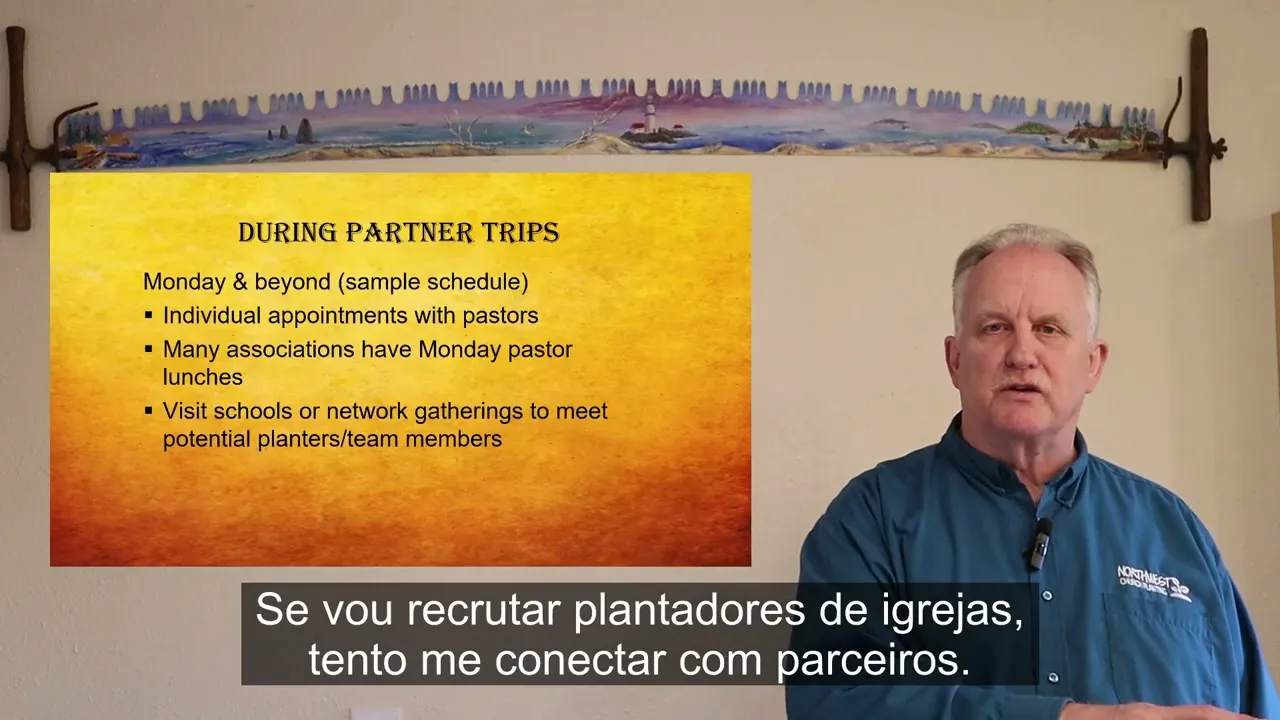
As we're developing partnerships, we have a couple of different kind of trips that we use to connect with churches and individuals and so on. Uh we have partnership trips where we go to them and what we're doing is we're going to make new relationships and to solidify existing relationships. uh we we want to connect with as many people as we can that might be receptive to what we're doing. When we go on Those, one of the things we're trying to encourage them, some will some will jump in and partner right there, but for many of
them, it takes the next step, which is getting them to come where we're planting the church and do what we call a vision tour. Now, we have vis vision tours that a church planter might have just for his church plant and get several partners to come and tour and and pray about helping that church planter and that church plant. And then We have others that are more of a network kind of vision tour where we'll have multiple churches come and they'll visit four, five, six church plants over a couple of days and then pray through
about which one they want to help. Interestingly enough, when it when we do that, they seem to all pick different ones and can't understand why the others didn't come to the same conclusion. And I always kind of smile smile and say, "Well, that's cuz God's speaking to Different ones of you in different ways." Uh, so those are the two kinds of trips where we want to dig into those a bit more. So, before you go on a partnership trip, there's some things you need to do. You need to develop prayer. Now, we've talked about this
a lot, but you need to have people praying for you. They need to pray for the potential partners. They need to pray for people that you need to meet that you didn't even know you were going to Meet when you left on the trip. They need to pray for your safety and for you to have the right words and to be able to communicate clearly to these people. Uh you need to have a solid plan. So do your mind mapping to come up with your plans like I was talking about earlier and then from that
mind mapping develop materials maybe a video or PowerPoint that will help you share this story. uh you need to get those materials together so that you have something to share with People while you're there and something that they can take back to others in their church or other settings. And you need to be prepared to receive gifts from day one. Now, this may sound obvious, but there's a number of times where people have gone out to plant and somebody goes, "Yeah, I'll write you a check." And then I hear the church planner go, "Yeah, we
don't have a bank account yet. We don't have any way to receive money." Well, they they just not Only didn't get the what they needed, but they damaged the relationship because they've lost some credibility. You're talking to a partner who's ready to write you a check for $10,000 and you're saying, "I don't have any place to put it. All I have is my personal account, and we don't put church planning funds in our personal account." You need to be ready to receive those funds. You need to prepare multiple kinds of presentations. You might have a
Three minute, a 10-minute, and a 30 minute. And let me tell you uh what those different presentations are used for. A lot of times when you're in a larger church, you get 3 minutes on a Sunday morning. And if they tell you 3 minutes, you are done in 2 minutes and 50 seconds. You do not go over because if you do, you've lost credibility. You've hurt what they're trying to do in their ministry. You've in their minds, you didn't have the integrity to do what You said you would do. 10-minute presentation might be something that
you get with somebody who's very busy, uh, a business person or or a pastor who says, "Oh, I can give you 10 minutes between meetings." And you need to be able to communicate that succinctly. And when you do, that person uh may then say, "Man, this is interesting." And they push back whatever they had next to have more time with you. I've seen that happen many times where I've had 10 Minutes or even 30 minutes with somebody. and the next thing you know it's turned into an hour or an hour and a half because they've
asked for and it extended it and sometimes I've had to say hey I'm sorry but I'm out of time I got to go catch a flight um but I'd love to carry on this conversation further and the 30 minute presentation is something where a lot of times a church will a smaller church or a bigger church maybe then on a Sunday night will give You basically the full uh sermon time to share your presentation. and they may want you to do a short devotional for a couple of minutes, but they really want you to talk
about your church plant and what you're going to do. And in that case, you have a longer presentation. Or the other one might be when you're hosting a lunch or a dessert for a bunch of pastors or potential partners or even people that will come be on a team with you and you can take longer in that Setting to give them a full presentation to really understand so they can understand what you're going to do. Um, another thing that you want to do ahead of these trips is you want to try to have an advocate
for each partner area. So, here's what we mean by that is have somebody who's local to the place you're going who will help coordinate the de the dinner, the dessert, the speaking engagements, but they will also be the local person that will use their Contacts, their relationships to get other people to show up. uh you need somebody who is excited about what you're doing and ideally somebody who's committed to be a partner who will bring others to be a part of it before you go on the trip. You also want to contact your partners about
sending materials or potential partners like what do you need and you send them stuff ahead of time. Now sometimes this means you printing things and sending Them. Sometimes it means sending digital files like videos and powerpoints. Sometimes you send them PDFs of the printed materials and if you're going to a large church, uh they'll print enough materials for the church instead of you having to pay the cost for that because they have in-house printing and to them it's an insignificant cost whereas for you it could be very expensive. So you just share uh either by
email or Dropbox or something like that. You share your Brochure with them and they print them out and have them ready to go to put in everybody's hands when they walk in on a Sunday morning or to have at a display table and so on. Also, before go before you go on the trip, you want to set appointments and secure logistics. That means rental cars, hotels, all that kind of stuff. Having places where you can have meals. Um, but you want to set appointments with different people. Uh, sometimes it's a group, sometimes it's Individuals, and
sometimes you have blank spots in your schedule for other things that come about while you're on the trip, and we'll talk more about that. So, what would a trip look like? What happens when you're on a trip? This is just one example of a schedule we've used a few times. So you would maybe you travel out on a Friday or it's close enough you can just leave on Saturday morning, but you you get there and you connect with whoever your advocate or Host is going to be to make sure all the logistics are in place.
You have some time in case something got forgotten or some change had to be made where you can make it happen. Uh you meet with potential planters and team members. Well, here's what I mean by that is maybe there's some people you've cast the vision or the advocate has helped cast the vision that you have people come to a meeting that they're not there to talk about sending you money, but They're there to hear about the vision and decide if they're going to come be a part of your church plant or if they're going to
come learn from you and then go out from you to plant another church. So, you can have a gathering just for that. Maybe you even go to other to schools in the area or there's a conference in the area. Finding places to go connect with larger groups of people that might be potential church planners to work with you or in the area That you're going to. Uh we often on a Saturday will have a host meal or dessert and do it with multiple partners. So, um, and you want to invite them as a couple. And
ideally, if you're married, you have your spouse come, too, because if the wives connect, there's a lot greater chance that this partnership's going to happen because they'll let you start, but they're not going to let your wife and kids start. They they they the wives will connect on A relational level beyond what a lot of guys will do. And, uh, and we know this is very important. Relationships, relationships, relationships. This is a big part of what we do. But in that meal or dessert, you you have an opportunity to make a full presentation to engage
in questions and ask for a commitment. And you have the advocate help do that to kind of set it up as well as do the ask on your behalf. Then what we might do is on a Sunday morning we may be in some Sunday school classes or Bible study classes uh where we get to share uh we get to share in a worship service and on Sunday morning and then we would also invite people from that church and other individuals to come do lunch with us. A lot of times we do a no host lunch
which means they pay for their own lunch or if you've got the funds you invite them and you pay for lunch but you do the full presentation and ask them to commit to the pray pay and par parlay just as You've been asking the churches and pastors to do. Um on on Sunday afternoons a lot of time we're meeting with a partner church or a potential partner church's committees or teams. Uh it may be finance or missions or personnel that they've got questions and it's in that setting again you you go into a more thorough
explanation and then you ask them specifically for what they can do. And uh in those settings um a lot of times that's the that's the Point where you can kind of challenge them to do more. And we'll talk about that later on as time allows. Uh then in the evening, maybe you're in a worship service somewhere. Some churches still have Sunday night services. You can go talk to a church on a Sunday night. Or maybe you just host another event for other interested parties. And uh then you can follow all that up with a late
night meal or dessert with anybody you've connected with. They're like, "Man, I want to talk more." And you're like, "Well, how about we go to dinner later tonight and let's just sit down and talk through it." And then on Monday, uh, a lot of times you have that's when you've got individual appointments with pastors. There's some pastors that are like, "Man, I just don't do anything like that on the weekend." Or they're a big church pastor and they just like, "Yeah, I don't go to those things with, you know, everybody Else because I've just got
I've got this whole big thing to oversee." And so they say, "I'll give you 15 minutes or I'll give you 30 minutes." And you're always make sure that you point out when your time's up. Hey, I'm out of time. So, I want to I want to be aware of your time. And usually, as I say, they they'll extend it. They'll say, "No, let's talk more." And um again, you're communicating clearly and with passion, and you're showing integrity by honoring Their time and and most the time uh I found that they will step up and and
lead their church to be involved. It's important when you set up these appointments that you find out who the decision makers are in the church. Like you may have a friend who's the assistant youth minister at such and such mega church, but he has nothing to do with deciding about mission teams or finances or anything like that. So you say to that friend, it's like who makes The decisions in your church on these kind of things and they tell you and you say, "Okay, could we meet with you and these pastors?" Uh maybe it's an
executive pastor, maybe it's a senior pastor, maybe it's both or missions pastor. said, "Can you get me a meeting where you and I sit down with these pastors and we make that presentation?" So, you want to be there where you're actually connecting with people who make decisions for the church. Now, a lot of Associations have Monday pastors lunches. And so, I would reach out whenever I go to an area, I'd reach out to local director missions. One, I want to let them know I'm in his in his area because uh if you don't, a lot
of times they' be like, "Why are you coming to my area?" And you don't even tell me. I have churches saying, "What about this guy?" And I don't even know you're here. And so I'll reach out and say, "Hey, I'm coming to meet with such and such a Church or such and such a business or school. Um, I was wondering if you and I could sit down." And also, I'm wondering, do you have any gatherings for pastors while I'll be there? And it may be a lunch or a training or something like that. And a
lot of times they're like, "Oh yeah, we have a pastor's lunch and if you'd like, you could be our speaker that week. I don't have anybody lined up for that week. why don't you come share what you're doing And ask churches to partner? And that's happened many many times. If they don't have it, you could uh say, "Hey, could I host a a lunch or a dessert? What do what time do you think get more people for a lunch or an afternoon dessert or something like that?" And get their input and get their help and
their advocacy and they'll help you set something up if they don't already have something. And then the other thing I do, I mentioned this briefly, I'll visit Other schools or other gatherings where people are already there looking for team members or potential planters. Uh if I'm going recruiting church planters, I try to connect with partners. If I'm going looking for partners, I try to connect with potential church planners. Another thing that we do on these trips is you want to you if you're the uh advocate or the network leader or if you work with one,
here's what a network leader can do for you. So a network Leader or a sending church pastor or multiplying church pastor. They can be an advocate for you. They can raise the bar in terms of giving people uh challenges to give more than you can. For example, if I go raise support for you, I have multiple stories of churches giving tens, if not hundreds of thousands of dollars to church plant, some where they've given over half a million, as I've said. Um, you probably don't have those stories. So, it's hard For you to say this
is what XYZ church did because it would be like third or fourthhand news if you told them, whereas I was a part of the process helping them do that. So a network leader like me could go and advocate on your behalf and can also give examples of how they can give. So for example, I went to one church where somebody was going to be on a team member. He was going to be a team member on a church plant and um we went there. We had few Minutes Sunday morning. We're going to get the whole
Sunday evening service. But after we had lunch, we met with a couple of committees that got together and normally I kind of cast a vision say here's what we'd like. But I just felt led at that time to say, "What are you thinking?" And there was a lady in the committee, older lady on a fixed income. And she was she was incredibly sweet. You could tell from her what she'd say. She was a person of prayer. And she's Like, "We just love brother soandso." And I'm omitting names for the sake of video, but I said,
"We just love him, and I think we should give him $300 to go start a church." And I said, "Ma'am, that's that's very sweet and I hear I do hear your love for him." But I said, ' Let me paint a picture for you about where it is. He's going to plant. I started describing the lostness and the challenge as well as the opportunity and how long it was going to take to plant a Church and how incredibly expensive it was. I said, "What I'd like to encourage you guys to do is I'd like you
to think about um first of all, let us in tonight's presentation, have people pledge to support above what the church might do and let us uh take up an offering. Anything that comes in in that special offering would go to support him as he plants his church." I said, "But there's the other thing. I know you've got to replace him on staff, but that's Going to be a while. So, I'm going to ask that for the next year that uh or I think it was 6 months actually. I said that you would pay half his
salary as he goes to the Northwest. And and they they talked about it and then prayed about it and they said, "Well, we can do the first two for sure. No problem. Take pledges and take up the offering. The second one, the third one will take more time. We're going to have to we're going to have to discuss it. We've got to make A proposal to the church and business meeting and uh and and our next business meeting is middle of next month. So, it won't be till after that, but we'll we're committing to do
that. And there's things that we did to follow up to make sure they knew what they needed to know. Well, they presented to the business meeting and what they did is they actually came back. They said, "Well, we're going to we're going to pay his full salary uh all the way through the End of next year." So, it was like a year and a half. So, but instead them I don't think they would have ended at $300, but I I just don't think they had a vision for what it was. But because it was their
guy um and this was a church of running about $800 in attendance. It was their guy going out um they were willing to make some sacrifices to make sure that he could land on his feet and get going forward with this new church plant. So somebody in my kind of role Can help raise the bar on that kind of opportunity. When you go on these partner trips, it's important that you share your materials. We've talked about that. That you tell stories. The story of what God is doing, the story of what God has done in
your life, what God has done in your area, and then also the story or vision of where you see that he is taking this church. And you're not begging them for help. You're not poor mouthing and going, "Oh, if you don't do This, my poor family, we're going to be living in a shoe box." Nothing like that. You are giving them an opportunity about to be a part of what God is doing. Um, and that's legitimate. You really are. You want to be a part of something that God's doing. We can't guarantee it's going to
work, but we can guarantee we're going to change some lives. And and we believe this is going to happen. So, God's at work here. Is he calling you to join us in what we're Doing? So when you're on partner trips, you need to do that and you need to be specific. You need to do the ask. So I will challenge churches and individuals and businesses of different levels, I will ask them on different levels because capacity. As a matter of fact, one of the principles is when you're getting partners together, if you know some people
that are multi-millionaires and you know some people that are, you know, they don't they're not like me, We're probably not sitting in the same meeting because if I'm asking on something everybody can obtain, I've just lowered the bar for the people that have greater resources. So, I'm want to get them together in one setting and meet with others in a different setting. I'm not saying it has to always be that way. Um, but if you have opportunities to do that, you can be bolder in the ask for those that have greater capacity. Um, don't say
no for people. We talked about that. If if God lays them on your heart, you have that opportunity. You need to do the ask and find out uh if God is calling him to be a part. You need to ask big. Resources begat resources. Um, we talk about this. Set the bar high. Not don't pour mouth. You're challenging them and you're going to people that will give more first and it raises the bar for everybody else. And remember the key question on the trip. Who do you know that I needed to Know? After all that,
you want to set a response time and follow up. And so I will say, hey, can how soon can you make this decision? Can you give me an answer in two weeks or in 30 days? and they'll say, "Well, we got a missions team the first of next month, so I can do it after that." So, I will I will follow up before that meeting, say, you know, I'll get them whatever they need, whatever he says he can need in terms of materials, but I'll follow up a few days before the Meeting going, "Hey, do
you need anything else?" Because, uh, I want to make sure I can get it to you in time. It also reminds that person, hey, yeah, I was going to talk about this in this meeting because sometimes they've got so much going on, it might have slipped their mind. And then I let them know and I'll call you later that night or I'll call you the next day so we can talk about it. So they know that I'm going to follow up with them which is some Accountability to them. They're more likely to do what they
need to do and then I can follow up and and uh see what where things need to go from there. Another thing on the trip that you need to know is never underestimate the power of now. Many of the major partners we've had, I had no relationship with, no appointment with before I left on a partnership trip. I would ask people that I did have relationship with, "Who else should I connect with? Who do you Know that I need to know?" And they would say, "Oh, you need to talk to this missions pastor or this
senior pastor or this professor." And they would connect me those people. And I multiple times I would call somebody and say, "Hey, somebody told me, you know, this person, this mutual friend of ours said I should call you and uh here's what I do. Are you interested in talking?" And multiple times I've had the response of we were just praying together and we felt God Was leading us to go west to plant churches and we didn't know how we were supposed to do it. And then you called, "Can you be here in 15 minutes?" And
and uh in some of those situations, I've been able to go, "Yes, I can. I'm that close. I'll be there in 15 minutes. And other times it's I can't I've got an appointment, but I can be available uh for lunch later today. Something like that. So, don't underestimate what God may be working up that you don't even Know. This is a spiritual enterprise. He's doing the work. You just have to be willing to walk o through the doors that he's open. So, after partner trips, what do we do? Talked about this before. Communicate. Communicate. Communicate.
Nothing will stop a partnership from getting off the ground or kill it once it is off the ground more than lack of communication. Make sure you get them the materials that they need. Make sure That you're available for mission teams or to go to their missions conferences uh and then follow up and have an expectation that they will do what they say they're going to do. And so you can't force them, but let them know, hey, we're in this together. You communicated this to me. So here's what I'm doing my part. So where are things
on your end? Uh that's very important after we have the partnership trip. So the other kind of trip that we Have is where they come to us. Again, we call those vision tours. So vision tours help us fulfill a very important goal of getting potential partners to the field. They need to see it, see your area, fall in love with your people, fall in love with your team, fall in love with your community. so that there will be a relational connection to want to move forward in planting a church. We need to provide ways for
them to register. Uh if it's a bigger thing where we're doing Multiple churches, we provide online registration where it gives them information and we get their information to help with their travel plans. Uh if it's smaller thing, it's just something you could do over the phone. Um we try to mobilize advocates to help recruit partners. We've been very blessed to have a partnership with Texas Baptist for a number of years. They bring teams up here where they do the recruiting. Now, we we can recruit for those too Through relationships we have, but they're working with
their over 5,000 churches to mobilize churches to come up and partner with us in the Northwest. Um, in addition to doing all this kind of reaching out, we want to make sure before we've done that, we have materials ready to send to potential partners. So, we will have already figured out who we're going to have on a vision tour most of the time. Sometimes we'll figure it out based on who's Coming, but most of the time we'll figure out which church plants are going to be there if we're doing a multiple church vision tour. And
we'll put together a vision tour guide book. Basically, it's a catalog of the church planners are going to meet, and it's got pictures and contact information, a little summary about them and space to take notes, uh, as we go through the different church plans. And so, uh, it'll have this schedule in it and how You can get more information. I'll have a QR code where we put information from the different church plants in a Dropbox folder, but we can send that catalog to them ahead of time so that they can try to figure out which
church plants they want to visit. Now, if it's for an individual church plant, it would be different than that. We would get them advanced materials, but it would be specific for that one church plant. Uh we would Provide a session where we're doing this for multiple church plants. We often provide an in-person or web-based orientation to let them know what they should do on a vision tour. Um, most plants planners have never done it before working with us and they could really mess it up. They could they could waste time of the people coming or
they could do it right and and have a really engaging experience. This is true for an individual planter doing a a vision tour Just for his church. He should receive coaching from a network leader about how to do this effectively because again we've done this dozens and dozens of times so we can help them know how to do it better. A lot of times we use a two-day format if we get so many people coming on a trip instead of you know we have had times where we've stuck them all in a bus. I don't
think that's best. And if we got too many coming for one van, we get more vans and we set up Multiple tours for them to go on. And so meaning, excuse me, each each group of four, five, six churches in a van would go meet four, five or six church plants and then another group of pastors would go meet another set of church plants and so on. Um the four to six is a good amount. Any more than that, they can't keep it straight. less than that, they they may not have had enough opportunities where
they they just don't find somebody that they resonate with. So, when they come on their vision tour, we have an orientation. We introduce our team. We introduce some of the planters that are there. Sometimes you got a planter. He's in an area that's too far away and we don't have time to go to his area. So, we'll have him come present at the orientation, so he gets an opportunity as well. We'll share about an overview about the area and the spiritual climate. will tell some of the stories of what God's doing in the area And
uh how he's blessing as well as some of the challenges and we can do that through multimedia meaning video or PowerPoint. We can have those things to kind of paint a picture of what they're going to see. We will give them gift bags that have different things they can need, snacks, water. We give them stuff from Seattle chocolate. Uh we give them uh gift cards and a mug from the original Starbucks at Pike Place Market. We have partnership materials including A print copy of the catalog we've sent to them earlier. We might have some materials
for some church plants and we might have a thumb drive, but more often now we use a a web link or QR code to point them to a Dropbox to get materials. We often, depending on what area we're covering, we'll also put in a map so they can kind of track where they've been and and kind of make notes so they can recognize where the different church plants are. We try to See two to three church plants in a day and uh as well as having time for meals and breaks in there, hitting coffee shops,
things like that. One of the things that we do to maximize time, it depends on the area. Sometimes between church planners, we want to let them have a break from hearing from people so they can talk amongst themselves and process. Other times, because of how compact the schedule is, we will have a a church planter when one church plant Tour ends, we'll have the next church planter there at the finishing point of that tour, and he'll get in the van and he'll start his presentation and tour while we're traveling to his area. So, he's getting
that opportunity to share with them uh throughout. And um we also want to make sure that we have good meals as we go. um that that uh we are not wasting their time, but meals are good conversation, relationship building times. We want to spend very limited Time inside. I don't mean when we're eating, we can eat inside, but when we're having presentations, I've seen too many planters, they'll get an hour and a half with the partner and they'll spend an hour and 15 minutes sharing a PowerPoint in a dark room and they go, "Okay, let's
go see the area." And we're like, "We don't have enough time to see your area. You spend all the time inside." You shouldn't spend more than 5, 10, at the most 15 minutes inside Showing a video and PowerPoint. They need to get out and see your community and hear from you while they're touring your community. So, we'll do a driving tour where you're describing the community. You're describing the need. You're sharing stories of what God has done. And along the way, you've got people strategically placed where we'll stop and meet some of your team members.
We'll meet somebody who came to faith in Christ uh in the church plant. We'll Meet a school principal at the school where you meet and this principal just loves you because of all the things you do for their kids and for the teachers. Uh so we'll see these important locations as we travel and it's just so much more impactful to let people do that. We also want to give them time to get out in some of these locations, not just drive by in a van, but get out and talk and see the areas. Uh get
out and and have a stop where they can have the Restroom and grab coffee because they've heard Seattle is a coffee place. yours may be something else they want to do. Uh but places where they can really engage and kind of get a picture of where they are. And then because of the way we tour, we don't go back to the start unless that's just naturally how the tour goes. We will end the tour. That church planner will get out at that location. He's got somebody waiting there to give him a ride back to his
car Or back home. And then the next church planter will get in and we move on to the next location. After all these different tours have gone on for the couple of days, we have a time of debrief and commitment. We want to have a a key partner like a sending church, a multiplying church pastor lead that or somebody in my kind of role lead that. Uh there's advantages if they do it because they're they've got skin in the Game. They're a peer of the others that are on the tour. There are some advantages if
I do it or at least have a part in it because I've got more experience in it and can share more ideas about ways they can partner usually more than most of the sending church or multiplying church pastors. So they lead this process but what we try to do is find out what each partner is thinking. We'll go around the circle and the the lead church the guy who's Leading it the multiplying church pastor or sending church pastor say hey so these are the church plants we're helping A B and C. this is kind of
this is what we're doing and he'll go through the pray play pay and obviously the parlay which he's doing then and he'll go around and say so what are you thinking you know Joe who are you thinking about helping um you know Fred who are you thinking about helping and and what does that look like and have Them describe it and then he will ask them to make a commitment and tell us where they are in that commitment sometimes they're like yep we're all in we're doing this other times they're like h we've got it
down to like three but we we need to go back and talk about it or this is the one I'm proposing in my church. I don't have the authority to make that decision. I got to take it back to the lead pastor or to our missions team and we'll get back to you. And what we do is we ask them to give us a response within 30 days. Some of them will say, "I need a little more time because of when our committees meet or meets, we're like fine, but let's set that as the date
and make that a commitment that you're going to give answers by then." uh if they say that they want uh a church planner to connect them, we'll pass their contact information on to the church planner. We don't want every church planner to call Every partner and just keep, for lack of a better term, hassling them. Uh we tell the partners, they're only going to call you if you tell us you're interested and it's okay for them to call you. And then we'll pass that along to the church planners. We ask them to commit to the
four Ps, pray, play, pay, and parlay. And then we use response forms uh that they can complete to give us some of the information, but we also have somebody there capturing notes uh taking down What everybody's committed to do or what they're thinking about doing. So what we want to do is have strong commitments. When commitments are made, we got to make sure that we're connecting those planters with the partners uh so that we can move forward. That's the goal of the vision tour. From there, we hand off the relationship. Now, we'll stay in contact
as much as the partners want, but because we're working with so many churches in our Setting, uh it's really on the church planner and that lead church, uh the partner churches, uh their pastor, missions leaders that are there. It's really between them now and we're support. But we make it clear to those partner churches that we are support. You may be in another state. We're boots on the ground. So, if you need something, if you're not hearing from your planter or you're not getting what you need from them, let us know and We'll step in
and help make that happen. We also have what we call next level partners. Now, next level partners uh are ones that will help us next level, the next phase. So maybe not in the startup, but a lot of times we get out there 3, four, 5 years and partnerships go away and the church plant's not really strong enough to totally be on its own and need some help to get to that next level. So the first thing when it comes to next level Partners is when I hear somebody say no, usually it's because they've got
other commitments. It's not that they're they don't have any interest in what we're doing. So when I hear them say no, what I hear is I hear not now. Like I've had one say, "We just signed three partnerships." I spent a week with these guys right before they signed three partnerships that they'd already committed to. And those partnerships were for 10 years. And I said, "Well, I'll stay in contact, but in nine years, I'm going to be asking you for one of those." Well, one of those three partnerships fell away. And after a year or
two, and they're like, "Hey, guess what? We have an opening." So to me, it wasn't a no forever. It was not now. and future possibilities were there. Another thing with next level partners is we ask partners to close the gap. And here's what we mean by that. Closing the gap is uh you probably can't see this as well, But this is imagine as a church planning budget. It's from years ago. And a church planner had a budget for four years and he was he had plenty of money in year one and two committed. Year three
he was it was close enough it didn't matter. But year four they were going to have a gap and it was pretty significant gap you know like 10% of their budget and so he would go to partners and he's like will you help us close the gap on this shortfall. So you You have a thoughtout plan where you can say here's what we've got committed but here's we're going to run out or maybe it's because some of the other partners are phasing out and so he needed to have somebody to step in and take their
place. Um, so the other thing about next level partners is former partners will still give to stuff. Um, meaning that if they've given you everything they've committed, uh, that doesn't mean they won't help you when you need something Else. And one church planner wanted to do an outreach activity and I won't take the time to go in all of it, but he he um didn't have the money to pay for what he was going to do. The short version is um they were going to buy a bunch of books because that's what a school said
they needed were books for their library and they were going to make it part of an outreach kind of thing, but they needed a few thousand to buy these books to connect with the local parents, do a Big carnival and be able to give these books to the to the school. And he goes, "I don't know how I'm going to pay for the books. That's what the principal said he needed. I don't know how to do it." I said, "Well, did you ask your partners?" He's like, "They're already giving me everything that they said they
would give me." I said, "That's not what I asked you." I said, "Did you ask your partners?" He's like, "No." I said, "Well, ask your partners." And so he Called the partners who were giving to him monthly and said, "Here's our situation." They go, "Oh, no problem. We'll send you the check." And they paid for the extra event, the books he needed for the outreach event. Uh because he did the ask and he didn't say no for people. U the other thing we want to see is don't forget about people at year end. There are
people that will um give to you all that they've committed, but when it gets towards the end of their Budget, they they've got some funds they want to spend before the year is up. They want to do good ministry with it. They want to be good stewards, but they also know if they don't spend this year's budget, it'll get cut out of next year's budget for so they're looking for some legitimate way to use those funds. And one guy who was getting a new worship space and he he uh needed chairs. And I said, "Have
you called your partners?" He's like, "No." He Calls the partner. The partner goes, "Nope. I we don't have the money for the chairs. I'm sorry." Hangs up the phone. And right after that, that partner, it was a missions pastor. His secretary came in and said, "Hey, you haven't spent these funds for the year. Is there something you want to do about it?" The guy picks up the phone, calls the church planner. He goes, "I got the money for your chairs." It's because he had year-end budget that he needed to do. Now, let me tell you,
when I say year end, figure out when their fiscal year is ends because it may not be December. It may be August. And don't wait till the last month. You got to go two or three months out. One, because you don't want it to all have been spent somewhere else. Two, because um they need enough time to make it happen before the year end. And three is some organizations will freeze spending in the last month just so people aren't dumping all their Money out of their budget by just spending it on stuff they don't really
need. So be strategic. So if the budget year ends in August, I might be calling in June, early July saying, "Hey, here's what we need help with." Now, here's an example of something that we use for a next level partnership. This was a a church planner who could identify all the things that had been happening in his church, the number of people they were contacted and How many people had attended one of their services and how many people been baptized and and about where they were meeting and and honestly it had current partners. Here's all
these churches that have helped us, you know, significant partnerships, but we still have more to do. So, what we want you to do is come on this day. In his case, as you can see there was May 24. come and hear about what's happening next. It'll be worth your time. Come look at this great Partnership opportunity. Um, other things that you may have, what are some materials you might need? I've mentioned materials a few times. Well, let me give you some examples. One is a network packet. Uh, here's one old Seattle church planning one. We
now have a Northwest church planting one. We you do where it talks about all the ways that we help church plants and we help partners that this tool along with our administrative hub Flyer which I'll have up here in a minute are some of the greatest recruiting tools for people wanting to partner with our church plants. And the reason is they look at that and say, "Well, your church plants out aren't out there on their own." They've had too many experiences where they've sent finances or teams to help a church plant and there's nobody locally
there to help them. And so we're letting them know they're not alone. Uh you want to have a Church perspectus. Now you'll see some examples of that in a minute, but a church perspectus uh a lot of times for us is like eight pages and and I'll I'll show you what's kind of in that, but it's a it's a brochure just about your church with great detail. Um you if you're working with a network, you might have a partner catalog. I'll show you examples of that as well. But a partnership catalog shows uh what's happening
in a vision tour or what Church plants are there so that potential partners can kind of look through and if for lack of a better term shop for who they want more information about and then we get them the the brochures on the individual church uh the church network hub. So, this administrative service we've had going on more more than two decades, and it provides financial help as well as other help, but it manages a lot of the administrative stuff for a church plant. Well, there's more of these around the country. When we started, it
was really the only one I knew of, and most people I met, it's the only one they'd ever heard of. And Janette Fai been running this for us the whole time. Well, it helps partner churches know that finances are going to be managed responsibly and that there's accountability. Uh, and so that's a great recruiting tool is to put that in front of them and say, "We're using this Service." And then having videos or partners, powerpoints for partners. So having those ready to go that you can send to people ahead of time or show them when
you're with them in person or show them in a service or whatever. And then another thing is of course your websites, Facebook groups, blogs, whatever it might be that paint a picture of what's going on. We see those both for uh the general public as well as ones that are focused on partners. So Those are some of the kinds of things you would want to have ahead of time. There's other examples like bookmarks and and a trifold single page brochure and we'll look at a little bit of that later. So, um, your brochure, as a
matter of fact, here's the the onepage brochure I was talking about. It's full color. Pictures are worth a thousand words. It doesn't need to be super textheavy. It needs to have images and graphs and Paint a story. So, it talks about the need. It talks about the planter and his family. Talks about their calling to plant a church. And and in the need, you're also talking about the community where they're going. It shares the vision and mission of the church plant. Uh it talks about how you can be a partner and outline specific financial needs.
And this one's very important. It's contact information. And let me say correct contact information. I've seen Planners put together partnership materials or outreach materials and left off important things like where do you send a check, where are we meeting, things like that. Or they got it wrong. We had one one church planner that sent out had printed 15,000 brochures with the wrong PO box for where to mail checks and he wasn't getting any checks and didn't know why. Um, you need to have have that right. And one of the things I'd encourage you on that
is have Somebody who's in my kind of role look at it because we look at so many of these things. It will jump out to us immediately if you've messed something up or left something out. So here's an example. This this is for a Chinese church that we have in the Portland area. And this I'm not going to take you through all of it, but it has those different components I just talked about, including where to send finances and talking about the pray, play, pay, And parlay. Uh, but it's image driven. It's colorful. Um, it
shows you pictures of the plant. It shows you pictures of the church planner and his family. So, it's just engaging and let you know, hey, we want you to be a part. And if you can't tell what that picture is in the background, you're looking at the Great Wall of China. Even though it's important, of course, the ties to China are important to communicate in this brochure. Another thing that we might Have, as I said, is a perspectus. And those quite often are like eight pages. Uh they may be more, but usually not not a
whole lot more and not a whole lot less. Uh warm and fuzzy, I like to call them. They've got lots of colors, lots of images and graphs and pictures. Um, you if you've got a big partner church that's willing to print you thousands of those, great. But if not, you may only have a couple hundred of these that you give to really key leaders, Contributors, people who might be big givers, and then you have hundreds, if not thousands of the onepage brochure to give out. Uh so it's got an opening statement information about the planter
and his family. It talks about their calling. It talks about the need and describes community and what the church plant need is there. Uh again mission, vision and values. The values being core values which are how you're going to do your mission and vision. Um and talks About how they can make a difference. It's also good in this to include a timeline. Now again, church planning is milepost driven, not timeline driven. So it won't say we're going to do this on this specific date. It'll have like target months, but say if we meet these mile
post, this is where we'll be at this time. It'll have budgets. Sometimes they'll have a like a very basic uh we need this much for personnel and this much for rent and this you know those Kind of things and shares it um on a annual basis or might say for the next three years we need this much and then I'll have uh startup needs like we need so much for equipment and we need so much for re relocation things like that. Um, so again, correct contact information, including how to give online and via mail. And
you want to make sure you're set up with that before you do all this because you need to be ready to receive gifts from day One. Uh, include links to your website or at least the web address or maybe a QR code to your website, putting that in there. You might also have in it business cards or response form how they can reply as much as you can. and getting them to do that online is great, a link to online or a QR code to online, but some people and a lot of people with money,
they still like to do things in the mail. So, you just have a postcard or something they can fill out and send Back in. So, here's an example of what one might look like. This is an older one, but it's a good one. And it talks about their mission. It it uh shows pictures of the church planter family of the community talks about them why in Seattle area why what's the need and what's the opportunity lays out the vision they call process and the values has the timeline that I talked about uh also shares about
cost they put in a two-year budget here's what we need and Then the partnership page here's how you can respond this is what we need you to do where you can send the funds and it asks people to commit to the pray play pay and parlay, those kinds of things. And so that's a simple brochure. Um, there's other examples which I'm not going to take the time to go through it right now. Another thing that we would have in a church plant setting is a catalog of church planters. Now, this is something a network could
use to Introduce multiple church planters. Again, some introductory information in it, have different websites they can look at and information about each church planter and his family. the church plant location, their name of the church, the contact information, family photos, uh their names, information about the location where they're planting and about the church plant and the planter himself. So, just something that paints a picture, just a little Snapshot so they can decide if they want more information on that church plant. So, this what our catalog would look like. Uh you see the cover there, but
we have it divided in regions in the Northwest. We have five regions. And so you would see church planters information from each of those. We used to be able to put more in, but we've had so many church plants. It was taking quite a bit of money to print something that detailed. So we had to make it more Succinct. Um, but you'll see that it could be divided. And that's just a part of our catalog. If we had the whole Northwest in there, be a much longer one. And then on the back um it has
contact information about how they can connect with leaders from different regions and so on. Um we also have partnership videos. It's great to have your family in there. It's great to have clips from your community in there and uh just a wonderful thing where you can Kind of bring them here before they actually get to come so they know if they want to engage. Now I love this video here. Now, this these are the elephants, Dave and Mary Ellif. And they've got quite a few more kids than this now, but this is an early video
where they were able to invite people into their family and into their neighborhood uh to see what God was using them to do. Online materials, of course, having a public website is Important. More than 80% of the people will check out your website before they come to your church. And so, it's important to have it for the community, but it also helps partners learn about you. Then there's also doing an e newswsletter and I strongly encourage you to do this. Um it's a way to keep it in front of people. Uh it it's inexpensive or
even free like if you depending on how many you're sending out. Uh it'll have good layout tools Where it can put photos in links to websites, links to videos, uh all those kinds of things. Some will even allow you to place the videos right in the newsletter. Um it it self-manages so people can opt in through like come to your website and say they want to be a partner and sign in. Um but they can also opt out if they're getting too many of these or they're not interested anymore. It's something easily be shared with
others. They can forward it on to Others. Whereas if you mail them one that's kind of hard to do. You're going to have some partners that still may want a print version. And if you can do it in such a way you can print it and mail it to them. Those folks are important too. uh even if they don't do web or e uh kind of newsletters. Um it's important in my opinion at at the top and the bottom of the newsletter to have a very easy give now button. Don't make them go hunting for
how to support your Church plant. Make it very easy. And then as I said, link it to your websites and track response. Are there things are there certain kinds of stories or certain kinds of images that are getting people to check out what you're doing more? Um, this is not the best thing to see on a screen like this, but just a very simple sample of what you might do either as a network or you could have one as an individual church plant. Then also remember using social media, using Different kinds of video sharing sites,
texting sites, websites, uh, excuse me, uh, social media sites where u it's very easy to share this information. You may say, man, that's just not me. I'm not techsavvy or I don't really want to spend my time doing it. I would strongly encourage you to find somebody else who loves doing that stuff. You know, I used to joke about find somebody who likes to Facebook for Jesus, who will not only be your online presence for your community, But for your partners, and uh have somebody who will go out and get the content that's needed, and
then set it up using different timereleas programs that will send them out at appropriate times. uh you need to keep ma not only ongoing in front of people but when you have major events you need to make sure that those things are being sent out or when you have specific prayer requests that you're sending those things out link those things to your newsletter to Your website and to your giving and there's so many different there's there's so many more we could put up here now but you know you know what some of those are uh
find somebody that can manage all that for you and a great idea is actually have that person be in char in charge of prayer partnerships as well. So, they're not only social media, but they're helping track your prayer partners and keep them informed because those two really are Interwoven. Um, another thing to have is a PowerPoint presentation. And it's good to have it in a Dropbox or one drive folder, but it's also good to have it with you in a thumb drive. Uh, I like to get the thumb drives that have USBA on one side,
the regular USB and USBC on the other side. So regardless of what kind of device somebody has, you can pop it in there and let them have the video that they can watch at that point or when they have time. But same kind of Things. It presents the need. It describes what's been happening. So you want to share some of the great things God's been doing in the area and then show what's coming, casting the vision, and then doing the ask. And a video should really only be two or three minutes long. a PowerPoint, you
could have a short version and a longer version. Um, but have these materials available digitally and you can make a a short code uh by using Bit.ly.com and it comes out to and make a code where it's bit.ly slash and you can customize those uh lines at the end. So, summit life Seattle, they could have bit.summitlife /summitlife Seattle that takes people to a folder that has all the partnership materials in there for Summit Life. It's a very simple thing to do and something that if you don't know how, we could always coach you through doing
it. And then a very important of all this is Make sure that you're doing the ask. Don't just share information, but give them in your presentation an opportunity to respond. Here's how you can respond. and it's a it's a short code link to a website or it's a QR code uh but basically takes them to some kind of response form online where they can be a partner and you can also have paper response forms for you when you get to share this in person. So, now that you've done all Those things, we want you to
take some time, do some mile posts, uh figure out if you need partners, if others you know need partners. Kind of go through that process. Who is it we're trying to find partners for? Dep determine your comp your excuse me, determine your components of overall partnership strategy. And uh again, it's that bit.decided slashdecided process three where you can kind of work on your outline of things you need to do for Strategy. um create milepost for the development of all the materials that you need to do and a lot of those are going to be listed
in that decided process three or you can go back in this presentation and look at some of those materials that you need to do come up with milepost stating in past tense you know brochure partnership brochure printed that's the final step you got it all done you know so you can hand them out and then Determine my post for implementation of the partnership development uh so what what's the process process you're going to use to get that information and those materials out to people and to secure partners. Uh so a few resources for you. I've
mentioned Janette Fenai and the church network hub. There's my assistant Natalie and you can also reach me through her if you're you're needing some help with some of this stuff. And then there's our DVD I keep talking About. It's actually all in Dropbox right now. It's bit.ly/cpresources. There's like 6,500 resources in there and they're all in different folders and subfolders and sub subfolders. It's like over 8 gigabytes of materials and there's a lot of it in there about partnership development. You'll find sample brochures and websites and videos. Um you'll find prospect eye, you'll find cataloges,
all that kind of stuff is in there. And so um you can go In there and find those materials and get what you need. Um, you're welcome to share that information with anybody. What you're not allowed to do is sell it to somebody else. But go check out what we have and find what will be helpful for you.
![Upbeat Lofi - Deep Focus & Energy for Work [R&B, Neo Soul, Lofi Hiphop]](https://img.youtube.com/vi/THh4fT0O7IY/maxresdefault.jpg)







![Upbeat Lofi - Power and Energize Your Workday - [R&B, Neo Soul, Lofi Hiphop]](https://img.youtube.com/vi/ONcY0BM5EAg/maxresdefault.jpg)



![Gravitation' by Richard Feynman [1080p HD Video with clear audio]](https://img.youtube.com/vi/q_edsSpDzHg/maxresdefault.jpg)
![A 46-Minute Strategy Session w/ Anna Leigh Waters [ON COURT]](https://img.youtube.com/vi/K9tX7F1U2wk/maxresdefault.jpg)