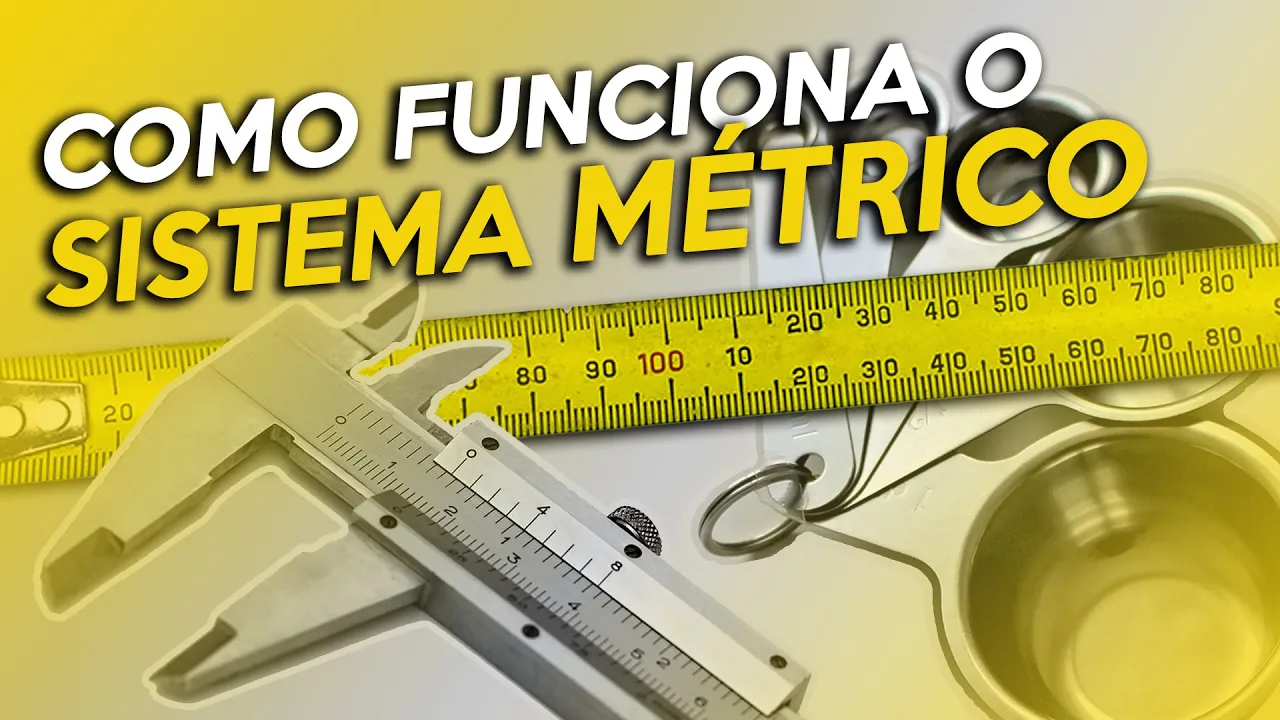
Some use millimeters, others inches, some measure kilometers and others miles. But after all, why is there this difference and why do we use the metric system and how does it work? What's up Engineering Lovers, my name is Igor Felipe and can you imagine if each people, each country or each region had its own measurement system?
Conversion tables would be crazy, and precisely to prevent this from happening the metric system was developed. Before global supply chains and trade agreements existed, convenience was the highest priority when it came to measurement. In most cases, people didn't have access to sophisticated measuring devices, so they relied on body parts, which were easy to carry and offered fairly consistent results.
For example, the width of a man's thumb is about an inch. This crude and informal system worked well for many years, but it began to fall apart as clans morphed into tribes and tribes morphed into nations. As civilizations expanded, it was seen that there was a lot of conflict between measurement systems and that interfered with commerce.
In France, the situation became particularly chaotic when the French Revolution began in 1789. Measurements of length, volume, and mass differed from city to city. Many people believed that the system used in Paris, based on units dating back to Charlemagne, should be imposed across the country, but guilds and nobles fought this idea.
With the French government on the verge of financial collapse, King Louis XVI convened the Estates- General, in a kind of assembly composed of representatives of the various classes of the country to collect new taxes. Ultimately, the legislative session turned out to be more fruitful than expected, which led to the formation of the National Assembly and a new constitution, and ultimately a new way of measuring things. The French called the new measurement system the métrique, a term derived from the word mètre, or meter, a fundamental measure of length defined as a ten-millionth of a quarter of the Earth's meridian passing through Paris.
Yes, the meter is exactly one-tenth of a millionth of a quarter of the Earth's meridian passing through Paris. The developers of this new measurement system believed that their work should be used all over the world. And they were right, because the metric system was adopted by almost every country on the planet.
But how did the metric system come about? The modern metric system can trace its roots to Gabriel Mouton, the vicar of St Paul's Church in Lyon, France, who was a noted astronomer and mathematician. In 1670, Mouton conceived a measurement system based on the duration of one minute of longitude, which means that for each degree of longitude and latitude on earth, there would be 60 minutes.
French scientists continued to modify and refine Mouton's ideas, but they were never formally codified until the French Revolution. After its creation in 1790, the National Assembly asked the French Academy of Sciences to "deduce an invariable standard for all measures and all weights". That is, they wanted standardization.
That academy, in turn, appointed a commission to develop the system, with the stipulation that the final solution should be both simple and scientific. Borrowing from Mouton, the commission established three basic principles: -The unit of length would be equal to a portion of the Earth's circumference. - Measurements of volume and mass would be derived from length, thus ensuring that all units would have a relationship.
- and major and minor multiples of each unit would be created by multiplying and dividing by 10 and its powers. It was then that the commission named the unit of length “meter” which is derived from the Greek word metron, meaning “to measure”. Next came the task of determining the exact length of one meter.
That fell to two men, Pierre Mechain and Jean Delambre, who spent six painstaking years measuring the distance on the meridian from Barcelona, Spain, to Dunkirk, in northern France. His research resulted in a value for the meter equal to "a ten-millionth part of a southern quadrant of the Earth". Once the meter was established, the other units came from that precisely defined meter.
For example, the gram was defined as being equal to the mass of a cubic centimeter of pure water at the temperature of its maximum density, and the liter was made equal to the volume of a cube of 10 centimeters on a side. We can see then that the system is called the metric system, because all other units follow the measurement of the meter. With this elaborate system, France officially adopted it in 1795.
Four years later, scientists created standards for the meter and kilogram of platinum. These were also officially recognized by the French government and stored in a safe place so copies could be made as needed. But how did this system created in France end up spreading around the world?
Strange as it may seem, it was because of Napoleon Bonaparte. Yes, thanks to Napoleon's conquest of Europe in the early 19th century, other countries adopted the metric system as their national system of measurement although some did not like the idea very much. Since then, several meetings have been held between countries to discuss and determine changes, improvements and simplifications to the model.
The work extended and in 1960, members ratified and approved the new system, calling it the International System of Units, or SI. The International System of Units is the modern form of the metric system, and although the two names are used interchangeably, SI is more technically accurate. The SI fundamental units cover all basic measurement needs.
There are times, however, when it is necessary to relate the measures mathematically. For example, let's say you measure the length of a football field and find that it is 120 meters long and 90 meters wide. If you wanted to find the area of the field, you would need to multiply its length by its width.
But you not only multiply the numbers found, but also the units. That's why the count of 120 meters times 90 meters is equal to 10,800 square meters, and the square meter that we see in the formula is exactly meter times meter. Now let's say you have a cube measuring 1 meter on each side.
If you wanted to find the volume of the cube, you would need to multiply three dimensions - length, width and height. Doing the multiplication, you would have 1 meter, times 1 meter, times 1 meter, which would be equal to 1 cubic meter, and that cubic meter is exactly, meter times meter times meter. But the interesting thing is that when the numerical factor is equal to 1, you can discard the number and simply show the unit.
Metrologists call this a coherent unit, because the number 1 corresponds exactly to the value of one unit. Area and volume are derived units because they are defined in terms of an SI base unit and a specific quantity equation. Some derived units are significant enough to earn SI names and special symbols.
The power unit serves as a great example. Isaac Newton defined force as the mass of an object times its acceleration. When you multiply these two quantities together, you get a unit derived from kilogram meter per second squared (kg-m/s2).
Because kg-m/s2 is a bit tricky and because force is such an important quantity in physics, SI bigwigs decided to call the derived unit the newton, after Sir Isaac. In all, there are 22 derived SI units with special names and symbols. Finally, it is important to know that some units are not officially part of the metric system, but appear frequently.
As such, the SI accepts these units for use with its family of measurements. Some of the common time quantities like the minute, hour, and day fall into this category, as do the metric ton and astronomical unit. However, all these units can be correlated with the SI base units.
For example, a day has 86,400 seconds and an astronomical unit (AU) is equal to the average distance between the Earth and the Sun which is equal to 1. 495978 × 10 to the power of 11 meters. For its elegance and simplicity, the International System of Units can be found all over the world.
But there are some countries that have not adopted them. The United States is the only industrialized nation that still clings to its inherited measures and, as a result, struggles with a confusing set of unrelated units. In the end, we have to use conversion tables to understand, for example, that a length measurement of 1 inch is equal to 2.
54 centimeters, which is also a unit of length. Now Imagine if each country still had its own measurement system to this day, and in addition to understanding other languages, we would have to deal with several unit conversion tables. I'll leave two videos here that you might like too, so click on one of them to check it out.
Don't forget to like the video, subscribe to the channel and take the opportunity to share the video on your social networks. That's it my friends, a big hug, and see you in the next video.















![SISTEMA MÉTRICO DECIMAL [Jhoni Zini]](https://img.youtube.com/vi/sP32TN4XjGY/maxresdefault.jpg)