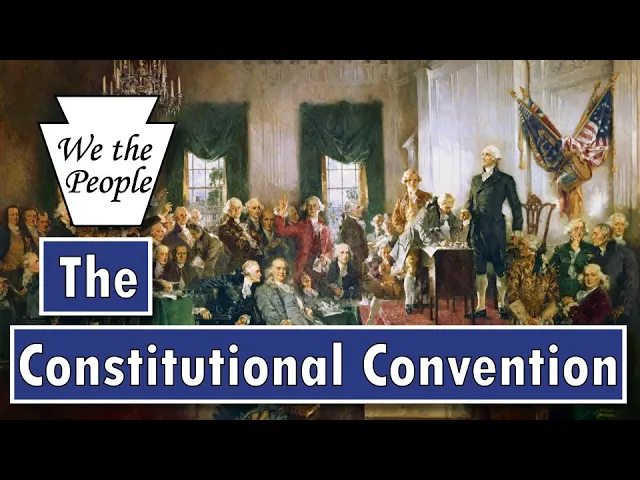
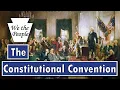
the story of the constitutional convention begins in the spring of 1787 with america's most overprepared politician james madison in the past months every state except rhode island had decided to hold what we today call a constitutional convention although at the time they called it the federal convention or just the philadelphia convention james madison arrived in philadelphia a week early since he had some scheming to do see most of the delegates that would be attending the convention assumed that they were going to propose amendments to the articles of confederation in fact the confederation congress had made
it clear that the sole and express purpose of the federal convention would be to propose revisions to the current articles madison wanted to sway some key voices into doing the exact opposite of what the congress asked them to do he wanted to propose a new constitution of the united states of america the way madison saw it there were three kinds of delegates that would be arriving federalists like himself that wanted a new constitution moderate reformers that wanted amendments to the articles of confederation in varying degrees and conservative anti-federalists opposing reform madison got his hands on
a list of every state delegation that was going to attend the convention and categorized each attendee into one of these boxes what he found was interesting a lot of the delegates had been officers in the continental army and even more had served in the federal government in one way or another both of these groups had first-hand experience into how broken the articles of confederation were chances are they'd at least hear madison out [Music] also apparently there were going to be like so many williams there like would it have killed him to send more interesting names
like gunning bedford jr or daniel of st thomas jennifer madison spent some of his extra time in philly letting other members of the virginia delegation in on his plan two in particular needed some convincing george mason and edmund randolph both recognized that a lot of reform was needed if america was going to succeed but they thought that what madison was proposing went too far madison had an ace up to sleep though he had been working the past months to convince this guy named george washington to attend the convention while letting him in on his plan
washington was really supportive of madison so mason and randolph kinda had to be too politicians didn't get very far in virginia by disagreeing with old george these early meetings were also attended by two pennsylvanians governor morris and james wilson both very supportive federalists what the virginia and pennsylvania delegations worked on before the convention became known as the virginia plan it proposed a new three-branch government where the legislative executive and judiciary would all share federal power the legislature would be bicameral having an upper and lower house both houses would have seats proportional to the population of
the states it seems pretty normal today because a lot of this stuff is the system we have today but at the time it was pretty radical stuff in the confederation congress each state received one vote no matter how many people were in that state according to the virginia plan the lower house would also be elected directly by the people unlike confederation congressmen which were chosen by the state legislatures most alarmingly to the state's rights crowd the federal government's laws would take precedence over state laws where they overlapped on may 25th enough delegates had shown up
to officially begin the convention washington was unanimously elected as the presiding officer surprise surprise and it adopted a rule of secrecy during proceedings the delegates wanted to have a reasonable discussion where they could voice their concerns debate and change their minds without any fear from the press or their constituencies a few days after the convention began the federalists set their plan in motion randolph presented the virginia plan to the convention and governor morris asked the delegates to take it into debate the federalists had shifted the debate from should we adapt a new government to what
is the new government going to look like a delegate from south carolina named charles pinckney also had some ideas about what to add to the articles of confederation his points became known as the pinkney plan and madison and a lot of other federalists decided that he was bringing up some really good points some of what he brought up got absorbed into the virginia plan like detailing the structure of the executive branch and outlining a better way to propose amendments despite winning the early victory and washington's support they began to face opposition small states and moderate
reformers weren't thrilled with the virginia plan and the debates began to tweak and propose changes to madison's vision they proposed the new jersey plan which kept states equally represented in congress they would also keep congress to just one house just like the confederation congress they also wanted to keep the powers of the federal government limited although they were prepared to make it more powerful than the current one this was great for small states and great for moderates since the plan was presented as amendments to the articles of the delegates split over predictable lines small states
supporting the new jersey plan and large states supporting the virginia plan new york which apart from alexander hamilton had sent two extremely conservative anti-federalists supported the new jersey plan speaking of hamilton he was being uncharacteristically quiet finally on june 18th he gave his first speech and it was a doozy hamilton proposed that both plans on the table put too much faith in the people or the mob as he referred to them the mob needed to be checked by a powerful central government or it would destroy everything that they had fought for in the revolution senators
should serve life terms on good behavior while the house should be elected periodically the executive should also serve for life unless impeached then hamilton said a no no word he referred to this executive as a monarch the speech was so far removed from what most delegates wanted that it was largely ignored by everyone else his plan was politely put on the back burner and the debate got back to the two main plans on the table the speech was leaked to the press and he'd have accusations of being a closet monarchist for years to come my
favorite description of this speech was that it was brilliant courageous and completely daft the speech did have one important achievement it made madison's plan look moderate by comparison suddenly madison was arguing for a middle ground some say this is exactly what hamilton had in mind all along but hamilton's whole shtick was being a loose cannon so who knows after hamilton's diversion the stalemate continued for weeks benjamin franklin who was the most respected delegate after washington proposed that they say a prayer for unity i only bring this up because franklin was a deist someone who believed
that god did not intervene in human affairs if even he was asking for divine intervention things were desperate on july 6 the new york delegation apart from hamilton packed up and left if they could have had it their way they would have kept the articles of confederation almost exactly as they were now thanks to madison they had to choose between two new forms of government that would hurt the economic boom that new york was going through hamilton kept on attending but a state needed two people to vote on measures so he was pretty powerless his
attendance was on and off for the rest of the convention now rhode island and new york were both out only 11 states remained and the delaware delegation threatened to leave two if the small states were not granted some concessions they needed a compromise roger sherman and the delegation from connecticut worked with benjamin franklin to put forward a compromise where the lower house of the legislature would be proportional to the population of each state but the upper house would be represented by the same number of senators no matter how populous the state splitting the houses of
congress helped ease the small and large state divide but there was another split that madison was even more worried about there was this understanding among the delegates that the more slavery was brought up the likelier the slave states were to walk out early opponents to slavery knew that pushing for emancipation at the convention would guarantee that the constitution would fail the slave states argued that their slaves should count towards their overall population giving them more congressmen in the house governor morris was one of the few delegates that had no issue badmouthing slavery despite his support
for the constitution he had risen more times to speak than any other person there despite having a wooden leg he also had no filter he said that counting slaves towards the amount of congressmen a state was allowed to send was absurd he went on to call slavery a curse something that was morally abhorrent and completely antithetical to everything america should stand for unfortunately the other delegates would not back him up and he did not press the issue fearing that the south would walk out instead the federal ratio or what's today known as the three-fifths compromise
was added to the connecticut compromise the population of five black slaves would be equal to three free white men when apportioning the house with this the connecticut compromise passed and the debates could continue the convention moved on to discussing the executive branch there were a few competing ideas of what the branch should look like ben franklin wanted an executive council which pennsylvania and a few other states had at the time elbridge gary wanted three executives one from the south one from the mid-atlantic and one from new england to share power and keep each region represented
in the government washington wanted just one person who would serve one seven year term then be prohibited from serving in the office ever again eventually the delegates agreed on one president with an unlimited amount of four-year terms how the president would be chosen was a complex question the delegates like hamilton were afraid of the mob so they couldn't let the president be directly elected others wanted the legislature to elect the president but this seemed a little too much like parliament and it violated the separation of powers that they were going for instead they came up
with the now infamous electoral college the idea was to keep the president insulated from the mob by a layer of electors chosen by the state assemblies i'm not going to go into the inner workings and criticisms of the electoral college here but it's been debated ad nauseum on the internet i'm sure you can find a place to explain it one thing i will add is that since the three-fifths compromise was adopted slave population would inflate the electoral college vote count of slave states so the electoral college was really a no-brainer for any state with a
growing slave population later when discussing the powers of congress slavery came up yet again the southern states were afraid of falling behind the mercantile north so they wanted any bill involving trade to require a super majority in congress this was a non-starter for the federalists one of the main reasons the current government wasn't working was that a super majority was needed to do anything instead they extended an offer to georgia and south carolina in exchange for allowing trade laws to pass with a simple majority the constitution would guarantee that no amendment or law could be
passed that could end the slave trade for 20 years george mason hated both halves of this deal he argued that as supermajority was the only way to keep the south from falling behind the north economically he also hated slavery especially the slave trade despite owning 300 slaves himself a lot of slave owners at the time like mason madison washington and jefferson all acknowledged that slavery was evil but they either refused to do anything about it or saw it as a necessary compromise to keep the constitution alive mason went on in his speech to predict that
the south's reliance on slavery would slow its economic growth allowing the country to be dominated by the northern free states he knew that slavery was evil and he and educated southerners knew that it would be a long-term burden on their states but slavery was in the process of embedding itself in southern society and not many were willing to stop it finally after four months of deliberation debate and compromise their ideas were ready to be put down on paper as the two most vocal supporters of the new government at the convention madison and morris were tasked
with writing the actual document when they completed the document the preamble read we the people of the states of and listed all the 13 states by name similar to how the articles of confederation began morris thought that instead of naming each state they should just be replaced with the united states it's a subtle change but it reflected the fact that the new government would be representing the people of the country as a whole not just the states that made up the union madison agreed one notable thing that the delegates left out was a bill of
rights some states had added one to their state constitutions but seeing the can of worms that debating one would cause they left it out [Music] the final article of the constitution article 7 stated that the constitution would go into effect after it was ratified by nine state conventions after that it would become the government of those nine states everything up to that point occupied a gray area of legality where the convention delegates were playing fast and loose with the articles of confederation but this one was in blatant violation of article 13. once you were in
the confederation you could not leave or form separate alliances with other states the only way to change this or leave was a unanimous amendment to the articles now a few dozen people in philly had just decided that if nine states agreed they could leave as the convention drew to a close george mason decided that the constitution went too far in its federal powers and didn't do enough to protect southern interests he wrote a list of objections and tried to find anti-federalist allies to oppose the signing of the document but by this point most of the
delegates had gotten some compromise out of the debates the anti-federalists in the new york delegation had already left and the anti-federalists in the maryland delegation had gone home at the beginning of september but he still wasn't the only critic of the constitution that stayed elbridge gary of massachusetts had several objections that he shared with mason plus madison and morris had not included a bill of rights how else was the government supposed to have checks on its own power mason was the guy that had written virginia's declaration of rights and he was adamant that it was
needed in a document that would be as powerful as the constitution edmund randolph also had objections he had been one of the earliest supporters of the convention and he had pushed washington to attend but now things seem to be getting out of control he proposed that the states should be able to propose amendments at their state ratifying conventions and send them back to another constitutional convention gary saw this as a chance to get a federal bill of rights and he seconded the motion charles pinckney of south carolina rose to address the proposal giving every state
the opportunity to propose their own amendments would lead to 13 sets of conflicting amendments it would kill the constitution gary attempted to rebut pinckney but he ended up shooting himself in the foot he basically said that before the constitution was ratified amendments needed to be added that would get rid of congress's power to tax and regulate trade as well as the three-fifths compromise regulating taxation and trade was like the core reason that they were even at the convention and the three-fifths compromise if any of the southern states were going to vote for the constitution that
had to stay in gary had successfully talked potential allies out of voicing their concerns the state delegations unanimously voted down randolph's proposal to allow amendments during the state conventions they were not the only people unhappy with the constitution madison hamilton and washington all thought that they had actually conceded too much but there was a general consensus that this constitution was the only alternative to the dissolution of the union before the constitution was signed ben franklin gave a speech that captured how the room was feeling this wasn't that document that he would have made if he
was the one writing it but it was the best they could do he wasn't totally on board with it but the constitution would enjoy his full support and he hoped that the other delegates would support it too on september 17th the constitution was voted on and signed by the state delegations all 11 states present voted to endorse the constitution of the 42 delegates present all but three signed the document edmond randolph and george mason of virginia and elbridge gary of massachusetts and a lot of times this is where the story will end the constitutional convention
succeeded and america lived happily ever after but the constitution wasn't a done deal yet 9 out of 13 states still had to ratify it and in september of 1787 that wasn't a sure thing the constitution was sent to the confederation congress and the battle for ratification began you