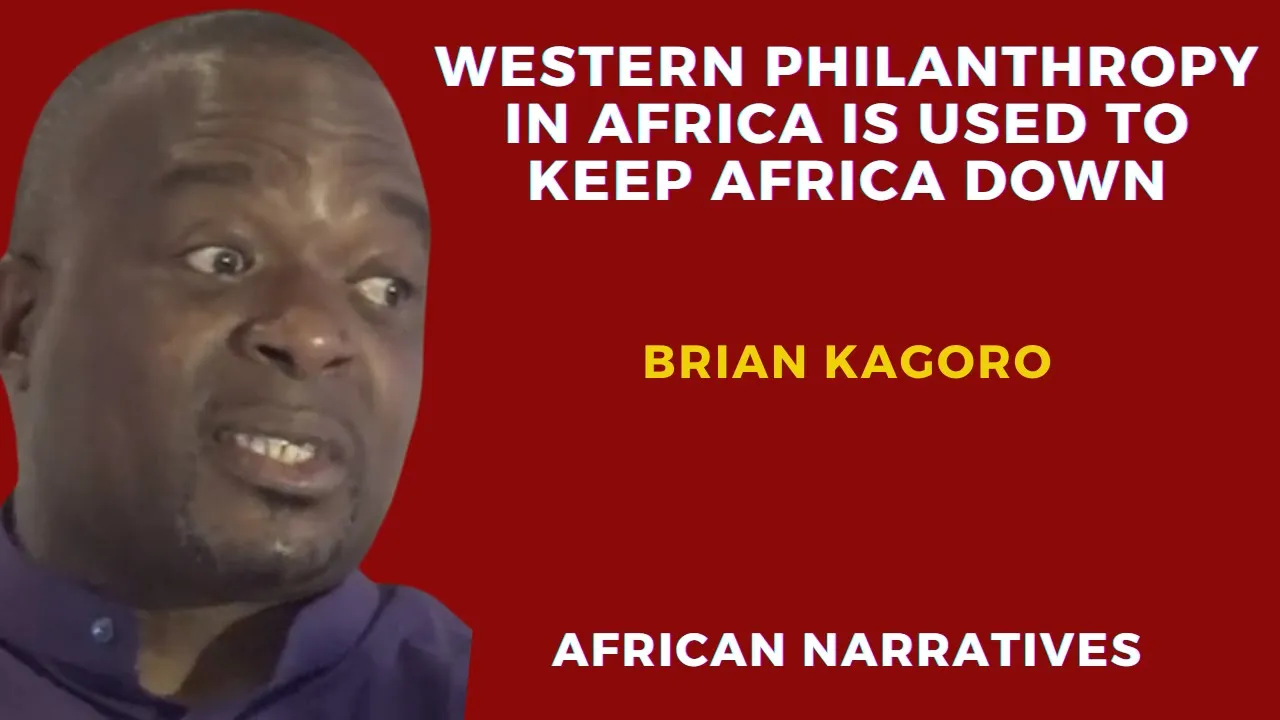
I came here and I listened to you talk about the virtues of philanthropy, African philanthropy and the leading African philanthropist are the Nigerian thieves who benefited from military rule uh and demutualisation of the state privatisation of the state. The Zimbabwean state elite who benefited from some funny contracting processes. The elite in Egypt and the elsewhere.
Wherever you turn, you cannot separate philanthropy from kleptocracy! [Music] I work for a global philanthropy and I can safely say without any fear of contradiction, not knowing whether I'll still have my job afterwards, that the three inseparable things are colonialism, imperialism and philanthropy. Because this country, Zimbabwe, was colonised by a philanthropist called Cecil John Rhodes who still gives money to Africans who are proud to be Rhodes’ scholars.
So the history of philanthropy in this country is a history of extraction. It's a history of undermining the collective will and sovereignty of my people. My own boss made money in ways that uh some of you have studied.
[Laughter] I came here and I listened to you talk about the virtues of philanthropy, African philanthropy and the leading African philanthropist are the Nigerian thieves who benefited from military rule uh and demutualisation of the state privatisation of the state. The Zimbabwean state elite who benefited from some funny contracting processes. The elite in Egypt and the elsewhere.
Wherever you turn, you cannot separate philanthropy from kleptocracy! Our theory of change has vacillated from the embrace of neoliberalism, kleptocracy, imperialism and colonialism and neocolonialism and all we really want is for these capitalist to show a little bit of empathy and give us money to keep beehives, to make crafts and arts and for the African women to be able to just put a meal of food on their table. And these philanthropist can continue to invest in extractive companies that are taking away water, taking away natural resources, taking away sovereignty.
Look my friends, I'm not in the business of crumbs. No matter how beautiful or tasty they are, I'm not here for the left overs of capitalism that is raping my country, raping our future, undermining our sovereignty. No!
If that's what you are here for, stay alone! They say, “oh Brian be practical” Okay. You should have told Mandela that be practical just be a good native.
Stop fighting for the liberation of South Africa. You know then you won't go to Robin Island. Freedom is not a convenience my brothers and sisters.
So this re-thinking. Somebody said shifting power, said you, I've been listening to them talking about shifting power. You know and I'm saying power it's not a gear that you shift.
You are shifting, it how, how do you shift power between yourself and Bill Gates? Between yourself and George Soros? Between yourself and look my friends you either make alternative power, disrupt existing power, right or ignore existing power.
Ah this please stop using placebos. When a child comes to you and they think they are sick they say no, I'm not well then you give them something. It's not even a tablet yeah and then they come and say are you okay baby?
Yes I'm well. And I have a bunch of African intellectuals and activists who now want to engage in the business of giving society placebos. The progressive underdevelopment of our society is because of three terrains.
The terrain that accept that black, brown people of colour and Africans really have no notion of civilisation and therefore they need to be civilised. They have no notion of commerce and therefore they need to be put into microfinance, microenterprise, micro-philanthropy. The micro management and micronisation of the native is also part of native intellectual genocide.
They accept we can never be macro at any stage. It is impossible for us to own our own economies. The real economies to manage our own economies.
To be the real deciders of our destiny. So we are happy to have crumbs from the master's table. If this is what we're doing, then you guys are really good native commissioners and you represent what Mom Dan said, decentralise despotism.
Just get another native to tell the other native everything is going to be all right. You know I worked for a group and I'm sorry uh my friends from ActionAID. I work for ActionAID international and after some time I discovered that we had been as ActionAID in Kenya for more than 40 years and the same people who founded action a had founded OXFAM and we had been doing some powerful work to deal with powerful issues.
And then uh I then asked, “guys, where are the people that we took out of poverty? ” Because it looks like we took them but the poverty is still in the community. Where we started, we built schools and even branded.
We had strategies to fight poverty together and the right to end poverty. Power to end poverty. And then I joined the United Nations Development Program.
And we were there empowering communities. Building their capacity. The people who needed capacity built were the capitalists who kept on doing the same old things even worse to undermine the global ecology leading to the ecological crisis.
And we were not paying attention to the people. Steve Biko got so upset with his uh white liberal friends because they were always coming to the black consciousness movement trying to help the black people have capacity. And he says, my friends, this is not racist.
It's practical list. Why don't you go and you since you're white and deal with your fellows. So in the theory of change, the self-serving organising principles that I heard this week, that you need to deal with are this idea of altruism of foreign, local, regional, uh rich sugar daddies and sugar mummies.
That their private preference and personal fixations should be appreciated no matter how disconnected they are from our own developmental aspirations as a collective, as a people. Now the power asymmetry in getting a billionaire to ask only one poor community what they want when they don't have information about what's possible, right, sounds so good. It sounds so empowering.
“I come from the left. The people must decide. The local must decide”.
And localism in the context of power and information asymmetries becomes the worst form of enslavement. Number two. So we use power as a ….
social power, political power, economic power, military power determines the contour of philanthropy, but these also determine the contour of injustice. And philanthropy does not work except in two of those dimensions. And it is almost deliberate.
When it works in technology, only 5% of philanthropy is talking about ownership of technology. And therefore leveraging the ability to become a global player from the local. Most of philanthropy is trying to help us to use technology more effectively to manage and report on our misery.
And the more we use that technology, the more the billionaires that are sitting in Silicon Valley and elsewhere that own the intellectual property rights to the technology become wealthier. And when philanthropy focuses on poverty and political repression it comes with an orthodox understanding of what is the best form of government. It is not willing to accept any other.
In fact, many of the major global philanthropies emerged and started coming into the context of this African territory as a way of defending hegemonic western interest, American interest, a particular form of governance and to counter communism. So it did not come to diversify, to guarantee diversity. It came to ensure that one version and vision of the world was established.
So my friends, if you don't look at the racialised nature of global philanthropy, you will not understand why, when philanthropy is controlled and transacted by the same principle, even if it is been done by people who look like Brian, who are black. Some of them are silver black as I am, that racialised outcomes are not dependent on the colour of the person that's implementing the project or the system. And so you can be analysing each other based on the colour of your skin, but racialised outcomes are about a system that produces the same.
You can produce apartheid without a single white person in the state. Because applying certain principles, certain approaches, certain tools gives you the outcomes of separate development. and that is why this localism breeds.
This localism is a dangerous ideology because when Jan Smuts wanted to explain to his Oxford court why apartheid was an important thing, he said the native must be allowed to develop separately in his locality and the white people because they have a unique culture must be allowed to develop separately. And then all your big professors come and say the world is a global village. If it is a global village let's share.
So this question, where we say we want agency of the oppressed. Give me the means of agency and the means of agency is not just money and voice. The means of agency is the instrument capital is not only cash and the idea that has gone into our artists, into our politicians that capital is only cash.
That if you have cash money you have capital, has meant that when we talking about shifting power we're only talking about cash changing hands. And we even said and it's important to do it. Give us long-term funding.
Even if I gave you money for 10 years, it will not shift power. It's important to give money long-term for core support. It will only create a local civilocracy.
An elite in civil society who like those of of us who work for the empire begin to drive the same cars, drink the same drinks, uh patronize the same hotel, play the same golf. And when there is an alliance of elites, the elite of labour in philanthropy the elite of leisure does not arrive. So Africans don't become owners.
Those who become civilocracy in philanthropy, whether they are black women and men and brown women and men who are working in global philanthropy, or they are people working at the local level, they now have a class interest to keep the status quo. Because the status quo is about their political economy. So it seems to me the coloniality of power in global philanthropy needs to be analysed together with the imperialism of philanthropism and philanthropisation, To transform, this you need to understand that capital and philanthropy are Siamese twins.
So when we say the failure of neoliberalism, neoliberalism was from the very onset racialised ideology which justified historically privileged races from extracting from historically underprivileged and oppressed. And also conscripting the elite from the regions and spaces and places to to believe that the system offers a dream to all. That accumulation and concentration of wealth and then giving a little bit of pieces, the poor shall always be with you.
Don't try and deal with wealth creation. The poor will always be poor. To those who have, more shall be given.
To those who don't have, even the little they have shall be taken away. And so philanthropy was doing this. What am I saying to you?
That it's the distribution, redistribution, deployment, investment and production of philanthropic resources remains entirely unrelated to questions of wealth creation amongst the communities that we seek to give to. So the communities are not becoming wealthy. Their poverty is not really becoming less, it's becoming only bearable.
Most philanthropic resources are financed, project-focused, theme-tied and non-renewable. Just like oil and gas! So I've come to ask, how do we find a green transition to philanthropic resources?
A sustainable, what are those critical minerals for new philanthropic imaginaries of resourcing? In the old days in Congo, when the Nyiragongo volcano erupted and then there was a conflict, philanthropies rushed in to give the women of Congo because of the incidents of rape ARVs. It was a 9month project.
When the project ended, the caring philanthropist went away. Those of you who know, giving ARVs to people who have no food and then discontinuing after you started was disaster. They were giving to help and killed helping.
You know after the George Floyd moment, all the big philanthropies started trying to find brown, black, blue, yellow faces to put on their boards. So you could win this DEI contest. Look if you go to our website and you see D Williams and Brian Kagoro and, oh my God we are DEI-compliant uh-uh.
But does that mean that the natives that populate the public facing components of these philanthropies have any power? There are things we can do there, but the expectation is that as a black or brown person you arrive at this position of privilege with appreciation. You leave your soul outside the door.
You leave your ideology outside the door. You leave your radicalism outside the door. You sit at the table of the masters and say, “so blessed am.
I and I've lifted. ” And you even write in in this moment, 50 years after liberation in Africa, the first black, the first Asian, the first this. My goodness, my goodness.
So this colour-fixing game has hidden across the globe the deep racist prejudices that inhere in most philanthropy. There has not been the courage to face the challenges of class inequity. The division when between global North, global South.
The division between men and women. The division between where do we send large grants to. And if we want to give Africa a lot of money or Asia, we have to find a white person we can trust in South Africa.
A white person we can trust in Zimbabwe. And I'm sorry I know those of you who are white, this is not really about you. It's about the system right this colour fixing.
African philanthropy that wishes to leverage its power globally must fight three struggles. The local struggle for dignity and agency and knowledge to end knowledge imperialism. The regional struggle to fight fragmentation and create an ecosystem of mutual support amongst philanthropy.
But the global struggle. Because you won't have time to do the African philanthropy. You will not be left alone because where do you think the rest of us will go uh-uh.
We also be trying to gain relevance in your context right. And so that's if you noticed all the big philanthropies. The minute DrMoyo and Vics started talking about Africa philanthropy in an organised way, they now don't give small or $1 billion $5 billion $10 billion.
And the best of us spend our time chasing the billions and that retains the influence of the status quo. Our ability to imagine alternative means and forms and ways of generating wealth and resources that give us longevity is undermined by the short-term availability of toxic goodness. I work in global philanthropy and I hope everyone that works with me will watch this because I say this internally and I say this in public.
Right? Deirdre says this internally and we say this in public because we're not about to be faces that sanitise continuation of hierarchisation of humanity. That some deserve more, some deserve less.
Why? Because they don't have capacity. So this constantly, “women don't have capacity to manage big amounts of money, black people don't have capacity to man manage”.
But we don't use women and black. We just say, “you know the institution is in formative stages uh it's also because um you know in order for us to complain with comply with C3 C4 C5 or C10. Right we got to make sure that you know, there's accountability.
That the governance is proper and also, yeah yeah we had we had issues about um their ability to report consistently. ” It's an institution of seven people. they’re working in a community of 10 million people.
You want them to be writing a report every week to you. To tell you master I've used your money as you [Applause] pleased. We end up dehumanising the poor.
We end up stigmatising the ability of local knowledge to be transformative. We end up objectifying Africanness, womanhood uh or any other state. And we end up disorganising the broad mass because money is not always an agent of good.
When it is irresponsibly poured, it often creates new hierarchies and contestation within a local mischaracterisation of the poor as voiceless and brainless. The next frontier of philanthropy is how to ensure that African philanthropy occupies and adopts the struggle to change what global philanthropy looks like. What global philanthropy does.
How global philanthropy does what it does. For those of us, who like you are in global philanthropy, it is for us to stop being self-righteous and thinking that our job is to act as native commissioners to ensure that you are complying with the imperial dictates of goodness of capacity. And it is the big billionaires philanthropist that need greater coordination.
I don't recall a moment where at the local level, for whatever reason, we were not coordinating. So local philanthropic development must be linked to Pan-African philanthropic development. It must be linked to global Africa aspirations.
African philanthropies and Caribbean philanthropies and black Brazilian philanthropies and European philanthropies must align to produce a narrative of philanthropy which is not only begging the status quo to do things better but a narrative of philanthropy that begins to reimagine the instruments, the institutions, the processes. It must contest the binary of profit and non-profit. Any of you who had mothers will know that your mother was both a for-profit and non-profit institution.
Because for one, she was your mother. But two, she had to do sell vegetables do something to educate you. And the fact that our government still have this very strict for-profit non-profit uh bit that's defined and you don't get a tax incentive as a woman who does philanthropy.
But if I come as an external philanthropy, I get a tax incentive. The tax codes need to be reimagined. The binaries need to be reimagined.
We need to create regional, national not just funds but repository of knowledge. Repository of technical support. We need to be African philanthropies giving to other Africans outside their borders.
Right now the limitations on remittances of money in Zimbabwe, in South Africa and elsewhere are such that even if you wanted to be a Pan-African philanthropist, it's very expensive to give money to your brethren and your sister. The struggle that is facing us is much more than natives being accepted as equal human beings. It is building the future based on our image.
And building the future based on our image means contesting, means protesting.