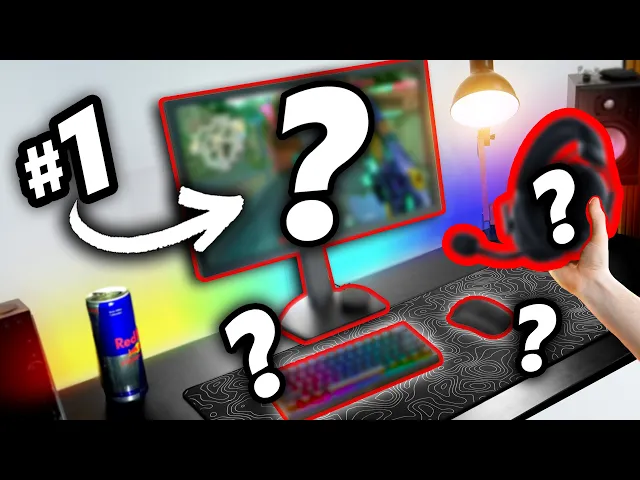
What's up, guys? I'm Random Frank P. And if you too want a game like the pros, today we're going to be going over the number one mostus gear and peripherals amongst all esports players.
So, let's jump in and start off with the number one mostused monitor amongst esports players, the ZOi XL2566K, responsible for 22% of all players currently. Now, that model is no longer in production and isn't available to buy. So, starting off with a slight caveat, the new successor to the 66K is the 2566X Plus, which is an upgraded version, obviously, jumping from 360 Hz to 400 Hz now, and gets an upgrade in their motion blur technology with DAK 2 Plus, but we'll talk about that in a second.
Now, Zawi is just dominating the esports scene. Granted, sponsorships play a large role in that, but the performance of these monitors is unmatched, and it's why a lot of the pro gamers still swear by them, even outside of tournaments. Doesn't have flashy RGB or any gimmicks.
At its core, it's a simple 1080p TN panel that emphasizes player performance with DAKA. DAK helps greatly reduce ghosting during gameplay. Most common in big FPS games and tournaments like Valerant or Counter-Strike where you're rapidly firing off shots or flicking your mouse.
Those fast-paced movements where your enemy would otherwise have ghosting artifacts or stuttering on a frame to frame basis. DAK and DAK 2 Plus now reduces that with their backlight strobing to counter motion blur. DAK had one layer of backlight strobing while DAK 2 Plus now has two layers.
In return, your enem is going to have greater contrast, letting them stand out more, giving you the advantage. Whereas, if you weren't using DAK, you'd be seeing a few ghosting frames or the backlighting still showing the previous frame, which could throw off your aim. So, despite not being OLED, 4K, or 27 in and above, yes, a 1080p TN panel at 24 1/2 in is still number one to the esports players.
And it makes sense, you know, cuz around 24 in, they're literally sitting right in front of the screen. Some guys sit like an inch away from the monitor. Some angle it up or down, whatever they deem as most comfortable to their play style.
So yeah, a screen size of 24 in, by far the most common. And fun fact, if you can touch your nose to the screen, you can actually smell your enemies, which is going to give you that competitive edge. I also dig the little controller that Zowi includes, letting you quickly toggle between three color profiles and pull up the menu with a little scroll wheel to navigate it and fine-tune your settings on the fly.
So, you can have these preset settings for the games you play most and then easily switch between them. And also, if you're wondering why 1080p is still the leader despite 4K monitors being more popular, a lot of these esports games aren't like graphically intensive or too taxing. you know, Dota, League, Valerant, Counter-Strike, these aren't going to graphically blow you away.
So, there's really no need for 4K, especially at the 24 in, like we said. But more importantly, frame rate is what's going to matter the most here. Having 360 to 400 hertz at your disposal, even if the games aren't going to be hitting that necessarily, it's going to give you that smoother gameplay at 1080p.
Frame rate over resolution is always going to take priority in the esports scene. And it's also why DIAC in the motion blur reduction is so OP in these panels. So, the new 66X Plus gives you that slight bump in refresh rate and gets a DIA 2 Plus treatment as well, becoming the successor to the OG model that's claimed the number one spot.
But, it's pretty apparent why Zi is dominating the esports scene as the most used panel. Just a really refined and reliable monitor that your favorite pro gamers are using to dominate. Now, moving on down to the mostused peripherals amongst all esports players.
The number one mostused mouse is actually a new one to this list, the Razer Viper V3 Pro, which came out just about a year ago, and has already claimed 18% of all players, taken over the previous number one spot from the Gro X Superlite. I've used this mouse as my main for about 6 months last year, so I can personally speak on its performance and durability. And again, despite companies and teams using, you know, branded products as sponsorships, there is no denying the overall influence Razer has on gamers just in general.
And the Viper V3 Pro is a mouse that is a top seller even a year later. So, checking it out, the V3 Pro is a mouse that stays true to that Viper design language overall, but it ditched the rubber grips and RGB of years past and got a more of a clean and minimal overhaul. And this is actually due in part to Razer's rise in the competitive scene where gamers were prioritizing weight.
So cut out the RGB, go simple, less unnecessary buttons that you could otherwise misclick. And in return, while the shape's relatively unmatched, it did manage to tighten up a bit by being 2 mm thinner at the grip with. And it adds an extra 2 mm up top for a more pronounced hump.
Similar to the Grox Superlite and Superlite 2, most people comfortably claw grip the V3 Pro or go fingertip grip, and all those internal and external changes helped cut an additional 5 g on the scale, now down to around 54 g overall. Some of the other new upgrades of the V3 Pro include their Focus Pro 35K optical sensor, which shipped with their hyperpolling dongle to make it adjustable up to the 8K Hertz pulling rate. And this still does use the Razer Gen 3 optical switches, same as the Death Adder V3 and the Viper V2 Pro, which to me isn't a big deal cuz I just love the feel and tactility to the switches.
But again, I'm someone who's mained the Viper Ultimate that launched in 2019. Then I used the Viper VT Pro, then like I said, the V3 Pro. So naturally, they just felt good to me after being what I got used to.
So, as a lightweight, symmetrical mouse that has a user-friendly shape, you know, it ditched the aggressive angled edges and went for that smooth, curved, higher hump to compete with the likes of the Gro X Superlite. It easily accomplished that and more because not only did it take over the number one spot from a mouse that held its rank after being released in 2020, but it managed to do so in just a year's time. It launched at 160 MSRP and rarely sees big sales since it's still kind of new on the market.
It's available in four different color options in the US, more if you're in China, and one that I personally love. So, I 100% understand the ranking here of being the number one mostused gaming mouse in the esports scene. So, then naturally, the next order of business is to go keyboard.
And that'll be the Wooting 60HE, reclaiming its number one spot actually from the Razer Viper V3 Pro TKL that quickly shot to the top of the ranks last summer when SOCD was all the rage. Then it got banned in a lot of games and now Wooding's back at number one. Just like DAK is the reason pro gamers love to go with Zoi, Wooding has that same influence in the market as they're pretty much pioneers in the Hall effect space.
Really being responsible for the absolute rise and dominance that is Hall effect keyboards as we know them today. So yeah, you can thank Wooting for that. They took control of innovating the key switch and just unlocking its full potential and it's why they're number one.
So, just a quick note, these stock wooding has plain PBT key caps, but I used clear ones in my review and on my board just to showcase how things like analog and rapid trigger works in real time. So, yeah, the stock key caps aren't clear. I just swapped them.
Now, I'm sure today in 2025, you're familiar with Hall effect and the advantages of rapid trigger, but just to quickly go over it, they're adjustable in steps of 0. 1 mm, let you set your actuation distance anywhere you like, as high or as low as you like. And with rapid trigger, it dynamically changes that actuation and deactivation point within your keystroke.
You can repeat a key press mid motion without needing that key to reset, letting you pull off these crazy fast movements in game. This coupled with it being completely customizable to your weight preference really shook the keyboard market when this dropped. And it does give gamers that slight advantage, especially when you perfect your movements.
And obviously pro gamers and their muscle memory is no joke. So, this is like putting a lethal weapon at your fingertips. While switches are hot swap with other Hall effect switches, the stock Leer ones really aren't too bad.
Granted, again, when this launched, there weren't a lot of other options. Nowadays, there's probably hundreds of third-party switches to choose from, but the OG Leers were smooth and factory lubed. In terms of specs, they were available in a 45 or 60 g weight option.
And as I mentioned, with them being analog, they're adjustable from 0. 1 millimeters up to four millimeters in total. Now, another reason it's so popular and still used widely today is because it's just a standard 60% tray mount keyboard.
Meaning, you can take out the PCB from the case and put it in any other standard 60% tray mount on the market, making customizing this a breeze, letting you separate yours from the rest visually. It's also widely used because that 60% footprint is vastly smaller and more compact, giving you more movement for your mouse. So, there's less interference if you accidentally smash into it while you're gaming or you're trying to pull off a quick 180 flick.
60% definitely more favorable for that reason. And let's be real, in most of the esports games, you don't need anything but a 60% layout as it is. And another thing you may have noticed about these pro gamers play style is almost all of them play with their board at an angle, mostly tilted downward toward them.
This is because naturally you don't play with a completely straight forearm and elbow at 90°. No, your arms sort of naturally bow inward. So having that keyboard tilt, so your hand is naturally resting on wedd.
But now with more area and space for your mouse with a 60% layout, it's an ergonomic combo that has clearly been working for the pro gamers. So again, unless you've been living under a rock, I'm sure you're very, very familiar with Voodoo and their 60 and their newer 80 because they really are who we have to thank for the rise of Hall effect keyboards out there and with the nice 60% form factor, nice and customizable, really great fast hall effect switches, really a leader in the market, and you can see why. And then lastly for today, the most used gaming headset is the Razer Black Shark V2 Pro.
And this actually surprised me because the HyperX Cloud 2 you see in spot number two was the leader in the esports scene for years, but now Razer comes out on top. This headset got re-released in 2023 and is the updated model from their 2020 version. I reviewed both on the channel and while the design stayed exactly the same, the 2023 model got a lot of people's attention cuz it upgraded three main things.
First, the battery life got a big boost. They added Bluetooth support. But the microphone is now greatly improved and it's up there with being one of the best microphones I've ever heard from a gaming headset in general.
It's a unidirectional super wideband mic. And I've heard from a lot of people who owned the original 2020 model that they were going to upgrade and buy this new one just because the mic was so good. So obviously in the heat of the moment, communication is going to be crucial in esports games.
Even if you're just talking to your friends, you know, when you're playing in a multiplayer space, you're going to need to have clear communication. So, for a microphone that does sound so good and clear for being wireless, it's pretty rare to come by even today in 2025. So, pretty pretty clear to see why it is such a major upgrade over the original model that had a pretty crappy mic.
And still today, a lot of crappy mics out there. This definitely not one of them. Now, one of the reasons I really like this pair personally is because I think they're super comfortable.
And for a wireless headset in the competitive gaming space, that's going to be important. It's under 12 oz. The headband and ear cups themselves are adjustable to fit a large variety of head sizes out there.
And the over-the-ear design helps it so there's not any pressure on your actual ear or on the side of your head, which is going to be great for people who wear glasses as well. Just super super comfy to me. But all that would mean nothing if they didn't sound good, right?
And straight up out of the box, they just sound okay. But where they really shine is when you hop into Synapse and either create your own EQ or pick from some of the preset ones they have built in for certain games. And while I typically avoid that fake 7.
1 surround sound, Razer's THX spatial audio setting is really, really good. It improves positional accuracy in the sound stage, making it easier to spot the location of sound effects like footsteps, gunshots, explosions. Being able to pinpoint where they're coming from is definitely a must-have awareness in competitive gaming.
And I was surprised to hear just how good it really was from a wireless stereo gaming headset. And honestly, it's still one of the premium options on the market. While there is others out there, yes, we've seen prices jump to around $250 to $300 for some of the flagship gaming headsets nowadays.
This launched at $200, frequently on sale around 150 to 160, which I think is a no-brainer for a great sounding headset with one of the best microphones I've ever heard. So guys, that'll wrap it up for some of the top number one gear amongst all esports players today. Little spoiler alert.
I've made this video two times already. Had to scrap the first two because the peripheral market changes, the leaders change. Uh, but this has been the consistent rankings for a little over 3 months now.
So, I figured why not put out this video showing you the number one mostused gear and peripherals amongst all esports players. If you want to check them all out, I have all the gear we showed off listed for you guys in the description down below. If you like this video, let me know by giving it a big thumbs up to show your support.
Comment down below on what other gear you might be interested in in the esports scene or just in general. Feel free to follow me on all socials, random frankp. At last, if you haven't already, hit that subscribe button.
Hope you all enjoyed this one. Have a good day.