every day I wake up and I work for a company not my company all these other companies and I'm not gonna sit here and act like I'm one of those people who don't sleep with my phone in my bed I do I'm not gonna act like I don't check my phone first thing in the morning I do I'm addicted and it's not just me millions of us are I just think it's funny you think it's that simple this isn't about our phones this is about a relationship between our senses and the culture we then to
an age of information glut this is something no culture has really faced before the typical situation is information scarcity lack of information can be very dangerous but at the same time too much information can be very dangerous because it can lead to a situation of meaninglessness this is the whole question if culture is communication and if it's shared information then what is that culture now Apple Facebook Warner all these media companies have invested over like 40 billion dollars in content in the past year the question isn't just why but at what cost I mean what
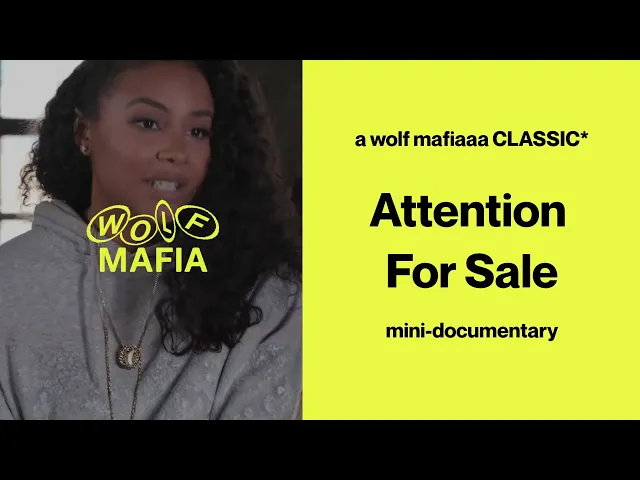
do we lose I'm Alex wolf I'm an author and artist some call me at digital anthropologist but I just like to call myself human I love studying culture people technology I like trying to figure out how we got here how ideas go from weird to normal there's a revolutionary there's been a shift in the modern economy in the past few decades where it feels like the only thing left for sale is our attention as a society we're openly and massively addicted to these like digital ad plantations that make money from our focus it's how we
keep in contact with our friends our family our president you got to wonder how did it get to a point where our eyeballs are the only thing that mattered because as an artist I've struggled with the incentive to make things for metrics or for meaning I'm a part of this myself and I just feel like I want to know how to navigate a world where every day my ability to focus my attention is for sale [Music] so we talked about the eyeball yes I don't think a lot of people realize that ninety percent of the
information we absorb is visual and this was an amazing asset for traveling the world it helped us invent new Sciences and figure out where we are in the universe when the printing press was released into the market by Gutenberg in the 1400s at that time people were thrilled to use their eyeballs to do something that's not as common today which is read little words printed on big papers were like feast to the eyes and it was one of the best ways to feel connected to the outside world and your imagination and by the 1800s something
revolutionized this special intimate relationship with the printed word which was the camera of course the thing I've always found fascinating about the camera is how much it looks and acts like an eye humans create technologies to extend our natural capabilities so like shovels are extensions of our hands wheels are extensions of our feet so it makes sense that we want to build a camera because it's like a mechanical portable eye that you can use to capture moments you know won't last anyway after cameras started to get better cheaper and easier to use they started to
transform our society and they were on the covers of magazines and newspapers which created a different standard for humans to absorb information an easier standard one where people didn't have to look and guess little words but where they just had to look and this was great for magazines and newspapers because it meant they could entice their readers and of course for advertisers because they got to use an array of stimulating visuals that's what it all comes down to stimulation your eyes are designed to honor stimuli no matter how cheap or exploitative it is so if
you put an image next to text your eyes are going to naturally drift away to the image its natural images control us as our society became more photo centric there became an ecological difference in the way we interacted with information and human behavior changed on a collective level and it didn't take long before at warp even more because of the television of course it might be the most American invention of all time because it's a box that projects images but not just images moving ones that totally influenced a generation of people to figure out what
they wanted to wear what they wanted to think and of course what they want to buy and it didn't take long for TV producers to realize that Americans want to be amused for as long and as much as they possibly can that's the other thing that's really interesting to me is entertainment because just as humans seem to be mostly visual we also seem to be mercilessly attracted to all types of amusement we dive headfirst into any enticement that 1ups the appearance of boredom and we have an unlimited appetite for distraction it's gotten us into a
lot of trouble well it's changed the way I can talk to you I'm a writer so I'd like to speak to you in little text on a page but my text on a page is competing with all the stimulating images and videos you're used to seeing every day so that means that even if you want to read what I or any other writer has to say your eyes are gonna drift away into all the competing stimulation every millennium I know wants to read more but they feel like they can't and it's because they can't you
know it's funny because people tell me that people still read and I feel like it's only to make themselves feel better people don't read readers read okay reading has become a novelty that's as niche as like scrapbooking there was once a point in our culture where it was a normal thing to read you can sit down and read for hours but the way our culture is set up our environment is not fit to honor that I mean the thing that you can't let go of from the moment you wake up to the moment you fall
asleep we call it a phone but that's a skeletal term it's not really a phone it's a 24/7 amusement device and it scattered the collective attention span to pieces the visuals on here from the perspective of the eyeball are fantastic they're infinite and with stimulation like that why would the eyeball even bother to go back companies that make money from selling ads it used to be newspapers and magazines and now it's social media they all work with the same business model and it works like this say there's a model named Julia and Julia's beautiful and
every time Julia does something people look at her this is great for those eyeball companies because they make more money the more they get people to look not for how much they get people to learn things or enjoy things just to get people to look so a brand was having a hard time selling their soda or whatever we'll come to one of these eyeball companies and say hey we see you've got a bunch of eyeballs we want to slab this expensive irrelevant ad in front of Julia because we know people are looking at her and
we hope that if people see our stuff after they see her they'll want to buy it it's not a bad idea but it's lazy because these eyeball companies don't really care if it annoys the crap out of the people on their platform or if no one even once sorta they get the money either way and Julia doesn't have to be beautiful she can be wacky or funny or whatever's gonna capture people's attention whatever's gonna capture your line of vision and so these companies are meeting the demand of the soda company about the people there's no
demand for ads but the funnier part is that the soda company is basing all of this on a faulty metric and it's usually a view count of some sort some kind of metric that says how much something's been watched and it's just watch just looked at just splatter in front of your face not engaged with not interacted with not indulged in not cared about and the result is you and I live in a world where we have to use our eyeballs thousands of times day to avoid the stimulation not only does it train our brain
to avoid boredom it makes the idea of it incomprehensible we're so used to laboring our eyes to navigate the world that the irony is we can't even see what's going on when heaps of entertainment are designed just to be injected next to ads it creates the standard which becomes a lethal combination to society because only things that are sensationalized and visually stimulating are rewarded and what happens is that this only lets junk content in and it pushes sophisticated information out and now we've been trained to think that all information should be easy to absorb when
in reality information doesn't work that way before ideas could be short and visually stimulating and simple people had to dedicate entire lives to figure out the complexities and things like math and science and philosophy the best way I can describe it is that we used to live in a world where people had to be calculators to understand math and now we only live in a world that handles a mechanical calculators output you don't need to know what 50 times 7 is you just need to know how to enter it on a screen because topics have
been index formulas have been categorized and now our world is sort of a playpen of results I mean of course not everything is figured out but we think it is and when you only have outputs when you only have the parts of the world that have been simplified enough just to be spit out not only do you have less understanding but less incentive to figure out how anything actually works because of the stimulating nature of our culture there are ideas that can not and will not penetrate public discourse because they lack visual stimulation or simplicity
they can't get in if your attention span is 8 seconds and their idea is that in 30 seconds 300 seconds 3000 seconds I can't penetrate your focus if people can't pay attention to each other then what happens to the world so are you no no I'm a capitalist so I believe in the power of free trade and commerce but I also believe in the individual and I don't think we need to get rid of ads but I do think we need to strive for better business models ones that consider the ecological quality of our experience
and don't just profit from interrupting our focus or cost the nation the ability to pay attention because attention being for sales so neglectfully like this has made it so that it be like offering unsweetened iced tea to someone who's only used to drinking with sugar yeah there's too much to lose if we keep exploiting our eyes and our sentences like this art is under threat because as I mentioned the industry is behind it are being ran by the wrong metrics good hearts law I don't know if you're familiar with it explains that once a metric
is sought for it ceases to become meaningful and no longer measures the desired results and you see this all the time with record labels and galleries and any third party platforms that use a metric like a follower count to distinguish good artists and you can see it the quality of our music film photography literature has suffered intellectualism is under threat because people need space to reflect an intellectual in space but the rate that information enters our lives leaves us with note to grapple the processes and dialogue that make my significant and of course probably the
scariest of them all is the quality of human relationships life is made up of attention if we put it in the pivot to and today it is in a constant war of exploitation given the distraction each of these business models where culture that seeks attention online instead of at home and it's we fragmented communication with the people would like to be closest if we want to at least try to sound it means that we need to create better systems beyond this outdated method of harvesting attention just for attention sake because it abuses our senses and
it's ripped so many of us apart from our reality the glory of the natural world can't even compete the worst part is most of these atoms don't even work there's no reason our culture should be turning to shreds to get these views that prove nothing to sell nothing I don't know like I said this is all a result of us exploiting our own human nature and I don't see the way we behave as a problem to be solved but more as a reality to be observed but I do know just telling people to just get
off their phones isn't good enough we're gonna have to be more creative than that because that's like telling a man who lives in the suburbs to just not have a car it's like yeah it's possible but how else is he supposed to get her out how else is he supposed to see the people he loves there's a road there and when you live in a world that uses that road to function and you want to be a part of that world then you have no choice but to take it it's frustrating it definitely makes me
feel powerless sometimes but I talk about it because I feel like every artist should know about this every person should know about this we're a species of the heart living in a world built for the eyeball [Music] you