in just a few [Applause] moments hi there welcome to the archive Channel today we are going to be exploring one of the most insane and thought-provoking footage kept away from the eyes and ears of the average citizen of Earth and without further ado let's get right into it Venus often referred to as Earth's sister Planet because of its similar size and composition is an inhospitable world with conditions so extreme that they make the possibility of Life as we know it nearly impossible despite its outward resemblance to Earth the environment of Venus is hostile in nearly
every way one of the most striking features of Venus is its extreme temperature temperatures the planet's surface averages around 887 de F or 475° c a temperature hot enough to melt lead Venus's atmosphere is nearly 90 times thicker than Earth's making it even more uninhabitable this immense pressure at the surface is equivalent to being 1 km underwater on Earth the crushing atmosphere is not only dense but also highly toxic containing significant amounts of sulfur dioxide and virtually no oxygen the clouds that enshroud Venus are another barrier to life these thick reflective clouds consist mainly of
sulfuric acid making them highly corrosive sulfuric acid droplets are destructive to biological molecules and pose yet another insurmountable challenge to the survival of any living organism moreover Venus lacks a key ingredient for Life any water that may have existed on the planet was likely vaporized long ago due to the extreme heat Venus is also bombarded by intense solar radiation as it a protective magnetic field without this shielding harmful radiation from the Sun permeates the planet's surface destroying complex organic molecules that are essential for Life as a matter of fact it's common knowledge that no life
can survive on Venus considering its extreme condition but is that really so [Music] in the 1970s the Soviet Union achieved what many thought was impossible they not only landed probes on Venus but also returned astonishing images of its surface the mission was named vanera program and it was believed to be motivated by the failure of the so Soviet Mars missions as well as NASA's focus on the red planet with the Viking Landers in 1975 instead of competing with the Americans the Soviets shifted their gaze to Venus embarking on a journey that would rewrite the history
of space exploration the Venera program officially began on February 12th 1961 with the launch of venira 1 which unfortunately didn't make it to Venus however it set the stage for future successes 4 and a half years later the second mission V 2 achieved the first Soviet flyby of the planet subsequent missions venira 3 through 8 carried atmospheric probes designed to collect data as they descended through Venus's thick atmosphere with some even reaching the surface the Breakthrough came with vanera 9 the first mission equipped with a camera the Soviets designed a revolutionary Lander having gathered data
learned from earlier missions the spacecraft had a cylindrical structure housing instruments mounted on top of an engine surrounded by a flared air bra fortunately the Soviets didn't have to worry much about the landing force of the spacecraft thanks to Venus's dense atmosphere they only needed absorbers to cushion The Landing cameras were technically placed on the Lander providing a limited but incredible view of the venusian surface Venera 9 touched down on October 22nd 1975 despite a minor setback with one of the lens caps the mission delivered a stunning 180° panorama of Venus's surface just 3 Days
Later vanera 10 followed with similar success while Venera 11 and 12 failed to return images Venera 13 and 14 made history in 1982 by capturing the first color photographs of Venus's surface the program concluded with vanera 15 and 16 which conducted orbital missions after this mission was concluded nobody supposedly conducted a deep examination of the resulting images enough to come up with reasonable deductions however this was about to change in 2012 Russian astronomer and physicist Leonid Sanoma made a contentious Claim about the potential discovery of Life on Venus he Revisited data and images captured by
the Soviet Union's vanera space probes during the 1970s and 1980s particularly focusing on photographs taken by the vanera 13 Lander in 1982 according to xan formality these images showed evidence of dynamic objects and anomalies on Venus's surface the venira 13 mission which was a groundbreaking achievement successfully transmitted data and images from Venus's surface for about 127 minutes before succumbing to the planet's extreme conditions the probe captured images of Venus's Rocky terrain expanding human knowledge about the planet's hostile environment one of the anomalies cassan formality observed was the change in position of an object he described
as a dis in the sequential images captured during the vanera mission a striking and mysterious element emerged a round disc with a regular circular shape distinctly separate from any part of the Lander this object shown in the video is partly obscured by the upper boundary of the image with only its lower section visible measuring approximately 0.34 m in diameter the disc appears to rest on the planet's surface notably no components of the Lander match this shape ruling out the possibility of Detachment from the spacecraft Dr sanom insights invite us to reconsider what we know about
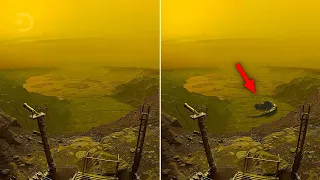
Venus challenging assumptions and inspiring new questions about the potential for dynamic processes or unknown phenomena on this hostile enigmatic world but what seems to be the most thought-provoking of his analysis was the discovery of what he described as a scorpion-like object that appeared to move or change position in sequential images sequential images of the Scorpion in the first image taken at 7 minutes a shallow oblong Groove is visible on the displaced soil measuring approximately 100 mm in length by the second image captured at 20 minutes the groove sides appear raised and its length extends to
about 150 mm interestingly the groove aligns with the orientation of the structure nicknamed the Scorpion in the 59-minute image a portion of the Scorpion's regular structure becomes visible by the 93rd minute the Scorpion seems to have fully emerged from The Sur surrounding soil which likely covered it with a layer no thicker than one tob2 this suggests that the process of freeing itself from the soil took roughly 1.5 hours potentially hinting at the object's limited physical capabilities however by the 11 19-minute Mark the Scorpion is no longer visible an alternative explanation for the object's movement could
also be the potential influence of wind on its displacement this analysis and claim gained traction amongst neens while some believed it and commended the efforts of the Venera program others believe they were just making things up but there was more decades after the mission had been concluded a supposedly Declassified footage leaked by Leonid sanom malti that has the potential of changing the entire history of Venus exploration mysteriously appeared it's indeed shocking and unbelievable [Music] the footage was believed to be caught on one of the veneer missions and it indeed showed a scorpion-like creature moving on
the shrouded unforgiving and crushing planet of Venus but what's even more insane was the supposedly classified information contained in the voice recording that was leaked with the footage SC for [Music] these claims indeed raised a lot of questions could this indeed be Dr kasan fomal and could he be telling the truth is there really alien life on Venus is the planet indeed capable of harboring life then what other secrets are kept from us while nobody has the answers to these questions yet there is even a bigger question is this footage even real I mean with
the level of people's creativity with powerful video editing software and the advancement of AI one would not be wrong to think the video is not real but of course we did our due diligence according to the video's analysis from open ai's advanced AI model language chap GPT the footage doesn't seem edited and it provided strong evidence as to why firstly the visual consistency throughout the frames might be an indication that the footage is genuine the color histograms show a natural distribution of pixel values across blue green and red Channels with no indications of tampering such
as abrupt color shifts or anomalies also brightness levels remain stable across all frames indicating consistent lighting which is characteristic of an environment with diffused illumination such as Venus's dense cloud covered atmosphere furthermore the surface details like rocks and terrain appear aligned with the known scientific understanding of Venus's surface with no evident patterns or textures suggesting digital manipulation shadows and Reflections also seem accurate and consistent with the assumed light source avoiding any obvious signs of fabrication such as mismatched or impossible Shadow angles and these are the reasons we can conclude this video has a very high
chance of being real but of course we'd love to know what you think think about the footage so do drop your thoughts in the comments however as you would expect making such a controversial claim is bound to face criticism from the scientific Community the vanera 13 images were taken under extreme environmental conditions with low resolution judging by today's standards this serves as one primary challenge to the claim many scientists argue that the anomalies described could be explained by Imaging artifacts dust or distortions caused by the harsh environment other astrophysicists also o believe that the apparent
movement of objects in the images could also be attributed to environmental factors such as Venus's strong winds or to noise in the data rather than genuine biological activity also internet users also have quite a lot to say about the video some took it as a total joke others were concerned about the extreme conditions under which this could have been filmed while his interpretation of the vanera 13 images is not widely accepted it has encouraged A Renewed focus on Venus as a target for exploration and in about time this happened in 2020 now next on outside
Source we're going to learn how a global team of astronomers have announced they found what could be evidence of life elsewhere and not on Mars but on the much more inhospitable Venus here's one of the team so what we think we found is phosphine gas in the atmosphere of Venus the detection of phosphine gas in the atmosphere of Venus has caused a wave of scientific curiosity as it could hint at the possibility of of Life existing on the planet just as sanom asserted phosphine gas with the chemical formula ph3 is a chemical compound made up
of one phosphorus atom and three hydrogen atoms on Earth phosphine is primarily associated with biological processes particularly those involving Anor robic microorganisms that is organisms that thrive in environments devoid of oxygen its presence in Venus's atmosphere raises questions about whether similar microbial life forms could exist there in 2020 scientists identified phosphine in the middle layers of Venus's atmosphere around 50 to 60 km above the planet's surface using Advanced telescopes like the James Clerk Maxwell telescope and the Atacama large millimeter researchers detected concentrations of phosphine at about 20 parts per billion this discovery was unexpected as
Venus is known for its extreme environment the significance of phosphine lies in its limited known production pathway on Earth it is either produced industrially or as a byproduct of biological activity particularly by microbes and oxygen-free environments Venus's harsh conditions make industrial production unlikely and natural non-biological processes such as Lightning volcanic eruptions or meteorite impacts do not adequately explain the observed levels of phosphine this has led scientists to hypothesize that microbial life might exist in Venus's temperate upper Cloud layers where condition are relatively more hospitable the cloud layers 50 to 60 km above Venus's surface have
temperatures ranging from 30° C to 70° CC and pressures similar to those on Earth these layers are considered a potential Habitat For Life despite the high concentration of sulfuric acid in the atmosphere if microbes are present they might have evolved unique biochemistry to survive the planets acidity producing phosphine as a metabolic byproduct this idea aligns with observations on Earth where certain anerobic bacteria produce phosphine in similarly extreme environments such as wetlands and the guts of animals however what makes this claim even more convincing is the discovery of yet another biologically produced gas ammonia ammonia was
tentatively detected on Venus in 1978 by the Pioneer Venus Mission conducted by NASA the spacecraft's atmospheric probe included instruments that detected chemical signatures suggesting the possible presence of ammonia in Venus's clouds in recent years interest in ammonia on Venus has been rekindled due to its potential role in atmospheric chemistry and as a possible bios signature studies in the 2020s have theorized that ammonia could explain some of the Unexplained chemical phenomena in Venus's highly acidic atmosphere ammonia is a compound of nitrogen and hydrogen that is often linked to biological activity on Earth its presence in the
harsh and acidic atmosphere of Venus is particularly interesting because it is not easily produced by known abiotic processes in such extreme conditions this discovery raises questions about whether ammonia might be a bio signature or the result of unknown chemical or geological processes on Venus studies conducted by astronomers and space scientists recently have reported traces of ammonia in Venus's upper atmosphere approximately 50 to 60 km above the surface which is often referred to as a habit able Zone owing to its similarities with Earth's condition however it is still highly acidic dominated by sulfuric acid clouds the
detection of ammonia in such an environment is unusual and suggests that it must have a continuous source as ammonia is highly reactive and does not persist for long under these conditions one of the most compelling explanations for the presence of ammonia is the possibility of biological activity on Earth ammonia is produced by certain microorganisms including those involved in nitrogen fixation and other metabolic processes if similar microorganisms exist in Venus's Cloud layers they might produce ammonia as a byproduct of their metabolism [Music] the footage shows what seems like a UFO harnessing the sun's energy before eventually
detaching if such UFOs were indeed Advanced extraterrestrial spacecraft their presence and activities could indirectly hint at the existence of life elsewhere in the solar system including on Venus the hypothesis is rooted in the possibility that extraterrestrial civilizations might use advanced technology to extract or utilize solar energy a fundamental resource for sustaining life and powering technological systems While most scientists attribute these sightings to Natural phenomena such as solar flares pixel glitches or cosmic rays some interpretations propose that they could represent advanced technology well to shed more light on the situation and avoid further confusion upcoming missions
such as NASA's D Vinci plus and veritus as well as the European space agency's Envision should aim to provide detailed data on Venus's atmosphere and surface I believe these missions could help evaluate past claims like San formalities and search for more concrete evidence of biological or geological activity advances in imaging technology and instrumentation might also offer a clearer understanding of Venus's mysterious surface features in conclusion Leonid Sanam malti's hypothesis of a scorpion-like creature on Venus is an interesting area that should be met with more Explorations and research rather than criticism while we await answers from
the top space exploration bodies do you think Dr khanom malti's claims are valid are we really not alone in the universe