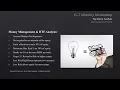
welcome back folks this is lesson five of january 2017 ict mentorship i'm going to be discussing money management and higher time frame analysis okay we're going to be just talking about a broad brush perspective on this view of trading in other words long term analysis we're going to assume for a moment that uh everyone that's learning the concepts from january is contemplating uh the medium of long-term trading or position trading now that may not be your cup of tea that may not be the disciplinary trading that you are going to adopt as your career but
i would advise you to at least work in this time frame a little while at least try to work it at least for a year and the reason why i say that is because some of you may not be contemplating managed funds in other words managing other people's money or working for a firm maybe working for a prop firm and while you may not have a large equity base to start with um it's not important now but what is important is growing your understanding over a long period of time and when that means getting experience
in the marketplace there's no better experience than actually applying the things that you practice in a demo account with positive results and then segwaying into a live setting where you're using live funds it's not important you have a big account because what you're focusing on is the control over drawdown keeping it manageable keeping it tolerable with a tolerable level of drawdown i think i'd say about uh 15 annually is a realistic objective um most folks would uh would start to cringe over 25 or so um but if you can control your draw down to around
15 as a maximum that's absolutely amazing uh but 20s it's probably okay and if you can still maintain a positive outcome for the annual return but thinking about managed funds i want you to think about the possibility that while you may be thinking about only managing your own individual assets and moving your uh your wealth forward independently apart from using anybody else's money for some of you that may not be the case maybe you came into this mentorship with every expectation of learning to do that very thing well it starts here you have to have
a realistic expectation coming in and knowing that you don't need a whole lot of money if you can show a consistent equity curve that's improving very little drawdown very very infrequent uh erratic or slow periods in your trading uh that is very good for uh for investors when they see things like that um and it doesn't have to be high rates of return but having a steady increase of over a calendar year that really attracts investors uh there's you have no idea how much money is sitting out there just waiting for people to say hey
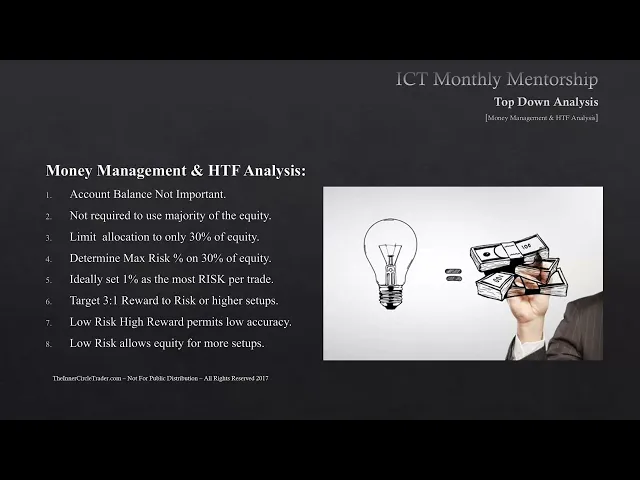
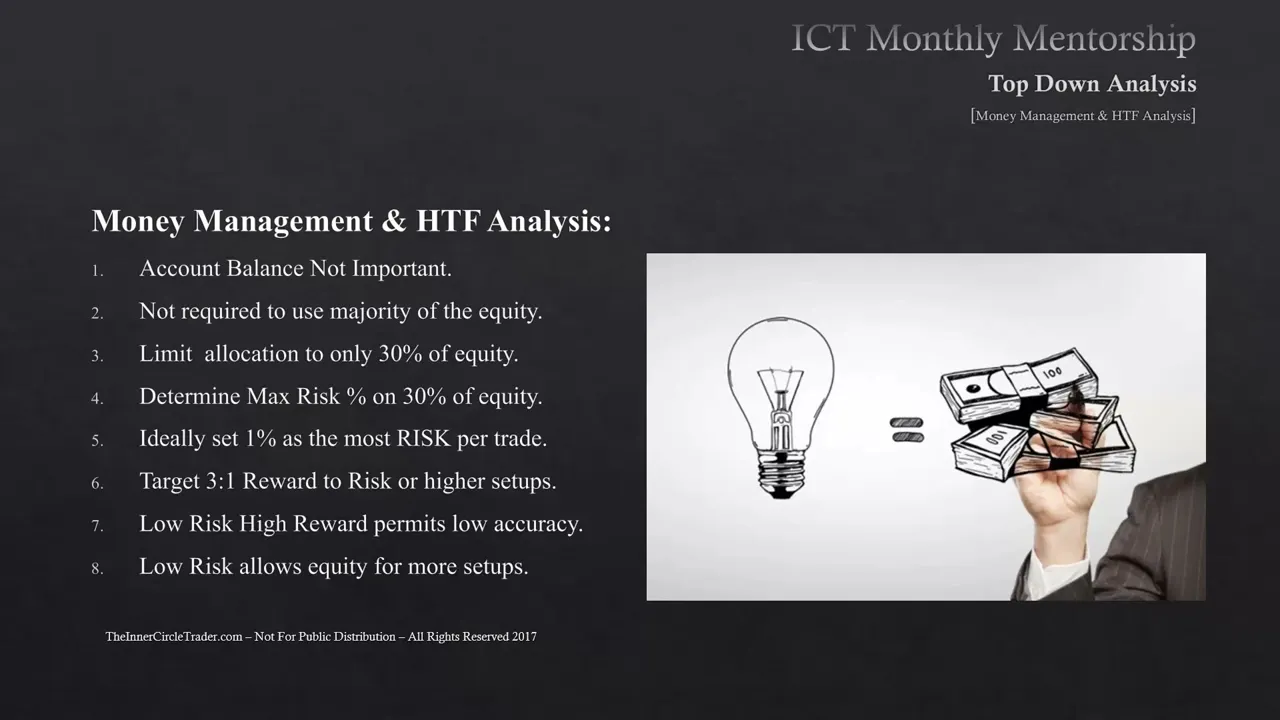
look you know i'll take that money and control it for you and turn a profit now you also don't need to use the entire equity base that you start with um many times ten thousand dollar trading account and they assume that they have to maximize every possible dollar in that account to get a respectable rate of return and i don't teach that i actually have a very conservative approach when i'm trading my view is i don't want to allocate every possible dollar to the marketplace what i do is i limit my allocation to only 30
of my total equity that may be shocking to some of you but it's the truth so let's say for instance i have a hundred thousand dollar trading account or let's say you have a hypothetical one hundred thousand dollar trading account that means i'm gonna be using thirty thousand dollars to meet whatever margin requirements or trade parameters that i use for that trading in other words if i'm going to be doing a percentage basis of my equity and let's just say for instance that i'm going to be using this standard in the industry of 2 that
means i'm gonna be using two percent of thirty thousand not two percent of one hundred thousand and the reason why that's done is because i'm never going to have to worry about margin calls i'm never going to be over leveraged i'm never going to have uh wild dips in my equity but i can still manage to carve out a very nice equity curve even just using 30 of my equity investors like to see that they like to see that you're not 100 exposed they like to see that you know having a a good reserve of
cash in the account that way you always have opportunities that you can still take that if they're really too good to pass on you have never extended yourself too much and spread yourself too thin so that we always have an opportunity to take something that may otherwise not have been on your radar screen something comes up in the chart something comes up as a an opportunity you always have equity at your disposal to take advantage of that that move so what you're doing again is you're determining your maximum risk exposure and a percentage basis on
30 percent of your equity so you're really really really drawn down in terms of risk you're not maximizing the risk for maximum return you're looking for a very low end risk exposure with the expectation that you're going to have consistently pulling in percents of return that are respectable over a calendar year again you're ideally set one percent as the most risk per trade that means one percent of 30 percent of your total equity base okay so you have 10 000 in your account and you're going to be using 30 of your account that means your
account trading is going to be based on three thousand dollars not ten thousand dollars over leveraged not looking for the maximum return you're looking at only using three thousand dollars for your trading account to be meeting those margin requirements for your trades one percent of that is going to be 30 so 30 is your total maximum risk per trade and i already know what some of you are thinking michael i can't get rich doing this and that's right you're not going to get rich right now you're not going to get rich tomorrow or next month
but you're not thinking like that right now i want you to consider and i'm not trying to force you into managed funds but i'm trying to broaden your perspectives okay on a lot of things and allow yourself the opportunity to even just think about the possibility and again i personally know from experience it's not fun to manage other people's money it's for me it's very stressful but for some of you it may be exactly what you'll need to get over that hump and you can make a lot of money managing other people's money rather quickly
and then you can take that money and seed your own investing and then you can do your own speculation how you'd like to do it and if you want to take a little bit more risk on not that you should but you can do that in that medium where you get other people's money to pay you fill your account up with funds not out of your own pocket you can independently trade apart from other people's money and then you can close shop on trading other people's money and just focus primarily on yourself let me target
three to one reward to risk or higher setups now again some of you are again totally completely turned off to actually trading a lot higher time frames but for some of you this is going to be perfectly designed for you it's going to be your cup of tea if you will there's still three to one setups that are offered on these higher time frames charts and that's what you're going to be focusing on now having low risk high reward permits very very low accuracy you don't have to be accurate all the time but you do
have to be patient on this time frame and the other benefit is low risk allows equity for more setups so numbers you're going to see more possible trade setups by not having all your money in one trade okay expectations again you want to be focusing on a hands-on annual percent return now what is this what's an annual return that's respectable um i think 18 to 25 a year which is like an industry standard for managed funds if you could do that every single year i can promise you you will never have a shortage of people
that will want to hand you money and manage their money for them now as we get deeper into this mentorship i'll actually tell you how you can well up other people's money and reach out to other people through different mediums and build business relationships with folks that would want to do that type of thing again it's something that you'll have to make the decision on your own but using higher time frame analysis like this i want you to go forward from this point on and contemplate taking long-term trades once we complete january's content i want
you to think about operating at least for the remainder of this mentorship for next eight months or so you want to be uh you want to be focused on doing that very thing looking for hard time frame trades and letting them pan out don't try to get in there and take a little bit of the marketplace and move to the sidelines real quick and remember when you're managing money with higher time frame trades there's very little in terms of frequency with higher time frame setups so long-term setups form very infrequently annually so there's not a
whole lot of trades throughout the year on a hard time frame charts when you're trading this higher time frame you're going to have to learn to allow short term drawdowns in profits that means that while you're in these long-term trades and they pan out because many times you're going to see that there's going to be retracements that you're going to have to weather you're going to sit through several days maybe a week or two where the market has actually given back some of your open profits okay they're not realized profits until you close the trade
so by allowing that mindset early on saying that okay i know that there's going to be some give and take in these trades sometimes over a period of time when you start trading larger this give and take can be rather large it could be you know emotionally charging if you've seen tens of thousands of dollars coming in and out of your account over the course of several weeks if you're not used to that actually makes uh it makes it hard for you to think about being objective about the trade so the reason why i also
talk about only using 30 of your equity getting back to that i know some of you probably snickered and said there's no way i'd be doing that but by having your account only allocating 30 towards long-term trades that gives you equity and margin to trade short-term trades so that way while we cannot in the u.s trade like a hedger in other words we can't hedge our trades we can trade markets that are closely correlated or inversely correlated dollar yen if your short position long term starts to have and you can anticipate these types of things
when it starts to have a retracement against your short position you're going to give back some of that open profit or paper profit before you realize it and close it and move that profit into your account that give and take on your p l is going to be bothersome for some of you most of you in fact so the way you can counteract that is if you're going to be a long-term trader or position trader if you're short on dollar yen if there's an opportunity for seeing a bounce in your short position on dollar yen
you can actually go in and trade the euro dollar it's an inverse related pair and you would do the opposite whatever you're seeing uh retraced in the dollar yen you would trade the opposite in euro dollar so if you're getting retracement higher on a short position on dollar yen you can actually go short euro dollar or maybe british pound dollar and capitalize some more money in the marketplace while your long-term position is in somewhat of a drawdown and you're giving back some profits you can actually hedge that by trading other pairs that are inversely related
so that's one way you can beat the north american hedging rule but you just have to understand simple inter-market analysis which we just covered in previous lesson so having an understanding that they're going to be a give and take you're going to have to have that in the forefront of your mind saying okay either i'm going to trade shorter term swing trades or short term trades to allow myself to compensate for the drawdown in open profits on my long-term trades and then when that retracement takes shape and comes to completion when your long-term trade then
it starts to resume you're back in there and you've made more money once you get back to that old equity high in your long term position so you're able to continuously make more money and also cover those draw down periods on open profits on your long term trades now stop-loss orders are not a measure of ability now obviously you know most of us in this mentorship are predominantly male and males have a tendency to like to pull out the measuring stick and see how they measure up against the next guy or how they measure up
against you stop loss orders for whatever reason has over the ages okay of a technical analysis it's become a way of knowing how good you are and if you can trade with a 10-pip stop-loss you must be elite that doesn't belong in any way shape or form in long-term trading long-term trading it's not it's you don't limit your your trade idea or opportunity based on a set number of pips like intraday trading i like to have about 35 maximum that's about a safe safe number for me 30 pips is a general rule of thumb but
about 35 pips is about the number one go-to number for me because generally if it's 100 pip daily range average adr not that everyone is or that it maintains 100 average but a third of that would be 33 so i rounded to 35 pips and that gives me a a real good round number to go for but you can use what i've always said before about 30 pips but on long term trades uh 30 pips just isn't going to do it sometimes especially if you're only trading off up and keying off of the daily time
frame so if your daily chart is your executable time frame which is what you'd be using if you're trading with a monthly and weekly chart and you can't use intraday charting because of your business or your your home life doesn't permit you to be up or in front of the charts or you just have a job i mean let's just face it some of you in here they have jobs and there's nothing wrong with that i came from a world where i had to go to work too but you have to understand that your stops
are going to have to be proportionate to the time frame you're trading in which leads us to the next point here now you know when you're trading a trade that has a setup that requires a 200 pip stop loss on it that means you're risking 200 pips for some of you that's mind-boggling there's no way that you're gonna permit yourself to risk 200 pips of price movement against you because you're so used to and ingrained in looking at those lower time frames but just because it's a 200 pip stop loss on a setup on a
daily time frame assume for a moment that you're aiming for a 600 pip win that's still a three to one reward to risk ratio there's nothing wrong with that you're still gearing the same way you would you know to be in line with a very low objective in terms of win rate you can still do very well with that gearing and obviously that's the minimum so you want to be looking for higher levels of reward to risk ratios on these higher time frame charts okay and then another thing you want to think about when you're
managing your money trading with these higher time frames is resist the impulse to move your stop loss to break even or even reducing the risk on a lot higher time frame long-term position trading you're going to have to suppress that desire to reduce risk right away position trading requires a great deal of patience and unfortunately there's no way of forming that for most of you you either have it or you grind it out and you develop it over a long period of time it just doesn't happen overnight so if you don't have a whole lot
of time to develop patients position trading is probably not going to be for you okay and that's one of those things you're just gonna have to live with um if you need to be in front of the markets a little bit more and you're trading these lower time frames then obviously we can move our stop loss sooner to break even and lock in profit on these lower time frames higher time frame just forget that all together because you want to be waiting for the market to really be moving a significant measure of pips before you
even consider moving that stop loss from the initial point at which you enter the trade you're gonna have to learn to exit at logical targets and look to re-enter at a later time we can take positions off at logical areas of resistance when we're in a long-term trend and instead of sitting through a measure of draw down on our p l what we would be doing is actually exiting the position or maybe some of the position and we'll talk about this when we go into trade management we're actually going to specifics this teaching here is
just to get your mind thinking about some of the things that's going to plague you as a long-term position trader but you know if you're looking at a long-term trade and you're bullish on for instance the dollar yen and you get to a level where you would reasonably in with high probability expect some resistance or some retracement um you may take some of your position off you may take half your position off you may take three quarters your position off a third of your position off you know uh you know one quarter of your uh
position off and allow that to you know be in your account as a profit and then once it retraces back to a level where it would be logically timed to see another uh move higher in your long-term trade then you can add back that position or maybe a little bit more than what you profited when you can't when you took off a quarter maybe you'll put back on a third maybe you'll put back on um a little bit more than a quarter okay or you'll just put back that original quarter you you took off for
some partial profits and then you can add it back and you can get a larger position built on and see that next lake price higher where you would make more money than you would have if you just would have kept the original gearing and entry point at the point of entry and finally long term is not get rich quick but get rich steady so before you go into the next series of teachings and where we actually go into a little more detail about what it is you're actually doing with long-term position trading just know that
you are not going to see velocity for your money trading these higher time frames it just isn't there now velocity is how fast you put your money at work and it makes a profit for you and you get it right back right away that's velocity that's why i like day trading because i can compound my money very quickly some of you cannot do that and don't feel that you can't be profitable because you can't do that disciplinary trading so therefore you can't be profitable that's not true you can make very very handsome returns on just
long-term position trading but it has to fit your psyche it has to fit your in inner trader that person inside you that makes who you are as a trader it has to fit that that criteria of that inner person because if it's at odds with your thinking process you can't no matter how you slice it it's going to be at odds with you you're not going to be able to sit through the trades you're going to force things because you're impatiently waiting for something to come to fruition and it's just going to be a problem
so the money management aspect will become harder for you if you can't get yourself in alignment but every one of you in the mentorship should be trying to apply long-term position trading to some degree for the remaining portion of this mentorship and you'll see how you don't really need a whole lot of skill in terms of entry technique okay the entry technique you're actually going to learn is rather simplistic and some of you will practice probably start using it a lot more frequent than i do if i was long-term position trading but for long-term position
trading this you know it's the style of entry that i use and when we get into all the entry techniques and concepts you'll learn it there but before we get into trade entry and stop loss orders and you know how much money should i risk and all that business you have to have some broad brush ideas about money management and that was the core point of this teaching because i want you to have the mindset going into it with yes you're managing money no it's not going to be a whole lot of trades it's not
going to allow you to parlay that account quickly and it's a pretty common sense but some of you are so new and you're naive to the fact that these time frames require a great deal time and by having that submission to time it will allow you to number one improve your overall analysis because what you see on these higher time frames that's what directs the lower time frame to move as they do but your objective if you're going to be a managed fund trader and you're going to be trading other people's money opm as they
call it other people's money that uh that career is very lucrative especially if you are consistent with your rate of return and if you can consistently pull 20 or 25 every single year and you're only doing a handful of trades now think about this we've already mentioned that there's very little trades going on on this higher time frame so if you have every three months there's a there's a potential trade that could theoretically form every three months it doesn't work like that though folks i would i look personally for two and if i'm lucky three
good position trade setups a year so that means over the course of january to the end of december you're probably going to see two very s very simple easy to find long-term trade setups maybe if you're lucky and you're really dialed in and the market's really working well and it's very symmetrical you may see a third set up for the year generally rarely have i seen four setups in in a full january december where i've actually been able to participate in it so unless you get you know to the degree where you know you're able
to see it better than i and it's the goal here also you want to be better than ict and also the market profile for that calendar year is just so conducive for a four move set up where you have every three months or so you have a quarterly shift that would be you know that that'd be great for you but just know going in the expectation should be it's not going to most likely be there for you okay so we're focusing primarily on two really good setups a year and really milking those positions and if
we're lucky we'll get a third okay and you're probably doing the math on this and thinking okay well if i just did three to one and i'm risking one percent the best i can make is three percent on each one okay grant yes i agree and if you get two that means you're only making six percent right that's correct but you're also only risking one percent per trade so that means if you have a setup that's moved into profitability now you have new equity so that equity can be put to work as well so on
new trade setups and just because you missed the lowest possible buy for a long term long position doesn't mean you can't get into the position in that long-term trend with a long-term mindset and still make more percent return and we'll talk about that when we get into execution and trade management so don't think you're just going to make well i could only make about um if there's only two a year and the best i can make is three percent return that means i'm going to make six percent for the year that's not attractive michael that's
only if you're taking one setup now if you take two trades and your maximum exposure is going to be at two percent and you change the rules here then obviously that gives you a little bit more leeway but it's not it's not meant for you to go in trying to maximize how much you can earn what your goal is is how much can you manage in terms of drawdown keeping it low and still carve out a rate of return over the full calendar year that's the goal that's the homework for the rest of this mentorship
you want to have at least one long-term trade where you were able to execute on and hold it through a long period of time at least three months so if you can do that you'll have what it is what i personally believe that it takes to take put it to work where you can turn a profit over a whole calendar year now if you're going to manage other people's money okay and you become better at your trading you understand what you're doing and you're risking two percent of thirty percent of the total equity if you
make two percent your total maximum risk per trade and you have several opportunities throughout the year where you can take the position then you should short term trade or swing trade any drawdown periods you can maximize that you can very easily get to that 18 to 20 rated return on equity for the year you're not going to be doing a whole lot of trades you won't be forced to be in front of the marketplace every single trading day you're actually going to be very free with your personal time that's the reason why large fund managers
are always on vacation they're always doing that because they're not trading every single day the idea is that you want to put other people's money at work for you but under the guys that you're doing it they're you're doing them a favor rather but really what you're doing is you're trying to do as very little as possible because you the more times you take a trade with other people's money the more times you're exposing them to risk when you expose a client to risk enough times eventually that risk will grow teeth and bite you now
you're going to feel it emotionally and psychologically and monetarily the client is going to feel it monetarily and they're going to be mad they're going to be upset especially if that drawdown continues for a long period of time it eats and erodes into what their equity base was when they allowed it to you so if you can keep your frequency low and focus on very high odds potential setups and keep the risk light and carve out that rate of return 18 to 20 percent per year people will dog pile on you throwing new money at
you and as you have a management fee all the percentage bonuses that you would establish and set up when you make your prospectus and you sit down with clients all those things are in your favor the client would be making money too obviously as a result but you're not working yourself too hard to get that that money for them and therefore because it's going to be a large degree of money hopefully a pooled account where you're having other people pull money into it not just you and one client you want to work with a fund
level that has a ability to bring other people's money in and when you do that it builds that equity base a lot larger so that way if you're making a 25 rate of return on say 10 million dollars now we're talking of something about a little bit more significant and then if you have a two percent management fee on top of that you're getting two percent management fee regardless of what you make and then you get a performance bonus that you would set up all that goes into your pocket so yes in your mind you're
probably thinking i want to push it to the limit and get a better performance incentive you know in terms of paying myself but that's not what your goal should be you should be having a steady eddy approach only aiming for that easy low hanging fruit the clients will absolutely love you they're going to talk about their their their fund manager you every time they go out they're all going to be asking you know who is he can you can you talk to him for me and new funds will always find their way to you so
your account that you manage would continuously be growing allowing new funds to you come in and that just by default keeps pushing your pay every single time this happens your pay goes up so it's not about how much money you have right now it's how you can manage money right now and going forward and the goal is not to see a lot of drawdown drawdown happens by way of a lot of action because no matter what it's a numbers game you can be good all day long okay but you if you play the game enough
you get up the bat enough times you're going to strike out when you deal with other people's money and you're managing that money you do not want to have a big long drawn out strikeout period you don't want that they want to see consistency and if you're consistently infrequent with risk exposure but you're showing rate of return that's handsome over the calendar year they will love you and love in the form of managed funds is money lots of money it comes by way of new funds they put more money into your hands because they've seen
that you've proven yourself a lot of folks will test you out and i'll put a small amount of money okay i'll see what you do with this and if you show consistency and a rate of return it's very sobering and it's not over the top you're not trying to swing for fences managing this money okay will invite and by default other money to come in by either the client you already have or clients that you have and by their word of mouth because they will invariably talk about what you're doing for them new money is
very talkative it dislikes the chatter so when it talks to other potential clients they by default will reach out to you and you will see your your fund management business grow and that just puts more money in your pocket and again nothing changes just because there's more money coming in and you're managing you don't want to change the idea of what you do about your trading you're not trying to impress anyone you've already made the impression that this is the rate of return you're aiming for there's no guarantee you're going to get it but are
they going to be mad if you made 16 no way they're not going to complain about that if they made 16 on their money and they had very little period of drawdown where they didn't have any real exposure to risk but they had 16 rate of return 16 return on 10 million dollars is respectable you can't find that rate of return anywhere in the marketplace right now they don't get it in cds they don't get it in equities they're not getting it in you know money markets or anything like that so what they're doing is
they're allowing you to work for them by managing that money well in their eyes you're working really hard and when you're managing money you don't want to be working hard you want to be working smart and smart means you're not doing a whole lot of work to make that money you only want to put it at risk when it's very favorable and you'll see when we get into the execution stage and the management stage of long-term trading you'll see this it takes very little to do very well on these higher time frames until next time
wish you good luck and good trading