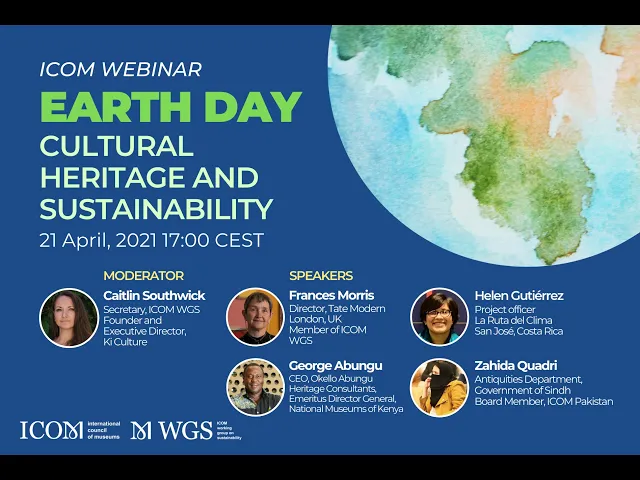
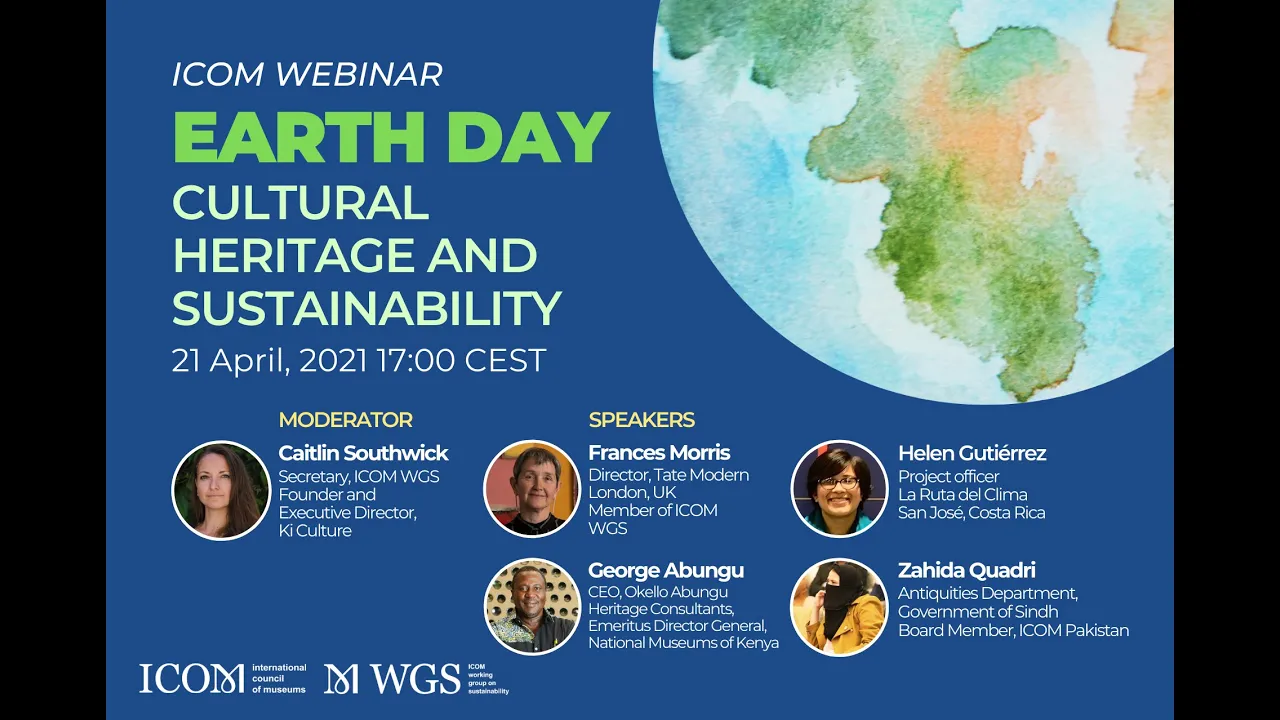
Welcome everyone my name is Caitlin Southwick i am the founder and executive director of Ki Culture as well as the secretary for the working group on sustainability at ICOM it's a great pleasure to have you all with us today. Tomorrow as I'm sure you are well aware of is Earth Day so we wanted to take this opportunity at the working group on sustainability to celebrate Earth Day and to talk a little bit more about sustainability and we have four incredible panelists joining us today: professor George Okello Abungu from the Okello Abungu heritage consultants nairobi and
Emeritus Director General at the National Museums of Kenya we have a Zahida Quadri who's the antiquities department and government of Sindh and board member of ICOM pakistan we also have Helen Gutierrez who's the project officer of la Ruta del Clima in san jose Costa Rica and Frances Morris director Tate Modern so I'd like to start by telling you all a little bit about the ICOM working group on sustainability And what we're doing and what we've been working on in the past couple of years and what we will be continuing to work on over the course
of the next two years and then of course we'll be inviting our panelists to join us in presenting their discussions on sustainability and then we will have a panel discussion and finally open up for questions and answers if anyone has any technical difficulties today we always write the easiest thing of course is to try logging off and logging back on 99 of the time that will fix the problem but if you are continuing to have problems please post in the chat, my colleague Alessandro is going to be manning the chat so he can help with
any unresolved issues. If you have any questions at any point during the presentations please feel free to go ahead and post them in the chat and then we will get to them at the end of the session so today we wanted to talk about this issue of sustainability and sustainability is a really interesting concept because it has many different meanings to different people in different parts of the world which is why it's such a pleasure for us to have such a diverse Representation on our panel today so we'll be discussing what sustainability means and also
what it means for culture we're going to be looking at how culture can be advocates for sustainability and also take action itself. In 2019 the ICOM working group on sustainability passed a resolution at the triennial meeting in Kyoto on sustainability and agenda 2030. Agenda 2030 is the united nations formal declaration on sustainability and it is the blueprint for a more sustainable future it surrounds the five Ps people planet peace partnership and prosperity and underlying this agenda are the 17 united nations sustainable development goals which highlight 169 targets for achieving a sustainable future in the resolution
icom has adopted the agenda 2030 and the united nations sustainable development goals as essential and vital for museums to engage with and this is what we're going to be discussing today the ICOM working group on sustainability has been working towards integrating the united nations sustainable development goals and the agenda 2030 into the work of icom and also to be able to Integrate it into the work of our institutions as museums so what we'd like to do today is go around and talk to our panelists a little bit about their experiences i've asked each panelist to
discuss a little bit about what sustainability means to them and also a little bit about what - their work is uh has been related to sustainability in their personal experiences and i think one of the really important things about earth day and about sustainability actually is to understand that sustainability affects all of us and therefore it requires a solution that includes all of us and one of the things that i'm really hoping we can highlight in today's session is global partnerships as well as local cooperations and how community engagement and involvement can be a hugely
powerful tool for our institutions and also how we can create global collaborations to tackle this issue as a sector in a unified way so without further ado i would love to pass over to our first panelist George who will be discussing his work in sustainability so George if you don't mind the floor is yours Okay first of all let me let me let me thank you really profusely for inviting us to have a chat about sustainability and the issues of culture or heritage or museums i see that there's quite a bit of representation before some
of these guys were removed including my brother is there maybe next time you invite my brother patrick he's much better than me i think in in that area because he practices it uh all the time so maybe you should have his name and invite him next time my follower now i was looking at the question of the sustainable development goals and i think that heritage although culture or heritage is not specifically mentioned and many people do grumble that it was not mentioned that it should have its own space within the sustainable development goals i think
that the fact that it is not specifically mentioned allows it to permeate all along the different goals the 17 goals and when i counted i realized that you can actually directly or indirectly apply museum work and heritage work and culture work to 11 of the sustainable goals whether you are talking of goal number one on poverty no poverty or zero hunger or Health and well-being quality education gender equality and number 10 reduction of inequality sustainable cities and communities responsible consumption and production climate action or peace and justice with strong institutions or just partnerships which you
have mentioned in your last in your concluding remarks they all apply directly and they require uh our cultural unknowns to to to to intervene now taking museum for example and we'll come back to these issues later there are a number of terminologies that museums do carry sometimes not at the same time but we aspire for them things like relevance we can only be sustainable if we are relevant to the communities in which we serve whether we are providing education whether we are advising on issues of landscapes or environment or climate relevance for me is crucial
and i think that museums always strive to be relevant the other thing is inclusivity museums try to be inclusive of all voices irrespective of how different they are and i think it is through those voices through those democratic voices that we are then able to discuss issues like gender equality Things like that reduction of inequality those are key uh sustainable goals that are actually we are looking forward to looking at whether we are discussing peace and justice the issue of inclusivity is absolutely paramount also the issue of awareness museums are always around to create awareness
either through education through communication through advocacy so awareness and advocacy for me are crucial in sustainability at people who are aware of their well-being people who are aware of their needs are people who are aware of their climate people who are aware of their environment are people who are able to treat it in a better way so that it can be sustainable then the question of partnerships and benefits i think we always try in the culture sector to create benefits whether we are talking dealing with artists in terms of music or we are dealing with
artists in terms of art and maybe uh frances will agree with me in the case of that you know it's benefits it is how do you better how do you create benefits out of the entity and without benefit there can be no sustainability so i think this is something That is incorporated in the museum language museums are also known for their education and in this particular area which is basically quality education is sustainable development goal number four in the sdg quality education I think museums complement the formal education by bringing in students children the grown-ups
the communities and they do that and so for me they are directly complement the area of education and therefore provision of quality education which is number four in the agenda the question of conservation which also looks at urban renewal and this is an area that i would like to come later because i have an experience with africa and especially east africa where you have urban centers which are conserved and where communities are living and where conservation work is done and where there are revival and development of the culture and this culture then is transformed into
an economic affair which then benefits the community either through tourism or direct buying from communities because they need these things so when we are talking about let me say agenda number number 11 which is sustainable cities And communities i think that conservation that museums promote is part of this sustainability that we are talking about so for me and for coming from this particular area conservation and upper renewal is part of that then there is the issue of dissemination disseminating knowledge disseminating information disseminating information to create awareness which is part of the museum then there is
the element of transformation for us to be able to be sustainable we must transform ourselves and sometimes our actions if we are not doing the right thing particularly for environment, museums are always the spaces where we discuss these things where we carry out exhibitions where we can learn to do better where we can actually exhibit environmental information where we actually have groups of environmental groups young groups to try to promote that so i see dissemination and transformation as very important the other one is impact, the impact that we make on communities through our actions through
our exhibitions through our educational programs through awareness creation programs And through many other programs that we do on culture are absolutely crucial in terms of sustainability and so we fit in perfectly there there is also the element of transparency we are talking about good governance there is no better place of dialogue and discussion than a museum there is no better place to exhibit issues of governance to exhibit issues of gender equality to deal with matters that you cannot be able to speak outside there that you can only speak through exhibition that touches people in their
heart when they see it so the museums and culture becomes crucial in that and so governance through transparency is absolutely important and lastly for me in this area is the issue of the future how do museums think about future because when you look about the whole issue of such development it is about now and the future do what is right now, so that you can leave this world a better place for the future and i think that museum should be projecting much more on the future just as they project on the present so the one
future for me is absolutely important And so for me out of the 17 sustainable goals of the u.n 11 of them are directly or indirectly impacted by the work that we do in culture the work that we do in museums and so museums should not be sitting aside and waiting for example let me let me take the case of the coronavirus all you hear now is how many museums are suffering how many you know staffs are being laid off how many museums are collapsing we would like to hear how many museums are in the front
line discussing culture as part of the solution of the problem not just looking at economics and health issues but culture as one of the drivers towards finding a solution for the pandemic that is actually turning the west side upside down we should take that rightful place and be able to say that some of these things are cultural issues that you can only turn around using a cultural language and there is no better place than a museum to be able to speak that language to bring in the people so rather than just mourning over the problem
that we have and how many of us have got coronavirus and all that kind of stuff we should actually be saying how Many exhibitions we have placed on each of the museums that we have whether they're 95 or 104 how many percentages have been able have stood in the front line advocating for particular change in cultural norms for including cultural activities for being there to mellow and to soothe the hearts of the people and communities who are suffering from this disease from this pandemic so that we are sitting there with everybody else because when we
are alive and when we are playing that role that for me is what sustainability is all about and at the end of the day the sustainable development goals as you have correctly pointed out looked at the issue of how we can actually take action in the area of climate change how we can in you know reduce issues of unemployment how we can strengthen gender equality and how we can create a peaceful society you cannot tell me that culture and museums cannot play role in those and maybe later when we are discussing we can then actually
give specific examples for example i have some examples that i want to say where museums have played A role in actually generating job employment in creating a market where artists are able to create resources to create products and we go outside in the market and stand outside there and sell their materials and sell their products through reviving of their own cultural products which are in demand and which does not contravene any of the the ethics of the museum but instead promotes that so to conclude i think that from whatever part of the world we are
and in any case the SDGs importance is because it is it applies both to the rich and the poor to the north and to the south in an equal way so wherever we are i think sustainable development goals must apply equally and each and every one of us must use the resources that we have the institutions that we have cultural institutions like museums to promote those and if we can play at all in promoting 11 of the 17 i think we would have done a great job Next time i think we may even go and
promote the underwater living thank you very much amazing George thank you so much that was an incredibly inspirational start to the conversation and i particularly loved what you were saying about The relevance but also the awareness and advocacy and how important it is for museums because this is this is something that I also very strongly believe that you know culture has the capacity to connect people with issues on sustainability in a way that sometimes facts figures news outlets just miss there's that that emotional attachment there's that empathy and understanding that you get when you're dealing
with culture that really is imperative for basically making people care and so it's really a beautiful thought to understand the agency that we have as cultural professionals and I also really loved how you highlighted the interconnectivity of all of these different assets and and facets of of sustainability so i'm looking forward to discussing more in the in the panel discussion so thank you so much George for your thoughts. I'd love to turn over to Helen if that's all right to um tell us a little bit about her work in Costa Rica so helen the floor
is yours well thank you first off for the invitation to come speak on this panel i'm really excited to Be able to talk about and share some of the work that we've been doing with the organization that i work with so today when i was preparing what i was going to talk about I kind of did a little short little list of words that i generally associate with sustainability and there were two kind of big overarching concepts that kept popping up for me and one of them George mentioned which is change and the other one
is for me is Justice so when i hear the word sustainability mostly because of my background and the work that i currently do which is almost all focused on climate i tend to focus more on the environmental aspect of sustainability but of course everything is connected so we can't talk about the environment without also talking about society culture politics economy health and everything else that you can think of so and as the sustainable development goals make very clear achieving sustainability also means addressing climate change so i think this is gonna Be the aspect that i'm
going to focus on mostly throughout the rest of my talk so i think in general there's a lot of ambiguity around the term sustainability and often when you hear it in more popular narratives a lot of what it's associated with is being quote-unquote eco-friendly or switching to more sustainable lifestyles meaning people are making the switch in their consumption patterns to more environmentally friendly products and other kinds of behavioral changes like using less carbon intensive transportation like biking and all of these things which are often more focused on individual action which in and of itself is
not bad but often this kind of narrative is embedded within privilege because this is the kind of lifestyle that's not necessarily accessible to everyone and i think one of the most stark examples of this kind of disparities illustrated by the many central american farmers who lived off the land most of their lives and are now unable to continue doing so because if they do they most likely won't survive so for a lot Of these people they're facing deep and systemic inequality there are high rates of poverty and food insecurity violence in a lot of central
american countries is a huge problem and they're also facing the direct impacts of climate change so for them to be able to live sustainably as they used to has become unsustainable and many of them are forced to leave their homes permanently and central america is also one of the regions that's most vulnerable to climate change not only because of the existing social vulnerabilities but also because the region geographically is more exposed to certain kinds of climate impacts and this is also a region that lacks a lot of the resources that are necessary to deal with
these impacts and this is due to existing inequality and disparity and this is also a region that has statistically contributed the least to climate change in terms of greenhouse gas emissions so if you look at comparatively across the world the regions or the countries that have contributed to climate change via greenhouse gas emissions were pretty low on the on the list So when i say that i associate sustainability with justice and change for me that means that for a more sustainable world we need justice for the people who have already been impacted by climate change
as well as other kinds of environmental harm as well as the resources to deal with current and future impacts we also need to dismantle the systems of oppression that makes it so that one group of individuals benefit from the oppression of others we need ambitious, effective and immediate climate action and we need to ensure that those who have been most responsible to contributing to climate change are also held accountable and all of this is deeply tied to the notion of justice and the basic and the respect for the basic human right to live and to
have health to live a dignified life and to get there will require as George said deep and transformative change so i think the sdgs or the sustainable development goals are a really excellent step in the right direction but i think if we want to truly achieve a more just and equitable and sustainable world i think we're going to need solutions That are very creative and interdisciplinary and that perhaps go beyond what the sdgs currently call for and i think it's in the space that arts and culture play a really critical role in imagining what is
possible and how we can collectively move towards meaningful change so climate change lies at the intersection of cultural and physical processes and it's the social and economic and cultural constructs that really create the conditions that perpetuate the sustained emission of greenhouse gases and the lack of political action um to kind of contain these actions and so it's also these constructs that reproduce the systems of oppression that make some people feel the impacts of climate change more than others and understanding the cultural aspect of climate change and the role of culture as a discursive tool for
maintaining the status quo is really fundamental and i think it's in this context that art can be a really powerful tool that allows us to begin to question these constructs and helps us to better understand and situate ourselves within this world And also just kind of that art plays a really important role in upholding and transforming dominant narratives so i think it's a really powerful tool that we can harness in order to create change and so i've seen in many instances art used as a tool for social activism as a tool for raising awareness about
specific issues and also for the preservation of ancestral cultural knowledge and practices which is also really important if we're talking about sustainability and then on the other hand i think it's important to acknowledge that the creative process itself of making art can also have a really profound effect over the people who create who create artwork and can also change the way that they situate themselves within the world but i think if you look at the kind of climate discourse more broadly you'll really see that art and and culture in general have been conspicuously absent from
these conversations and the conversations around climate change in general tend to be really Technical and heavily technocratic and so when you go to climate spaces like for instance the climate summit from by the united nations or CoP as it's commonly known what you'll hear a lot is voices from the physical sciences sometimes voices from the social sciences a lot of politics and almost no voices from the culture or humanity sector but climate change is an issue that affects us all and so i think creating spaces that these other voices can also participate in is really
key for achieving meaningful change and so well some of the work that we do at la Ruta del Clima actually all of it is based on our human right to participate in climate governance and our right to have a say in the decisions that are going to affect all of our lives and so we were kind of analyzing this disparity that we noticed in within the climate sphere and the humanities and we thought that it was really a unique opportunity to try to implement a project that might help to bridge this gap and so the
project that we came up with is called in spanish "Hilando Justicia Climática" and this translates very roughly to the act of stringing together climate justice and the word "hilar" means it refers to the act of spinning a raw substance such as cotton or silk into threads and so there was something that really spoke to us about this this kind of analogy of taking something intangible and and creating something a little bit more concrete and the project itself is the result of a collaborative effort between our organization La Ruta del Clima the costarican embroidery club the
costarican jade museum and the Heinrich Böll foundation and our overall goal is to create a space and nurture a space where we can talk about issues related to climate change and climate justice and and learn about all of these things while also using embroidery arts kind of as our chosen medium of expression and we also chose embroidery not only because we're all really keen embroiderers but also because it's a an art form that has been traditionally marginalized within the more formal art world and so in this project we've created a virtual space which we hope
will become a real physical space in the future Pandemic allowing for people to come together and learn and talk about climate justice while at the same time embroidering and this format is modeled off one that's been used for quite a while by the costarican embroidery club where people come together to embroider and just chat in general about different topics and so so far we've hosted two virtual meetups and shared two open access embroidery designs and in the first meeting we talked generally about climate change and what it is and then the second one we do
we dug a little deeper about what climate justice means and and how that's linked to feminism and then in the following meetups we're going to have two more we're going to be talking about participation and empowerment about climate change and the last one will be focused more specifically on climate sorry i have a dog um and the last one will be focused more specifically on climate impacts and so aside from our our virtual meetings we're also sharing content and information on social media to complement this conversations that we've been having And in fact next week
we'll be highlighting a few latin american embroidery artists where we hope to start a conversation about the different ways that embroidery art can be and textile arts more generally can be used as a powerful tool for environmental activism and then to finish our learning process we're going to be embroidering a collective piece hopefully if the conditions allow that summarizes everything that we've been learning and discussing during our conversations and then hopefully taking it to Cop 26 which is going to be held in Glasgow and hopefully foster a conversation that's a little more rich and diverse
perspectives on climate justice and so i think just to close i wanted to mention that our partnership with the Jade museum has really enriched our project not just because it has provided us with some of the spaces to hold our activities also because of the visibility that they've given our project and i'd also like to point out that the idea of bringing together embroidery and climate change is a bit of a crazy idea and not necessarily one that's more accepted in traditional Uh spaces so i think one of the things that we're most grateful to
the museum is in validating and legitimizing our project by becoming our official collaborators and providing an alternative space to hold such such an important conversation so i think i'm going to close with that and i think sorry about the dog oh not a problem amazing thank you so much helen it's so exciting to hear about um the projects that you're working on and I think what really resonated with me was you know well maybe embroidery for some might be a non-traditional way to talk about climate change that's part of the the issue that we're that
we're discussing today is the different approaches in different languages with which people can understand issues related to sustainability and that's of course the power of culture is that we can communicate with people in different ways as you pointed out a lot of times especially climate discussions are very limited to scientific jargon and i mean when i first got into this nexus of sustainability and culture and would be talking with a climate scientist or even a sustainability engineer And they start throwing out you know kWh and EUI and all of these acronyms that me and you
know mega tons of carbon dioxide and it was didn't really mean much and so if we can find ways as cultural institutions and as cultural professionals to connect with people in a way that fosters that comprehension that understanding that is what it's all about and expressing climate in different languages is a really beautiful thing so i'm really excited to to learn more about the project and thank you so much for sharing so it look it looks like we have zahida back so i would love to pass over to Zahida to finish her presentation so Zahida
are you with us yes i am and i'm really sorry for the inconvenience that occurred due to my connection instability it is not sustainable so i think that was the problem absolutely no worries the floor is yours thank you thank you so much so i was talking about the potential that pakistan has regarding harnessing heritage and its museums to address global challenges and i was quoting one of the examples in fact a project that government Has initiated in 2019 the Billion Tree program and it really got a very good feedback from people in the local
community the figure I was sharing is that 3.5 billion trees we have already planted and we u you know wanted to plant three billions more by the mid of 2023 but due to the Covid-19 you know the project was badly affected and we were waiting for resuming all that again so the best part of this project was the government has invested in a field which is very much under represented and underestimated like environment culture and heritage are fields which got less attention in government policies considering the status of under developed countries like Pakistan but interestingly
this process has generated nurseries which provide a livelihood to many and the program has generated ten of thousands of new employment opportunities, I would like to share a figure: when it was started the nursery stock we have is about 30 million all over Pakistan but like later it has increased And become 300 million and this is an official government statement of our federal minister of climate change, so see how on a micro level it benefits the community and i hope if it continues we will hope it will increase more jobs and more revenues for the
community later on, so yes the efforts have been taken to meet as much sdgs as possible like with this initiative our goal was to reach, or you may say we have targeted one of the goals, goal 13 climate action but on the other hand also covered goal number 1 no poverty and along with it it has also created an opportunity for decent work and economic growth lead to the goal number 8 so in this scenario we are trying to establish a sustainable future but unfortunately there are many hard things due to which it takes time
in implementations so now if we bring museum in this context to be very honest we are still far to relate sdgs and museums, a very interesting and a very important point raised during a webinar which ICOM pakistan has organized on international museum day last year was that when our museum Communities were struggling with pandemic shutdowns and loss of revenues and facing crises selling their museum antiquities to run their expenses and reduce the staff, museums in pakistan were stable and sustainable we did not face any issue of unemployment like I'm specifically talking about museum employees in
general yes we face unemployment but no museum employee was you know lost his job just because of the pandemic because our museum sector here is under the supervision of government and there funds allotted to them so instead of any such difficulties our museums were fortunate to looking forward for options how to facilitate their audience for example i was just supporting an example of the state bank museum of pakistan with one of its social media posts they have posted some selected selfies and photos that visitors will have captured there and that post got a 200 views
which for any museum organization pakistan is really a good number so then they have organized an exhibition which document lockdown and pandemic because for You know it's a kind of a phase that we have we all were being tricks and historical phases that came in our life and still stay with us so it has memories maybe terrible or whatever but it has memories so similarly the national history museum in Lahore they've organized a virtual exhibition for their visitors and they have launched their online storytelling sessions during lockdowns just to engage their audience with the museums
so like the this is how the museums are connected uh during lockdown and kind of um pandemic and all these things but uh the another point i would like to share here that our tourism policy which in the beginning of 2020 before pandemic it was like a boost of the tourism industry in pakistan Pakistan brought the maximum votes by travel adventure and was declared world third highest potential adventure destination for the 2020 by british backpacker society and later earlier a u.s travel magazine list pakistan is a top tourist destination for 2020 so it was like
it was we have a tourist places plus the tangible and intangible cultural heritage Which can connect your people from other parts of the world to the pakistan if you come here you will probably get a chance to meet with the Kalash people of the Hindukash which are the descendants king of alexander the great so the government has made heritage trail in a Peshawar as well and also now they are resuming the old railway track which was once active at the time of british period and it's connected to one city to another so people were moving
toward the heritage sites the museums and where it's like it's a trail between two cities so in case of museum in pakistan it is very much connected to heritage and tourism on the other hand and community here is need to engage with museum by creating events generally uh museum is not very much attractive for a local community until and unless museums themselves invite people to come and for an exhibition or foreign event and yes whenever we have organized such exhibitions or event at a national level or even a provincial level the response from community and
local people was amazing uh i would like to add one more thing in 2019 ICOM pakistan has to organize A week-long event and it was the women in museum you know it's a theme of ICOM women in museums so we have organized a week-long event woman and museum and the participation from female curators was really amazing and groundbreaking because interestingly the higher authorities here in pakistan they are kind of you know male dominated society so they do not just give very much a good space for women to take a lead during um i mean the
work space or you you understand so but during this week um the each and every event was organized by the woman and attended by the woman so yeah i can say that during this woman in museum week it totally changed the scenario in Pakistan entirely for in all provinces and that was one of the major projects of museum in pakistan that took women in all museums in league so yes still uh there are many policies of related to climate change or climate sustainability and heritage which remain unimplemented and still there is a need to find
ways to better capture the complexity of heritage and rigid impact but that's how we are moving toward the achieving Our sustainable development goals through museums heritage and tourism so thank you so much amazing Zahida thank you so much i'm incredibly inspired i love the uh the events you're talking about with the women in museums and it's just it's it's really moving to see what power and what and empowerment can be gained through institutions and also through events but also just advocacy for these these types of initiatives so i'm really excited to to learn more and
thank you so much for sharing i think another thing that was really interesting that you were talking about was museums offering events in order to facilitate engagement and especially with local communities and how powerful that is but i also find it really interesting talking about what george was was discussing in his conversation about inviting people in and not just giving outputs but also getting inputs from communities and i think this is something that we'll touch upon in the panel discussion but of course i would love to discuss that after we hear from Our last panelist
so it's with great pleasure i'd love to turn the floor over now to Frances oh Frances you're still on mute there we are. Caitlin it's it's really lovely to be here and it's always it's good to be last because with a great panel like this i find a lot of really important things have been said and one of the striking aspects of this conversation today is that we are all part of this incredible ecosystem which we call culture and we all occupy incredibly different spaces within it but we are all bound together and our fates
are bound together so it is incredibly important that we meet together and find a way to move forward kind of in solidarity and you ask Caitlin for us to talk about what sustainability means to each of us i think for me as director of tate modern it's so much more than you know the kind of working towards carbon reduction though of course that plays a part but it kind of represents a code of conduct acting within a kind of ethical and artistic framework And economic framework that delivers a range of social and civic responsibilities to
the public and can help change the world and if we're going to survive and thrive we need a new set of structures and systems and beliefs to create our code of conduct i mean all of our all the museums all of us in ICOM we're a huge community and we come in very different shapes and different sizes from from very different places and so i just thought i don't want to say too many general things because George and Helen you did that so brilliantly alongside Zahida and helen's kind of micro stories of engagement but i
thought i might just talk a little bit about Tate Modern as a case study because Tate modern is a relatively new museum we only date from 2000 so a very modern 21st century museum but we're part of a much older museum founded in the late 19th century which is absolutely part of that baggage of colonial capitalist Europe the foundations not just of culture but also of climate emergency and all the things that mean that we need those sustainability goals we're a public Institution with a civic person a public mission we're free to our public but
we only have 50% of our funding from public sources so we have this extraordinary and problematic business model where we have to balance that civic purpose that has civil service mentality with a pretty shrewd entrepreneurial income generating model for ticketed programs was substantially dependent on commercial enterprise both corporate and philanthropic and like many museums at least in the western world we carry all those paradoxes and internal contradictions with us while abiding by a governmental governance model so it's a really interesting and challenging kind of organization that doesn't fit any single model it is genuinely hybrid
we have a long history of thinking about sustainability in terms of our building and our operations and that's partly because we've built several buildings in the last decade so being a a institution that is committed to creative endeavor and innovation we've naturally gravitated towards architectural engineering practices who are interested in sustainability But and we have a team that's very committed to it so a lot of the groundwork in terms of kind of just number crunching and reduction of emissions has been in place and growing since really the early part of this century but there was
a huge paradigm shift for me as director of Tate modern when in 2019 we made a kind of official declaration of climate and ecological emergency and that meant like putting out a press release saying we recognized what was happening in the world we were terrified by it and we want to be part of driving solutions and understanding the problem and I think we did that because of a growing unease amongst many of us in the institution a sense that we needed a step change but equally really big bold pressure from artists in our community who
look to places like the Tate as institutions that hold trust are trusted by the public that have high profiles that we can provide a voice and leadership and advocacy, we can burn our bridges and we can shield artists from having to put themselves on the front line so at that time in the uk globally there's a context Of Extinction Rebellions activism and as Tate is so, although we are a huge global organization we also are very hyper local very embedded in our neighborhood so the kind of community-based programs were also putting pressure on us and
we're raising really really important questions around race equality around access all those issues that have been thrown to start relief by Covid and also called underpin the need for those sustainability goals and agenda 2030 so making that declaration was really important and as i said it was like crossing a line from passivity to action from kind of working underground under the radar to full exposure and you know having taken that we are full exposure is absolutely we have to be held to account for everything that we do and since that time we've been much more
exposed and criticized and held to account on social media which is scary but probably in the end a very good thing it's a very it's a it's a very open space for judgment and criticism so the last two years alongside Covid which has both had a massive impact Complex impact on the whole context of sustainability for Tate and the cultural sector it's been difficult navigating the kind of conjoined emergencies but i just wanted to take you through some of the kind of play out the impact of that declaration one is that across the whole organization
there's been a much more energized sense of working towards practical solutions for really grappling with the kind of deep but more polluting aspects of our business so taking responsibility we've had a full audit of our carbon emissions from Julie's Bicycle in London and that information is real knowledge a little bit like the way the science has helped us with dealing with Covid information around our processes our buildings has helped us we've switched to an entirely renewable energy provider we've reduced almost eliminated single-use plastic I mean i know we're all doing these things we're trying circular
economies we've removed salmon from the menus in our shops and also then in delivering our programs and then here we have been massively helped by Covid we have reduced our productivity by half we've doubled The length that exhibitions are on the walls for we've halved the number of works we loan we've slowed down we've intensified and all that has actually had a huge impact on the experience of being in a museum we have been at the height of neoliberal growth and expansion for 20 years and we all realize that it's got to stop so beyond
those practical actions when I say it's got to stop i really mean it's got to stop the model is broken we know the model of industrial civilization is broken we know the model of capitalism is broken we know the power players are broken and the museum is inevitably a microcosm of all those things so the model is broken and you see that very starkly uptake just to get come back to the practical very quickly we are an institution that principally serves international tourists and we do that because that is where our income comes from but
80 percent of our carbon footprint is also accounted for by their journey they come to see our big blockbuster exhibitions which themselves account for a significant proportion of the remaining 20 we're caught in this kind of extractive consumptive Model at the same time those exhibitions take energy and resource and imagination away from our wonderful permanent collection our kind of circular economy because it's always there our work with our schools and our families and our work in the community so what is this doing for our ecosystem the model is is not working and we absolutely now
look to really need to look at serious systemic shift and we've got to survive so it's a kind of pivotal moment in our history we'd recognize the problem but in acting, in solving the problem can we survive? it comes down really to thinking about what the true value of art is what is the true value what does it really deliver to people and what is its true cost? and they are not monetary equivalents they are about value in terms of education in terms of access it came to learning in terms of narratives and those are
the things that we need to treasure and nurture and that if we're going to deliver them we need deep and fundamental change within that and we're a big museum how can we use our very trusted position As a thought leader and a role model not to influence not just our audiences and our internal ways of things but how can we lever that to challenge our political and and economic leaders because we need big change to some exchange from a leadership position we need it at grassroots but we also need in any ecosystem we may need
to make the networks work for us and can we in what we do demonstrate by our behaviours an alternative model to the growth model, there's huge cynicism about that out there about whether museums can change we have to change and we have to initiate it ourselves can we evolve as an organization or organizations that puts environmental and social responsibility at the heart of the business model not outside it so that really i think i probably got to the end of my time that is where i am at the moment that thinking about the wider understanding
of value thinking about the museum's core mission of access and inclusion and fundamentally they are aligned with agenda 2030 and those sustainability goals we're asking big questions George you talked about the power of art Helen you talked about the power of embroidery of course there are so many ways to tell a story and we need many ways for the huge public who need to come on board to understand our stories and part of the true value in art is the value of the imagination of storytelling of narrative of engaging people in profoundly non-verbal but interactive
ways rethinking the past and envisioning the future and i'm just going to end with a beautiful quote from Susan Hiller great friend and brilliant artist who died just before Covid but she described art as a locus where futures otherwise not possible can begin to shape themselves and it's that otherwise not possible that speaks to me of the absolute importance of culture to sustainability amazing thank you so much Frances i think that's an incredibly powerful statement thank you so much for sharing that you know i mean one of the really exciting parts about having such a
diverse group here is that while we all have very different perspectives there seem to be many common threads and i'm really excited about spending the next 20 minutes or so exploring these with you i would like to also invite our audience if anyone has any questions please feel free to put them in the chat for any of our panelists and we will we will go through those um but I wanted to kind of touch a little bit upon what what Frances was talking about the models being broken and i don't know how everyone else reacted
but when Zahida said that there were no layoffs at museums in Pakistan because of Covid i was very impressed by that and shocked and i think you know there's a lot of different elements that we can discuss here in terms of learning from each other and i think that part of it is the economic models as Frances mentioned a lot of museums particularly in europe and in north america are very reliant on this these very broken business models that kind of keep museums in a place of short-term thinking and survival mode and forcing layoffs which
perpetuates job insecurity which perpetuates a lack of diversity in the field and it's just all this big messy web but and then of course we've also talked a little bit about Relevance in communities and you know some institutions are obviously doing it better than others and being able to you know move away from blockbuster exhibitions and we'll get into all of that and the accountability as well but what i was interested is something that Helen said about accountability and this is a controversial perhaps topic but one of the things that i've always been interested in
is this concept of you know climate control and in a lot of museums people insist that climate control is absolutely essential and you know or they say it's essential because of loan agreements or what it is but i gave a presentation at an ICOM CC conference in 2017 where i was talking about lowering the climate control restrictions in different institutions and someone came up to me afterwards and she said you know Caitlin we're already doing all the things that you say to do but it's because we only have access to energy three hours a day
and she worked at a museum in indonesia and so it's these ideas of you know financial models also maybe greener initiatives more engagement With community that we should actually be sharing and learning and i'd love to hear from the panel you know what how can we better work together how can we share our experiences in order to come up with solutions that are going to be more effective and help our institutions because it seems to me that people are doing really great things in different parts of the world but we're not communicating it or sharing
it in a way that's getting engagement on a global scale and as a sector unified so i'd love to open up the floor to the panel to if there are any reactions i don't know if anyone wants to take that first no no thoughts George maybe you have some uh thoughts about that. Yeah maybe i come in but from a different angle I wanted to give a few examples also from an institution that i am very much used to it that i also ran at some point back some years ago which is the National Museums
of Kenya and i think the National Museums of Kenya has done a lot of good work of course that doesn't mean that you know everything their tried has been A success but i think they have made impact on human life and I have a the way i i'm a little bit reluctant to reduce everything to basically climate change the whole sustainability to that because i think there is more to it than just climate change and i think that this is a problem that we have had before where we tend to confine ourselves within a set
structure of a box and yet we don't have the language that those people who control that box have and then at the end of the day we probably lose out i mean just in summary in what sustainability means some of the development goals i mean it says what is the aim of sustainable goals and in short the aim as they say is to end poverty protect the planet which now brings climate change and ensure that all people enjoy peace and prosperity now and the future so there are about three elements there and climate change which
is about environment is one of them and we know that environment of course catches on everything and very quickly i just want to mention some of the work that i think have been sustainable That the museum as a museum in kenya has done and also in Tanzania and other parts of Africa and very few, very little of this is known outside because museum is defined from the norm so much and it becomes something where people go and look at exhibition and then enjoy themselves and go back but the african museum since the 1990s have been
very proactive with communities and two examples, two or three examples in areas that i think are crucial but which we take for granted one is in the area of knowledge systems and of course South America is known for this i think Helen you've mentioned quite some of that stuff knowledge systems especially traditional knowledge systems that a lot of that is disappearing but if you look at the knowledge system of the past they are extremely important in terms of food production and the types of food that we are doing live along this genetically modified food that
we now have in terms of medicinal plants which have become what ecologists and other people have Exploited and turned into the medicines of the present that you go to the pharmacy and buy in terms of peace and conflict resolution and for example the National Museums has been working on these knowledge systems in relation to some of those where they are looking at issues of plant issues for food and helping the communities to produce the traditional foods that sustained them and that were used as a buffer against hunger, because hunger now comes because everybody has moved
into these new crops that you have to depend so much on others to give you seeds but people used to make their own seeds and people used to have particular crops that grew in particular areas so this is an area that they have gone into and they are that for me is sustainability in terms of peace and conflict resolution they have used the traditions of pastoralists you know pastoralists are always in very difficult environments and because of those environments there is always a possibility of conflict because people are fighting over there is The resources that
are always very scarce for example water for example pasture and so on and because of those experiences they have developed mechanisms of reconciling and creating peace amongst themselves when we talk about conflicts and peace now when we talk about environment and climate change, climate change may actually introduce a lot of these problems that you have in desert and semi-desert areas now one area in which we could be able to benefit from is from this knowledge of the pastoralist and the communities who have grown up and developed these systems of peace building so in this case
the national museums actually from the 1990s worked with the pastoralist communities to build this knowledge of peace building which then is used even currently so that it is not forgotten to try to bring peace among communities especially when they are now faced with conflict arising out of climate change which is bringing you know challenges in terms of resources and i think that for me is very powerful the third and last example i have many of these examples but i'm giving you examples that have been used by the Museum here is that the museum is also
in charge of monuments sites and historic towns and one of the towns is listed as a world heritage list on the world release which is Lamu and then there is Mombasa these are old towns where people are living and working and have created architectural phenomenons but the knowledge of this creation was disappearing and yet these places were listed as World heritage or as heritage places in order for us to be able to sustain that we had to actually train young people in the traditional knowledge systems of architecture or masonry of art but it was done
in such a way that they created a swahili cultural center where they were also trained in business administration in proposal writing and also in fundraising and to cut the story short some of the people who were trained in the 1990s and 2000s now own their own shops produce their own produce and run their own businesses and they are the ones who are now maintaining these old houses and towns and landscapes because they have that knowledge which was then gifted to them by not the museum itself by the traditional knowledge bearers who for years Have done
this through passing it over generation regeneration but the lead agency was the museum so the museums can do lots of other things and i think when we talk about sustainability it's about making sure that what you have can be able to be passed over even in a better way and that it meets the needs of the present generation that for us is sustainability and so i think that environment you can only talk environment when you have people who can feed themselves you can only talk environment when you have people who are aware of the problems
you can only talk environment when you have a people who are free to express themselves and you create spaces for expression, the museums provide those particular spaces do those things and it does work in africa and i think it can work everywhere else it's not just a place where you go to enjoy Van Gogh and Picasso and then after that it's over but as Frances has mentioned you can do it in england you can do it in europe and what they are doing is very similar to what we are doing here which Is practically applying
to communities and to people and to the institution it's creating a change and transformation absolutely amazing George thank you so much this is exactly why i wanted you on this panel because i think that there's such powerful examples and i also really love what you were saying about incorporating indigenous or traditional knowledge and that was something that um Helen had also touched upon um in in her presentation i know that Frances had indicated that she would like to maybe have a reaction you know I've been so carried away by Georgia's narrative that i can't really
remember what the question was about but i think George is absolutely right i mean the the role that museums can have in that broader sense of the environmental which is about changing people's lives and providing with access and being part of the ecosystem is, it's not about where in the world you are it's about what kind of organization you are and for me you know it's really important that the heart of what we do Is putting people in touch with each other and with a sense of renewal in their lives and this afternoon just before
i came onto the zoom i just had a really wonderful five minutes outside in our landscape helping two artists who are climate activist artists install a hundred very small oak trees which they have grown from tiny oaks taken from Joseph Beuys's great installation in Kassel which i think dates from the 1970s and it's a kind of gesture of renewal and hope andJoseph Beuys activist artist hugely significant international founder of the german green party and connecting this younger generation to that earlier generation and the public within them to show the power of what you can do
from a little oak for me is incredibly important so that how you connect these micro stories that touch people's lives and how they participate is and connecting that with the dry science and the facts and the stuff around decarbonization is the most important thing that we can do we can live it and help other people live it I love that and that's exactly the power of culture and i think this string that we're resonating with here about connectivity through culture but also on the different levels you know we've talked a little bit about kind of
grassroots we've talked about policy and we've talked about global and working together i did have a comment from one of our audience members and i'd actually love to pass the mic over to her for just about one minute to talk about her work in this area and then i'd like to swing over to Helen but Johanna if you would like. Alessandro if you can unmute Johanna for just one minute go ahead Hi thank you so much Caitlin and congratulations to putting this panel together It really brings it all to life in a cohesive way i
call myself a cross-pollinator working between the worlds of diplomacy, corporate and arts and culture and Frances, so glad that you mentioned about Joseph Beuys i've been living in Kassel for a year and just came back what I can help with is particularly in the work that we're doing even though we believe we're global These days you need people that are building those relationships with the policy makers because they find it very alienating to come to the art world and also you have in the art world initiatives like this that need to be put out there
to the people that have the power to make legislation as well as the people that have the resources and i'm very happy to bridge that i've worked with the queen producing reports the g20 reports and i've also been working with the world economic forum over the past few years so very happy to help that's one of the themes you know in terms of how not only we can advocate as cultural institutions within our communities and within our audiences but also on policy level and how we can influence that top down approach as well one of
the things that George was talking about that i mentioned was very much resonating with me was this idea of connecting with ancient traditions and indigenous communities and also what Frances was saying about accountability and this is something that Helen had talked about so i'd love to pass it Over to Helen now for her thoughts on this on this topic so helen floor is your thanks caitlin i might i think there were two points that struck me during this conversation and i the first was when Frances was talking about accountability and the role of the museum
as acting as kind of a protector for artists who are on the front line and i think that's a really important role that museums can take especially in a region like central and south america but also in africa and southeast asia where protections for environmental defenders and advocates really lacks and it's actually really dangerous to be an environmental defender in these regions and we have the unfortunate distinction of being i think the region that is most dangerous for environmental defenders so i think that the museum in this role i think could be a potentially good
way to kind of act as maybe perhaps a buffer in providing a name and perhaps shedding more light to this issue which is a really really important issue to us and then I Think the second point relating to accountability and environmental and traditional knowledge which i think is a really important role that museums can take is is also kind of acknowledging the colonialist history that some museums have had and the colonialist role that some museums have had and when we talk about indigenous knowledge i think it's often taken out of context and sometimes used in
an extractivist way where researchers come into a community they extract their knowledge and then they take it and the community who originally had the knowledge or the resources never really gets any benefit so i think that's a real another really important way that perhaps museums i don't know might broker this relationship and ensure that communities aren't only being extracted from but also on the receiving end and protected as well yeah and that's that's such an important fact what you're saying about the reciprocity and the mutually beneficial relationship and i think that's one of the really
powerful aspects Of cultural institutions as buildings and as physical places is that idea that we can invite in our audiences and our and conversations and create safe spaces for dialogue and this is very much what George was talking about at the beginning about museums and cultural institutions offer a place to have what could be seen as confrontational conversations and we have the capacity to talk about these issues in a way that is not confrontational but that is empathetic and i think that's that's a really interesting interesting point this actually kind of segues really nicely into
a question we received in the chat from a guest who's joining us from canada and she said in canada environmentalism is often perceived as divisive, a political issue and she's curious how to know how the panelists institutions navigate the political conversations that often accompany discussions about sustainability and i would actually really love to hear from Zahida on this if you would mind taking taking this one yes interestingly we have really have a good control on this because Before that we have a problems of political issues because in pakistan we have a multicultural country each of
his ex province has a different ethnicity and we have ethnic problem on its peak here which is also a kind of a major issue, a major backbone of conflicts arising in pakistan but in 2011 what happened was that the decision making power moved to the provinces before that the power of taking decisions regarding policy making or whatever was at a federal level so it was really a tension between provinces about who will take the control and the ruling party had all the rights to make decisions but after Eighteenth Amendment in 2011 the power has been
transferred to each province so now each province has a freedom to to make policies to make decisions and interestingly each province has its own political party so there's no clash on it, we all have our own cultural policies we have all museums which are not bound to federal government or any other province Interfere in our policy or any museum strategy we are free to develop, every province is free to develop its own policy they are free to develop their own you know heritage trails, I have mentioned that we are making a heritage trail so this
is basically made in northern Pakistan i'm from the lower part in southern Pakistan so the heritage trail was basically over there, and now with the collaboration of two provinces we are making a Gandhara trail from northern pakistan to the southern pakistan and this is in process so in this way we really have a good control on this political tension regarding policies on sustainability and everything so we really are free from these political tensions yeah that's that's quite amazing to hear and it's something that in some parts of the world is really a huge issue and
in other parts of the world they seemed to got a control on it so that's that's really amazing I don't know if any other panelists wanted to weigh on on this particular question before we Wrap up i know that we're a little over time yeah Frances please. I suppose just a slightly different issue here is that i think we as a state governmental organization it's very difficult for us, the perception that we might take a political position can put in us in a very difficult situation so we thread a tight rope in how we communicate
and how we perform as activists in this field and the relationship with artists is incredibly important when a recent activist group arrived at the turbine hall we welcome them we have to very careful about which words we use and so far that has been very effective but i'm very aware that it is an act of diplomacy and continuous negotiation because we need to sit between the two we need to negotiate that space actively rather than lose our public standing or lose the trust of our public you know the first and probably the only environmentalist who
has got who got a nobel peace prize was from Kenya, Wangari Maathai She had to undergo a lot of pressure you know from government and business and so i understand what the colleague from canada said i think the problem is that the government and the private sector expect activism from environmentalists because either you keep quiet and they go overboard or you say something and you are taken as you know being a protester and I think there is need for a balance for me and this is why i'm saying the museums are privileged institutions and positions
you can tell different stories you can tell many stories museums act as agoras as places of dialogue and discussion and some of these things you don't have to directly address them but by giving those spaces to those voices they may be different you let the people now decide and you use the museum as a place where people can have those different voices and i've seen museums that do provide those spaces for those particular different voices and let the community design i was reading i think it was today or yesterday's Art newsletter i think there's a
museum i don't know exactly where but it's getting a lot of burning for accepting money from Shell company which is an oil company i don't know what other colleagues would say but if they are getting the money and shell is going to correct the mistakes or Shell is not putting anything they can criticize shell i think that probably they can use that money to change their share so it's a difficult situation but i think that for me museums are places for dialogue and if there are places for dialogue they can provide those voices even if
those voices are not coming together but they act as places for people to come and judge for themselves so i think that we can play that role as museums without necessarily taking one particular position and for me that is the privilege, we can take positions and we do protect positions positions for the better one for good things but we can also actually sort of openly open up those wounds and let communities and people see for themselves The damages that are being done and being hidden by those who do that, whether it's government or business community.
Amazing, thank you so much George i think that's a really really powerful sentiment and i know that we're over time here so i'd love to i'd love to wrap up and actually what i'd like to do is to just ask for a final thought from each of our panelists if you could give one piece of advice or one tip for a practical solution for how we can start moving towards a sustainable future as cultural sector what would it be and i'd love to start with Helen if she's doesn't mind me putting her on the spot
Helen what do you think sure i think the first thing that comes to mind is the importance of museums as a space of for dialogue but also as an inclusive space and a space where perhaps voices that have been underprivileged or voices that have been smothered can also come to light and participate in these important discussions. Amazing thank you so much absolutely Zahida would you like to go next? Yes well i was speaking in context of my country Museum in pakistan have a great potential to create job opportunities for many of the people because we
are facing economic crisis so much I think that basically the government think that museums are just a place to display archaeological artifacts or some cultural objects, no. Museums have a multiple kind of opportunities for everyone. Just a quick example one of our World heritage site, the heritage site of Makli has a huge beggar community over there, so after we have initiated some projects and try to engage them in some kind of heritage related activities we involved them in conservation and work and now few of them are that much trained that they are supposed to be
guides in the museum, and they are 20 to 30 girls who will be museum guides in the coming six months, we are still working on it. So for me a museum is a Place to create job opportunities for very marginalized communities and even for the people who don't have employment so please do engage museums in policy making while you make policies for know sustainable development, it's just a piece of advice for my own government. Amazing thank you so much, Frances I suppose on a personal basis after or after a long career that has been spent
thinking about the past and kind of rewriting the narratives of the past bringing gender parity transnational to replace the kind of western modernism i think we have to think about the future and i would like to see museums making a kind of fundamental shift away from tangible heritage towards the intangible possibility of a future i think that's yeah we need to dream about the future and make it happen I love that it's really beautiful and George would you like to round us off yes thank you very much i think that there are about three or
four things that i think the museum Project if i can call museum a project, museums should finish the process of decolonization to finish the process of demystifying itself to finish the process of mind change which i think Frances did mention earlier on so that we can have a total paradigm shift and if we do that then my sentence my word would be that the museums should not do it for others but they should do it with others because if you do it for me you are against me if you do it with me we are
together i love that amazing, we do it with each other we are together that's beautiful a beautiful way to finish off this incredibly inspirational conversation and i have been looking forward to this for quite some time and i'm just so grateful for our panelists joining us today and for all of their time and insights and all the incredible work that they do so i'd love to thank you all for for listening and thank our panelists for participating today as the ICOM working group of sustainability we certainly hope to be bringing you more insightful discussions such
as the One we've had today and we would love to welcome comments feedback and ideas we want to start engaging more with the icom community so please do let us know reach out to us do let us know how we can help you what you'd like to see from us as the working group and we will be in more frequent communication upcoming so we're really looking forward to continuing to work together to position icom as leaders for this sustainable future that we're working towards together so thank you all so much for joining us today i
hope that you had as good of a time as i did and very much looking forward to speaking with you all soon and seeing you as we continue our sustainable journey together, and happy Earth Day!