of a beam particularly for IBS and if you look from the side that's what the variation this is the cross-section you will remember that the variation of shear varies Asajj here and here in various parabolically so that's the variation of tau the magnitude of out over the cross section for an Ibis once again it's time to go back to twenty-three-twelve and remind yourself that this is indeed the case all right so what are we going to be doing next time what you're going to be doing next time is very simply performing experiments that involve beam
bending and the intent again is to see how accurate and how true the relationships the equations the theories that you learned about beam bending and the shear you can be mending is how that accurate those equations are how much experiments experimental data supports the theory that we learned in twenty three now I will remind you that if you have a bar as such with a moment of light and at the end this code this is a case of bending or pure bending pure bending as opposed to the case where you have a beans that's Dutch
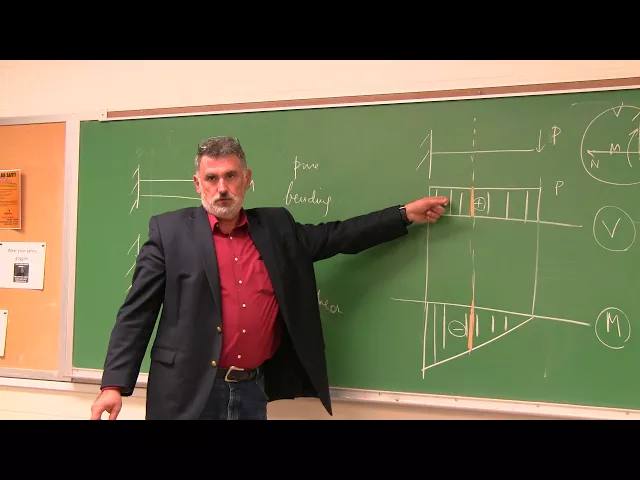
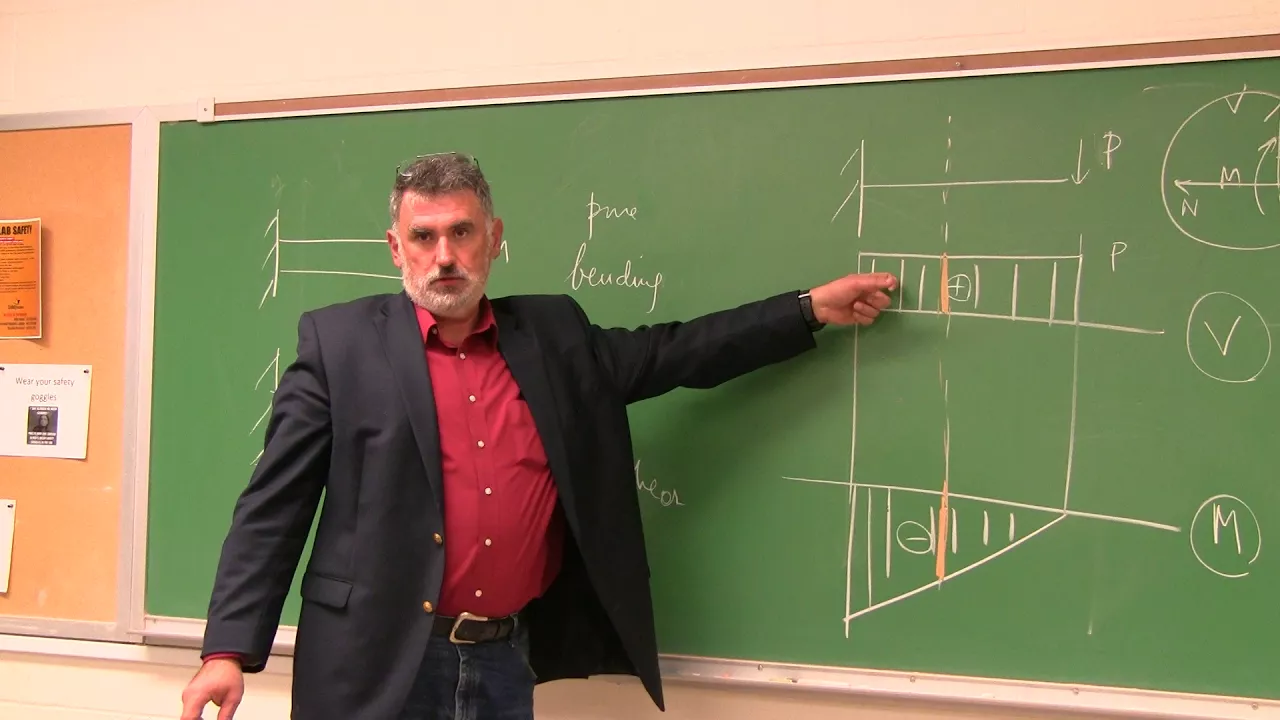
and you have a shear force and you remember that in this case or afar that has a shear force as such this opens you're going to have a shear force diagram and the bending moment diagram and I trust that you still remember how to do that I will remind you that for beam element what is positive is by convention is this situation and so this is by conventions what is positive for the for a beam element this is the convention for possibly face where this is the convention or a negative face the difference being that
the positive face has a normal in the direction of the axis whereas a negative face as it's normally outward normal in the direction opposite the axis so that's what positive many bending moment shear force and axial force are for this space and positive for this space so for this particular beam you're gonna have a shear force diagram that's considering here from here you start with a positive value so it goes this way plus and the value people whereas from the standpoint of bending pieces of the bending is negative it starts at zero here so this
is your distribution of the bending moment so you have a bending moment diagram shear force diagram for the case of a cantilever all right in this case at any cross-section that you issue in color you're gonna have a shear force and the bending moment so this case here where you have a load P applied at the end in shear it forms a case of bending which here so two kinds of been pure bending bending with sheer pure bending moment only no shear force bending would shear at every cross section you have both bending moments and
shear force as a result you will have a distribution of stresses associated with bending which are given by that equation and you remember that the equation was Sigma is equal to M times y divided by PI and there was a minus here in fact of the equation and then you have this division of shear force which is given by P times Q divided by B times I the shear force the static moment of all the area above the cross-section the width of the cross section and the moment of inertia all this again is are things
that I trust that you remembered from twenty-three-twelve if you don't you need to go back but these are two fundamental equations that are that you learn in twenty-three-twelve describing the behavior beam subject bending pure bending and this equation applies both pure bending and bending which shear and both of them apply for the case of bending which you so let's proceed for next time you're going to be performing an experiment using the testing machine and in that experiment you're going to be applying a force a set of forces to a beam in the following configuration you're
gonna have a beam and you're gonna have one supported here and one support to you and then you're going to have one force applied here and one support right here so 2 over 2 B over 2 and then obviously at the supports are going to have P over 2 and P over 2 this is called four points so we're gonna have a beep subject before appointment maybe I shouldn't represent the demon such to be more clearly for pointment a four point bending expert now when you look at this particular configuration and you draw the shear
force and bending-moment diagrams you have the bar you have these two forces and these two forces then the whole picture is symmetric in other words there's a particular distance here let's say a is this and then there's a distance here is B and here so the whole thing is symmetric and the whole bar will have a length and then if you do the shear force and the bending moment diagram for this case you have from this point here you have no shear force whatsoever then you have here the shear force jumping over to zero down
of their this point down here and back to zero so this is Plus this is minus this is the shear force bending moment diagram right so let me see ya from your - is correct and then for the moment you will have a variation of moment that has a positive slope here zero slope in between and the negative slope here so this is all positive so there are two regions of the beat there is this region or their piece who reaches here and then there is in another region that let me find the different color
red but brother yellow there's the region of the team here in the middle in the middle all you have is bending moment no so for the middle region you have pure bending for these regions you're going to have bending which here because anywhere in this in these regions you will have a certain amount of shear force and a certain amount of bending mode for the cross section so in one experiment in a four point bending experiment we can test both we can have two regions of the bar of the beam one that is where there's
a region there are two regions here and one in the middle there are two kinds of regions so for these regions you have bending which here you have both bending moment and shear force in the middle you only have bending moment therefore you have a pure benefit so in one experiment we can test both kinds of bending pure bending and bending which what's the basic idea well these equations are going to allow you to determine the stress distribution the normal stress distribution and the shear stress distribution at each of these cross section so we're going
to consider for this experiment one cross section here and one cross section here the profile of the bar is going to be an IV so this is the cross section of the meal and the dimensions of the hood of the I beam are going to be provided to you by the TAS the length of the bars distances between supports the distances between 1.0 the application all these are going to be provided for you by the TAS