The history of humanity is made by transformations . . .
Transformations that led to the domain of hunting, transformations that led to the domain of land, transformations that led to the mastery of space. . .
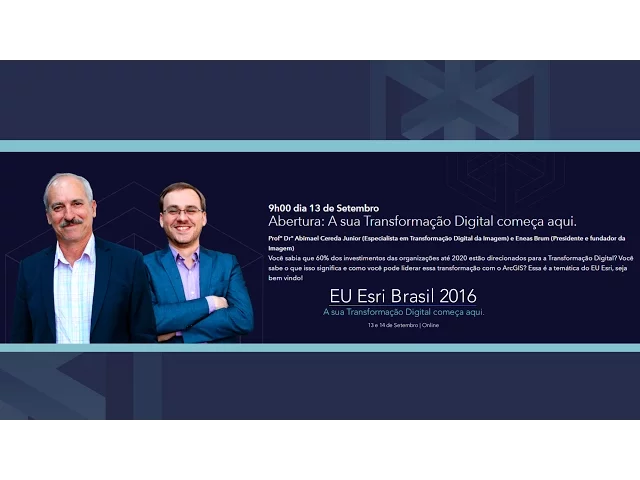
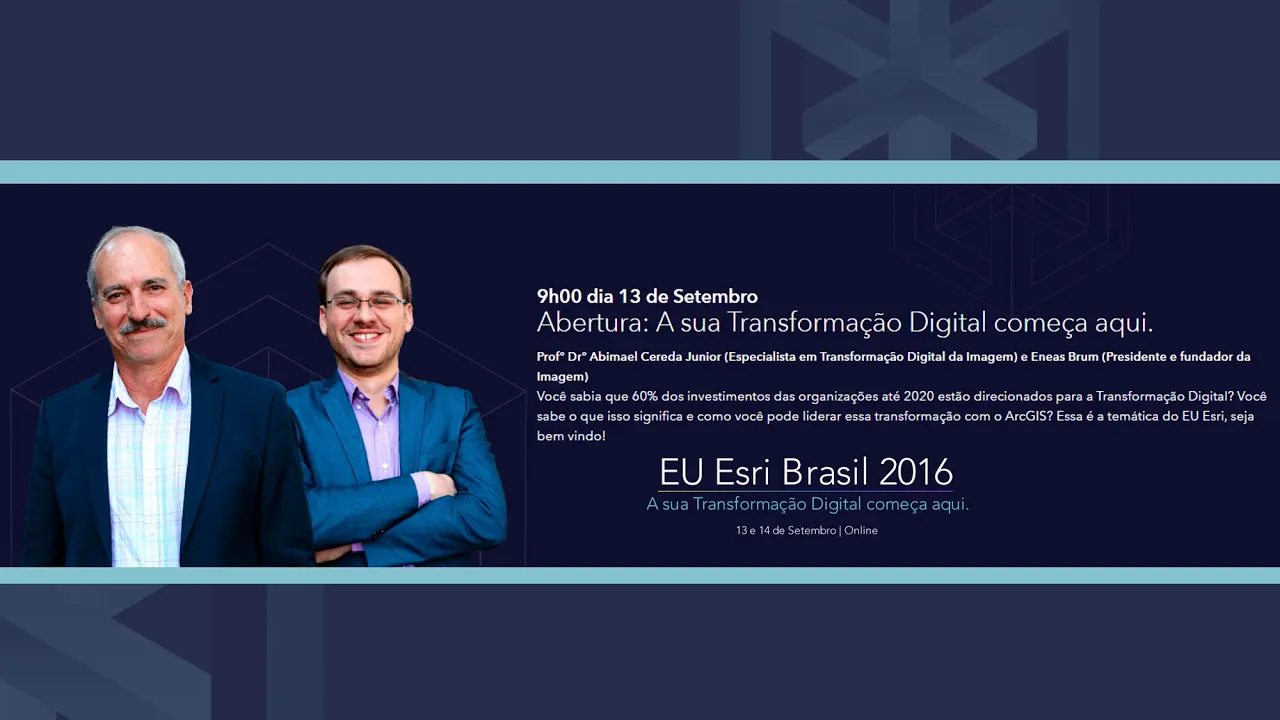
Welcome to the Esri User Conference 2016 (Brazil)! Welcome at the time of digital transformation, not only of your company or your government, but mainly the digital transformation of our society. Through techniques, appropriation of instruments and transformation in technologies, we could transform the entire planet.
At this time, we discuss and we talk and the media and science talk about changes. . .
Climate changes, technological changes, political changes and social changes. . .
But at the end, what are we doing with these changes? Or, how are we boosting these changes? Through transformations in the history of humanity .
. . New changes occur through transformations in the territory and old changes are transformed.
We are talking about a bigger thing than a software transformation or the change of a subject to another. . .
We are talking about a change of culture and I will quote Damian Gessler, who said: Transformational changes, that mean changes in culture. . .
are possible by the simplification of past technologies. We can think on these along many dimensions. Until a short time ago, we didn’t think that our mother, grandparents or uncles could use tools like mobile devices, and today we see that they are using these devices.
. . These are technologies that are already available since a long time .
. . For example, when we think in the geotechnology area, perhaps many of you had a GPS for navigation, a navigation system.
. . and you were proud of it.
. . Today, almost all people have these devices and they are hunting virtual monsters with them!
You can see that in the history of humanity transformation. . .
We can think in the Ancient Egypt. . .
the understanding of Nile floods, at which time of year to plant. . .
How can I take ownership of it. . .
How can I understand? The first cities. .
. Definitely, we cause transformations . .
. Transformations that are caused and are driven by the changes. It is logical that these changes will not cease.
Those changes and transformations don’t stop, because they are part of the human condition … …of the construction of what we are as society. But we can remember some things. .
. We can remember that two main points differentiate us in the entire history of humanity, of those changes and transformations. .
. And that is why our event is an invitation to the Digital Transformation… Because it is the first time in the history of humanity that we are a society in network. Perhaps you are thinking about social networks or technological networks.
. . You're not wrong.
. . you are right in some way.
. . But here we are talking about collaborative networks, about governmental networks and, unhappily, about criminal networks.
We are talking about a network society announced by Castells. . .
And we are also talking about a new historical moment. . .
A moment in which the times are a bit different. . .
Because we never had this volume of information at such high speed and quantity – I’m not discussing the information quality. But the time is the same of the caveman, the time is the same that we are experiencing in recent years. .
. 24 hours are the same. .
. What we might think? That we could reach a lot of knowledge with so much information but it is not happening that way.
At the same time, we can’t use all the power of the temporal information… We can’t turn it into knowledge. Because maybe, we are missing a “watch” in that equation… that is "the watch of space". .
. Then, when we are talking about knowledge, we should join two dimensions: time and space. .
. I will quote the Philosopher Pierre Lèvy, specialist in cyber-culture, that said: The digital and the intensive use of computers and networks provide a new dimension of interaction that is economically and socially tangible. The virtual space redefines the concepts of time, space and the very notion of knowledge.
Some of the people who are attending this event and who attended previous events, must be wondering. . .
Where are the maps in this presentation? Where is the Geoprocessing? Where are the Geographic Information Systems?
And I can answer. . .
You have to consider that these are smaller categories in comparison with the space and time. Think on this, maps, products, representations, previously were available only for some people. We had specialists, cartographers.
. . here is the figure of Mercator, and here's that professor of geography that could draw all the maps.
. . And here I have a map in a matrix representation.
. . Maybe some of you created maps in that way.
Here, you must be imagining that the next slide is. . .
"Now Maps for Everybody". . .
But rather than maps, we are talking that the "Geographic Information is for Everybody ". Actually, for everybody… This example is fantastic. This is a basketball court where I can see all the players of the NBA American League.
. . Here I can check the players position and what kind of analysis I can perform.
. . For example, what is the best place to shoot, where to place the ball, what are the stats.
. . This is a very interesting example… it makes us think "out of the box" Because if I can do that for a basketball court.
. . What would we do in your neighborhood?
What would we do in a city? What would we do in a rural area? What would we do for transforming our society…?
We are talking here of geographic information at any time, anywhere and from any device. . .
For using it in any type of interaction, for example, to know how to arrive to a place, how to get back, what is the traffic condition… For hunting “virtual monsters”. . .
for building and rebuilding cities. . .
In other words, we are interacting with space and time in an unprecedented manner in the history of mankind. . .
Manuel Castells, already mentioned here, in a book from 2003 that discussed the “Galaxy of the internet”, he explains that internet culture is formed by four large sub-cultures: “tecnomeritocracy”, “hacker”, “virtual community” and “entrepreneur”. And this is a result of our time. When we are talking about digital transformation.
. . some of you may say.
. . "Digital transformation is just a new term.
. . " "They are only using a new name for what already existed.
. . " Actually, we are here presenting a new moment, the moment of a new transformation that now is digital, because we live in a technical, scientific and informational world.
So we have a completely different interaction with our urban spaces. . .
We have a completely different interaction with our rural spaces. . .
With our agricultural production, in which we can have sensors, real time information, drones, smartphones. . .
A myriad of new ways of understanding the reality… For what? For knowing in a different way. .
. Here we will present 4 points of digital transformation based on some reports of UNESCO on education that mention how to appropriate the space… And here we could say “how to appropriate of the time and space to create knowledge”. Knowing in a different way.
. . with new instruments, methodologies and analysis.
We are saying to obtain a different and better knowledge not only quantitatively but also qualitatively so that we can "do better". Act on the environment to transform our reality, whether individuals, companies or government . .
. To serve your business with technological tools and not only isolated tools, apps or software . .
. To encourage forms of collaboration, enabling us to live along with these technologies. .
. And that is not possible with an application A or B or with the software C, but we are talking here about a platform. A technology platform that allows a quick, easy and accessible integration.
. . at any time, anywhere and from any device.
. . So we can be Digital Citizens, Digital Companies and Digital Governments.
. . We won’t create only a simulation of reality, but we could really be transformative of our space.
Even in the ancient games simulators like this, if there was a digital evolution of these forms of representation of space which evolved from representation to a simple analysis to a complex analysis and today we can produce simulations in these environments. . .
We can construct and deconstruct, and there are millions of children and adolescents talking about space in these tools. . .
Why we don’t already have that reality in our companies? Why we don’t already have that in our cities… in our agricultural areas or in our neighborhood. .
. ? Because the decision is in our hands, the decision now is ours.
You don't have to define if you will work with that or not, but at what time you will enter into this new historical moment. . .
in which the geographic space and the time acquire a unique dimension in the history of humanity… Thinking about geoprocessing, GIS, maps and geography is restricted. . .
because we're talking about something much bigger. . .
Philosophically speaking, space, time, world, knowledge. . .
Through changes and transformations. . .
and at this historic moment, the digital transformation, people and platforms that work with all these things. . .
and data and devices that allow a true digital transformation . Turn data into Insight. Turn insight into action… More than only a decision, it lead us to action.
Time, space and insights. That is our great discussion during today and tomorrow. Now, I ask you to attend all the sesseions, ask, take notes, participate!
This moment is for everyone and I’m going to hand it over to our CEO, Enéas Brum, from our company Imagem, that celebrates 30 years since their foundation. I invite him to share his insights with us Thank you very much for your attention, have a great work and. .
. Live the digital transformation! Good morning and welcome to the Esri User Conference 2016.
Are attending to this event, professionals and managers of South, North and the Center of Brazil and also professionals of Angola, Mozambique, Portugal and other countries and regions where Portuguese is spoken. You are very welcome! All of us have something in common: in our daily work we transform the world.
We do not transform the world at once. We transform the world step by step, with our daily actions in our businesses. These transformations happen when we produce foods and when we organize our areas to produce these foods in a better way.
The transformation also happen when we generate and distribute energy, considering the structures of distribution and the environment for generation and transmission of that energy. We also change the world when we perform operations of transportation, logistic operations and communication operations with our customers. .
. We also change the world when we serve our customers and deliver our products taking into account the different aspects of the geographical structure that surrounds these operations. We change the world when we serve the citizens considering their needs and the interaction of their needs with the infrastructure that is available in the state or the country.
The changes that we perform are extremely important and we are vectors of important modifications during the execution of all the procedures. We are here to connect with others and inpire ourselves to work in our businesses. With that knowledge we could lead the challenges of the future.
We are really facing significant changes. . .
actually, technological changes have reached the highest exponential rate. On the one hand, technological evolution boosts the evolution of our procedures and workflows and on the other hand, our procedures require technological innovations. Today we are talking about the Internet of Things, Big Data and Big Platforms… The platforms of communication between people, social platforms and technology platforms.
These changes are extremely significant and we can see them in our personal lives, but here we will understand the impacts of these changes in our companies. Leaders of businesses and governments do not have the option to go along with those changes. As leaders and actors of this process, we can be carried by those changes or we can be agents of those changes.
There is a very strong investment by companies and organizations for understanding how to better use technology in business processes. Throughout the day, we will be talking with different persons that will present insights about "4 Pillars". These 4 pillars support a significant change in the way that our companies and our governments will interact with citizens.
The first pillar is related to Mobile Applications. This means that each of us has the possibility of connecting with the core of company decisions at any time, anywhere, and activate and receive at the same time the information needed for a process, in a specialized and simplified way. Also this is possible with a second pillar: Big Data Analysis.
This means that our companies receive data in real time which are transformed into insights or in information points for taking business process decisions. The possibility of being anywhere and having access to massive data is also supported by other pillar that is Cloud Computing. That means that all of these is everywhere, decentralized and easily accessible.
The way we will take action and will interact with our business is going to be integrated with social platforms. Our work will be integrated like the way we interact on social platforms in our personal lives. We are facing a transformation that brings to our professional lives an enormous opportunity.
The opportunity to be closer and in constant contact with our customers. The opportunity to evaluate multiple data from multiple platforms that we have in our corporation, for understanding all the information and provide better answers to economize resources, obeying all laws, respecting matters relating to the environment. .
. And that engages the entire organization with the core process. .
. That engages the organization for serving its customer. These pillars are not isolated pieces.
They are the vertices of a powerful structure that can support them. This is the structure of platforms. We will be talking a lot about how you can bring these four powerful visions to your organization using the concept of plataforms.
The concept of plataform supports all the information. you have an information management system, you have a system that makes available that information, a system to combine that information and generate APIs. so that specific applications for every need can be developed, at every level of your organization.
We're talking about a platform that we have in common in terms of knowledge and experience: the ArcGIS Platform. This platform has the power to integrate other sources of information and other platforms. It allows to synthesize visions, analyze large volume of data - Big Data, It make available APIs and ready-to-use applications.
All this is offered to you and your company, no matter what is your work position - it may be a technical position, a process management position, a business management position or at the management of the company - you can acess the platform, from anywhere through simple and easy to use applications because they are similar to social networks. The digital transformation is already happening. Many of you already have processes in your companies that consider this vision of platform.
I invite all of you to evolve that vision. . .
And for some of you who not started the modification process, I invite you to lead that process in your organization, with the geography interconnecting all types of information that your company organizes. . .
And with a strong platform structure connecting everybody in your organization as well as every customer or citizen that you serve, in a single view. A vision that is powerful and that will bring significant results for your business. Thank you very much.
See you again in 2017.