Thank you very much gotcha thank you very much mr. ambassador thank you all for coming to this lecture and I would like to introduce new to this to this project it's my thank you have to all of you to hosting this lecture and for me here to invite him in Moscow for my first visit to this amazing city and my first visit to Russia I would also like to warmly thank the braava particular Katya for Organizing this nice venue but as an introduction to my lecture I would like to quote the famous artist Owen max
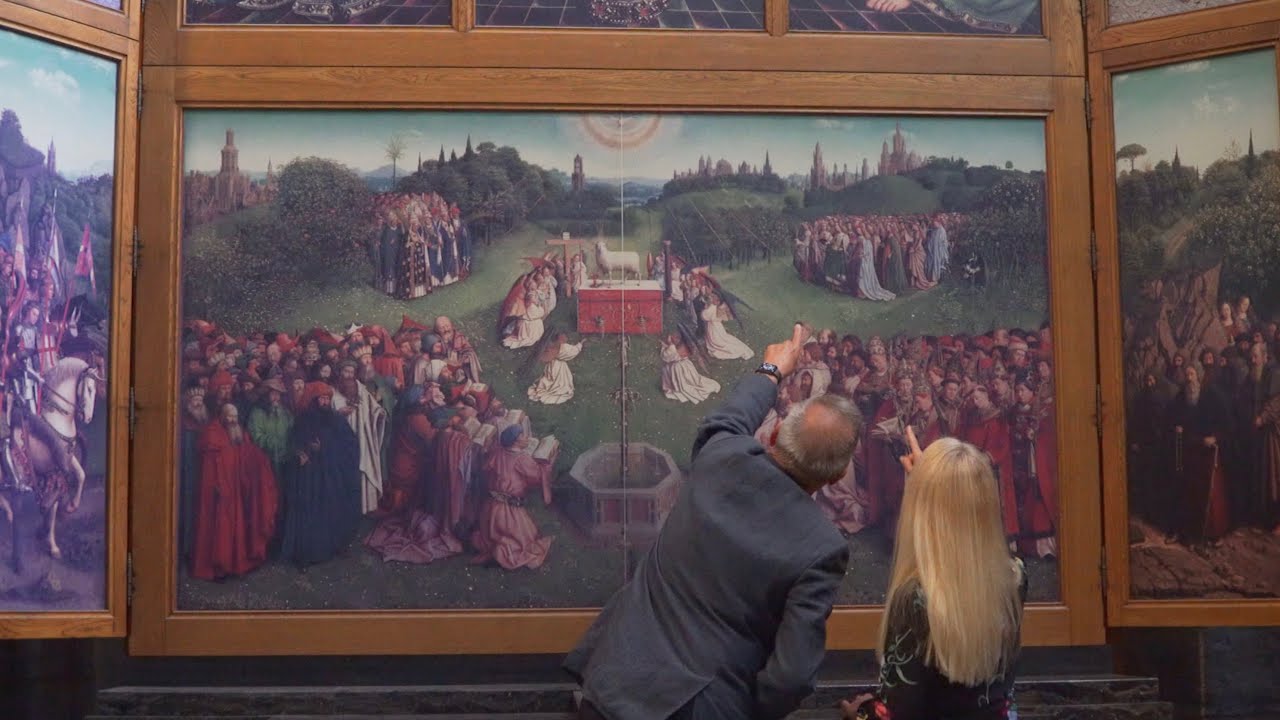
Friedlander specialist of Flemish primitives he writes he writes I quote by its size complexity and almost encyclopedic variety the gondola piece stands head and shoulders above all others 15th century auto pieces in the Netherlands it is thus a challenge for one's career to be involved in the conservation restoration of this Extraordinary work of art the Ghent Altarpiece is internationally known as such because it still hangs in Ghent in the cathedral Saint Bavo which was at the time of an egg the Church of st. John it is now hosted in a different location in the church
which I come back to but its original place was in the Whitechapel here at the back which was financed by the donor your site this was the base of the altarpiece Until 1986 where he went from and returned through a very challenging history through all the centuries on this slice you see a little bit of a silhouette here in to imagine the scale of this altarpiece now as it is presented is presented really into registered registers which are stuck to each other and it has at the moment height of 3 meters 75 and with when
open of 5 5.14 meters you see is quite large and it of course is Presented on an altarpiece but initially in the in the 15th century apparently he must have had a much more complex structure descent the frames of the central panels here I knew the date from 1950s and those from the side panels have been transformed through centuries but they're still the original ones it is an altarpiece with wings this central part is fixed and the wings here are mobile so they were open enclosed but for the Equation of masses and feast days but
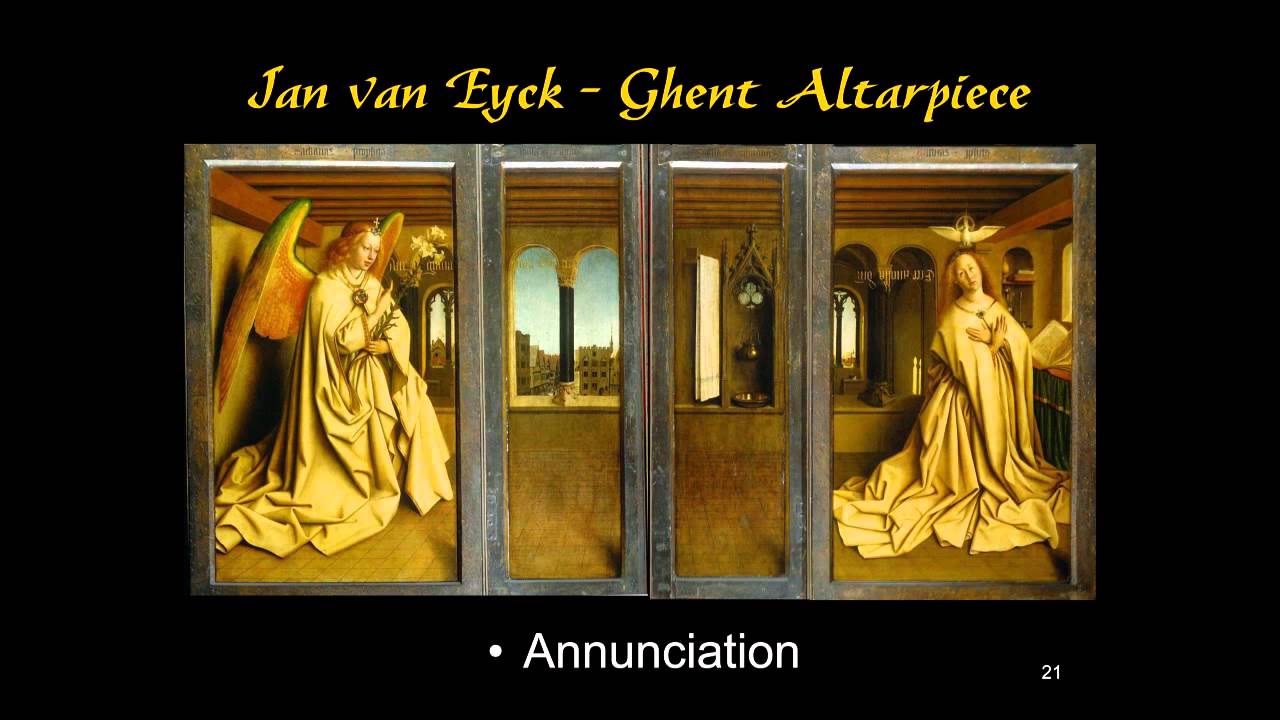
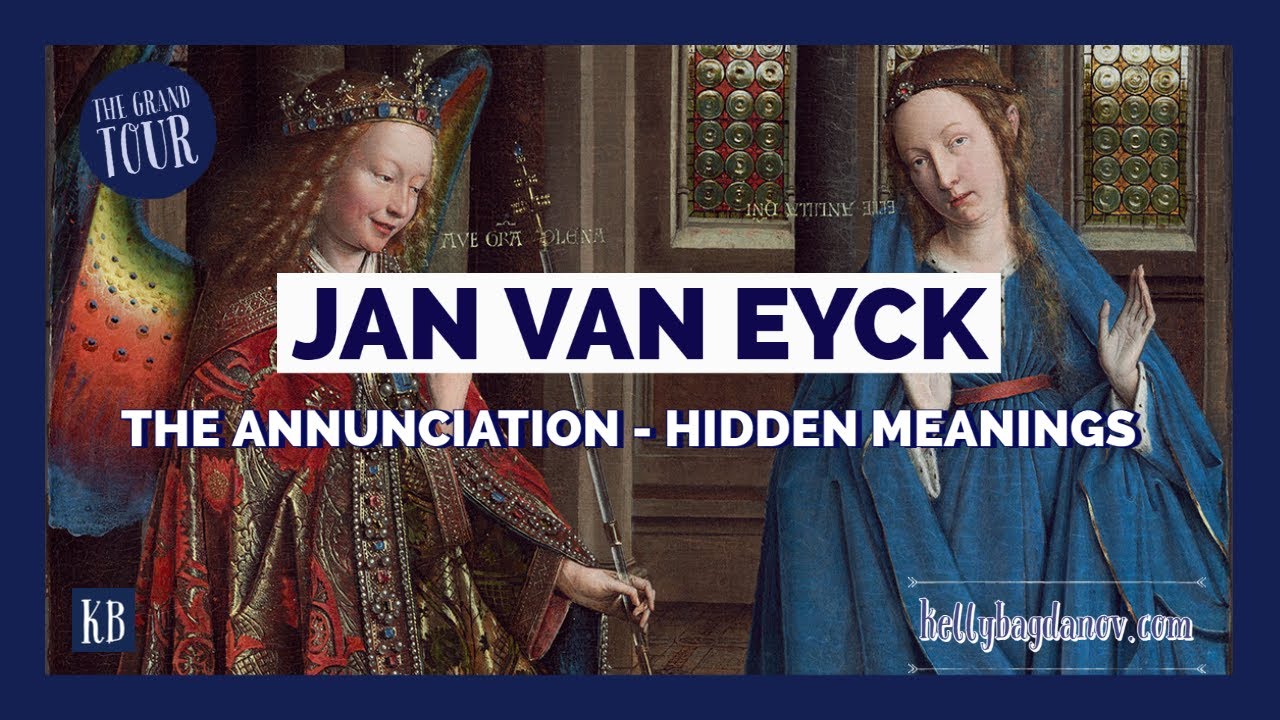
most of the time the altarpiece was presented close in this presentation in a much more subdued iconography with at the center at the top here the iconography of the Annunciation with the Archangel Gabriel and a virgin on the right the scene is presented over four panels and he's suggesting a one unique space here spread over these four panels at the bottom we have here the donor yah sevate on the right his wife Elizabeth Boulud and in the middle two sculptures of John the Baptist and John the Evangelist these four figures are a bit smaller than
life-size and presented in individual niches with slightly different light incidents in shape at the top you'll see here figures of prophets and sibyl's and you will notice in general apart for Yoos very extraordinary bright red coat which was made made from the most expensive scarlet fabric that exists at the time You see the rest of the scene is painted in new tones of beige brown whites light green and bill bell pink and this is quite a usual presentation really for politics of this Paris when I presented close to protected protect the inside with very brightly
and modest scenes but your side was much more modest still use wait who was a very wealthy and influential man who so close to the Duke of Burgundy he's presented in a very bright and could be seen from Very far so on the occasion of masses although we don't know how frequently this was done the older piece was open to reveal the inside and a very complex composition here on this slide you'll see on the left professor Ann van Gravenstein who has been for years the adviser of the church on this project and also the
director of the study that preceded the restoration and on the right you have reader : who is director of the cathedral and Who's a very important figure within this this project project when the other piece was revealed it just showed an incredibly intricate iconography in we have separated into registers with an underneath here composition flowing from one to the other with this unified landscape with the domination of green tone tones of meadows and trees rocks and the sky continuing all through and at the top much more iconic presentation over the diocese with a divine figure
Some dispute that is being a figure of God of Christ of both combined on the left the Virgin Mary on the right John the Baptist all seated on Vaio netted Thrones in a composition that goes back of course to icons and then on on this side the very famous figures of the singing angels and musician angels and at the extreme the naked figures full-size of Adam and Eve who became so famous in the 16th century that the name of the Altarpiece and the name of the chapel became just the Chapel of Adam and Eve instead
of being the chapel and the other piece of yours fate at the bottom is near the scene with the altar and the central figure the the Lamb bleeding on the altar and surrounded by angels as well as groups of religious figures with the Apostles masters here on the side prophets and on the side of panels processions of Hermits pilgrims on this on this side here the Knights of Christ And on the left extreme the righteous judges now these panels is a reconstruction I think many of you must know that this panel was stolen in 1934
was never found again it's replaced by a reconstruction that was made during the Second World War as she finished in 1951 the altarpiece was extremely famous already in the Middle Ages in the lifetime of an egg in the 16th century and humanists and writers critics critics used to gush about the details And the amazing skill in reproducing materials would it be metals jewels stones or even flesh tones your wonderful detail of the singing angels where you have here in this beautiful stone actually a reflection of the window of the chapel is actually a tiny detail
which is about that high and you see the level of precision and the wish of an egg to reproduce reality not only in the forms of textures and materials but also the reflection of lights on Every single materials humanist in the 16th century as well which comment on his absolute skill in refugees profusing nature I mean to us modern Ida seems like almost photographic reproduction and you have to imagine put it in context this artist just went far beyond anyone who was painting before him to achieve this kind of quality and ashley botanists who studied
the other piece nowadays can actually identified every Single species of trees and bushes and grasses and flowers which are painted on the Ghent Altarpiece critics would say as well that animals and humans who look as humans you can even imagine that this tree is this horse is that just waiting to go he's been waiting and ready to go we can see his expression in his face and this was again just an object of admiration and then of course figure of Adam really alive man here every single hair every single flesh stone it seems To step
out of the picture into our space now the other piece was attributed to rebirth onion van egg mr. ambassador reminded us of this and this is actually on basis of an inscription actually very badly damaged which figures on the lower profile of the old of the frames of the altarpiece it's an inscription in four verses in Latin with also OData in a Koenig Ram in red red letters I've just put you here that the translation English of the inscription which is in Latin and it reads the painter Herbert Vanek a great man who cannot be
found began this work yawn his brother his younger brother second in art completed away tasks at the request of yours faith that Easter Dona and he invites you in this verse on a sixth of May 14 32 to look at what has been done now this inscription although had been transcribed by humans in the sixteenth century became forgotten later on and was rediscovered At the beginning of the 19th century after layers of overpaint which were completely covering it were scraped away and at the time its authenticity was very much doubted by some critics and even
the existence of who - it has been doubted in literature literature for the seniors if there's still some art historians you know 21st century still doubt of its existence although now as recent archival research has shown that a massive effect existed Although no works of art actually can be attributed to him with a certainty now this inscription itself that this is one of the revelation of this of this restoration project has been shown to be original original and certainly East apology the apology and his technique is typical of young Vanek so there's no reason to
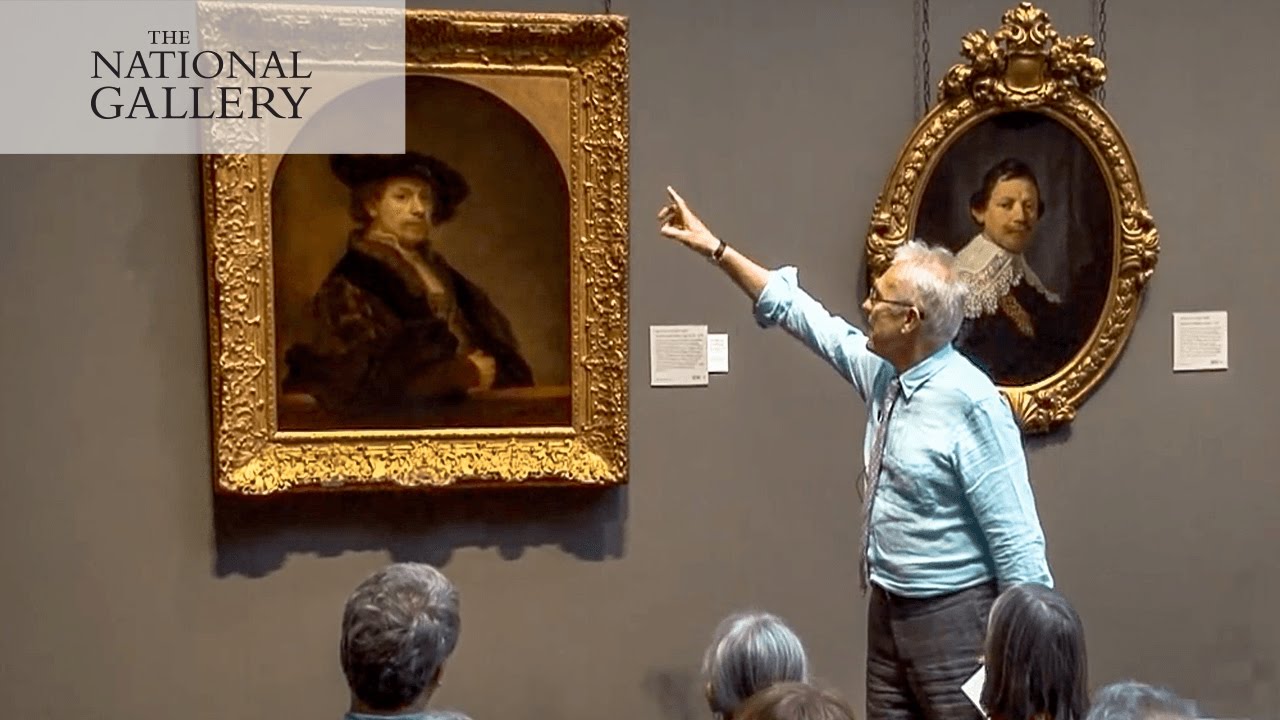
think that this is not authentic now Jan van Eyck is known particularly by a small amount of small paintings that this is a portrait of him From the National Gallery which is very famous and which is thought to be a self-portrait it's only 26 centimeters high and so you can imagine that there is not very much of affiliation with the Ghent Altarpiece with this massive massive dimensions and so we have to keep everything in context in terms of technique now young Vinay to work for the Duke of Burgundy at some point of his career before
that for John or Bavaria Bavaria and was Based in under Hague he was attached to the personal service of the Duke of Burgundy and travelled with him and he was also charged with some diplomatic mission he was an ambassador for for the Duke and went for him and of what with certain to Spain and Portugal and also historians think that might have traveled as far as the Holy Land his skill was so well known when he died also his Widow received a very large pension After to keep the family afloat and he was recommended also
all all through his career very highly and very close to Duke of Burgundy it was a very highly intellectual man or so later literature described him as a knowledge of of science of mathematics of geography of the river and also obviously he had a very good knowledge of the reflection of light and eye movement now on I this altarpiece has miraculously actually survived the attacks of time and Centuries he has a very complicated material history and by this I mean that three centuries its shape and its appearance has been altered through the events of wars
who thefts movements but also through different restorations which were not not always and actually rarely very careful respect or respectful of the work of art there's actually about fourteen restorations that have been documented by archives for the altarpiece but there must have Been also many other restorations which are not documented by archives one which is very famous and has remained into the literature is a intervention which is documented by Marcus Van Vleck who was an historian and a chronicle of Gant and who writes in 1568 the two famous masters at the time Lance the blonde
ale and young ones who came to hand on the 15th of September 1550 and cleaned the old piece it's holy size he says in duchesses Watson and Curson and the word Watson is very clear it means cleaning with water but Kherson means also cleansing it means correcting it means improving and this is something you'll see I will describe this here in through this there's presentation now we know that you see here on the scheme that the since the restoration in 1951 it was so that large part of the altarpiece had been over painted so had
been largely redone sometimes early in history of the Ghent Altarpiece and during a restoration in 1951 the the restores and researchers links what they saw as early overpaint to dimension by Marcus van valuator I just I just read to you and his concerned zones in the inside of the altarpiece actually the whole figure of the deity also lots of details and ripley's in the angel panels the faces here of the Virgin and the Baptist's as well as the flaws and also large areas here of the adoration of the Lamb so This is they made is
very careful link to the mention but after 1953 other scholars who studied the altarpiece just completely contradicted this conclusion and said there's actually no overpaint visible here this conclusion was rather brush and we do not agree with this at all but as she as you will see this turns out to be very true then what what concerns the material history then it got extremely complicated for the century in the sense that different Player parts of the altarpiece were separated from the others and moved to other places where they also were modified and restored so for
example the central panels were taken by the French armies at the end of the 18th century taken to Paris where they were restored and also the upper part of these these panels were sewn so they must actually mush well quite higher I probably were covered with complex ornaments and were Closed because they were sewn because I quote they made framing difficult complicated so they were made into a very nice square so they could be fitted into an astroid square frame in the Empire galleries in the Louisville now these panels came back to to Ghent in
1816 but in 1816 also six of the side wings were sold by the church in great dire need of funds and the landed in eventually later in the nineteenth century in a collection of the king of The King of Prussia and became also really the the most important panels of the gamellia gallery of the royal museums which were created in in 1830 these wings were stayed in berlin 1919-20 where they restituted to to belgian under the auspice of the Treaty of Versailles the other panels Adam and Eve were not sold had been 90 century but
a bit later to the Belgian state and actually are still a property of the Royal Museum of Anna's of Belgium in Brussels so you see all these paintings were taken apart they were also restored in very very different ways and so he looked very quite disparate in the when compared to each other I cannot go too much in detail until the year into the material history but I'd like to mention a very very intrusive operation that took part in Berlin at the end of the nineteenth century you will remember that the wings that were sold
and bought by the Prussian Collections were painted on both sides so that reason for this is Ashley they function as an altarpiece when they were then you presented into a musical context this this became a little bit complicated and for the sake of clarity the director of the museum Willem border decided to have them sewn through the thickness to make them separate one sided pan also have to actually have 12 panels instead of six And so they were sewn with sorry they were sewn with a steam driven mechanical sewn that was designed of this kind
this kind of stuff that was designed for for this particular purpose which must've been a quite a stressful operation I have to say so basically the path we see what we can gather from the repose of the paintings was just fed through this mechanical zone so after a few tests were done on similar paintings from the same period anyway the painting is a Survive this operation and you can see here actually the thickness there about one and a half to two C millimeters thin originally there were 1.5 centimeters thick and they are provided on the
reverse is you see the side of the panel's with a cradle which is a structure that keeps them straight and more stronger which was put on reverse at the same time now these cradles are structures which are typical from the 19th century that one was often put on Reverse of panels which tend to distort with time and just I went to the Kremlin this morning and you could see all these great icons as well have this distortion which is a natural evolution of the supports coming through the influence of the climate and the aging of
wood in the 19th century was thought as not being acceptable and paintings were just straight and so on and provided with these cradles to keep them straight but of course these structures can bring Their own problem with them and create actually splits and distortions another Orton's face was the restoration of 1951 after the Second World War you probably have heard of the history of the Ghent Altarpiece whereby during the Second World War it was taken by the German armies and hidden in the in the salt mines of art assay in Austria recovered by the German
armies and brought back to Belgium and at the time it was not possible to do restoration a treatment Was done then a few years later by a man called Albert Filippo who only had a few months so here she worked in on his own for 11 months and just just had a little time to thin down varnishes and absolutely no time to study the reverse of the of the wings so you see him thinning down varnishes and this is why we didn't know very much about this before we started the results of this restoration and
the study were published under the direction of Paul Corman's was The founder of our Institute and he is the the one who made conclusions about the over paint which I mentioned earlier now in after restoration 1950s the altarpiece was put back in the White Chapel so as I mentioned it was here but in 1986 it was put in this Chapel here into a glass vitrine at the time or people were just really very worried about vandalism and terrorism and just wanted to preserve in this show so bullets so breed resistant glass which Is not a
very attractive situation particularly because the glass is green the it's the painting is lit with artificial lighting in the form of spots with very strong reflections we can see on this slide and also it's always presented open so very different situation in the White Chapel where he was regularly opening close and you had a much better interaction with the work of art now through the through the in 1986 the condition in this glass case Worsened very much because of extreme fluctuations in relative humidity light levels and heat which are linked to the turning the lights
on and off and also to increasing influx of visitor into the chapel and so in nineteen 2008 the the church asked the the right Institute for which I work to have a look at the condition of the paintings and after a few reports it was decided to do a very organised documentation and of the condition and a very high-resolution Photography of all the paintings to understand what was going on now this was the condition of the painting so in 1986 something is really difficult to imagine for a painting of such importance is that the varnishes
were very strongly colored you can see open is very yellow very brown looking very dull something that was not immediately visible through the green glass and what was particularly shocking as well is the amount of surface dust and grime to such An extent that the cleaning teams had been writing their initials where their fingers on the surface dirt which was not very clever since then the right initials we could tell who who had done this but anybody so this was quite quite a shock a shock for all of us then also in many places you
could see that there was a lot of raised flakes of paint which were caused by the repeating fluctuation of humidity and restriction and expansion of the wooden panels and The painting the painter said leaking stuff with with time and starting to lift from the from the paint so this problem which was already present and was the reason of the treatment from 1951 was not completely cured and have continued at continued to progress what was also notices that to every mention that the paintings were painted on wooden panels which made were are made of several planks
glued to each other and oak the oak planks as Disjointed in places there's some distortions and opening of the joints at the top so which made a structure more fragile and was as she had needed to be stabilized so what also why we could see although it was not immediately visible through the the yellowness of the varnish is through the application of scientific imaging we could see under the paint layers also a lot of dark stains like here for example which were actually all the retouching which were Not not always visible to the naked eye
but that something is very important to know in advance if you will attempt to do any cleaning of paintings this slide is extract structured from a website a website close to two Vanek which I'll come back to which is an amazing amazing website where you can compare all the photographs of the paintings also taken during and after restoration so following this I'm sorry I see there's a lot of steps here in the Presentation I don't know there must be some problem comfortability of the of the diversions you can see here that on this slide this
the Commission authority is the church wardens of the same bajo Cathedral and following a tender procedure the restorations was given to institute the right Institute for cultural heritage particularly because of the combined skills that the Institute can offer in terms of research and also interdisciplinary cooperation Between different different specialists the project is supported by the Flemish government for 80% and by a sponsor the forum by Allah - for 20% and which is a very great support to do this work for the researchers the research is taken by the right Institute for cultural heritage so everything
that comes to analysis which has to be done during during the Train the the project and yeah to understand all the condition of the paintings in Collaboration with University of ganden and work the belgium belgian science policy and also the funding of the histor tribus fund now the project was taken in two different phases and reason was that the cathedral wished also to keep the other piece into the kotero accessible to visitors and it was decided and to divide it into three phases starting with the reverse of the panel's the second phase is just the
under the lower level of the open Altarpiece and this third phase which still still has to be done is the upper level of the open outer piece it was decided to start with this because it's these paintings were the ones which are where the less known and it was very important to work on with the two levels together because the what absolutely is important is the the coherence of the altarpiece as a whole does if you particularly this scene here is continuous from one panel To the other and so it's essential to treat them together
together so that despite the different conditions of the panels you can still retrieve the monumental coherence of the whole you will find a to attract attention again to this website all the information about the organization of the projects all the techniques in education techniques documentation also all the reports done on the treatments are accessible online and freely to Download on your own on your own machines then also all the paintings can be compared together at a very high resolution what they were very important fact that I was considered for this restoration is the visibility of
the work for the public one platform of course is the website on which your documentation can be seen and virtually zoom into the millimeters into the paintings but also to work on-site in the city of Ghent so the other the Populations of of course very very close to the altarpiece is incredibly important for the city and you it was really essential to communicate the advancement of the works and the different methods that were used when we are doing this is actually working in public so the museum donates actually a room which was transformed into a
studio and on which you can work in public all every day of the week compacted sat work and information is communicated in the Inner through explanation in public and also written materials and reports and publications so this was the condition before we start as I say this monumental ensemble keeping the coherence of the asam was a very essential point of this of this work and this meant as well because they if we had to take into consideration the very divergent condition of all the panels because they have a different material history different treatments but also
because in The past they had been presented in different condition so for example these panels here when the altarpiece was open we're much closer to the humid wall they were also mesh closest to the window and had direct sunlight coming on them and so they all of them had these different conditions which would influence them their appearance of course so strategy was than to remove vanishes very gradually in different steps to keep Control of the coherence of the whole and to work really in two of three separate phases the first one being to remove varnishes
that were applied since the nineteen 1950 repeatedly the auto piece had been revarnished several times with synthetic varnishes that had turned out not to be very stable particularly when the preventive conservation so the climate of the presentation is not stable with high light level and fluctuations in the indoor humidity so Many solvents were mixed and prepared that would only focus dissolve the top layers of varnish and not touching the underlying 19th century and all the varnishes so after the first phase of the restoration there was already a considerable improvement in the appearance of the paintings
recovering much of the modeling of the phases the all these much more of the contrast of the shadows and of course in terms of colors is quite evident with the whites Becoming White's again yet some of the earlier whatever retouching were dissolve in the course of the most recent retouching dissolving course of this treatment when we presented this work to the International Commission's following of our project it's actually a commission which is composed of 21 members very highly distinguished specialists art historians chemists and restores who very knowledgeable of the work of an egg came to
see this work and And advice in going further into the cleaning and removing the older varnishes because the quality of painting was not still not fully visible and also he was still not possible to properly consolidate the paint layers so we went on to the next phase of the rest of the cleaning you see here on this Lashley an illustration of the three phases here before cleaning the stream the yellow modern varnishes were taken off to get To this level and then after the third phase to go to this level where most of the old
varnishes were removed and it's only at this stage we start of retrieving the finest incredible scale of an egg showing all these reflections here and you see really a reflection of polished marble with a surface that was considered when he was still covered with the vanishes as being an imitation of sandstone it turns out to be highly polished marbles which had been hidden For centuries under this yellow varnishes in the course in the second phase we also removed layers of oval paint on the architecture and the background this was a considerable improvement already and very
straightforward in terms of cleaning because these this dark really unified black colors were covering very lovely light nuances from light to dark and structure in the wall that were completely hidden so there was not much Question about going in this direction of course the restores who might be present here our canal curators and collectors among you who are familiar with with restoration would know that cleaning removing all varnishes and retouching has an improvement of course retrieving the quality of the original but also reveals defects reveals all the damages which were hidden underneath these layers and
this is yeah something that You need to anticipate and realize that it can happen and certainly in a case of the elegant auto piece we knew already of a certain amount of them that were expecting appear and I'm showing you in the next slide the area which was the most damage and thing thankfully it was only a few like this is the background behind the portrait of yours weight was extremely abraded and had been heavily retouch in us in three centuries the reason of this abrasion is That the painting had been lifting and also had
been scraped off and overly over cleaned or say really brutally damaged by previous cleanings now this is a negative aspect but what we became very intriguing is that by this claim we covered this incredibly subtle elements of iconography so for example in the background behind elizabeth ball root we could see here these wonderful cobwebs these are spider webs which were in the corner of the wall behind Elizabeth Valhalla which had completely been hidden by varnishes and over paint quite an element of our con Agra fee that will be looked at by artist owens and which
are the same we should have found here which was still visible here in the corner behind a virgin unknown on the panel which lies above it is a bit bored in the altarpiece so after the three phases of varnish removal there was a considerable improvement into the the colors the effect of three Dimensionality the contrast of the figures which was certainly very positive but still there were some very puzzling effects which were intriguing us as restores working on the paintings and we we know at the beginning cannot explain fully and one of these in very
strange aspect is that the scene here of the Annunciation did not appear to continue fully from one penguin 20 to the other we could mentally imagine that the artist was suggesting this well you Couldn't really see it because these walls here were much darker than the one's on the side and also the floors here looked like a vertical plane rather than suggesting the depth into the room this was one of the aspects that we found to be stranger could explain actually very quickly about the presence of very early over paint which was non original and
had been applied on top of very thick layers of varnishes and after removing the the after the clean we came To realize for example that on the architecture they were very thick I see here dark stains here actually a crust of over pain that had been flaking off already and which was present in every single arch on the on the altarpiece there were some large areas but also very subtle layers which had been applied for example here on the sculpture of the Baptist you had these crusts of over paint and varnishes which seemed very oddly
put here in the middle Of the sculpture and they were actually hiding this extremely thin just brushstroke with very few pigments and you'd see that this highly magnified photograph should think that it does not count for much but actually what it represents as she where the veins into the marble which had been completely covered by the varnishes and the over paint that had been applied sometimes after the naked finish the paintings so we can come back to this scene of the Annunciation that you can see again this problem of the wall here being much darker
in the center this the situation was the same here we are confronted with very early old and dark and rather clumsy over paint we made us some little tests and then came to remove these over pain which was hiding brown stains and abrasions but the improvement was considerable and I will show you the result after removing the over paints you can see again The coherence of the space was restored by the cleaning and that was just a great success I'll come back again before and after over paint removal so it see it was in that
case a particularly straightforward in terms of reasonably of removing by early interventions but you rested to read the Equality which was not visible anymore and could be easily a restitute as we worked on and continued we came to realize that actually large areas of Also the draperies well flesh tones were also equally over painted and that actually we were not really looking at Vanek anymore since the sixteenth century and something that had been suggested already 1950s but yet not for the reverse of the panels and and a very striking discovery for example here on the
hands of yours wait this highlights had been added very crude thick white highlights by removing them we just came Back to the soft modeling of the original now these over paint layers and this is kind of an example of the samples that or laboratory analysis is a very tiny sample of paint which was taken on the side of the hand to fully understand the condition of the painting this flake of paint is actually smaller than grain of salt it is embedded in a square of resin and then cut through so you can see the actual
buildup of layers here you have The layers by van egg so this is the flesh tones of an X or these colors and then on top of this you can see this brown thick brown translucent layers actually two to three layers of varnish which were also chemically very much altered as well as a layer of retouching here and this here this in white here where the highlights are were added so that meant that this and this is quite typical of thumbs I had to be taken at this point To fully understand the situation is that
the painting by Van Dyck had been varnished several times through through the seniors and that and then extensively over painted so this was quite a shocking revelation really and so we we talked to the church about this to the Advisory Advisory Council and we were asked and which was a quite a normal thing too to put all the research into action to fully understand the situation to understand how much of a Pain was present to to make it very obvious also who people are not specialists and to understand why they were put on the surface
and of course if the underlying original was in good condition there was also the question would it be would it be a positive thing to remove these over pains which is also always a very risky operation and of course if the original underneath is not is ruined it's not in good condition certainly is not something to wish for So to really understand fully the condition of the paintings we had we were lucky to be able to collaborate for the University of Ghent in Antwerp a University of Antwerp I developed this amazing analytical technique which does
not involve any sampling but by scanning by x-ray fluorescence we were able to have an image of the composition of each layer depending on the pigments but they were used by the artists and so for example here you have a detail of the Sleeve of Elisabeth Boulud here the sleeve to the naked eye appeared completely perfect we knew from X radiographs that they were some some kind of very strange phenomenon if you looked with the scan of copper you seem to have like very smooth image but on the scan of led you could still see
here this interruption of the signal which meant that they were actually losses underneath the visible paint so the Visible paint was was contained copper and the old original underneath contained lead and this is why you can have a very clear image of the damages which were not visible to the naked eye a very difficult to see on the X radiograph on the image of iron we could see also this very strong signal exactly in the same place which called it which correspond to a feeling within the losses which had been applied before the whole sleeve
and the whole cloth was Over painted following this we had the permission to make some small windows some small tests to evaluate the condition of the original underneath and to see whether this over pen could be removed so where they were already existing invisible losses this area this was extended and you could see underneath the the original bye-bye van eck which is very lighter in tone and also was had showed some some abrasions in some some area the same thing was Done also for the drapery of yours fate and these with these cleaning windows you
could see here this is the original by Van Eyck and this is here the over paint which had been known since the 16th century this is even here a four by one egg which had been completely covered now in terms of style while you will notice in the window is that the shadow is much darker than in the over paint and also there's a presence of a very fine and sharp highlight here at The limit between the half shadow and the darkest shadow and this is actually very typical of an egg now after having this
in mind we shown it to two specialists with a comparative material we could see that in terms of style and technique that the drapery of u.s. rate is completely different from the of here the Madonna Afghan Canon van de parler which hangs in Bruges which she certainly is by van egg you can see the difference in terms of modeling here Much sharper intricate folds darker shadows and also again these very sharp highlights are the limits between the harsh shadows and the darkest shadows so in general also the aspect of the drapery of US aid was
much softer much more natural like a real fabric where this here has a sharper and more stylized almost abstract quality to the condition so we went on and with the University of Antwerp to understand fully the whole figures the whole Figures were scanned it takes several days to do this and then we could see on the scan of in the case of yours wait this is a scan for mercury you could see here these dark stains where there are some damages in the original underneath the surface that looked up completely continuous in the same area
also feelings of basis of iron which is exactly the same situation that we had found in a case of Elizabeth portrait so after much research on all the figures Much observation scanning and our own analysis of situation we came to this representation is that the Ghent Altarpiece which had so famous for so many centuries as she had been over painted if you counted the the also the frames for about 70 percent of its surface so extremely extremely transformed which is very unusual for early Netherlandish paintings that something that here in Russia for medieval artists something
is very Common for paintings to have been repainted and icons to be redone but in the case of Allanon in spain this is actually extremely exceptional case after we we showed all these results to the International Commission of experts expert coming from the Metropolitan Museum from Vienna from Berlin from from London from everywhere who all together advised to take off the over pain if possible to regain the incredible quality of the paintings Which were underneath so of course this could be done only if no damages were caused or to aversion underneath and it was also
possible because the we could estimate that damages to regional to the origin underneath the overpaint was actually quite limited to a few areas now this work could only be carried out if it was we could gain support from the Flemish government and from the church and this was actually of course the case is supported through this modification Of the budget and over a period of almost a year the overpaint was taken up very very slowly centimeter by centimeter sometimes yeah 1 centimeter square per day sometimes - it was a good day for on a very
good day we just proceed in this safely through to reveal the original ueno techniques we use for example is quite spectacular is the use of solvent compresses put on the surface by which we could soften the intermediary varnishes which were kind Of a buffer if you like a protection between the original and the over paint you see here the compress being put on the surface then the varnish was actually being softened migrating into into the surface and then the over pain can be taken off softly with the remains taken off with a blade of the
surgical scalpel driven a surface in very good condition in some zones the results were absolutely amazing for example here in the case of yours fate you could see how The over paint was actually completely flattening the modeling and the original was revealed with incredibly dark sharp shadows and highlights again which are typical of an egg here again here this intricate fault had been completely subdued but he will paint this work these photos were taken during cleaning this after this long procedure we're finally able to consolidate the paint layer this is a detail taken in raking
light so the Light coming very strong from the side to emphasize the structure and we very fine micro spatulas and Sturgeon glue we were able to put on a older loose paint of back onto the support softly without damage after the application of very thin varnish layers then losses where were filled with a white fill which is also reversible it's a base of chalk and glue here's a case of the portrait of yours wait which was the the picture was the most damaged you can see here that Some areas which were visible on the chemical
imaging had to be filled since damages were revealed underneath the over paint then after that retouching x' were carried out with reversible materials first who watercolors and then with pigments bound into acrylic resins here you see several members of the team who worked on this on the restoration is actually on average eight painting restores working on this and here an example of a zone which was an Incredibly good good condition but despite this had been completely over painted this is the Sibyl of Eritrea you see here before cleaning with the yellow varnishes then the over
paint which actually had become a light blue but had been originally was actually a purple tone by taking this layer off we came to this this figure which is an absolutely perfect condition so he was not painted over because he was damaged but also to change the style too Yeah to to to just to adapt to the taste of the time another example here so after four years wait with the filling and then following by retouching you see you could reach the coherence and also the very nice light transitions in the back in this little
fill the family can see now all the steps of the restoration here in the case of the portrait of Elizabeth boards by varnish removal first followed over several months by over paint removal we will a much more Intricate and paler drapery and a softer transition of light in the background very light architecture then vanishing and retouching through final varnish and the striking frames now I track your attention to the frames I see here here on the whole here the frames are incredibly important the art of an egg on all his portraits he just put a
lot of efforts into a suggestion of materials and with our signatures and and inscriptions which appear like Engraved of the materials are painted on it and you will remember the famous poem was painted here here on the bottom of these frames the frames here are painted with decoration suggestion stone put on each other you can see her the joint between those stones and they suggest also a projection of the frame here of a shadow on the floor and this accent which then the effect of death of the composition which was reestablished by the cleaning now
what was also more Striking although these these these frames which were restored by specialists of the of the polychromy were particular striking when I painted them on silver leaf originally now they look like a natural stone but what van I try to achieve was actually giving them a very soft glow so they painted with glazes on silver leaf and they must have had an incredible optical effect of kind of a like a barrier between the space of the chapel And the composition and much more if you can picture this more as a light light effect
of a transition between the two now how can we date this over paint of course one of the preoccupation where they possibly bleeb a young man's colon and Lance Rocke blonde ale has it been suggested in the past and one way we could do this is by making a comparison by with a copy as a copy was made of the altarpiece by Michiel coxy the Royal painter Philip the second in 1557 and 58 It's the very precise copies with some changes but while you can see here from this comparison here depending by coxy and a
detail here of this drapery is that he may I copied the over painted phonic and this is the the Vanek before we move the over paint and this is after remove the whole paint so very clearly this copy was made after the paintings had been over painted and therefore the over pen was dated from before 1557 well now why was this over painted so we Could establish before 57 this was also confirmed by an analysis of the pigments that were used they were they were paintings were overpaying to hide some local damages you've seen it
already have talked to you about this for euros fate underneath the oval paint you could see some actually very clumsy retouching and damages into the paint see these dark dark stains here corresponds to damages in the original and retouching which were underneath the over paint so Another reason why they were over painted was to cover local damages but why paint such extensive surfaces to such a degree to hide retouching and early things which could be easily just retouched locally another reason was the adaptation of style so you can see here yeah a detail of the
the drapery of Elizabeth bonnet after restoration you can see how intricate this is with many Falls going in many directions here Which are very beautiful in themselves a very abstract quality of a bit like a prismatic geometrically geometric quality to them and which had been softened and made look more natural by the over paint so the over plane was very well done but was also simplifying the style of an egg so I go back to this famous quote by by van van awake it is very possible that these two painters young ones Cole and Lance
LeBlanc Dale did clean the paintings and has Van Van Wyck says corrosion current adapted the altarpiece rather than just cleaning they adapted the altarpiece and painting them to the taste of the time now the reason why this was was also due to the political context now just go back to this a bit later now after dealing with the this wonderful restoration of the reverse which was done actually under the direction of Livia depart oprah's it just was directing a first phase of Project I took all over than the project for the second phase here concerning
the inside of the altarpiece and a very important composition of the with the adoration of the Lamb now we came in this situation also to confirm what had been concluded in 1950s and that is that huge areas of the which are marked in red again were already also over painted in the same fashion exactly in the same style as a reverse they were covering actually very a small amount of damages In red again you can see the local damn just that were covered by the over paint this correspond to about four percent of the surface
of this register which compares for the a duration about 50% of over paint so you see the scalar difference is actually quite quite enormous now there's the the same operation that was carried out again we went to the same process of submitting or researching a result results to the International Commission who again Supported the removal of the oval panes knowing on the same basis of the result of the result of the reverse we worked also on the pinion horizontally sometimes with four or five of us it was a very very slow extremely slow process because
particularly for the sky we were not able to use any solvents to remove the overpaying I had to work exclusively with very very tiny surgical tools under the binocular microscope I show you here a few results of this amazing cleaning We were loose only looking at Vanek but not as well as we can do now see extremely beautiful reflections here of the lights has become immediately visible the softness here of the fabrics here the detail the life reflecting here on the metals it is really a joy to the eye which has been regained also the
depth into the landscape the you see the quality and actually a very good condition of the green glazes the green tones have a tendency to become brown in Early knowledge painting and also Italian paintings from the 15 15th century but it's not the case for the Ghent Altarpiece it has remained retained incredible brilliance and beauty in a depth now removing the varnishes also just takes us into the depths of the forest into the landscape just carries the eye into the depths of of the landscape but also by cleaning some what we see the ground for
example in brown tome Which might appear slightly boring at first instance removing these these layers of varnishes give us all these details of this dis shadow again then here the dust here on the on the shoe of that of that pilgrim and here actually the structure of the sand we can see such ly a very firm stand on which the pilgrims are who are walking towards the lam this contracts amazingly to the Knights on the Left who with the horses which are here walking into this very Muddy watery dirt here which is this dis contrast
you can see all these lights and ripples of the water re gains thanks to the cleaning again for to illustrate the problem in the over paint the over paint was very much concentrated on the draperies the sky and part of the upper landscape and also on some of the phases where they had been damaged here as in us wait again before cleaning here regaining this very sharp folds of the the draperies and Here the fully recovered figures sometimes in extremely good condition with just a little bit of a damage and I in some other cases
with more damages which are also very localized compared to the surface of the over paint now you might wonder how can you see the difference and how can you not be mistaken this is of course a complete irreversible operation that we've been doing with removing this open could we as a question we often get but could you Be confused and think that perhaps you're removing Yun's work from Hubert's work and the obvious obvious question but something we obviously also have also in mind but this is what we see under the microscope which you cannot mistake
here is Vanek's work with is amazing five different tones and very deep shadows to describe the folds and here the mesh most simple modeling although was done with very expensive in high quality Pigments and a very strong structure of the of the brushstrokes completely different from the Araneta nourished quality of the original painting now one detail I have to go back to of course is not an important detail is the lamb and some of you might have seen that in the press because it came also into the international press and certainly in Belgium and for
the church was a very important development of restoration is that it was known that the overpaint The lamb as well had been over painted so we came back from the war in 45 he still had two years you can see and a very natural lamb kind of face but that in 1951 when it was restored Albert Filippo removed some over paint and he revealed another set of ears and so since 1951 the lamb had four years and still in 2012 and we study had four is actually even in 2016 when we started the study it
was still the case and it had became like a normal thing that the Lamb of God had for years but no one really asked themselves why and actually we we we had you such an important it's now very much enlarged on this screen but actually it's a detailed it's just about that high it's only three and a half centimeters high we had to of course investigate very carefully whether the original was still present underneath and whether it was in good condition and we took a very long time to do this again with the same scans
From the University of Antwerp you could see for example that the nose on the original lamb that was not visible on the surface could be traced through looking a signal of of mercury which is a typical of a million by looking through the microscope very very much detail we could see that all the elements were present before we started it was a very slow and delicate result to reveal which is completely different different And has shocked many in a positive and negative sign because it's something you just just do not expect but which was eventually
very very well received and partially interesting the Lamb of Vanek is a lamb which had been transformed into a human you see the Lamb of an egg he has eyes placed in front like a human but also the ears are lower in the skull like in a human skull so in the 16th century one was over paint he was transformed into an animal very passive But also anatomically correct but young Vinod has wanted to show this lamb with his very intriguing staring expression which must had must have had very much of an importance he was
completely capable of painting a lamb which was anatomically correct but he made this choice of showing this human expression which is very calls you into the composition and cause you to look at his sacrifice on the on the altar now I invite you to to come to Ghent and see The altarpiece we are now finishing the retouching it will return to the cathedral in January 2020 where you will see a result if you have a chance to come to again during the Christmas holidays the paintings will be shown any Museum of Fine Arts very close
to the window of our studios you can see them very very closely and you know in which we you know not so not so much the case we will return it will return first to the glass case from 1986 and then in the Course of 2020 in the 4020 in a new installation which was will be much more agreeable to to look at now you must understand why no one could actually this difference between Yun and Herbert's work because both were so heavily over painted in the 16th century and now by removing door did all
this over paint where we were able in the course of our work to look at this question and is something that we would like very much To publish next and I just show you know an example here which has been documented through infrared reflectography which is a technique that sees through the paint and shows you all the versions or under drawing for example here in the bushes on the left of the adoration of the land is very beautiful rose bushes which are certainly by Vanek you can see underneath the actually trees with high stems this
is just one only another Example which could be the face by her but taken over by bian and we have made in the course of our many consultation that will will enable us to publish some some work which would be a completely new step in scholarship on Vanek in 2020 and so we're not presently doing some fundraising for this project in 2020 now the next phase of the restoration as I've told you as must not happen they must now happen this is of course these amazing panels with Adam and Eve and all These panels are
absolutely striking and we will be confronted to same situation we were able to make some scans of the the god figure of the deity as we call it and we can see what we see now here and what the macro XRF reveals we can see completely different folds here underneath here and still a condition which is very good so this figure has also been completely over pane in the same period as the rest and the open procedure coxey's work The next step we're expecting exactly the same kind of same kind of work which will be
amazing in terms of Revelation of the art of this unique artists I will finish on this slide and thank you very much for your attention I have put my references here and will be very happy to answer any questions you might have thank you [Applause] [Music]