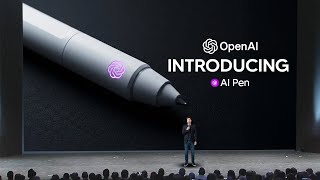
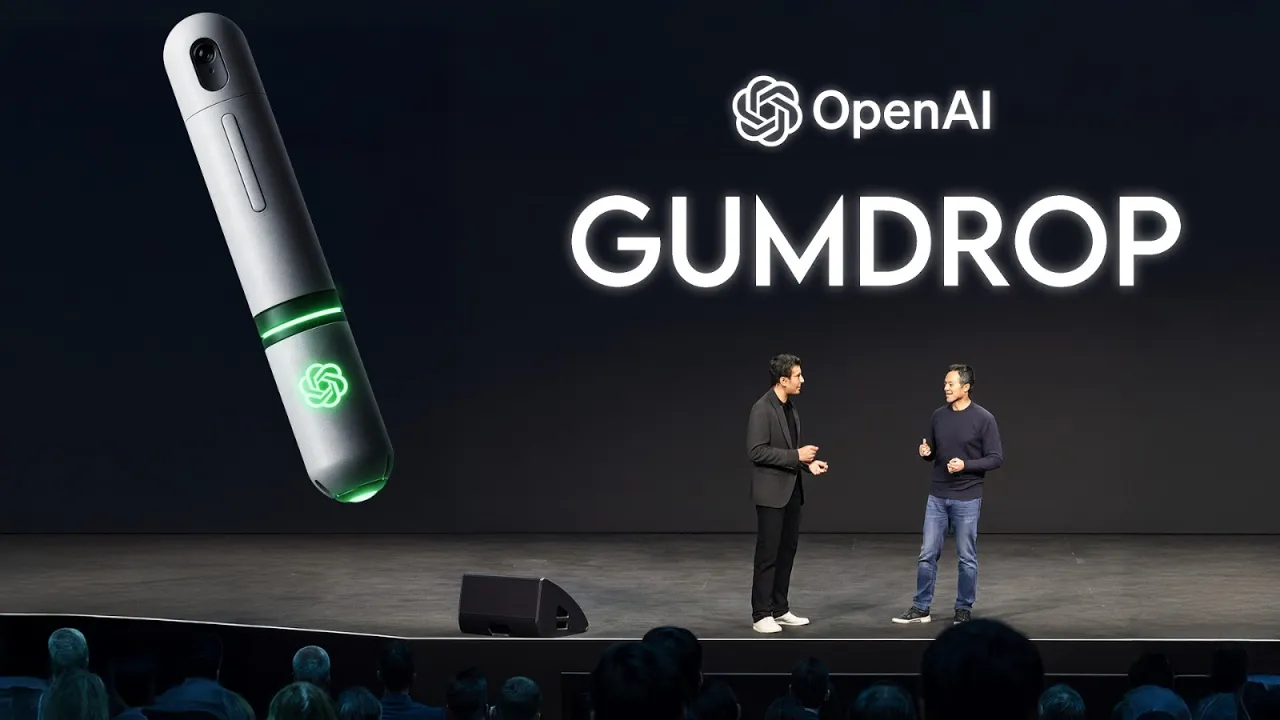
So, OpenAI is building its own physical device designed by Joanie IV, manufactured by Foxcon, and meant to sit alongside the iPhone and the MacBook as a so-called third core device. It's small, screenless, pen-shaped, [music] and internally known as Gumdrop. And according to supply chain leaks, court testimony, and multiple reports across the US and Asia, this is no side experiment.
It's a serious attempt by OpenAI to take control of how people access AI before someone else locks them out completely. So, the device itself is still officially unannounced, but the picture is already unusually clear. OpenAI's first consumer hardware product is currently in the design phase with a projected launch window in 2026 or 2027.
It's described consistently across reports as being roughly the size of an iPod Shuffle, light enough to be worn around the neck or carried in a pocket, and intentionally screenless. Instead of a display, it relies on a microphone and a camera with voice as the primary interface. One specific capability shows up repeatedly, the ability to transcribe handwritten notes and upload them directly into Chat GPT.
That detail is actually important because it hints at what this device is actually optimized for. This is obviously not a phone replacement. It's not a smartwatch competitor and it's not trying to win screen time.
It's designed to live alongside the devices you already use, capturing information, context, and intent in moments where pulling out a phone feels unnecessary or disruptive. The involvement of Joanie Iive immediately raised eyebrows, and for good reason. Open AAI acquired IV's hardware startup, IO Products, [music] in an all stock deal reportedly valued at around $6.
5 billion. That's an enormous commitment for a company that has never shipped a consumer device before. Both IV and Sam Alman have publicly described early prototypes in unusually strong terms with Iive calling the project a priority and Altman suggesting the devices are far ahead of what people expect from AI hardware.
Manufacturing decisions reinforce that this is meant to scale. Early plans reportedly involve Luxare, a major Chinese contract manufacturer. But OpenAI changed course.
Production has been shifted to Foxcon, the same company responsible for assembling iPhones and Google Pixel devices. Manufacturing is expected to take place in Vietnam with the possibility of US production as well. The reason given by supply chain sources is that OpenAI does not want its first major hardware product manufactured in mainland China.
That move is expensive but strategic. It signals that Open AI is treating this device as infrastructure, not a gadget. Foxcon doesn't enter projects casually and OpenAI doesn't reroute manufacturing unless it's planning for long-term volume and geopolitical stability.
Of course, this move didn't come out of nowhere. AI hardware has a terrible recent track record. The Humane AI PIN launched with massive [music] hype and collapsed in under a year, eventually being discontinued after widespread criticism.
HP acquired [music] Humane's remaining assets for roughly $116 million, a tiny fraction of what had been invested. Rabbits R1 sold around 130,000 units initially, but reports suggest daily active usage dropped [music] to roughly 5,000 users, representing a catastrophic collapse in engagement. Open AAI is fully aware of those failures.
The difference is that Humane and Rabbit were trying to create new categories without controlling the underlying platform economics. But OpenAI's approach starts with platform leverage, not hardware hype. Right now, OpenAI's biggest vulnerability is not intelligence, it's [music] access.
Chat GPT lives behind layers it does not control. On iPhones, Siri owns the system level interaction. On Android, Gemini is deeply embedded.
Browsers, app stores, and default assistants act [music] as gatekeepers, and OpenAI is dependent on companies that are also its strongest competitors. That concern stopped being hypothetical when OpenAI's head of chat GPT, Nick Turley, said it directly in open court during Google's antitrust trial. He admitted that OpenAI is deeply worried about being shut out by companies that control discovery points like browsers and operating systems.
People don't find AI through model comparisons. [music] They find it through defaults. And OpenAI controls none of them.
A dedicated device changes that equation. A screenless, always available object creates a direct interaction path that bypasses app stores and home screens entirely. Instead of episodic usage where you open an app and close it again, the company gets persistent presence.
Voice becomes the primary interface and habits form naturally because the device is physical, not buried in a folder. This is also why audio has suddenly become a major internal focus at OpenAI. According to reporting from the information and confirmations from multiple outlets, OpenAI is actively upgrading its audio models in preparation for this hardware launch.
Internally, [music] researchers believe the current audio systems lag behind text models in both accuracy [music] and response speed. That gap matters enormously when your device relies almost entirely on voice. Open AAI is reportedly reorganizing teams across research, engineering, and product to unify text and audio capabilities.
One leaked technical detail suggests the company has developed a new audio architecture that allows the AI to speak while the user is still talking instead of waiting for silence. That may sound small, but it fundamentally changes the feel of an interaction. It moves AI away from turn-based exchanges and towards something closer to real conversation.
The timing lines up cleanly. These upgraded audio models are expected to surface in early 2026, which matches the projected prototype phase for Gumdrop. And this isn't coincidence.
The device is shaping the models, not the other way around. There's also an uncomfortable subtext running beneath all of this. Data.
High-quality human generated data is becoming scarce. Synthetic data helps, but it introduces distortions and feedback loops. A wearable device that captures audio, environmental context, and handwritten input represents a powerful new data stream.
Some commentators have half- jokingly referred to Gumdrop as a reality scraper. And while that remains speculative, the incentive structure is obvious. OpenAI has not said this is the goal and the company would face immediate backlash if the device behaved opaquely.
Privacy is the single biggest existential risk here. A screenless device with a microphone and camera must ship with hard physical mute controls, visible indicators, transparent logs, and meaningful ondevice processing. Humane's failure made that lesson painfully clear.
Without trust, this device dies instantly. From a business perspective, Gumdrop is not meant to win on hardware margins alone. Estimates suggest a retail price somewhere between $199 and $299 with a bill of materials in the $70 to $120 range.
That's respectable but not transformative. The real economics sit behind the device. If even 25% of buyers convert into paying Chat GPT subscribers at $20 per month and stay for 2 years, that's roughly $120 in lifetime value per user.
at scale that can rival or exceed the hardware profit itself. This is the Kindle strategy applied to AI. Maximize distribution, then monetize the ecosystem.
That long-term thinking matters because OpenAI is under intense financial pressure. According to 247 Wall Street, the company is seeking to raise up to $100 billion in new funding, potentially setting its valuation around $850 billion. That's an extraordinary number for a company that does not expect to be profitable until 2030.
At the same time, OpenAI needs hundreds of billions more to fund data centers, compute infrastructure, and energy consumption. Energy, in particular, is becoming a limiting factor. AI data centers are among the most electricity hungry projects ever built.
Large portions of the US power grid are decades old. Electricity prices are rising and local opposition to new data centers is increasing due to concerns about pollution and infrastructure strain. This is no longer just a technical bottleneck.
It's political. Competition is tightening as well. Alphabet's Gemini 3 and Gemini 3 Flash have already outperformed GPT 5.
2 on some benchmarks. Microsoft Perplexity and XAI are investing billions to close gaps or leap ahead. There's a growing belief that AI models will eventually converge in quality, offering similar capabilities at lower and lower cost.
If that happens, intelligence becomes commoditized and distribution becomes the decisive factor. That context explains why OpenAI is thinking far beyond a single device. In recent reporting, the information suggested that Pinterest could become an acquisition target in 2026.
With OpenAI named as a potential buyer, Pinterest brings a unique mix of assets. Roughly 600 million users, a massive image data set, high purchase intent, [music] and an existing advertising business. Outbound clicks to advertisers recently increased by 40% [music] and its performance plus ad suite has delivered a reported 24% higher conversion lift for retail advertisers.
[music] Combined with conversational AI and generative image tools, Pinterest could evolve into an AI native discovery and shopping engine rather [music] than a passive inspiration platform. Monetization remains a challenge, especially in the US and Canada, but the strategic fit is clear. Even more striking was OpenAI's openness to acquiring Google Chrome.
In court testimony, Nick Turley stated that OpenAI would be interested in buying Chrome if regulators forced Google to divest it as part of antitrust remedies. Chrome is not just a browser. It's the primary gateway to the internet for billions of users.
Owning it would give OpenAI the ability to introduce an AI first browsing experience at an unprecedented scale. Turley was explicit about the motivation. Open AAI struggles to integrate deeply into Android because Gemini is already embedded.
Discovery happens through browsers and app stores and OpenAI does not control either. Buying Chrome would change that overnight. Of course, this only becomes possible if courts force Google's hand.
Google is fighting aggressively, pointing out that it pays companies like Samsung to pre-install Gemini and arguing that users choose its products because they work well. When you connect all of these moves, Gumdrop stops looking like a quirky AI pen. It looks like the physical edge of a much larger strategy.
Hardware, audio models, browsers, platforms, and distribution channels are all part of the same fight. OpenAI is trying to secure direct access to users before the doors close. The biggest risk is not failure.
The bigger risk is irrelevance. A beautifully designed device that works well but never becomes essential. A subscription funnel instead of a paradigm shift.
But even that outcome might still serve OpenAI's broader goals. Because in a future where AI is everywhere and increasingly interchangeable, the company that controls how people interact with AI controls everything else. So here's the real question.
Will people trust a screenless AI device enough to make it part of daily life? Drp your take in the comments. I'm curious where you land on this.
If you found this useful, hit like, subscribe for more deep dives like this, and thanks for watching. Catch you in the next one.