Hey friends, a housewife from Chennai turned an investment of just ₹5 lakh into ₹25 crore. This is a true story of a silent investor from our country named Dolly Khanna, whose net worth today is almost ₹650 crore. Before COVID-19, around 2018, her net worth was even more than ₹1,000 crore It means you could say she made so much money in her lifetime that it will benefit her children and even her children’s children.
Now, the question that must come to your mind is how did Dolly Khanna achieve such great results. Well, the mastermind behind her success is her husband, Mr Rajiv Khanna, who has been managing his wife’s portfolio since 1996 Mr Rajiv Khanna’s journey began with a solid educational foundation. Coming from a family with a judiciary background in Punjab, Rajiv completed his secondary education in Delhi.
He got admitted to IIT Madras in 1986, where his performance was average. After IIT, Rajiv did not find a job for almost six months During this time, he invested his time in learning German, and finally, after six months, he got a job as a management trainee at a company named Jagat Jeet. This company was a liquor company, you could say alcohol company.
He worked there for 11 months, and during his time there, he learned many valuable business lessons. This was a turning point in his career, where he gained many interesting insights into the business world After that, he worked for another company in Jharkhand for eight years. Then, in 1990, he finally decided to start his own business.
He started an ice cream business and named it Quality. Yes, this is the same Quality Walls ice cream that you might have eaten at some point. Rajiv was the founder of it, inspired by his wife’s side of the family’s business In Madras, he acquired a 3,000-square-foot shed, where he faced many difficulties, but his hard work paid off.
By 1993, he had established his own factory in Bangalore. In 1993 and 1994, Hindustan Unilever entered the ice cream industry, which he saw as a great opportunity It was an opportunity to sell his company. So, in 1995, he sold his business to HUL, which earned him a substantial amount of money.
Now, with this large sum of money, he was unsure what to do with it, so he decided to put all his money into fixed deposits, where he was getting a fixed return of six to seven percent Now, up to this point, he had no idea about the stock market or related things. He says that his stock market journey began as a hobby. It was just a hobby.
He was interested, so he started doing it. In fact, he even said, “Business is my profession, and investment is my hobby. ” Then, in 1997, he made his very first investment in Satyam Computers.
And do you know why he made that investment Their neighbor’s son was working at Satyam and earning a good salary. After a bit of investigation, he found out that the company was doing very well and offering good salaries. This was the reason he decided to invest in it.
And in the late nineties, as you might know, there was a tech boom All the tech stocks had surged significantly. But then that boom burst. When the dot-com bubble burst, all the stocks crashed drastically.
This crash was a huge shock to Rajiv. But do you know what the good thing was? He had already made more than 300 percent gains by selling his stocks, and he did this before the stocks crashed You could say that by luck, his money was saved.
After that, Rajiv felt that this situation wasn’t right, so he sold all his stocks and put his money back into fixed deposits. He decided that he would never return to the stock market. But then, in 2003, when he came to Delhi, he started looking for an apartment for himself At that time, he visited the Unitech office and liked the company very much.
He was impressed by the way their operations were run, so he did some research on it. He found out that the company’s earnings were very good, the growth was quite strong, and the management was solid. Seeing all this, he decided to invest ₹5 lakh in Unitech’s stock You could say that was his comeback in the investment world.
In just a few years, his ₹5 lakh turned into ₹25 crore. And then, when the stock market crash happened in 2008, this stock crashed so badly that it hasn’t recovered since. But again, he had sold his stocks at the right time That’s why he made a lot of money.
His investment strategy was entirely inspired by Peter Lynch’s philosophy. Peter Lynch has a quote: “If you like the store, chances are you will love the stock. ” Think about which products you use daily from companies that are listed in the stock market For example, I use Apple products.
If you look at Apple’s stock, it’s the world’s first $70 trillion company. Many people like Maggi, which is owned by Nestlé. If you look at its stock, it has given around 116 percent returns over the past five years.
If I sell through Amazon and listen to books on Audible, check the share prices of those companies It has given a 44% growth. Similarly, look at the products you use at home, the ones you like, and those that are popular worldwide. Often, investing in the stocks of such companies can yield very good returns.
Rajiv Khanna did the same. He invested in Fan Care because his daughter used its products His wife cooked with Hawkins pressure cookers, and since he himself had built and sold a quality business, he knew that small-cap and mid-cap companies have a lot of potential. Therefore, he focused on such small companies, which often provided multi-bagger returns.
But do you know the interesting part Previously, no one had ever heard of Dolly Khanna and Rajiv Khanna. This husband and wife duo invested very secretly and were making money. There were no interviews, no news reports.
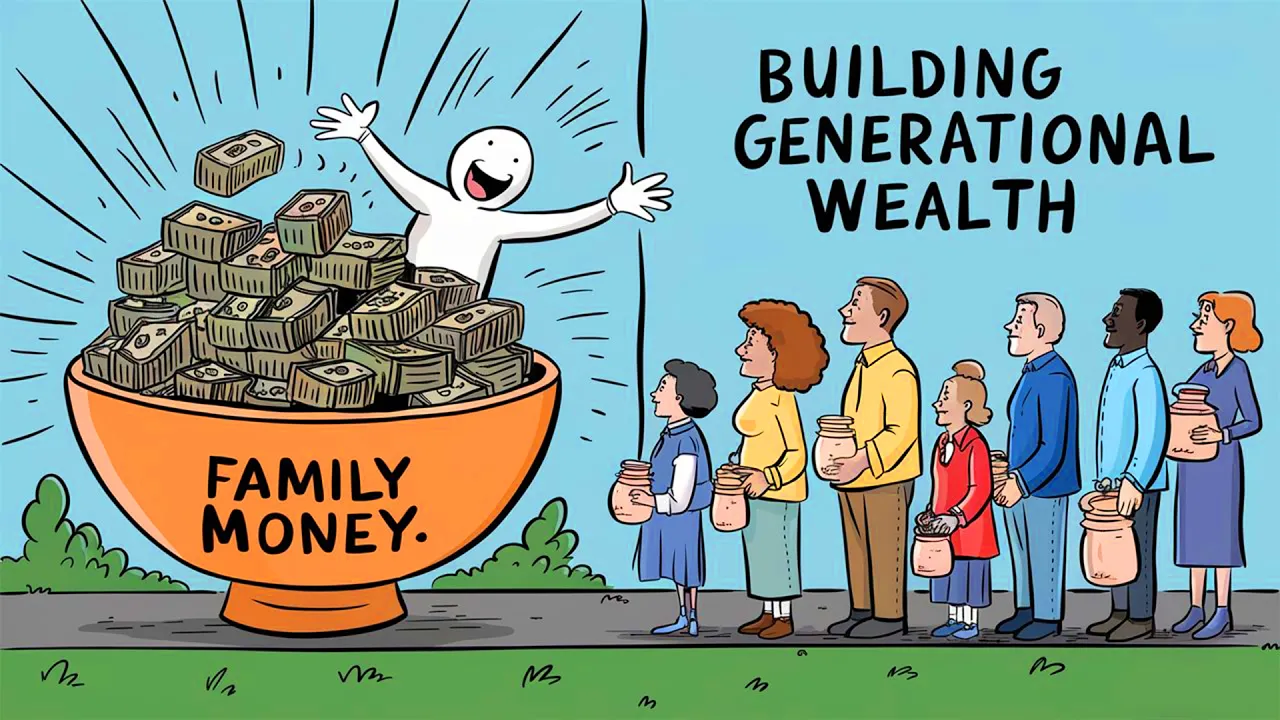
But then, when SEBI issued the notice that every company must publicize the details of shareholders with more than one percent of the shares, Dolly Khanna’s name came to light Although their portfolio includes more than 500 stocks, there are many companies where their shareholding is over one percent. As you can see, Rajiv and Dolly Khanna have created wealth for themselves—generational wealth. And they achieved this by using two out of the three methods described by Lafoy Thomas III in his book Generational Wealth, which I will explain to you one by one But first, understand that generational wealth is not just about fulfilling your dreams.
It’s not limited to a big house, expensive sports cars, or retirement; it’s much more than that. However, most people don’t think that big. They think it’s a big deal just to achieve small dreams.
But you should think bigger When you think about generational wealth, it’s like the saying, “Aim for the moon; even if you miss, you’ll reach the stars. ” Similarly, if you think big about creating generational wealth, you’ll likely achieve your dreams. But people often think too small.
They don’t understand one important thing. Many people don’t grasp the difference between income and expenses on a financial graph Income typically grows gradually over time, at least for most people. However, expenses don’t increase in the same way.
Expenses tend to rise steadily, but they can also experience sudden, large jumps. For example, if you need to buy a house, purchase a car, pay for a wedding, deal with a medical emergency, or cover education costs for your children, these can lead to significant, unexpected expenses Often, we encounter many large expenses. When you compare income and expenses, expenses tend to grow more rapidly.
This is why many people are unable to become wealthy. In fact, the income graph can even drop to zero at times. This happens when many people retire after a certain age, and their income stops completely After some time, people often become dependent on others or rely on the small amount of money they have saved to get by.
I don’t want that to happen to you. Therefore, it’s crucial for both you and me to understand that we need to create generational wealth—wealth that can cover even the large expenses that arise Along with that, we should also fulfill our dreams and leave a significant amount of money for the next generation. The author of the book describes three methods for creating generational wealth.
These are the three most common methods that have been used for many years in history. I have already shared the first one with you The first method is stocks. Do you remember the story where a man appeared on a news channel and said that his grandfather had bought 20,000 shares of MRF in 1990, which are now worth 1.
3 billion? He didn’t know at the time that he would have so much money. Back then, MRF was trading at around ₹65,000 per share, so the value of those 20,000 shares was significant ₹130 crore.
By the way, as I’m making this video, MRF’s current price is more than double that amount. It is ₹1,38,200. If he had not sold those shares, their value would have been even higher.
Similarly, if you look at it, Dolly Khanna and Rajiv Khanna also picked stocks that helped them build their generational wealth Similarly, beyond your retirement planning, you should definitely invest in some stocks in your lifetime. Choose good stocks that you trust, whether you do fundamental analysis yourself or engage in active investing like Rajiv Khanna. If you don’t want to put in the effort, the best approach I’ve found from reading many books is.
. In addition to this, Tony Robbins, after interviewing some of the world’s top investors, wrote a book called Unshakeable. In that book, the core idea he presents, based on his interviews with numerous top investors, is that the best strategy is to start a regular SIP in index funds, especially direct funds.
This approach, with minimal expenses, will give you the best returns Without overcomplicating things, which I personally do and would also suggest to you, is the first tool you can use for building generational wealth. Now, let’s move on to the second method. Let me share a real story that isn’t from books, but one that was told to me by a team member.
A friend of my team member, who studied with him in childhood, is the subject of this story Recently, he completed his master’s degree in Germany and has returned to India. Now, he is going back to the USA for his PhD. The interesting thing is that all his expenses are covered by his father.
Additionally, he has an older brother who is married and has two children, and a significant portion of their expenses is also borne by their father Now, his brother earns money, but the friend, who is still studying, said that he hasn’t earned a single rupee in his life so far. He never needed to because his father has accumulated so much wealth that all his expenses are covered by it. So, the point is that he’s not just spending on his children You might be wondering what kind of work they do to have so much money that their children don’t need to earn.
Well, the thing is, my team member’s friend revealed that they own a total of 58 properties in Delhi. Yes, 58, most of which are rented out They also buy and sell properties regularly, flipping them to make a profit in the millions. He mentions that when the boy was young, he used to go with his father carrying a bag at the end of each month, visiting each property to collect rent.
The bag would be filled with cash because, at that time, UPI and other internet payment methods didn’t exist, so everything was done in cash Now, payments are all done online. Back then, they used to collect so much cash that they would come home, count it, and store it. My team member said it was quite surprising for him because he had no idea that they were so wealthy.
Even seeing them, one wouldn’t think they are so rich They don’t have expensive cars, fancy phones, or costly hobbies. They follow a very simple lifestyle. The difference is that while the whole world struggles to earn money, they don’t have any tension about earning money.
Plus, their father is wise and has also used the first method, which is investing in the stock market They continue to invest money there as well. I’ve shared my team member’s story with you. You should also look around; you might have friends or relatives who are very wealthy.
Often, there’s a good chance that their fathers or grandfathers bought a lot of land or property, which is why they have a lot of money today If you have a similar story, make sure to share it in the comments. So, the second thing that will help you build generational wealth is real estate. Now, many wise people might say that buying is stupid in today’s time, and it’s better to rent or invest in the stock market.
But as a friend, I would suggest that if possible, go ahead and buy properties in your lifetime if you don’t already own any And rent them out. Rental income keeps coming in. Plus, property rates also tend to rise.
The third and most important point is that a home isn’t just an investment; it also provides security. I have lived in rental properties myself and have also bought homes and placed them in a trust When I live in my own home, it provides a different level of satisfaction and feeling. With rental properties, the owner can evict you for various reasons, which could suddenly disrupt your life and reduce your stability.
That’s just one reason There are many reasons why I personally believe real estate is very powerful and should still be used for building generational wealth. What’s your opinion? Be sure to share in the comments.
Now, let’s move on to the third thing: Ingvar Kamprad was born in 1926 in the Småland province of Sweden. Kamprad was an entrepreneur from a young age From the age of just five, he started selling matchboxes. At the age of 10, he sold bicycles and pens.
You could say Kamprad had a business instinct from childhood. In 1943, when Kamprad was only 17 years old, he started a business using his initials I and K for the name. What was the name of his business Ingvar Kamprad took the initials I and K and then incorporated the name of his farm and village, which is somewhat difficult to pronounce, Elmtaryd Agunnaryd.
He used these initials to create IKEA. Initially, IKEA was a mail-order business that sold small household items like picture frames, watches, and jewelry But then Kamprad quickly noticed something: he saw that the furniture market had a lot of potential, as people were buying expensive, high-quality furniture for their homes. So, he shifted his entire focus to this market.
Kamprad also implemented several innovations in his business, which gave him a significant unfair advantage One of the most significant innovations was flat-pack furniture. Previously, furniture posed major issues, particularly with transportation and storage, as it was often bulky and expensive to move and store. To address these challenges, Kamprad introduced flat-pack furniture.
This meant that furniture could be packed in flat boxes, broken down into pieces that customers could assemble themselves, thus reducing transportation and storage costs Additionally, this made the products more affordable. The second innovation was the introduction of self-service stores. The first IKEA store opened in 1958 in Älmhult, Sweden.
This store was quite different from others. It was designed as a showroom where customers could check out the designs and pick their flat-pack furniture. The entire experience was unique and distinct, setting IKEA apart from other stores Today, IKEA is a global brand present in over 50 countries with more than 400 stores.
It sells stylish, affordable, and functional furniture. Kamprad’s innovative ideas and strong business ethics made IKEA so successful that it has become a $16 billion company and brand. Although Kamprad is no longer with us He passed away in 2018, but at the time of his death, he was the 8th richest man in the world, with a reported net worth of $58.
7 billion. Before his passing, he built such wealth for his family that today, his three sons—Peter, Jonas, and Mathias Kamprad—each hold roles as board members of the IKEA Group of Companies All three Kamprad brothers own the IKANO Group, a conglomerate involved in areas such as real estate, banking, insurance, and retail. Initially, IKANO was part of IKEA, but after Kamprad’s death, it became an independent company.
Peter Kamprad is the Chairman of the Board, while Jonas and Mathias are also board members, and all three brothers are billionaires. You’ll find that people who run large businesses are almost always very wealthy You might have seen many businesses that have been passed down through generations. In India, if you build a successful business, it can often last for several generations.
Ambani, Tata, and Birla are some of the major examples in India who have significant generational wealth. If you look at Rajeev Khanna’s story, it also started with business, although he eventually sold his business Perhaps if he hadn’t sold his business and had managed it properly, it could have been a great source of generational wealth as well. The point is, you have three options to focus on.
Now you might ask, which of these three paths should you choose? Well, in my opinion, choose all three paths, but keep in mind that each will require investment In the second option, real estate requires a significant amount of money. In the stock market, you can’t create a large amount of wealth quickly with a small investment; it takes time and consistent investment.
Therefore, the best option is the third one. All three methods require money to earn money. In the stock market, you invest a little, earn a little, or it may take a long time and require regular contributions While all three methods require money, real estate demands a large amount of capital upfront.
Although each method involves investing money, the best way that has helped me earn significant wealth is creating a business. Now you might say that starting a business also requires money, but that’s not always the case. I made a video explaining exactly how you can start a successful business with little to no investment, or at least with minimal capital As I have done myself.
Alright. Make sure to watch that video. You’ll find the link here.
For now, that’s all. See you in the next video. Bye bye!